1991 Edition
CIA World Factbook 1991 (Project Gutenberg)
Geography
Climate
tropical monsoon with wide topographic-induced variation; some areas prone to extended droughts
Coastline
1,094 km
Comparative area
slightly less than twice the size of Texas
Disputes
southern half of the boundary with Somalia is a Provisional Administrative Line; possible claim by Somalia based on unification of ethnic Somalis; territorial dispute with Somalia over the Ogaden; separatist movement in Eritrea; antigovernment insurgencies in Tigray and other areas
Environment
geologically active Great Rift Valley susceptible to earthquakes, volcanic eruptions; deforestation; overgrazing; soil erosion; desertification; frequent droughts; famine
Land boundaries
5,141 km total; Djibouti 459 km, Kenya 861 km, Somalia 1,600 km, Sudan 2,221 km
Land use
arable land 12%; permanent crops 1%; meadows and pastures 41%; forest and woodland 24%; other 22%; includes irrigated NEGL%
Maritime claims
Territorial sea: 12 nm
Natural resources
small reserves of gold, platinum, copper, potash
Note
strategic geopolitical position along world's busiest shipping lanes and close to Arabian oilfields; major resettlement project--that was ongoing in rural areas and would have significantly altered population distribution and settlement patterns over the next several decades--has been derailed because of ongoing civil wars
Terrain
high plateau with central mountain range divided by Great Rift Valley
Total area
1,221,900 km2; land area: 1,101,000 km2
People and Society
Birth rate
45 births/1,000 population (1991)
Death rate
15 deaths/1,000 population (1991)
Ethnic divisions
Oromo 40%, Amhara and Tigrean 32%, Sidamo 9%, Shankella 6%, Somali 6%, Afar 4%, Gurage 2%, other 1%
Infant mortality rate
114 deaths/1,000 live births (1991)
Labor force
18,000,000; agriculture and animal husbandry 80%, government and services 12%, industry and construction 8% (1985)
Language
Amharic (official), Tigrinya, Orominga, Guaraginga, Somali, Arabic, English (major foreign language taught in schools)
Life expectancy at birth
50 years male, 53 years female (1991)
Literacy
62% (male NA%, female NA%) age 10 and over can read and write (1983 est.)
Nationality
noun--Ethiopian(s); adjective--Ethiopian
Net migration rate
NEGL migrants/1,000 population (1991)
Organized labor
All Ethiopian Trade Union formed by the government in January 1977 to represent 273,000 registered trade union members
Population
53,191,127 (July 1991), growth rate 3.1% (1991)
Religion
Muslim 40-45%, Ethiopian Orthodox 35-40%, animist 15-20%, other 5%
Total fertility rate
7.0 children born/woman (1991)
Government
Administrative divisions
25 administrative regions (astedader akababiwach, singular--astedader akababi) and 5 autonomous regions* (rasgez akababiwach, singular--rasgez akababi); Addis Abeba (Addis Ababa), Arsi, Aseb*, Asosa, Bale, Borena, Debub Gonder, Debub Shewa, Debub Welo, Dire Dawa*, Ertra (Eritrea)*, Gambela, Gamo Gofa, Ilubabor, Kefa, Metekel, Mirab Gojam, Mirab Harerge, Mirab Shewa, Misrak Gojam, Misrak Harerge, Nazaret, Ogaden*, Omo, Semen Gonder, Semen Shewa, Semen Welo, Sidamo, Tigray*, Welega
Capital
Addis Ababa
Constitution
12 September 1987
Diplomatic representation
Counselor, Charge d'Affaires ad interim GIRMA Amare; Chancery at 2134 Kalorama Road NW, Washington DC 20008; telephone (202) 234-2281 or 2282; US--Charge d'Affaires Robert G. HOUDEK; Embassy at Entoto Street, Addis Ababa (mailing address is P.O. Box 1014, Addis Ababa); telephone [251] (01) 550666
Elections
President--last held 10 September 1987 (next to be held September 1992); results--MENGISTU Haile-Mariam elected by the National Assembly, but resigned and left Ethiopia on 21 May 1991; National Assembly--last held 14 June 1987 (next to be held NA); results--WPE was the only party; seats--(835 total) WPE 835
Executive branch
president, vice president, Council of State prime minister, five deputy prime ministers, Council of Ministers
Flag
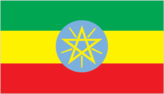
three equal horizontal bands of green (top), yellow, and red; Ethiopia is the oldest independent country in Africa and the colors of her flag were so often adopted by other African countries upon independence that they became known as the pan-African colors
Independence
oldest independent country in Africa and one of the oldest in the world--at least 2,000 years
Judicial branch
Supreme Court
Leaders
Chief of State--Interim President Meles ZENAWI (since 1 June 1991); Head of Government--Acting Prime Minister Tamrat LAYNE (since 6 June 1991)
Legal system
complex structure with civil, Islamic, common, and customary law influences; has not accepted compulsory ICJ jurisdiction
Legislative branch
unicameral National Assembly (Shengo)
Long-form name
People's Democratic Republic of Ethiopia
Member of
ACP, AfDB, CCC, ECA, FAO, G-24, G-77, IAEA, IBRD, ICAO, IDA, IFAD, IFC, IGADD, ILO, IMF, IMO, INTELSAT, INTERPOL, IOC, ISO, ITU, LORCS, NAM, OAU, UN, UNCTAD, UNESCO, UNIDO, UPU, WFTU, WHO, WMO, WTO
National holiday
National Revolution Day, 12 September (1974)
Other political or pressure groups
Oromo Liberation Front; Ethiopian People's Revolutionary Party (EPRP)
Political parties and leaders
only party--Workers' Party of Ethiopia (WPE)
Suffrage
universal at age 18
Type
on 28 May 1991 the Ethiopian People's Revolutionary Democratic Front (EPRDF) took control in Addis Ababa; on 29 May 1991 Issayas AFEWORKE, secretary general of the Eritrean People's Liberation Front (EPLF), announced the formation of a provisional government in Eritrea, in preparation for an eventual referendum on independence for the province
Economy
Agriculture
accounts for 45% of GDP and is the most important sector of the economy even though frequent droughts and poor cultivation practices keep farm output low; famines not uncommon; export crops of coffee and oilseeds grown partly on state farms; estimated 50% of agricultural production at subsistence level; principal crops and livestock--cereals, pulses, coffee, oilseeds, sugarcane, potatoes and other vegetables, hides and skins, cattle, sheep, goats
Budget
revenues $1.8 billion; expenditures $1.7 billion, including capital expenditures of $842 million (FY88)
Currency
birr (plural--birr); 1 birr (Br) = 100 cents
Economic aid
US commitments, including Ex-Im (FY70-89), $504 million; Western (non-US) countries, ODA and OOF bilateral commitments (1970-88), $3.1 billion; OPEC bilateral aid (1979-89), $8 million; Communist countries (1970-89), $2.0 billion
Electricity
330,000 kW capacity; 700 million kWh produced, 14 kWh per capita (1989)
Exchange rates
birr (Br) per US$1--2.0700 (fixed rate)
Exports
$429 million (f.o.b., FY88); commodities--coffee 60%, hides; partners--US, FRG, Djibouti, Japan, PDRY, France, Italy, Saudi Arabia
External debt
$2.6 billion (1988)
Fiscal year
8 July-7 July
GDP
$6.6 billion, per capita $130, real growth rate - 0.4% (FY89 est.)
Imports
$1.1 billion (c.i.f., FY88); commodities--food, fuels, capital goods; partners--USSR, Italy, FRG, Japan, UK, US, France
Industrial production
growth rate 2.3% (FY89 est.); accounts for 13% of GDP
Industries
food processing, beverages, textiles, chemicals, metals processing, cement
Inflation rate (consumer prices)
5.2% (1989)
Overview
Ethiopia is one of the poorest and least developed countries in Africa. Its economy is based on subsistence agriculture, which accounts for about 45% of GDP, 90% of exports, and 80% of total employment; coffee generates 60% of export earnings. The manufacturing sector is heavily dependent on inputs from the agricultural sector. Over 90% of large-scale industry, but less then 10% of agriculture, is state run. Favorable agricultural weather largely explains the 4.5% growth in output in FY89.
Unemployment rate
NA
Communications
Airports
153 total, 111 usable; 9 with permanent-surface runways; 2 with runways over 3,659 m; 13 with runways 2,440-3,659 m; 49 with runways 1,220-2,439 m
Civil air
21 major transport aircraft
Highways
44,300 km total; 3,650 km bituminous, 9,650 km gravel, 3,000 km improved earth, 28,000 km unimproved earth
Merchant marine
13 ships (1,000 GRT or over) totaling 69,398 GRT/89,457 DWT; includes 9 cargo, 1 roll-on/roll off cargo, 1 livestock carrier, 2 petroleum, oils, and lubricants (POL) tanker
Ports
Aseb, Mitsiwa
Railroads
988 km total; 681 km 1.000-meter gauge; 307 km 0.950-meter gauge (nonoperational)
Telecommunications
open-wire and radio relay system adequate for government use; open-wire to Sudan and Djibouti; radio relay to Kenya and Djibouti; stations--4 AM, no FM, 1 TV; 45,000 TV sets; 3,300,000 radios; 1 Atlantic Ocean INTELSAT earth station
Military and Security
Branches
Army, Navy, Air Force, Air Defense, Police Force
Defense expenditures
$NA, 8.5% of GDP (1988) _%_
Manpower availability
males 15-49, 11,717,614; 6,072,112 fit for military service; 609,346 reach military age (18) annually