1981 Edition
CIA World Factbook 1981 (Internet Archive)
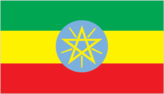
Geography
Area
1,178,450 km8; 10% cropland and orchards, 55% meadows and natural pastures, 6% forests and woodlands, 29% wasteland, built-on areas, and other
Coastline
1,094 km (includes offshore islands)
Fiscal year
8 July-7 July
Land boundaries
5,198 km
Limits of territorial waters (claimed)
12 nm; for sedentary fisheries, territorial sea extends to limit of fisheries
Monetary conversion rate
2.07 Ethiopian Birr=US$l
People and Society
Ethnic divisions
Calla 40%, Amhara and Tigrai 32%, Sidamo 9%, Shankella 6%, Somali 6%, Afar 4%, Gurage 2%, other 1%
Labor force
90% agriculture and animal husbandry; 10% government, military, and quasi-government
Language
Amharic official; many local languages and dialects; English major foreign language taught in schools
Literacy
about 5%
Nationality
noun — Ethiopian(s); adjective — Ethiopian
Organized labor
All Ethiopian Trade Union formed January 1977 to represent 273,000 registered trade union members
Population
30,569,000 (July 1982), average annual growth rate 1.9%
Religion
35%-40% Ethiopian Orthodox, 40%-45% Muslim, 15%-20% animist, 5% other
Government
Branches
executive power exercised by the Provisional Military Administrative Council (PMAC), dominated by its chairman and small circle of associates; predominantly civilian Cabinet is ineffectual and holds office at sufferance of military; legislature dissolved September 1974; judiciary at higher levels based on Western pattern, at lower levels on traditional pattern, without jury system in either
Capital
Addis Ababa
Communists
probably a few Communist sympathizers in the government; government officially committed to organize a Communist party, but progress is slow
Elections
urban dwellers' association officials elected June 1981 Political parties and leaders: no political party exists, although efforts to create one have been underway for the past few years
Government leader
MENGISTU Haile-Mariam, Chairman of the Provisional Military Administrative Council
Legal system
complex structure with civil, Islamic, common and customary law influences; constitution suspended September 1974; military leaders have promised a new constitution but established no time frame for its adoption; legal education at Addis Ababa University; has not accepted compulsory ICJ jurisdiction
Member of
AFDB, EGA, FAO, G-77, IAEA, IBRD, ICO, ICAO, IDA, IFAD, IFC, ILO, IMCO, IMF, IPU, ITU, NAM, OAU, UN, UNESCO, UPU, WHO, WMO, WTO
National holiday
Popular Revolution Commemoration Day, 12 September
Official name
Ethiopia
Other political or pressure groups
important dissident groups include Eritrean Liberation Front (ELF), Eritrean People's Liberation Front (EPLF), and Eritrean Liberation Front/Popular Liberation Forces in Eritrea; Tigrean Peoples Liberation Front (TPLF) in Tigre Province; Western Somali Liberation Front (WSLF) in the Ogaden Region
Political subdivisions
14 provinces (also referred to as regional administrations)
Suffrage
universal over age 21
Type
under military rule since mid-1974; monarchy abolished in March 1975, but republic not yet declared
Economy
Agriculture
main crop — coffee
Electric power
330,000 kW capacity (1980); 720 million kWh produced (1980), 25 kWh per capita
Exports
$408 million (f.o.b., 1981 est.); 70% coffee, 5% hides and skins
External debt
$740 million, 1981; external debt ratio 6.6%
GDP
$4.4 billion (1981), $138 per capita; growth rate 2.03.0% (1981)
Imports
$779 million (c.i.f., 1981 est.) 18% petroleum
Major industries
cement, sugar refining, cotton textiles, food processing, oil refinery
Major trade partners
imports — Saudi Arabia, Japan, Italy, West Germany, Iran, UK, France, and US; exports — US, Djibouti, Saudi Arabia, Japan, Italy, West Germany
Communications
Airfields
187 total, 167 usable; 7 with permanent-surface runways; 1 with runways over 3,659 m, 8 with runways 2,440-3,659 m, 47 with runways 1,220-2,439 m DEFENSE FORCES
Civil air
16 major transport aircraft
Highways
44,300 km total; 3,650 km bituminous, 9,650 km gravel, 3,000 km improved earth, 28,000 km unimproved earth
Military manpower
males 15-49, 6,871,000; 3,690,000 fit for military service; 346,000 reach military age (18) annually
Ports
2 major (Assab, Massawa)
Railroads
1,089 km total; 782 km meter gauge (1.00 m), of which 97 km are in Djibouti; 307 km 0.95-meter gauge