2015 Edition
CIA World Factbook 2015 Archive (Wayback Machine ZIP)
Introduction
Background
Autonomy for the Swazis of southern Africa was guaranteed by the British in the late 19th century; independence was granted in 1968. Student and labor unrest during the 1990s pressured King MSWATI III, Africa's last absolute monarch, to grudgingly allow political reform and greater democracy, although he has backslid on these promises in recent years. A constitution came into effect in 2006, but the legal status of political parties remains unclear. The African United Democratic Party tried unsuccessfully to register as an official political party in mid-2006. Talks over the constitution broke down between the government and progressive groups in 2007. Swaziland recently surpassed Botswana as the country with the world's highest known HIV/AIDS prevalence rate.
Geography
Area
- land
- 17,204 sq km
- total
- 17,364 sq km
- water
- 160 sq km
Area - comparative
slightly smaller than New Jersey
Climate
varies from tropical to near temperate
Coastline
0 km (landlocked)
Elevation extremes
- highest point
- Emlembe 1,862 m
- lowest point
- Great Usutu River 21 m
Environment - current issues
limited supplies of potable water; wildlife populations being depleted because of excessive hunting; overgrazing; soil degradation; soil erosion
Environment - international agreements
- party to
- Biodiversity, Climate Change, Climate Change-Kyoto Protocol, Desertification, Endangered Species, Hazardous Wastes, Ozone Layer Protection
- signed, but not ratified
- Law of the Sea
Freshwater withdrawal (domestic/industrial/agricultural)
- per capita
- 962.1 cu m/yr (2005)
- total
- 1.04 cu km/yr (4%/2%/94%)
Geographic coordinates
26 30 S, 31 30 E
Geography - note
landlocked; almost completely surrounded by South Africa
Irrigated land
498.5 sq km (2003)
Land boundaries
- border countries (2)
- Mozambique 108 km, South Africa 438 km
- total
- 546 km
Land use
- arable land 9.8%; permanent crops 0.8%; permanent pasture 57.7%
- agricultural land
- 68.3%
- forest
- 31.7%
- other
- 0% (2011 est.)
Location
Southern Africa, between Mozambique and South Africa
Map references
Africa
Maritime claims
none (landlocked)
Natural hazards
drought
Natural resources
asbestos, coal, clay, cassiterite, hydropower, forests, small gold and diamond deposits, quarry stone, and talc
Terrain
mostly mountains and hills; some moderately sloping plains
Total renewable water resources
4.51 cu km (2011)
People and Society
Age structure
- 0-14 years
- 35.99% (male 261,213/female 255,489)
- 15-24 years
- 22.26% (male 161,626/female 157,990)
- 25-54 years
- 33.64% (male 249,233/female 233,703)
- 55-64 years
- 4.26% (male 24,229/female 36,968)
- 65 years and over
- 3.84% (male 21,582/female 33,580) (2015 est.)
Birth rate
24.67 births/1,000 population (2015 est.)
Child labor - children ages 5-14
- percentage
- 9% (2000 est.)
- total number
- 28,043
Children under the age of 5 years underweight
5.8% (2010)
Contraceptive prevalence rate
65.2% (2010)
Death rate
13.56 deaths/1,000 population (2015 est.)
Dependency ratios
- elderly dependency ratio
- 6.1%
- potential support ratio
- 16.5% (2015 est.)
- total dependency ratio
- 69.3%
- youth dependency ratio
- 63.2%
Drinking water source
- urban: 93.6% of population
- rural: 68.9% of population
- total: 74.1% of population
- urban: 6.4% of population
- rural: 31.1% of population
- total: 25.9% of population (2015 est.)
Education expenditures
7.8% of GDP (2011)
Ethnic groups
African 97%, European 3%
Health expenditures
8.4% of GDP (2013)
HIV/AIDS - adult prevalence rate
27.36% (2013 est.)
HIV/AIDS - deaths
4,500 (2013 est.)
HIV/AIDS - people living with HIV/AIDS
204,100 (2013 est.)
Hospital bed density
2.1 beds/1,000 population (2011)
Infant mortality rate
- female
- 48.53 deaths/1,000 live births (2015 est.)
- male
- 56.49 deaths/1,000 live births
- total
- 52.57 deaths/1,000 live births
Languages
English (official, used for government business), siSwati (official)
Life expectancy at birth
- female
- 50.5 years (2015 est.)
- male
- 51.6 years
- total population
- 51.05 years
Literacy
- definition
- age 15 and over can read and write
- female
- 87.5% (2015 est.)
- male
- 87.4%
- total population
- 87.5%
Major infectious diseases
- degree of risk
- intermediate
- food or waterborne diseases
- bacterial diarrhea, hepatitis A, and typhoid fever
- vectorborne disease
- malaria
- water contact disease
- schistosomiasis (2013)
Major urban areas - population
MBABANE (capital) 66,000 (2014)
Median age
- female
- 21.3 years (2014 est.)
- male
- 20.7 years
- total
- 21 years
Nationality
- adjective
- Swazi
- noun
- Swazi(s)
Net migration rate
0 migrant(s)/1,000 population (2015 est.)
Obesity - adult prevalence rate
14.8% (2014)
Physicians density
0.17 physicians/1,000 population (2009)
Population
- 1,435,613
- note
- estimates for this country explicitly take into account the effects of excess mortality due to AIDS; this can result in lower life expectancy, higher infant mortality, higher death rates, lower population growth rates, and changes in the distribution of population by age and sex than would otherwise be expected (July 2015 est.)
Population growth rate
1.11% (2015 est.)
Religions
Zionist 40% (a blend of Christianity and indigenous ancestral worship), Roman Catholic 20%, Muslim 10%, other 30% (includes Anglican, Baha'i, Methodist, Mormon, Jewish)
Sanitation facility access
- urban: 63.1% of population
- rural: 56% of population
- total: 57.5% of population
- urban: 36.9% of population
- rural: 44% of population
- total: 42.5% of population (2015 est.)
School life expectancy (primary to tertiary education)
- female
- 11 years (2011)
- male
- 12 years
- total
- 11 years
Sex ratio
- 0-14 years
- 1.02 male(s)/female
- 15-24 years
- 1.02 male(s)/female
- 25-54 years
- 1.07 male(s)/female
- 55-64 years
- 0.66 male(s)/female
- 65 years and over
- 0.64 male(s)/female
- at birth
- 1.03 male(s)/female
- total population
- 1 male(s)/female (2015 est.)
Total fertility rate
2.8 children born/woman (2015 est.)
Urbanization
- rate of urbanization
- 1.32% annual rate of change (2010-15 est.)
- urban population
- 21.3% of total population (2015)
Government
Administrative divisions
4 districts; Hhohho, Lubombo, Manzini, Shiselweni
Capital
- geographic coordinates
- 26 19 S, 31 08 E
- name
- Mbabane; note - Lobamba is the royal and legislative capital
- time difference
- UTC+2 (7 hours ahead of Washington, DC, during Standard Time)
Constitution
previous 1968, 1978; latest signed by the king 26 July 2005, effective 8 February 2006 (2013)
Country name
- conventional long form
- Kingdom of Swaziland
- conventional short form
- Swaziland
- local long form
- Umbuso weSwatini
- local short form
- eSwatini
Diplomatic representation from the US
- chief of mission
- Ambassador Makila JAMES (since 27 August 2012)
- embassy
- 7th Floor, Central Bank Building, Mahlokohla St., Mbabane
- FAX
- [268] 404-5959
- mailing address
- P. O. Box 199, Mbabane
- telephone
- [268] 404-6441
Diplomatic representation in the US
- chancery
- 1712 New Hampshire Avenue, NW, Washington, DC 20009
- chief of mission
- Ambassador Abednigo Mandla NTSHANGASE (since 19 July 2010)
- FAX
- [1] (202) 234-8254
- telephone
- [1] (202) 234-5002
Executive branch
- cabinet
- Cabinet recommended by the prime minister, confirmed by the monarch
- chief of state
- King MSWATI III (since 25 April 1986)
- elections/appointments
- the monarchy is hereditary; prime minister appointed by the monarch from among elected members of the House of Assembly
- head of government
- Prime Minister Barnabas Sibusiso DLAMINI (since 23 October 2008); Deputy Prime Minister Themba Nhlanganiso MASUKU (since 2008)
Flag description
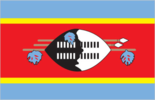
three horizontal bands of blue (top), red (triple width), and blue; the red band is edged in yellow; centered in the red band is a large black and white shield covering two spears and a staff decorated with feather tassels, all placed horizontally; blue stands for peace and stability, red represents past struggles, and yellow the mineral resources of the country; the shield, spears, and staff symbolize protection from the country's enemies, while the black and white of the shield are meant to portray black and white people living in peaceful coexistence
Government type
monarchy
Independence
6 September 1968 (from the UK)
International law organization participation
accepts compulsory ICJ jurisdiction with reservations; non-party state to the ICCt
International organization participation
ACP, AfDB, AU, C, COMESA, FAO, G-77, IAEA, IBRD, ICAO, ICRM, IDA, IFAD, IFC, IFRCS, ILO, IMF, IMO, Interpol, IOC, IOM, ISO (correspondent), ITSO, ITU, ITUC (NGOs), MIGA, NAM, OPCW, PCA, SACU, SADC, UN, UNCTAD, UNESCO, UNIDO, UNWTO, UPU, WCO, WHO, WIPO, WMO, WTO
Judicial branch
- highest court(s)
- the Supreme Court of the Judicature comprising the Supreme Court (consists of the chief justice and at least 5 justices) and the High Court (consists of the chief justice - ex officio - and at least 4 justices); note - the Supreme Court has jurisdiction in all constitutional matters
- judge selection and term of office
- justices of the Supreme Court of the Judicature are appointed by the monarch on the advice of the Judicial Service Commission or JCS, a judicial advisory body consisting of the Supreme Court Chief Justice, 4 members appointed by the monarch, and the JCS head; justices of both courts eligible for retirement at age 65 with mandatory retirement at age 75 for Supreme Court justices and at age 70 for High Court justices
- note
- the national constitution as amended in 2006 shifted judicial power from the monarch and vested it exclusively in the judiciary
- subordinate courts
- magistrates' courts; National Swazi Courts for administering customary/traditional laws (jurisdiction restricted to customary law for Swazi citizens)
Legal system
mixed legal system of civil, common, and customary law
Legislative branch
- description
- bicameral Parliament or Libandla consists of the Senate (30 seats; 20 members appointed by the monarch and 10 indirectly elected by simple majority vote by the House of Assembly; members serve 5-year terms) and the House of Assembly (65 seats; 55 members directly elected in single-seat constituencies by simple majority vote and 10 members appointed by the monarch; members serve 5-year terms)
- election results
- House of Assembly - balloting is done on a nonparty basis; candidates for election nominated by the local council of each constituency and for each constituency the three candidates with the most votes in the first round of voting are narrowed to a single winner by a second round
- elections
- House of Assembly - last held on 20 September 2013 (next scheduled for September 2018)
National anthem
- lyrics/music
- Andrease Enoke Fanyana SIMELANE/David Kenneth RYCROFT
- name
- "Nkulunkulu Mnikati wetibusiso temaSwati" (Oh God, Bestower of the Blessings of the Swazi)
- note
- adopted 1968; uses elements of both ethnic Swazi and Western music styles
National holiday
Independence Day, 6 September (1968)
National symbol(s)
lion, elephant; national colors: blue, yellow, red
Political parties and leaders
- the status of political parties, previously banned, is unclear under the 2006 Constitution and currently being debated; the following are considered political associations
- African United Democratic Party or AUDP [Stanley MAUNDZISA, president]
- Ngwane National Liberatory Congress or NNLC [Alvit DLAMINI, president]
- People's United Democratic Movement or PUDEMO [Mario MASUKU, president]
Political pressure groups and leaders
- Swaziland Democracy Campaign
- Swaziland Federation of Trade Unions
- Swaziland Solidarity Network or SSN
Suffrage
18 years of age
Economy
Agriculture - products
sugarcane, cotton, corn, tobacco, rice, citrus, pineapples, sorghum, peanuts; cattle, goats, sheep
Budget
- expenditures
- $1.406 billion (2014 est.)
- revenues
- $1.349 billion
Budget surplus (+) or deficit (-)
-1.5% of GDP (2014 est.)
Central bank discount rate
- 6.5% (31 December 2010)
- 6.5% (31 December 2009)
Commercial bank prime lending rate
- 8.8% (31 December 2014 est.)
- 8.5% (31 December 2013 est.)
Current account balance
- $34 million (2014 est.)
- $140.8 million (2013 est.)
Debt - external
- $568.3 million (31 December 2014 est.)
- $488.5 million (31 December 2013 est.)
Distribution of family income - Gini index
50.4 (2001)
Economy - overview
Surrounded by South Africa, except for a short border with Mozambique, Swaziland depends heavily on South Africa for more than 90% of its imports and for 60% of its exports. Swaziland's currency is pegged to the South African rand, effectively relinquishing Swaziland's monetary policy to South Africa. The government is heavily dependent on customs duties from the Southern African Customs Union, and worker remittances from South Africa supplement domestically earned income. Swaziland’s GDP per capita makes it a lower middle income country, but its income distribution is highly skewed, with an estimated 20% of the population controlling 80% of the nation’s wealth. Subsistence agriculture employs approximately 70% of the population. The manufacturing sector diversified in the 1980s and 1990s, but manufacturing has grown little in the last decade. Sugar and wood pulp had been major foreign exchange earners until the wood pulp producer closed in January 2010, and sugar is now the main export earner. Mining has declined in importance in recent years. Coal, gold, diamond, and quarry stone mines are small-scale, and the only iron ore mine closed in 2014. With an estimated 40% unemployment rate, Swaziland's need to increase the number and size of small and medium enterprises and to attract foreign direct investment is acute. Overgrazing, soil depletion, drought, and floods are persistant problems. On 1 January 2015, Swaziland lost its eligibility for benefits under the African Growth and Opportunity Act (AGOA), threatening the remaining 12,000 jobs in the textile and apparel sector, after 3,000 jobs were lost since the 2014 announcement of the loss of AGOA. As of 2013 more than one-quarter of the adult population was infected by HIV/AIDS; Swaziland has the world’s highest HIV prevalence rate.
Exchange rates
- emalangeni per US dollar -
- 10.6 (2014 est.)
- 9.6442 (2013 est.)
- 8.2 (2012 est.)
- 7.2597 (2011 est.)
- 7.3212 (2010 est.)
Exports
- $2.192 billion (2014 est.)
- $2.104 billion (2013 est.)
Exports - commodities
soft drink concentrates, sugar, timber, cotton yarn, refrigerators, citrus and canned fruit
Fiscal year
1 April - 31 March
GDP - composition, by end use
- (2014 est.)
- exports of goods and services
- 51%
- government consumption
- 25.3%
- household consumption
- 80.5%
- imports of goods and services
- -70.2%
- investment in fixed capital
- 13.5%
- investment in inventories
- -0.1%
GDP - composition, by sector of origin
- agriculture
- 7.2%
- industry
- 47.4%
- services
- 45.4% (2014 est.)
GDP - per capita (PPP)
- $7,800 (2014 est.)
- $7,700 (2013 est.)
- $7,500 (2012 est.)
- note
- data are in 2014 US dollars
GDP - real growth rate
- 1.7% (2014 est.)
- 2.8% (2013 est.)
- 1.9% (2012 est.)
GDP (official exchange rate)
$3.676 billion (2014 est.)
GDP (purchasing power parity)
- $8.621 billion (2014 est.)
- $8.476 billion (2013 est.)
- $8.245 billion (2012 est.)
- note
- data are in 2014 US dollars
Gross national saving
- 12.2% of GDP (2014 est.)
- 15.8% of GDP (2013 est.)
- 11.8% of GDP (2012 est.)
Household income or consumption by percentage share
- highest 10%
- 40.1% (2010 est.)
- lowest 10%
- 1.7%
Imports
- $2.097 billion (2014 est.)
- $1.987 billion (2013 est.)
Imports - commodities
motor vehicles, machinery, transport equipment, foodstuffs, petroleum products, chemicals
Industrial production growth rate
2.1% (2014 est.)
Industries
coal, forestry, sugar, soft drink concentrates, textiles and apparel
Inflation rate (consumer prices)
- 5.8% (2014 est.)
- 5.6% (2013 est.)
Labor force
435,500 (2012 est.)
Labor force - by occupation
- agriculture
- 70%
- industry
- NA%
- services
- NA%
Market value of publicly traded shares
- $NA
- $203.1 million (31 December 2007)
- $199.9 million (31 December 2006)
Population below poverty line
69% (2006 est.)
Reserves of foreign exchange and gold
- $780.9 million (31 December 2014 est.)
- $762.5 million (31 December 2013 est.)
Stock of broad money
- $1.109 billion (31 December 2014 est.)
- $1.068 billion (31 December 2013 est.)
Stock of direct foreign investment - abroad
$NA
Stock of direct foreign investment - at home
$NA
Stock of domestic credit
- $657 million (31 December 2014 est.)
- $643.9 million (31 December 2013 est.)
Stock of narrow money
- $453.5 million (31 December 2014 est.)
- $419.6 million (31 December 2013 est.)
Taxes and other revenues
35.1% of GDP (2014 est.)
Unemployment rate
40% (2006 est.)
Energy
Carbon dioxide emissions from consumption of energy
936,900 Mt (2012 est.)
Crude oil - exports
0 bbl/day (2010 est.)
Crude oil - imports
0 bbl/day (2010 est.)
Crude oil - production
0 bbl/day (2013 est.)
Crude oil - proved reserves
0 bbl (1 January 2010 est.)
Electricity - consumption
1.295 billion kWh (2011 est.)
Electricity - exports
0 kWh (2013)
Electricity - from fossil fuels
59.7% of total installed capacity (2011 est.)
Electricity - from hydroelectric plants
40.3% of total installed capacity (2011 est.)
Electricity - from nuclear fuels
0% of total installed capacity (2011 est.)
Electricity - from other renewable sources
0% of total installed capacity (2011 est.)
Electricity - imports
909 million kWh (2011 est.)
Electricity - installed generating capacity
149,000 kW (2011 est.)
Electricity - production
415 million kWh (2011 est.)
Natural gas - consumption
0 cu m (2012 est.)
Natural gas - exports
0 cu m (2012 est.)
Natural gas - imports
0 cu m (2012 est.)
Natural gas - production
0 cu m (2012 est.)
Natural gas - proved reserves
0 cu m (1 January 2014 est.)
Refined petroleum products - consumption
4,520 bbl/day (2013 est.)
Refined petroleum products - exports
0 bbl/day (2010 est.)
Refined petroleum products - imports
4,761 bbl/day (2010 est.)
Refined petroleum products - production
0 bbl/day (2010 est.)
Communications
Broadcast media
state-owned TV station; satellite dishes are able to access South African providers; state-owned radio network with 3 channels; 1 private radio station (2007)
Internet country code
.sz
Internet users
- percent of population
- 23.8% (2014 est.)
- total
- 337,300
Radio broadcast stations
AM 3, FM 2 (plus 4 repeaters), shortwave 3 (2004)
Telephone system
- domestic
- single source for mobile-cellular service with a geographic coverage of about 90% and a rising subscribership base; combined fixed-line and mobile cellular teledensity roughly 60 telephones per 100 persons in 2011; telephone system consists of carrier-equipped, open-wire lines and low-capacity, microwave radio relay
- general assessment
- a somewhat modern but not an advanced system
- international
- country code - 268; satellite earth station - 1 Intelsat (Atlantic Ocean) (2009)
Telephones - fixed lines
- subscriptions per 100 inhabitants
- 3 (2014 est.)
- total subscriptions
- 44,400
Telephones - mobile cellular
- subscriptions per 100 inhabitants
- 65 (2014 est.)
- total
- 916,800
Television broadcast stations
12 (includes 7 relay stations) (2004)
Transportation
Airports
14 (2013)
Airports - with paved runways
- 2,438 to 3,047 m
- 1 (2013)
- over 3,047 m
- 1
- total
- 2
Airports - with unpaved runways
- 7 (2013)
- 914 to 1,523 m
- 5
- total
- 12
Railways
- narrow gauge
- 301 km 1.067-m gauge (2014)
- total
- 301 km
Roadways
- paved
- 1,078 km
- total
- 3,594 km
- unpaved
- 2,516 km (2002)
Military and Security
Manpower available for military service
- males age 16-49
- 344,038 (2010 est.)
Manpower fit for military service
- females age 16-49
- 175,477 (2010 est.)
- males age 16-49
- 201,853
Manpower reaching militarily significant age annually
- female
- 15,763 (2010 est.)
- male
- 16,168
Military branches
Umbutfo Swaziland Defense Force (USDF): Ground Force (includes Air Wing (no operational aircraft)) (2013)
Military expenditures
- 3.17% of GDP (2012)
- 3.11% of GDP (2011)
- 3.17% of GDP (2010)
Military service age and obligation
18-30 years of age for male and female voluntary military service; no conscription; compulsory HIV testing required, only HIV-negative applicants accepted (2012)
Transnational Issues
Disputes - international
in 2006, Swazi king advocated resorting to ICJ to claim parts of Mpumalanga and KwaZulu-Natal from South Africa