1996 Edition
CIA World Factbook 1996 (Project Gutenberg)
Introduction
Description
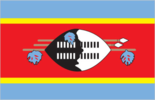
three horizontal bands of blue (top), red (triple width), and blue; the red band is edged in yellow; centered in the red band is a large black and white shield covering two spears and a staff decorated with feather tassels, all placed horizontally
Location
26 30 S, 31 30 E -- Southern Africa, between Mozambique and South Africa Flag ----
Geography
Area
- comparative area
- slightly smaller than New Jersey
- land area
- 17,200 sq km
- total area
- 17,360 sq km
Climate
varies from tropical to near temperate
Coastline
0 km (landlocked)
Environment
- current issues
- limited access to potable water; wildlife populations being depleted because of excessive hunting; overgrazing; soil degradation; soil erosion
- international agreements
- party to - Biodiversity, Nuclear Test Ban, Ozone Layer Protection; signed, but not ratified - Climate Change, Desertification, Law of the Sea
- natural hazards
- NA
Geographic coordinates
26 30 S, 31 30 E
Geographic note
landlocked; almost completely surrounded by South Africa
International disputes
Swaziland has asked South Africa to open negotiations on reincorporating some nearby South African territories that are populated by ethnic Swazis or that were long ago part of the Swazi Kingdom
Irrigated land
640 sq km (1993 est.)
Land boundaries
- border countries
- Mozambique 105 km, South Africa 430 km
- total
- 535 km
Land use
- arable land
- 11%
- forest and woodland
- 7%
- meadows and pastures
- 62%
- other
- 20%
- permanent crops
- NEGL
Location
Southern Africa, between Mozambique and South Africa
Map references
Africa
Maritime claims
none (landlocked)
Natural resources
asbestos, coal, clay, cassiterite, hydropower, forests, small gold and diamond deposits, quarry stone, and talc
Terrain
- mostly mountains and hills; some moderately sloping plains
- highest point
- Emlembe 1,862 m
- lowest point
- Great Usutu River 21 m
People and Society
Age structure
0-14 years: 46% (male 227,634; female 229,129) 15-64 years: 52% (male 247,156; female 271,096) 65 years and over: 2% (male 9,864; female 13,851) (July 1996 est.)
Birth rate
42.91 births/1,000 population (1996 est.)
Death rate
10.56 deaths/1,000 population (1996 est.)
Ethnic divisions
African 97%, European 3%
Infant mortality rate
88.4 deaths/1,000 live births (1996 est.)
Languages
English (official, government business conducted in English), siSwati (official)
Life expectancy at birth
- female
- 61.4 years (1996 est.)
- male
- 53.25 years
- total population
- 57.26 years
Literacy
- age 15 and over can read and write (1995 est.)
- female
- 75.6%
- male
- 78%
- total population
- 76.7%
Nationality
- adjective
- Swazi
- noun
- Swazi(s)
Net migration rate
0 migrant(s)/1,000 population (1996 est.)
Population
998,730 (July 1996 est.)
Population growth rate
3.24% (1996 est.)
Religions
Christian 60%, indigenous beliefs 40%
Sex ratio
- all ages
- 0.94 male(s)/female (1996 est.)
- at birth
- 1.03 male(s)/female
- under 15 years
- 0.99 male(s)/female 15-64 years: 0.91 male(s)/female 65 years and over: 0.71 male(s)/female
Total fertility rate
6.05 children born/woman (1996 est.)
Government
Administrative divisions
4 districts; Hhohho, Lubombo, Manzini, Shiselweni
Capital
Mbabane (administrative); Lobamba (legislative)
Constitution
none; constitution of 6 September 1968 was suspended 12 April 1973; a new constitution was promulgated 13 October 1978, but has not been formally presented to the people
Data code
WZ
Diplomatic representation in US
- chancery
- 3400 International Drive NW, Washington, DC 20008
- chief of mission
- Ambassador Mary Madzandza KHANYA
- telephone
- [1] (202) 362-6683, 6685
Executive branch
- cabinet
- Cabinet; designated by the king
- chief of state
- King MSWATI III (since 25 April 1986) is a hereditary monarch
- head of government
- Prime Minister Prince Jameson Mbilini DLAMINI (since 12 November 1993); appointed by the king
FAX
- [1] (202) 244-8059
- [268] 45959
Flag
three horizontal bands of blue (top), red (triple width), and blue; the red band is edged in yellow; centered in the red band is a large black and white shield covering two spears and a staff decorated with feather tassels, all placed horizontally
House of Assembly
elections last held 26 September and 11 October 1993 (next to be held NA); results - balloting is done on a nonparty basis; of the total of 65 seats, 10 are appointed by the king and 55 are elected by secret, popular vote; candidates for election are nominated by the local council of each constituency and for each constituency the three candidates with the most votes in the first round of voting are narrowed to a single winner by a second round
Independence
6 September 1968 (from UK)
International organization participation
ACP, AfDB, C, CCC, ECA, FAO, G-77, IBRD, ICAO, ICFTU, ICRM, IDA, IFAD, IFC, IFRCS, ILO, IMF, Intelsat, Interpol, IOC, ITU, NAM, OAU, PCA, SACU, SADC, UN, UNCTAD, UNESCO, UNIDO, UPU, WHO, WIPO, WMO, WTrO
Judicial branch
High Court, judges are appointed by the king; Court of Appeal, judges are appointed by the king
Legal system
based on South African Roman-Dutch law in statutory courts and Swazi traditional law and custom in traditional courts; has not accepted compulsory ICJ jurisdiction
Legislative branch
bicameral Parliament is advisory
Name of country
- conventional long form
- Kingdom of Swaziland
- conventional short form
- Swaziland
National holiday
Somhlolo (Independence) Day, 6 September (1968)
Political parties and leaders
- illegal parties
- Peoples' United Democratic Movement (PUDEMO), Mario MASUKU; Swaziland Youth Congress (SWAYOCO), Benedict TSABEDZE; Swaziland Communist Party (SWACOPA), Mphandlana SHONGWE; Swaziland Liberation Front (FROLISA); Convention for Full Democracy in Swaziland (COFUDESWA), Sabelo DLAMINI; Swaziland National Front (SWANAFRO); Ngwane Socialist Revolutionary Party (NGWASOREP)
- note
- political parties are banned by the constitution promulgated on 13 October 1978; illegal parties are prohibited from holding large public gatherings
Senate
consists of 30 members (10 appointed by the House of Assembly and 20 appointed by the king)
Suffrage
NA; note - no suffrage before September 1993; 55 of the 65 seats in the House of Assembly were filled by popular vote in the elections of September and October 1993; of a population of less than 1 million, the electorate numbered 283,693
Type of government
monarchy; independent member of Commonwealth
US diplomatic representation
- chief of mission
- Ambassador John T. SPROTT
- embassy
- Central Bank Building, Warner Street, Mbabane
- mailing address
- P. O. Box 199, Mbabane
- telephone
- [268] 46441 through 46445
Economy
Agriculture
sugarcane, cotton, maize, tobacco, rice, citrus, pineapples, corn, sorghum, peanuts; cattle, goats, sheep
Budget
- expenditures
- $410 million, including capital expenditures of $130 million (1994 est.)
- revenues
- $342 million
Currency
1 lilangeni (E) = 100 cents
Economic aid
- recipient
- ODA, $NA
Economic overview
This small landlocked economy is based largely on subsistence agriculture, which occupies more than 60% of the population. Manufacturing features a number of agroprocessing factories. Mining has declined in importance in recent years; high-grade iron ore deposits were depleted by 1978, and health concerns cut world demand for asbestos. Exports of sugar and forestry products are the main earners of hard currency. Surrounded by South Africa, except for a short border with Mozambique, Swaziland is heavily dependent on South Africa, from which it receives 90% of its imports and to which it sends about half of its exports. Remittances from Swazi workers in South African mines supplement domestically produced income by as much as 20%. Overgrazing, soil depletion, and drougth persist as problems for the future.
Electricity
- capacity
- 120,000 kW
- consumption per capita
- 1,003 kWh (1993)
- production
- 410 million kWh
Exchange rates
emalangeni (E) per US$1 - 3.6417 (January 1996), 3.6266 (1995), 3.5490 (1994), 3.2636 (1993), 2.8497 (1992), 2.7563 (1991), 2.5863 (1990); note - the Swazi emalangeni is at par with the South African rand
Exports
- $798 million (f.o.b., 1994 est.)
- commodities
- sugar, edible concentrates, wood pulp, cotton yarn, asbestos
- partners
- South Africa 50%, EU countries, Canada
External debt
$240 million (1992)
Fiscal year
1 April - 31 March
GDP
purchasing power parity - $3.6 billion (1995 est.)
GDP composition by sector
- agriculture
- 25%
- industry
- 40%
- services
- 35% (1995 est.)
GDP per capita
$3,700 (1995 est.)
GDP real growth rate
2.6% (1995 est.)
Imports
- $827 million (f.o.b., 1994 est.)
- commodities
- motor vehicles, machinery, transport equipment, petroleum products, foodstuffs, chemicals
- partners
- South Africa 90%, Switzerland, UK 2.6%
Industrial production growth rate
4.2% (1993 est.)
Industries
mining (coal and asbestos), wood pulp, sugar
Inflation rate (consumer prices)
14.7% (1995 est.)
Labor force
- 160,355 (1986 est.)
- by occupation
- private sector about 65%, public sector 35%
Unemployment rate
15% (1992 est.)
Communications
Branches
Umbutfo Swaziland Defense Force (Army), Royal Swaziland Police Force
Defense expenditures
exchange rate conversion - $22 million, NA% of GDP (FY93/94)
Manpower availability
- males age 15-49
- 220,097
- males fit for military service
- 127,285 (1996 est.)
Radio broadcast stations
AM 7, FM 6, shortwave 0
Radios
129,000 (1992 est.)
Telephone system
- domestic
- system consists of carrier-equipped, open-wire lines and low-capacity, microwave radio relay
- international
- satellite earth station - 1 Intelsat (Atlantic Ocean)
Telephones
30,364 (1993 est.)
Television broadcast stations
10
Televisions
12,500 (1992 est.) Defense
Transportation
Airports
- total
- 17
- with paved runways 2 438 to 3 047 m
- 1
- with paved runways under 914 m
- 10
- with unpaved runways 914 to 1 523 m
- 6 (1995 est.)
Highways
- paved
- 804 km
- total
- 2,960 km
- unpaved
- 2,156 km (1993 est.)
Ports
none
Railways
- narrow gauge
- 297 km 1.067-m gauge (single track)
- total
- 297 km; note - includes 71 km which are not in use