1989 Edition
CIA World Factbook 1989 (Internet Archive)
People and Society
Birth rate
35 births/ 1,000 population (1990)
Death rate
8 deaths/ 1,000 population (1990)
Ethnic divisions
73.8% black, 14.3% white, 9.1% Colored, 2.8% Indian
Infant mortality rate
52 deaths/ 1,000 live births (1990)
Labor force
1 1,000,000 economically active; 34% services, 30% agriculture, 29% industry and commerce, 7% mining (1985)
Language
Afrikaans, English (official); many vernacular languages, including Zulu, Xhosa, North and South Sotho, Tswana
Life expectancy at birth
6 1 years male, 67 years female (1990)
Literacy
almost all white population literate; government estimates 50% of blacks literate
Nationality
noun — South African(s); adjective— South African
Net migration rate
NEGL migrants/ 1,000 population (1990)
Organized labor
about 17% of total labor force is unionized; African unions represent 1 5% of black labor force
Population
39,549,941 (July 1990), growth rate 2.67%; includes the 10 socalled homelands, which are not recognized by the US four independent homelands — Bophuthatswana 2,352,296, growth rate 2.80%; Ciskei 1,025,873, growth rate 2.93%; Transkei 4,367,648, growth rate 4.19%; Venda 665,197, growth rate 3.86% six other homelands — Gazankulu 742,361, growth rate 3.99%; Kangwane 556,009, growth rate 3.64%; KwaNdebele 348,655, growth rate 3.35%; KwaZulu 5,349,247, growth rate 3.62%; Lebowa 2,704,641, growth rate 3.92%; Qwagwa 268,138, growth rate 3.59%
Religion
most whites and Coloreds and roughly 60% of blacks are Christian; roughly 60% of Indians are Hindu, 20% Muslim
Total fertility rate
4.5 children born/ woman (1990)
Government
Administrative divisions
4 provinces; Cape, Natal, Orange Free State, Transvaal; there are 10 homelands not recognized by the US — 4 independent (Bophuthatswana, Ciskei, Transkei, Venda) and 6 other (Gazankulu, Kangwane, KwaNdebele, KwaZulu, Lebowa, Qwaqwa)
Capital
administrative, Pretoria; legislative, Cape Town; judicial, Bloemfontein
Communists
small Communist party illegal since 1950; party in exile maintains headquarters in London, Daniel Tloome (Chairman) and Joe Slovo (General Secretary)
Constitution
3 September 1984
Diplomatic representation
Ambassador Piet G. J. KOORNHOF; Chancery at 3051 Massachusetts Avenue NW, Washington DC 20008; telephone (202) 2324400; there are South African Consulates General in Beverly Hills (California), Chicago, Houston, and New York; US — Ambassador William L. SWING; Embassy at Thibault House, 225 Pretorius Street, Pretoria; telephone [27] (12) 28-4266; there are US Consulates General in Cape Town, Durban, and Johannesburg
Elections
House of Assembly (whites) — last held 6 September 1989 (next to be held by September 1994); results— NP 58%, CP 23%, DP 19%; seats— (178 total, 166 elected) NP 103, CP 41, DP 34; House of Representatives (Coloreds) — last held 6 September 1989 (next to be held by September 1 994); results — percent of vote by party NA; seats — (85 total, 80 elected) LP 69, DRP 5, UDP 3, Freedom Party 1, independents 2; House of Delegates (Indians) — last held 6 September 1989 (next to be held by September 1 994); results — percent of vote by party NA; seats — (45 total, 40 elected) Solidarity 16, NPP 9, Merit People's Party 3, United Party 2, Democratic Party 2, People's Party 1 , National Federal Party 1 , independents 6
Executive branch
state president, cabinet, Executive Council (cabinet) Ministers' Councils (from the three houses of Parliament)
Flag
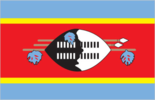
actually four flags in one — three miniature flags reproduced in the center of the white band of the former flag of the Netherlands which has three equal horizontal bands of orange (top), white, and blue; the miniature flags are a vertically hanging flag of the old Orange Free State with a horizontal flag of the UK adjoining on the hoist side and a horizontal flag of the old Transvaal Republic adjoining on the other side
Independence
31 May 1910 (from UK)
Judicial branch
Supreme Court
Leaders
Chief of State and Head of Government— State President Frederik W. DE KLERK (since 13 September 1989) Political parties and leaders: white political parlies and leaders — National Party (NP), Frederik W. de Klerk (majority party); Conservative Party (CP), Dr. Andries P. Treurnicht (official opposition party); Herstigte National Party (HNP), Jaap Marais; Democratic Party (DP), Zach De Beer, Wynand Malan, and Denis Worrall; Colored political parties and leaders — Labor Party (LP), Allan Hendrickse (majority party); Democratic Reform Party (DRP), Carter Ebrahim; United Democratic Party (UDP), Jac Rabie; Freedom Party; Indian political parties and leaders — Solidarity, J. N. Reddy (majority party); National People's Party (NPP), Amichand Rajbansi; Merit People's Party
Legal system
based on Roman-Dutch law and English common law; accepts compulsory ICJ jurisdiction, with reservations
Legislative branch
tricameral Parliament consists of the House of Assembly (whites). House of Representatives (Coloreds), and House of Delegates (Indians)
Long-form name
Republic of South Africa; abbreviated RSA
Member of
CCC, GATT, IAEA, IBRD, ICAO, IDA, IFC, IHO, ILZSG, IMF, INTELSAT, ISO, ITU, IWC— Interna tional Whaling Commission, IWC — International Wheat Council, Southern African Customs Union, UN, UPU, WFTU, WHO, WIPO, WMO, WSG (membership rights in IAEA, ICAO, ITU, WHO, WIPO, and WMO suspended or restricted)
National holiday
Republic Day, 3 1 May (1910)
Other political groups
insurgent groups in exile — African National Congress (ANC), Oliver Tambo; Pan-Africanist Congress (PAC), Zephania Mothopeng; internal antiapartheid groups — Pan-Africanist Movement (PAM), Clarence Makwetu; United Democratic Front (UDF), Albertina Sisulu and Archibald Gumede
Suffrage
universal at age 18, but voting rights are racially based
Type
republic
Economy
Agriculture
accounts for 6% of GDP and 30% of labor force; diversified agriculture, with emphasis on livestock; products — cattle, poultry, sheep, wool, milk, beef, corn, wheat; sugarcane, fruits, vegetables; self-sufficient in food
Aid
NA
Budget
revenues $24.3 billion; expenditures $27.3 billion, including capital expenditures of $NA billion (FY91)
Currency
rand (plural — rand); 1 rand (R) = 100 cents
Electricity
34,941,000 kW capacity; 158,000 million kWh produced, 4,100 kWh per capita (1989)
Exchange rates
rand (R) per US$1 — 2.5555 (January 1990), 2.6166 (1989), 2.2611 (1988), 2.0350 (1987), 2.2685 (1986), 2.1911 (1985)
Exports
$21.5 billion (f.o.b., 1988 est.); commodities — gold 40%, minerals and metals 23%, food 6%, chemicals 3%; partners—FRG, Japan, UK, US, other EC, Hong Kong
External debt
$21.2 billion (1988 est.)
Fiscal year
1 April-3 1 March
GDP
$83.5 billion, per capita $2,380; real growth rate 3.2% (1988)
Imports
$18.5 billion (c.i.f., 1989 est.); commodities — machinery 27%, chemicals 11%, vehicles and aircraft 11%, textiles, scientific instruments, base metals; partners—US, FRG, Japan, UK, France, Italy, Switzerland
Industrial production
growth rate 5.6% (1988)
Industries
mining (world's largest producer of diamonds, gold, chrome), automobile assembly, metalworking, machinery, textile, iron and steel, chemical, fertilizer, foodstuffs
Inflation rate (consumer prices)
14.67% (1989)
Overview
Many of the white one-seventh of the South African population enjoy incomes, material comforts, and health and educational standards equal to those of Western Europe. In contrast, most of the remaining population suffers from the poverty patterns of the Third World, including unemployment, lack of job skills, and barriers to movement into higher-paying fields. Inputs and outputs thus do not move smoothly into the most productive employments, and the effectiveness of the market is further lowered by international constraints on dealings with South Africa. The main strength of the economy lies in its rich mineral resources, which provide two-thirds of exports. Average growth of 2% in output in recent years falls far short of the level needed to cut into the high unemployment level.
Unemployment rate
22% (1988); blacks 25-30%, up to 50% in homelands (1988 est.)
Communications
Airports
931 total, 793 usable; 124 with permanent-surface runways; 4 with runways over 3,659 m; 10 with runways 2,440-3,659 m; 213 with runways 1,2202,439 m
Branches
Army, Navy, Air Force, Medical Services Military manpower males 15-49, 9,544,357; 5,828,167 fit for military service; 419,815 reach military age (18) annually; obligation for service in Citizen Force or Commandos begins at 18; volunteers for service in permanent force must be 17; national service obligation is two years; figures include the so-called homelands not recognized by the US
Civil air
8 1 major transport aircraft
Defense expenditures
5% of GDP, or $4 billion (1989 est.) South Georgia and the South Sandwich Islands (dependent territory of the UK)
Highways
188,309 km total; 54,013 km paved, 134,296 km crushed stone, gravel, or improved earth
Merchant marine
9 ships (1,000 CRT or over) totaling 275,684 GRT/273,973 DWT; includes 7 container, 1 vehicle carrier, 1 petroleum, oils, and lubricants (POL) tanker
Pipelines
931 km crude oil; 1,748 km refined products; 322 km natural gas
Ports
Durban, Cape Town, Port Elizabeth, Richard's Bay, Saldanha, Mosselbaai, Walvis Bay
Railroads
20,638 km route distance total; 35,079 km of 1.067-meter gauge trackage (counts double and multiple tracking as single track); 314 km of 610 mm gauge
Telecommunications
the system is the best developed, most modern, and has the highest capacity in Africa; it consists of carrier-equipped open-wire lines, coaxial cables, radio relay links, fiber optic cable, and radiocommunication stations; key centers are Bloemfontein, Cape Town, Durban, Johannesburg, Port Elizabeth, and Pretoria; 4,500,000 telephones; stations — 14 AM, 286 FM, 67 TV; 1 submarine cable; satellite earth stations — 1 Indian Ocean INTELSAT and 2 Atlantic Ocean INTELSAT Defense Forces