2011 Edition
CIA World Factbook 2011 Archive (HTML)
Introduction
Background
After centuries of Danish, Swedish, German, and Russian rule, Estonia attained independence in 1918. Forcibly incorporated into the USSR in 1940 - an action never recognized by the US - it regained its freedom in 1991 with the collapse of the Soviet Union. Since the last Russian troops left in 1994, Estonia has been free to promote economic and political ties with the West. It joined both NATO and the EU in the spring of 2004.
Geography
Area
- 45,228 sq km 42,388 sq km 2,840 sq km includes 1,520 islands in the Baltic Sea
- total
- 45,228 sq km
- water
- 2,840 sq km
Area - comparative
slightly smaller than New Hampshire and Vermont combined
Climate
maritime; wet, moderate winters, cool summers
Coastline
3,794 km
Elevation extremes
- Baltic Sea 0 m Suur Munamagi 318 m
- highest point
- Suur Munamagi 318 m
- lowest point
- Baltic Sea 0 m
Environment - current issues
air polluted with sulfur dioxide from oil-shale burning power plants in northeast; however, the amount of pollutants emitted to the air have fallen steadily, the emissions of 2000 were 80% less than in 1980; the amount of unpurified wastewater discharged to water bodies in 2000 was 1/20 the level of 1980; in connection with the start-up of new water purification plants, the pollution load of wastewater decreased; Estonia has more than 1,400 natural and manmade lakes, the smaller of which in agricultural areas need to be monitored; coastal seawater is polluted in certain locations
Environment - international agreements
- Air Pollution, Air Pollution-Nitrogen Oxides, Air Pollution-Persistent Organic Pollutants, Air Pollution-Sulfur 85, Air Pollution-Volatile Organic Compounds, Antarctic Treaty, Biodiversity, Climate Change, Climate Change-Kyoto Protocol, Endangered Species, Hazardous Wastes, Law of the Sea, Ozone Layer Protection, Ship Pollution, Wetlands none of the selected agreements
- party to
- Air Pollution, Air Pollution-Nitrogen Oxides, Air Pollution-Persistent Organic Pollutants, Air Pollution-Sulfur 85, Air Pollution-Volatile Organic Compounds, Antarctic Treaty, Biodiversity, Climate Change, Climate Change-Kyoto Protocol, Endangered Species, Hazardous Wastes, Law of the Sea, Ozone Layer Protection, Ship Pollution, Wetlands
- signed, but not ratified
- none of the selected agreements
Freshwater withdrawal (domestic/industrial/agricultural)
- 1.41 cu km/yr (56%/39%/5%) 1,060 cu m/yr (2002)
- per capita
- 1,060 cu m/yr (2002)
- total
- 1.41 cu km/yr (56%/39%/5%)
Geographic coordinates
59 00 N, 26 00 E
Geography - note
the mainland terrain is flat, boggy, and partly wooded; offshore lie more than 1,500 islands
Irrigated land
40 sq km (2008)
Land boundaries
- 633 km Latvia 343 km, Russia 290 km
- border countries
- Latvia 343 km, Russia 290 km
- total
- 633 km
Land use
- 12.05% 0.35% 87.6% (2005)
- arable land
- 12.05%
- other
- 87.6% (2005)
- permanent crops
- 0.35%
Location
Eastern Europe, bordering the Baltic Sea and Gulf of Finland, between Latvia and Russia
Map references
Europe
Maritime claims
- 12 nm limits fixed in coordination with neighboring states
- exclusive economic zone
- limits fixed in coordination with neighboring states
- territorial sea
- 12 nm
Natural hazards
sometimes flooding occurs in the spring
Natural resources
oil shale, peat, rare earth elements, phosphorite, clay, limestone, sand, dolomite, arable land, sea mud
Terrain
marshy, lowlands; flat in the north, hilly in the south
Total renewable water resources
21.1 cu km (2005)
People and Society
Age structure
- 15.1% (male 99,919/female 94,066) 67.2% (male 410,132/female 451,736) 17.7% (male 74,803/female 152,307) (2011 est.)
- 0-14 years
- 15.1% (male 99,919/female 94,066)
- 15-64 years
- 67.2% (male 410,132/female 451,736)
- 65 years and over
- 17.7% (male 74,803/female 152,307) (2011 est.)
Birth rate
10.45 births/1,000 population (2011 est.)
Death rate
13.55 deaths/1,000 population (July 2011 est.)
Drinking water source
- urban: 99% of population rural: 97% of population total: 98% of population urban: 1% of population rural: 3% of population total: 2% of population (2008)
- rural
- 3% of population
- total
- 2% of population (2008)
- urban
- 1% of population
Education expenditures
4.9% of GDP (2007)
Ethnic groups
Estonian 68.7%, Russian 25.6%, Ukrainian 2.1%, Belarusian 1.2%, Finn 0.8%, other 1.6% (2008 census)
Health expenditures
4.3% of GDP (2009)
HIV/AIDS - adult prevalence rate
1.2% (2009 est.)
HIV/AIDS - deaths
fewer than 500 (2009 est.)
HIV/AIDS - people living with HIV/AIDS
9,900 (2009 est.)
Hospital bed density
5.71 beds/1,000 population (2008)
Infant mortality rate
- 7.06 deaths/1,000 live births 8.21 deaths/1,000 live births 5.85 deaths/1,000 live births (2011 est.)
- female
- 5.85 deaths/1,000 live births (2011 est.)
- total
- 7.06 deaths/1,000 live births
Languages
Estonian (official) 67.3%, Russian 29.7%, other 2.3%, unknown 0.7% (2000 census)
Life expectancy at birth
- 73.33 years 68.02 years 78.97 years (2011 est.)
- female
- 78.97 years (2011 est.)
- total population
- 73.33 years
Literacy
- age 15 and over can read and write 99.8% 99.8% 99.8% (2000 census)
- definition
- age 15 and over can read and write
- female
- 99.8% (2000 census)
- male
- 99.8%
- total population
- 99.8%
Major cities - population
TALLINN (capital) 399,000 (2009)
Major infectious diseases
- intermediate bacterial diarrhea tickborne encephalitis (2009)
- degree of risk
- intermediate
- food or waterborne diseases
- bacterial diarrhea
- vectorborne disease
- tickborne encephalitis (2009)
Maternal mortality rate
12 deaths/100,000 live births (2008)
Median age
- 40.5 years 37 years 43.9 years (2011 est.)
- female
- 43.9 years (2011 est.)
- male
- 37 years
- total
- 40.5 years
Nationality
- Estonian(s) Estonian
- adjective
- Estonian
- noun
- Estonian(s)
Net migration rate
-3.31 migrant(s)/1,000 population (2011 est.)
Obesity - adult prevalence rate
14.4% (2004)
Physicians density
3.409 physicians/1,000 population (2008)
Population
1,282,963 (July 2011 est.)
Population growth rate
-0.641% (2011 est.)
Religions
Evangelical Lutheran 13.6%, Orthodox 12.8%, other Christian (including Methodist, Seventh-Day Adventist, Roman Catholic, Pentecostal) 1.4%, unaffiliated 34.1%, other and unspecified 32%, none 6.1% (2000 census)
Sanitation facility access
- urban: 96% of population rural: 94% of population total: 95% of population urban: 4% of population rural: 6% of population total: 5% of population (2008)
- rural
- 6% of population
- total
- 5% of population (2008)
- urban
- 4% of population
School life expectancy (primary to tertiary education)
- 16 years 15 years 17 years (2008)
- female
- 17 years (2008)
- male
- 15 years
- total
- 16 years
Sex ratio
- 1.063 male(s)/female 1.06 male(s)/female 0.91 male(s)/female 0.49 male(s)/female 0.84 male(s)/female (2011 est.)
- 15-64 years
- 0.91 male(s)/female
- 65 years and over
- 0.49 male(s)/female
- at birth
- 1.063 male(s)/female
- total population
- 0.84 male(s)/female (2011 est.)
- under 15 years
- 1.06 male(s)/female
Total fertility rate
1.44 children born/woman (2011 est.)
Unemployment, youth ages 15-24
- 27.3% 31.8% 21.2% (2009)
- female
- 21.2% (2009)
- total
- 27.3%
Urbanization
- 69% of total population (2010) 0.1% annual rate of change (2010-15 est.)
- rate of urbanization
- 0.1% annual rate of change (2010-15 est.)
- urban population
- 69% of total population (2010)
Government
Administrative divisions
15 counties (maakonnad, singular - maakond); Harjumaa (Tallinn), Hiiumaa (Kardla), Ida-Virumaa (Johvi), Jarvamaa (Paide), Jogevamaa (Jogeva), Laanemaa (Haapsalu), Laane-Virumaa (Rakvere), Parnumaa (Parnu), Polvamaa (Polva), Raplamaa (Rapla), Saaremaa (Kuressaare), Tartumaa (Tartu), Valgamaa (Valga), Viljandimaa (Viljandi), Vorumaa (Voru) counties have the administrative center name following in parentheses
Capital
- Tallinn 59 26 N, 24 43 E UTC+2 (7 hours ahead of Washington, DC during Standard Time) +1hr, begins last Sunday in March; ends last Sunday in October
- daylight saving time
- +1hr, begins last Sunday in March; ends last Sunday in October
- geographic coordinates
- 59 26 N, 24 43 E
- name
- Tallinn
- time difference
- UTC+2 (7 hours ahead of Washington, DC during Standard Time)
Constitution
adopted 28 June 1992
Country name
- Republic of Estonia Estonia Eesti Vabariik Eesti Estonian Soviet Socialist Republic
- conventional long form
- Republic of Estonia
- conventional short form
- Estonia
- former
- Estonian Soviet Socialist Republic
- local long form
- Eesti Vabariik
- local short form
- Eesti
Diplomatic representation from the US
- Ambassador Michael C. POLT Kentmanni 20, 15099 Tallinn use embassy street address [372] 668-8100 [372] 668-8265
- chief of mission
- Ambassador Michael C. POLT
- embassy
- Kentmanni 20, 15099 Tallinn
- FAX
- [372] 668-8265
- mailing address
- use embassy street address
- telephone
- [372] 668-8100
Diplomatic representation in the US
- Ambassador Marina KALJURAND 2131 Massachusetts Avenue NW, Washington, DC 20008 [1] (202) 588-0101 [1] (202) 588-0108 New York
- chancery
- 2131 Massachusetts Avenue NW, Washington, DC 20008
- chief of mission
- Ambassador Marina KALJURAND
- consulate(s) general
- New York
- FAX
- [1] (202) 588-0108
- telephone
- [1] (202) 588-0101
Executive branch
- President Toomas Hendrik ILVES (since 9 October 2006) Prime Minister Andrus ANSIP (since 12 April 2005) Ministers appointed by the prime minister, approved by Parliament president elected by Parliament for a five-year term (eligible for a second term); if a candidate does not secure two-thirds of the votes after three rounds of balloting in the Parliament, then an electoral assembly (made up of Parliament plus members of local councils) elects the president, choosing between the two candidates with the largest number of votes; election last held on 29 August 2011 (next to be held in the fall of 2016); prime minister nominated by the president and approved by Parliament Toomas Hendrik ILVES reelected president; parliamentary vote - Toomas Hendrik ILVES 73, Indrek TARAND 25
- cabinet
- Ministers appointed by the prime minister, approved by Parliament
- chief of state
- President Toomas Hendrik ILVES (since 9 October 2006)
- election results
- Toomas Hendrik ILVES reelected president; parliamentary vote - Toomas Hendrik ILVES 73, Indrek TARAND 25
- elections
- president elected by Parliament for a five-year term (eligible for a second term); if a candidate does not secure two-thirds of the votes after three rounds of balloting in the Parliament, then an electoral assembly (made up of Parliament plus members of local councils) elects the president, choosing between the two candidates with the largest number of votes; election last held on 29 August 2011 (next to be held in the fall of 2016); prime minister nominated by the president and approved by Parliament
- head of government
- Prime Minister Andrus ANSIP (since 12 April 2005)
Flag description
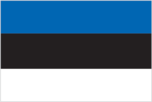
three equal horizontal bands of blue (top), black, and white; various interpretations are linked to the flag colors; blue represents faith, loyalty, and devotion, while also reminiscent of the sky, sea, and lakes of the country; black symbolizes the soil of the country and the dark past and suffering endured by the Estonian people; white refers to the striving towards enlightenment and virtue, and is the color of birch bark and snow, as well as summer nights illuminated by the midnight sun
Government type
parliamentary republic
Independence
20 August 1991 (declared); 6 September 1991 (recognized by the Soviet Union)
International law organization participation
accepts compulsory ICJ jurisdiction with reservations; accepts ICCt jurisdiction
International organization participation
Australia Group, BA, BIS, CBSS, CE, EAPC, EBRD, ECB, EIB, EMU, ESA (cooperating state), EU, FAO, IAEA, IBRD, ICAO, ICC, ICRM, IDA, IFC, IFRCS, IHO, ILO, IMF, IMO, Interpol, IOC, IOM, IPU, ISO, ITSO, ITU, ITUC, MIGA, NATO, NIB, NSG, OAS (observer), OECD, OIF (observer), OPCW, OSCE, PCA, Schengen Convention, UN, UNCTAD, UNESCO, UNHCR, UNTSO, UPU, WCO, WHO, WIPO, WMO, WTO
Judicial branch
Supreme Court (chairman appointed for life by Parliament)
Legal system
civil law system
Legislative branch
- unicameral Parliament or Riigikogu (101 seats; members elected by popular vote to serve four-year terms) last held on 6 March 2011 (next to be held in March 2015) percent of vote by party - Estonian Reform Party 28.6%, Center Party of Estonia 23.3%, Union of Pro Patria and Res Publica 20.5%, Social Democratic Party 17.1%, Estonian Greens 3.8%, Estonian People's Union 2.1%, other 4.6%; seats by party - Estonian Reform Party 33, Center Party 26, Union of Pro Patria and Res Publica 23, Social Democratic Party 19
- election results
- percent of vote by party - Estonian Reform Party 28.6%, Center Party of Estonia 23.3%, Union of Pro Patria and Res Publica 20.5%, Social Democratic Party 17.1%, Estonian Greens 3.8%, Estonian People's Union 2.1%, other 4.6%; seats by party - Estonian Reform Party 33, Center Party 26, Union of Pro Patria and Res Publica 23, Social Democratic Party 19
- elections
- last held on 6 March 2011 (next to be held in March 2015)
National anthem
- "Mu isamaa, mu onn ja room" (My Native Land, My Pride and Joy) Johann Voldemar JANNSEN/Fredrik PACIUS adopted 1920, though banned between 1940 and 1990 under Soviet occupation; the anthem, used in Estonia since 1869, shares the same melody with that of Finland but has different lyrics
- lyrics/music
- Johann Voldemar JANNSEN/Fredrik PACIUS
- name
- "Mu isamaa, mu onn ja room" (My Native Land, My Pride and Joy)
National holiday
Independence Day, 24 February (1918); note - 24 February 1918 was the date Estonia declared its independence from Soviet Russia and established its statehood; 20 August 1991 was the date it declared its independence from the Soviet Union
National symbol(s)
barn swallow
Political parties and leaders
Center Party of Estonia (Keskerakond) [Edgar SAVISAAR]; Estonian Greens (Rohelised) [Marek STRANDBERG]; Estonian People's Union (Rahvaliit) [Andrus BLOK]; Estonian Reform Party (Reformierakond) [Andrus ANSIP]; Social Democratic Party [Sven MIKSER]; Union of Pro Patria and Res Publica (Isamaa je Res Publica Liit) [Mart LAAR]
Suffrage
18 years of age; universal for all Estonian citizens
Economy
Agriculture - products
grain, potatoes, vegetables; livestock and dairy products; fish
Budget
- $7.719 billion $7.692 billion (2010 est.)
- expenditures
- $7.692 billion (2010 est.)
- revenues
- $7.719 billion
Budget surplus (+) or deficit (-)
0.1% of GDP (2010 est.)
Commercial bank prime lending rate
7.759% (31 December 2010 est.) 9.385% (31 December 2009 est.)
Current account balance
$677.8 million (2010 est.) $893.1 million (2009 est.)
Debt - external
$24.22 billion (30 June 2011 est.) $22.03 billion (31 December 2010 est.)
Distribution of family income - Gini index
31.4 (2009) 37 (1999)
Economy - overview
Estonia, a 2004 European Union entrant, has a modern market-based economy and one of the higher per capita income levels in Central Europe and the Baltic region. Estonia's successive governments have pursued a free market, pro-business economic agenda and have wavered little in their commitment to pro-market reforms. The current government has followed relatively sound fiscal policies that have resulted in balanced budgets and very low public debt. The economy benefits from strong electronics and telecommunications sectors and strong trade ties with Finland, Sweden, and Germany. Tallinn's priority has been to sustain high growth rates - on average 8% per year from 2003 to 2007. Estonia's economy slowed down markedly and fell sharply into recession in mid-2008, primarily as a result of an investment and consumption slump following the bursting of the real estate market bubble. GDP dropped nearly 14% in 2009, among the world's highest rates of contraction. Rising exports to Sweden and Finland lead an economic recovery in 2010, but unemployment stands above 17%. Estonia joined the OECD in December 2010 and adopted the euro in January 2011.
Electricity - consumption
7.08 billion kWh (2009 est.)
Electricity - exports
2.943 billion kWh (2009 est.)
Electricity - imports
3.025 billion kWh (2009 est.)
Electricity - production
8.779 billion kWh (2009 est.)
Exchange rates
kroon (EEK) per US dollar - 11.8 (2010) 11.23 (2009) 10.7 (2008) 11.535 (2007) 12.473 (2006) on 1 January 2011 Estonia adopted the euro as legal tender
Exports
$11.66 billion (2010 est.) $9.125 billion (2009 est.)
Exports - commodities
machinery and electrical equipment 21%, wood and wood products 9%, metals 9%, furniture 7%, vehicles and parts 5%, food products and beverages 4%, textiles 4%, plastics 3%
Exports - partners
Finland 18.5%, Sweden 17%, Russia 10.4%, Latvia 9.8%, Germany 5.7%, Lithuania 5.3% (2010)
GDP - composition by sector
- 2.7% 29.1% 68.2% (2010 est.)
- agriculture
- 2.7%
- industry
- 29.1%
- services
- 68.2% (2010 est.)
GDP - per capita (PPP)
$19,100 (2010 est.) $18,400 (2009 est.) $21,300 (2008 est.) data are in 2010 US dollars
GDP - real growth rate
3.1% (2010 est.) -13.9% (2009 est.) -5.1% (2008 est.)
GDP (official exchange rate)
$19.78 billion (2010 est.)
GDP (purchasing power parity)
$24.69 billion (2010 est.) $23.95 billion (2009 est.) $27.81 billion (2008 est.) data are in 2010 US dollars
Household income or consumption by percentage share
- 2.7% 27.7% (2004)
- highest 10%
- 27.7% (2004)
- lowest 10%
- 2.7%
Imports
$11.94 billion (2010 est.) $9.903 billion (2009)
Imports - commodities
machinery and electrical equipment 22%, mineral fuels 18%, chemical products 3%, foodstuffs 6%, plastics 6%, textiles 5%
Imports - partners
Finland 15.7%, Germany 11.9%, Sweden 11.6%, Latvia 11.5%, Lithuania 8.2%, Poland 6.8%, Russia 4.5% (2010)
Industrial production growth rate
13.2% (2010 est.)
Industries
engineering, electronics, wood and wood products, textiles; information technology, telecommunications
Inflation rate (consumer prices)
3% (2010 est.) -0.1% (2009 est.)
Investment (gross fixed)
18.6% of GDP (2010 est.)
Labor force
686,800 (2010 est.)
Labor force - by occupation
- 2.8% 22.7% 74.5% (2008)
- agriculture
- 2.8%
- industry
- 22.7%
- services
- 74.5% (2008)
Market value of publicly traded shares
$2.26 billion (31 December 2010) $2.654 billion (31 December 2009) $1.951 billion (31 December 2008)
Natural gas - consumption
1.02 billion cu m (2009 est.)
Natural gas - exports
0 cu m (2009 est.)
Natural gas - imports
1.02 billion cu m (2009 est.)
Natural gas - production
0 cu m (2009 est.)
Natural gas - proved reserves
0 cu m (1 January 2011 est.)
Oil - consumption
31,000 bbl/day (2010 est.)
Oil - exports
0 bbl/day (2009 est.)
Oil - imports
28,520 bbl/day (2009 est.)
Oil - production
7,642 bbl/day (2010 est.)
Oil - proved reserves
0 bbl (1 January 2011 est.)
Population below poverty line
19.7% (2008)
Public debt
6.6% of GDP (2010 est.) 7.1% of GDP (2009 est.)
Reserves of foreign exchange and gold
$2.568 billion (31 December 2010 est.) $3.981 billion (31 December 2009 est.)
Stock of broad money
$11.36 billion (31 December 2010 est.) $11.7 billion (31 December 2009 est.)
Stock of direct foreign investment - abroad
$6.029 billion (31 December 2010 est.) $6.618 billion (31 December 2009 est.)
Stock of direct foreign investment - at home
$16.39 billion (31 December 2010 est.) $16.25 billion (31 December 2009 est.)
Stock of domestic credit
$18.95 billion (31 December 2010 est.) $20.91 billion (31 December 2009 est.)
Stock of narrow money
$6.614 billion (31 December 2010 est.) $5.99 billion (31 December 2009 est.) this figure represents the US dollar value of Estonian kroon in circulation prior to Estonia's joining the Economic and Monetary Union (EMU); see entry for the European Union for money supply in the euro area; the European Central Bank (ECB) controls monetary policy for the 17 members of the EMU; individual members of the EMU do not control the quantity of money circulating within their own borders
Taxes and other revenues
39% of GDP (2010 est.)
Unemployment rate
16.9% (2010 est.) 13.8% (2009 est.)
Communications
Broadcast media
the publicly-owned broadcaster, Eesti Rahvusringhaaling (ERR), operates 2 television channels; national private TV channels expanding service; a range of channels are aimed at Russian-speaking viewers; high penetration rate for cable TV services with more than half of Estonian households connected; publicly-owned broadcaster, ERR, operates 4 radio networks and there are a growing number of private commercial radio stations broadcasting nationally, regionally, and locally (2008)
Internet country code
.ee
Internet hosts
729,534 (2010)
Internet users
971,700 (2009)
Telephone system
- foreign investment in the form of joint business ventures greatly improved telephone service with a wide range of high quality voice, data, and Internet services available substantial fiber-optic cable systems carry telephone, TV, and radio traffic in the digital mode; Internet services are widely available; schools and libraries are connected to the Internet, a large percentage of the population files income-tax returns online, and online voting was used for the first time in the 2005 local elections country code - 372; fiber-optic cables to Finland, Sweden, Latvia, and Russia provide worldwide packet-switched service; 2 international switches are located in Tallinn (2008)
- domestic
- substantial fiber-optic cable systems carry telephone, TV, and radio traffic in the digital mode; Internet services are widely available; schools and libraries are connected to the Internet, a large percentage of the population files income-tax returns online, and online voting was used for the first time in the 2005 local elections
- general assessment
- foreign investment in the form of joint business ventures greatly improved telephone service with a wide range of high quality voice, data, and Internet services available
- international
- country code - 372; fiber-optic cables to Finland, Sweden, Latvia, and Russia provide worldwide packet-switched service; 2 international switches are located in Tallinn (2008)
Telephones - main lines in use
482,200 (2010)
Telephones - mobile cellular
1.653 million (2010)
Transportation
Airports
19 (2010)
Airports - with paved runways
- 2 (2010)
- 1,524 to 2,437 m
- 2
- 2,438 to 3,047 m
- 7
- 914 to 1,523 m
- 2 (2010)
- over 3,047 m
- 2
- total
- 13
Airports - with unpaved runways
- 3 (2010)
- 1,524 to 2,437 m
- 2
- 914 to 1,523 m
- 1
- total
- 6
- under 914 m
- 3 (2010)
Heliports
1 (2010)
Merchant marine
- cargo 4, chemical tanker 1, passenger/cargo 17, petroleum tanker 2 3 (Germany 1, Norway 2) 77 (Antigua and Barbuda 20, Belize 1, Cambodia 1, Cyprus 7, Dominica 6, Finland 2, Latvia 4, Malta 16, former Netherlands Antilles 1, Norway 1, Saint Kitts and Nevis 3, Saint Vincent and the Grenadines 10, Sierra Leone 1, Sweden 3, Venezuela 1) (2010)
- foreign-owned
- 3 (Germany 1, Norway 2)
- registered in other countries
- 77 (Antigua and Barbuda 20, Belize 1, Cambodia 1, Cyprus 7, Dominica 6, Finland 2, Latvia 4, Malta 16, former Netherlands Antilles 1, Norway 1, Saint Kitts and Nevis 3, Saint Vincent and the Grenadines 10, Sierra Leone 1, Sweden 3, Venezuela 1) (2010)
- total
- 24
Pipelines
gas 859 km (2010)
Ports and terminals
Kuivastu, Kunda, Muuga, Parnu Reid, Sillamae, Tallinn
Railways
- 1,196 km 1,196 km 1.520-m and 1.524-m gauge (131 km electrified) (2010)
- total
- 1,196 km
Roadways
- 58,034 km 34,936 km (includes 104 km of expressways) 23,098 km (2009)
- total
- 58,034 km
- unpaved
- 23,098 km (2009)
Waterways
335 km (320 km are navigable year round) (2010)
Military and Security
Manpower available for military service
- 291,801 302,696 (2010 est.)
- females age 16-49
- 302,696 (2010 est.)
- males age 16-49
- 291,801
Manpower fit for military service
- 210,854 251,185 (2010 est.)
- females age 16-49
- 251,185 (2010 est.)
- males age 16-49
- 210,854
Manpower reaching militarily significant age annually
- 6,668 6,309 (2010 est.)
- female
- 6,309 (2010 est.)
- male
- 6,668
Military branches
- Estonian Defense Forces: Land Force, Navy, Air Force (Eesti Ohuvagi), Defense League (Kaitseliit, KL) (2011)
- Estonian Defense Forces
- Land Force, Navy, Air Force (Eesti Ohuvagi), Defense League (Kaitseliit, KL) (2011)
Military expenditures
2% of GDP (2005 est.)
Military service age and obligation
obligation for compulsory service ages 16-60, with conscription "likely" ages 18-27; service requirement 8-11 months (2009)
Transnational Issues
Disputes - international
Russia recalled its signature to the 1996 technical border agreement with Estonia in 2005, rather than concede to Estonia's appending a prepared unilateral declaration referencing Soviet occupation and territorial losses; Russia demands better accommodation of Russian-speaking population in Estonia; Estonian citizen groups continue to press for realignment of the boundary based on the 1920 Tartu Peace Treaty that would bring the now divided ethnic Setu people and parts of the Narva region within Estonia; as a member state that forms part of the EU's external border, Estonia must implement the strict Schengen border rules with Russia
Illicit drugs
growing producer of synthetic drugs; increasingly important transshipment zone for cannabis, cocaine, opiates, and synthetic drugs since joining the European Union and the Schengen Accord; potential money laundering related to organized crime and drug trafficking is a concern, as is possible use of the gambling sector to launder funds; major use of opiates and ecstasy
Trafficking in persons
- Estonia is a source, transit, and destination country for women subjected to forced prostitution, and for men and women subjected to conditions of forced labor; women from Estonia are found in sex trafficking situations in Finland, the Netherlands, the United Kingdom, Germany, and Italy; men and women from Estonia are subjected to conditions of forced labor in Spain, Sweden, Norway, and Finland Tier 2 Watch List - Estonia does not fully comply with the minimum standards for the elimination of trafficking; however, it is making significant efforts to do so; despite these efforts, the government did not demonstrate evidence of increasing its efforts; Estonia remains the only European Union country without a specific trafficking law; trafficking offenders convicted under non-trafficking statutes avoided accountability; the Estonian Government, however, gave some financial support to NGOs who care for trafficking victims, and it developed a national action plan with elements addressing trafficking in persons (2011)
- current situation
- Estonia is a source, transit, and destination country for women subjected to forced prostitution, and for men and women subjected to conditions of forced labor; women from Estonia are found in sex trafficking situations in Finland, the Netherlands, the United Kingdom, Germany, and Italy; men and women from Estonia are subjected to conditions of forced labor in Spain, Sweden, Norway, and Finland
- tier rating
- Tier 2 Watch List - Estonia does not fully comply with the minimum standards for the elimination of trafficking; however, it is making significant efforts to do so; despite these efforts, the government did not demonstrate evidence of increasing its efforts; Estonia remains the only European Union country without a specific trafficking law; trafficking offenders convicted under non-trafficking statutes avoided accountability; the Estonian Government, however, gave some financial support to NGOs who care for trafficking victims, and it developed a national action plan with elements addressing trafficking in persons (2011)