2005 Edition
CIA World Factbook 2005 (Project Gutenberg)
Introduction
Administrative divisions
15 counties (maakonnad, singular - maakond): Harjumaa (Tallinn), Hiiumaa (Kardla), Ida-Virumaa (Johvi), Jarvamaa (Paide), Jogevamaa (Jogeva), Laanemaa (Haapsalu), Laane-Virumaa (Rakvere), Parnumaa (Parnu), Polvamaa (Polva), Raplamaa (Rapla), Saaremaa (Kuressaare), Tartumaa (Tartu), Valgamaa (Valga), Viljandimaa (Viljandi), Vorumaa (Voru) note: counties have the administrative center name following in parentheses
Age structure
0-14 years: 15.5% (male 106,300/female 100,446) 15-64 years: 67.7% (male 429,843/female 472,034) 65 years and over: 16.8% (male 74,037/female 150,233) (2005 est.)
Agriculture - products
potatoes, vegetables; livestock and dairy products; fish
Airports
29 (2004 est.)
Airports - with paved runways
- total
- 14 over 3,047 m: 1 2,438 to 3,047 m: 8 1,524 to 2,437 m: 1 914 to 1,523 m: 3 under 914 m: 1 (2004 est.)
Airports - with unpaved runways
- total
- 15 over 3,047 m: 1 2,438 to 3,047 m: 1 1,524 to 2,437 m: 3 914 to 1,523 m: 4 under 914 m: 6 (2004 est.) Military Estonia
Area
- land
- 43,211 sq km
- total
- 45,226 sq km
- water
- 2,015 sq km note: includes 1,520 islands in the Baltic Sea
Area - comparative
slightly smaller than New Hampshire and Vermont combined
Background
After centuries of Danish, Swedish, German, and Russian rule, Estonia attained independence in 1918. Forcibly incorporated into the USSR in 1940, it regained its freedom in 1991, with the collapse of the Soviet Union. Since the last Russian troops left in 1994, Estonia has been free to promote economic and political ties with Western Europe. It joined both NATO and the EU in the spring of 2004. Geography Estonia
Birth rate
9.91 births/1,000 population (2005 est.)
Budget
- expenditures
- $4.601 billion, including capital expenditures of NA (2004 est.)
- revenues
- $4.622 billion
Capital
Tallinn
Climate
maritime, wet, moderate winters, cool summers
Coastline
3,794 km
Constitution
adopted 28 June 1992
Country name
- conventional long form
- Republic of Estonia
- conventional short form
- Estonia
- former
- Estonian Soviet Socialist Republic
- local long form
- Eesti Vabariik
- local short form
- Eesti
Currency (code)
Estonian kroon (EEK)
Currency code
EEK
Current account balance
$-1.169 billion (2004 est.)
Death rate
13.21 deaths/1,000 population (2005 est.)
Debt - external
$8.373 billion (2004 est.)
Diplomatic representation from the US
- chief of mission
- Ambassador Aldona Zofia WOS
- embassy
- Kentmanni 20, 15099 Tallinn
- FAX
- [372] 668-8134
- mailing address
- use embassy street address
- telephone
- [372] 668-8100
Diplomatic representation in the US
- chancery
- 2131 Massachusetts Ave. NW, Washington, DC 20008
- chief of mission
- Ambassador Juri LUIK
- consulate(s) general
- New York
- FAX
- [1] (202) 588-0108
- telephone
- [1] (202) 588-0101
Disputes - international
in 1996, the Estonia-Russia technical border agreement was initialed but both states have been hesitant to sign and ratify it, with Russia asserting that Estonia needs to better assimilate Russian-speakers and Estonian groups pressing for realignment of the boundary based more closely on the 1920 Tartu Peace Treaty that would bring the now divided ethnic Setu people and parts of the Narva region within Estonia; as a member state that forms part of the EU's external border, Estonia must implement the strict Schengen border rules
Distribution of family income - Gini index
37 (1999)
Economic aid - recipient
$108 million (2000)
Economy - overview
Estonia, as a new member of the World Trade Organization and the European Union, has transitioned effectively to a modern market economy with strong ties to the West, including the pegging of its currency to the euro. The economy benefits from strong electronics and telecommunications sectors and is greatly influenced by developments in Finland, Sweden, and Germany, three major trading partners. The current account deficit remains high; however, the state budget enjoyed a surplus of $130 million in 2003.
Electricity - consumption
6.358 billion kWh (2002)
Electricity - exports
1.562 billion kWh (2002)
Electricity - imports
200 million kWh (2002)
Electricity - production
8.301 billion kWh (2002)
Electricity - production by source
- fossil fuel
- 99.8%
- hydro
- 0.1%
- nuclear
- 0%
- other
- 0.2% (2001)
Elevation extremes
- highest point
- Suur Munamagi 318 m
- lowest point
- Baltic Sea 0 m
Environment - current issues
air polluted with sulfur dioxide from oil-shale burning power plants in northeast; however, the amount of pollutants emitted to the air have fallen steadily, the emissions of 2000 were 80% less than in 1980; the amount of unpurified wastewater discharged to water bodies in 2000 was one twentieth the level of 1980; in connection with the start-up of new water purification plants, the pollution load of wastewater decreased; Estonia has more than 1,400 natural and manmade lakes, the smaller of which in agricultural areas need to be monitored; coastal seawater is polluted in certain locations
Environment - international agreements
- party to
- Air Pollution, Air Pollution-Nitrogen Oxides, Air Pollution-Sulfur 85, Air Pollution-Volatile Organic Compounds, Antarctic Treaty, Biodiversity, Climate Change, Climate Change-Kyoto Protocol, Endangered Species, Hazardous Wastes, Ship Pollution, Ozone Layer Protection, Wetlands signed, but not ratified: none of the selected agreements
Ethnic groups
Estonian 67.9%, Russian 25.6%, Ukrainian 2.1%, Belarusian 1.3%, Finn 0.9%, other 2.2% (2000 census)
Exchange rates
krooni per US dollar - 12.596 (2004), 13.856 (2003), 16.612 (2002), 17.478 (2001), 16.969 (2000)
Executive branch
- cabinet
- Council of Ministers appointed by the prime minister, approved by Parliament
- chief of state
- President Arnold RUUTEL (since 8 October 2001)
- election results
- Arnold RUUTEL elected president on 21 September 2001 by a 367-member electoral assembly that convened following Parliament's failure in August to elect then-President MERI's successor; on the second ballot of voting, RUUTEL received 186 votes to Parliament Speaker Toomas SAVI's 155; the remaining 26 ballots were either left blank or invalid
- elections
- president elected by Parliament for a five-year term; if a candidate does not secure two-thirds of the votes after three rounds of balloting in the Parliament, then an electoral assembly (made up of Parliament plus members of local governments) elects the president, choosing between the two candidates with the largest percentage of votes; election last held 21 September 2001 (next to be held in the fall of 2006); prime minister nominated by the president and approved by Parliament
- head of government
- Prime Minister Andrus ANSIP (since 12 April 2005)
Exports
$5.701 billion f.o.b. (2004 est.)
Exports - commodities
machinery and equipment 33%, wood and paper 15%, textiles 14%, food products 8%, furniture 7%, metals, chemical products (2001)
Exports - partners
Finland 23.1%, Sweden 15.3%, Germany 8.4%, Latvia 7.9%, Russia 5.7%, Lithuania 4.4% (2004)
Fiscal year
calendar year Communications Estonia
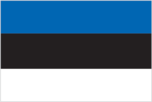
Flag description
pre-1940 flag restored by Supreme Soviet in May 1990 - three equal horizontal bands of blue (top), black, and white Economy Estonia
GDP - composition by sector
- agriculture
- 4.1%
- industry
- 28.9%
- services
- 67% (2004 est.)
GDP - per capita
purchasing power parity - $14,300 (2004 est.)
GDP - real growth rate
6% (2004 est.)
GDP (purchasing power parity)
$19.23 billion (2004 est.)
Geographic coordinates
59 00 N, 26 00 E
Geography - note
the mainland terrain is flat, boggy, and partly wooded; offshore lie more than 1,500 islands People Estonia
Government type
parliamentary republic
Highways
- paved
- 13,874 km (including 99 km of expressways)
- total
- 55,944 km
- unpaved
- 42,070 km (2002)
HIV/AIDS - adult prevalence rate
1.1% (2001 est.)
HIV/AIDS - deaths
less than 200 (2003 est.)
HIV/AIDS - people living with HIV/AIDS
7,800 (2003 est.)
Household income or consumption by percentage share
lowest 10%: 3% highest 10%: 29.8% (1998)
Illicit drugs
transshipment point for opiates and cannabis from Southwest Asia and the Caucasus via Russia, cocaine from Latin America to Western Europe and Scandinavia, and synthetic drugs from Western Europe to Scandinavia; increasing domestic drug abuse problem; possible precursor manufacturing and/or trafficking; potential money laundering related to organized crime and drug trafficking is a concern as is possible use of the gambling sector to launder funds This page was last updated on 20 October, 2005 ======================================================================
Imports
$7.318 billion f.o.b. (2004 est.)
Imports - commodities
machinery and equipment 33.5%, chemical products 11.6%, textiles 10.3%, foodstuffs 9.4%, transportation equipment 8.9% (2001)
Imports - partners
Finland 22.1%, Germany 12.9%, Sweden 9.7%, Russia 9.2%, Lithuania 5.3%, Latvia 4.7% (2004)
Independence
20 August 1991 (from Soviet Union)
Industrial production growth rate
5% (2000 est.)
Industries
engineering, electronics, wood and wood products, textile; information technology, telecommunications
Infant mortality rate
- female
- 6.6 deaths/1,000 live births (2005 est.)
- male
- 9.06 deaths/1,000 live births
- total
- 7.87 deaths/1,000 live births
Inflation rate (consumer prices)
3% (2004 est.)
International organization participation
Australia Group, BIS, CBSS, CE, EAPC, EBRD, EIB, EU (new member), FAO, IAEA, IBRD, ICAO, ICCt, ICFTU, ICRM, IFC, IFRCS, IHO, ILO, IMF, IMO, Interpol, IOC, IOM, ISO (correspondent), ITU, MIGA, NATO, NIB, NSG, OAS (observer), OPCW, OSCE, PCA, UN, UNCTAD, UNESCO, UNTSO, UPU, WCO, WEU (member affiliate), WHO, WIPO, WMO, WTO
Internet country code
.ee
Internet hosts
82,142 (2004)
Internet Service Providers (ISPs)
38 (2001)
Internet users
444,000 (2002) Transportation Estonia
Investment (gross fixed)
28.2% of GDP (2004 est.)
Irrigated land
40 sq km (1998 est.)
Judicial branch
National Court (chairman appointed by Parliament for life)
Labor force
660,000 (2004 est.)
Labor force - by occupation
agriculture 11%, industry 20%, services 69% (1999 est.)
Land boundaries
- border countries
- Latvia 339 km, Russia 294 km
- total
- 633 km
Land use
- arable land
- 16.04%
- other
- 83.51% (2001)
- permanent crops
- 0.45%
Languages
Estonian (official) 67.3%, Russian 29.7%, other 2.3%, unknown 0.7% (2000 census)
Legal system
based on civil law system; no judicial review of legislative acts
Legislative branch
- unicameral Parliament or Riigikogu (101 seats; members are elected by popular vote to serve four-year terms)
- election results
- percent of vote by party - Center Party 25.4%, Res Publica 24.6%, Reform Party 17.7%, Estonian People's Union 13%, Pro Patria Union (Fatherland League) 7.3% People's Party Moodukad 7%; seats by party - Center Party 28, Res Publica 28, Reform Party 19, Estonian People's Union 13, Pro Patria Union 7, People's Party Moodukad 6
- elections
- last held 2 March 2003 (next to be held NA March 2007)
Life expectancy at birth
- female
- 77.6 years (2005 est.)
- male
- 66.28 years
- total population
- 71.77 years
Literacy
- definition: age 15 and over can read and write
- female
- 99.8% (2003 est.) Government Estonia
- male
- 99.8%
- total population
- 99.8%
Location
Eastern Europe, bordering the Baltic Sea and Gulf of Finland, between Latvia and Russia
Manpower available for military service
males age 18-49: 291,696 (2005 est.)
Manpower fit for military service
males age 18-49: 200,382 (2005 est.) : note - in 2004, 51% of the young men called up for service were determined to be unfit; main obstacles to conscription were psychiatric and behavioral
Manpower reaching military service age annually
- males
- 11,146 (2005 est.)
Map references
Europe
Maritime claims
- exclusive economic zone
- limits fixed in coordination with neighboring states
- territorial sea
- 12 nm
Median age
- female
- 42.35 years (2005 est.)
- male
- 35.52 years
- total
- 39.06 years
Merchant marine
- by type
- cargo 17, passenger/cargo 20, petroleum tanker 2, roll on/roll off 4
- foreign-owned
- 6 (Norway 6)
- registered in other countries
- 51 (2005)
- total
- 43 ships (1,000 GRT or over) 212,998 GRT/177,488 DWT
Military branches
- Estonian Defense Forces
- Ground Forces, Navy, Air Force and Air Defense Staff, Republic Security Forces (internal and border troops), Volunteer Defense League (Kaitseliit), Maritime Border Guard, Coast Guard note: Border Guards and Ministry of Internal Affairs become part of the Estonian Defense Forces in wartime; the Coast Guard is subordinate to the Ministry of Defense in peacetime and the Estonian Navy in wartime
Military expenditures - dollar figure
$155 million (2002 est.)
Military expenditures - percent of GDP
2% (2002 est.) Transnational Issues Estonia
Military service age and obligation
18 years of age for compulsory military service, with 11-month service obligation; Estonia has committed to retaining conscription for men and women up to 2010; 17 years of age for volunteers (2004)
National holiday
Independence Day, 24 February (1918); note - 24 February 1918 is the date Estonia declared its independence from Soviet Russia; 20 August 1991 is the date it declared its independence from the Soviet Union
Nationality
- adjective
- Estonian
- noun
- Estonian(s)
Natural gas - consumption
1.27 billion cu m (2001 est.)
Natural gas - exports
0 cu m (2001 est.)
Natural gas - imports
1.27 billion cu m (2001 est.)
Natural gas - production
0 cu m (2001 est.)
Natural hazards
sometimes flooding occurs in the spring
Natural resources
oil shale, peat, phosphorite, clay, limestone, sand, dolomite, arable land, sea mud
Net migration rate
-3.18 migrant(s)/1,000 population (2005 est.)
Oil - consumption
24,000 bbl/day (2001 est.)
Oil - exports
NA
Oil - imports
NA
Oil - production
5,100 bbl/day (2001 est.)
Pipelines
gas 859 km (2004)
Political parties and leaders
Center Party of Estonia (Keskerakond) [Edgar SAVISAAR, chairman]; Estonian People's Union (Rahvaliit) [Villu REILJAN, chairman]; Estonian Reform Party (Reformierakond) [Andrus ANSIP]; Estonian United Russian People's Party or EUVRP [Yevgeniy TOMBERG, chairman]; Pro Patria Union (Isamaaliit) [Tunne KELAM, chairman]; Res Publica [Juhan PARTS, chairman]; Social Democratic Party (formerly People's Party Moodukad or Moderates) [Ivari PADAR, chairman]; Social Liberals (group of 8 parliamentarians, former Center Party members) [Peeter Kreitzberg]
Political pressure groups and leaders
NA
Population
1,332,893 (July 2005 est.)
Population below poverty line
NA (2000)
Population growth rate
-0.65% (2005 est.)
Ports and harbors
Kopli, Kuivastu, Muuga, Tallinn, Virtsu
Public debt
5.4% of GDP (2004 est.)
Radio broadcast stations
AM 0, FM 98, shortwave 0 (2001)
Radios
1.01 million (1997)
Railways
- broad gauge
- 958 km 1.520-m/1.524-m gauge (132 km electrified) (2004)
- total
- 958 km
Religions
Evangelical Lutheran 13.6%, Orthodox 12.8%, other Christian (including Methodist, Seventh-Day Adventist, Roman Catholic, Pentecostal) 1.4%, unaffiliated 34.1%, other and unspecified 32%, none 6.1% (2000 census)
Reserves of foreign exchange and gold
$1.503 billion (2004 est.)
Sex ratio
- at birth
- 1.06 male(s)/female under 15 years: 1.06 male(s)/female 15-64 years: 0.91 male(s)/female 65 years and over: 0.49 male(s)/female
- total population
- 0.84 male(s)/female (2005 est.)
Suffrage
18 years of age; universal for all Estonian citizens
Telephone system
- domestic
- a wide range of high quality voice, data, and Internet services is available throughout the country
- general assessment
- foreign investment in the form of joint business ventures greatly improved telephone service; substantial fiber-optic cable systems carry telephone, TV, and radio traffic in the digital mode; Internet services are available throughout most of the country - only about 11,000 subscriber requests were unfilled by September 2000
- international
- country code - 372; fiber-optic cables to Finland, Sweden, Latvia, and Russia provide worldwide packet-switched service; two international switches are located in Tallinn (2001)
Telephones - main lines in use
475,000 (2002)
Telephones - mobile cellular
881,000 (2002)
Television broadcast stations
3 (2001)
Televisions
605,000 (1997)
Terrain
marshy, lowlands; flat in the north, hilly in the south
Total fertility rate
1.39 children born/woman (2005 est.)
Unemployment rate
9.6% (2004 est.)
Waterways
500 km (2003)