1999 Edition
CIA World Factbook 1999 (Internet Archive)
Introduction
Background
In and out of Swedish and Russian control over the centuries, this little Baltic state was re-incorporated into the USSR after German occupation in World War II. Independence came with the collapse of the USSR in 1991; the last Russian troops left in 1994. Estonia thus became free to promote economic and political ties with Western Europe. The position of ethnic Russians (29% of the population) remains an issue of concern to Moscow. European Union (EU) membership negotiations, which began in 1998, remain a domestic issue.
Geography
Area
total: 45,226 sq km land: 43,211 sq km water: 2,015 sq km note: includes 1,520 islands in the Baltic Sea
Area--comparative
slightly smaller than New Hampshire and Vermont combined
Climate
maritime, wet, moderate winters, cool summers
Coastline
3,794 km
Elevation extremes
lowest point: Baltic Sea 0 m highest point: Suur Munamagi 318 m
Environment--current issues
air heavily polluted with sulfur dioxide from oil-shale burning power plants in northeast; contamination of soil and groundwater with petroleum products, chemicals at former Soviet military bases; Estonia has more than 1,400 natural and manmade lakes, the smaller of which in agricultural areas are heavily affected by organic waste; coastal sea water is polluted in many locations
Environment--international agreements
party to: Biodiversity, Climate Change, Endangered Species, Hazardous Wastes, Ship Pollution, Ozone Layer Protection, Wetlands signed, but not ratified: Climate Change-Kyoto Protocol
Geographic coordinates
59 00 N, 26 00 E
Irrigated land
110 sq km (1993 est.)
Land boundaries
total: 633 km border countries: Latvia 339 km, Russia 294 km
Land use
arable land: 25% permanent crops: 0% permanent pastures: 11% forests and woodland: 44% other: 20% (1996 est.)
Location
Eastern Europe, bordering the Baltic Sea and Gulf of Finland, between Latvia and Russia
Map references
Europe
Maritime claims
exclusive economic zone: limits fixed in coordination with neighboring states territorial sea: 12 nm
Natural hazards
flooding occurs frequently in the spring
Natural resources
shale oil (kukersite), peat, phosphorite, amber, cambrian blue clay, limestone, dolomite
Terrain
marshy, lowlands
People and Society
Age structure
0-14 years: 18% (male 130,883; female 126,112) 15-64 years: 67% (male 455,112; female 491,819) 65 years and over: 15% (male 66,700; female 137,897) (1999 est.)
Birth rate
9.05 births/1,000 population (1999 est.)
Death rate
14.21 deaths/1,000 population (1999 est.)
Ethnic groups
Estonian 65.1%, Russian 28.1%, Ukrainian 2.5%, Byelorussian 1.5%, Finn 1%, other 1.8% (1998)
Infant mortality rate
13.83 deaths/1,000 live births (1999 est.)
Languages
Estonian (official), Russian, Ukrainian, English, Finnish, other
Life expectancy at birth
total population: 68.65 years male: 62.61 years female: 75 years (1999 est.)
Literacy
definition: age 15 and over can read and write total population: 100% male: 100% female: 100% (1998 est.)
Nationality
noun: Estonian(s) adjective: Estonian
Net migration rate
-3.08 migrant(s)/1,000 population (1999 est.)
Population
1,408,523 (July 1999 est.)
Population growth rate
-0.82% (1999 est.)
Religions
Evangelical Lutheran, Russian Orthodox, Estonian Orthodox, others include Baptist, Methodist, Seventh Day Adventist, Roman Catholic, Pentecostal, Word of Life, Seventh Day Baptist, Judaism
Sex ratio
at birth: 1.05 male(s)/female under 15 years: 1.04 male(s)/female 15-64 years: 0.93 male(s)/female 65 years and over: 0.48 male(s)/female total population: 0.86 male(s)/female (1999 est.)
Total fertility rate
1.28 children born/woman (1999 est.)
Government
Administrative divisions
15 counties (maakonnad, singular--maakond): Harjumaa (Tallinn), Hiiumaa (Kardla), Ida-Virumaa (Johvi), Jarvamaa (Paide), Jogevamaa (Jogeva), Laanemaa (Haapsalu), Laane-Virumaa (Rakvere), Parnumaa (Parnu), Polvamaa (Polva), Raplamaa (Rapla), Saaremaa (Kuessaare), Tartumaa (Tartu), Valgamaa (Valga), Viljandimaa (Viljandi), Vorumaa (Voru) note: administrative divisions have the same names as their administrative centers (exceptions have the administrative center name following in parentheses)
Capital
Tallinn
Constitution
adopted 28 June 1992
Country name
conventional long form: Republic of Estonia conventional short form: Estonia local long form: Eesti Vabariik local short form: Eesti former: Estonian Soviet Socialist Republic
Data code
EN
Executive branch
chief of state: President Lennart MERI (since 5 October 1992) head of government: Prime Minister Mart SIIMANN (since 12 March 1997) cabinet: Council of Ministers appointed by the prime minister, approved by Parliament elections: president elected by Parliament for a five-year term; if he or she does not secure two-thirds of the votes after three rounds of balloting, then an electoral assembly (made up of Parliament plus members of local governments) elects the president, choosing between the two candidates with the largest percentage of votes; election last held August-September 1996 (next to be held fall 2001); prime minister nominated by the president and approved by Parliament election results: Lennart MERI elected president by an electoral assembly after Parliament was unable to break a deadlock between MERI and RUUTEL; percent of electoral assembly vote--Lennart MERI 61%, Arnold RUUTEL 39%
Flag description
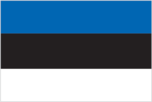
pre-1940 flag restored by Supreme Soviet in May 1990--three equal horizontal bands of blue (top), black, and white
Government type
parliamentary democracy
Independence
6 September 1991 (from Soviet Union)
International organization participation
BIS, CBSS, CCC, CE, EAPC, EBRD, ECE, EU (applicant), FAO, IAEA, IBRD, ICAO, ICFTU, ICRM, IFC, IFRCS, IHO, ILO, IMF, IMO, Interpol, IOC, ISO (correspondent), ITU, OPCW, OSCE, PFP, UN, UNCTAD, UNESCO, UNMIBH, UNTSO, UPU, WEU (associate partner), WHO, WIPO, WMO, WTrO (applicant) Diplomatic representation in the US: chief of mission: Ambassador Grigore-Kaleu STOICESCU chancery: 2131 Massachusetts Avenue NW, Washington, DC 20008 consulate(s) general: New York Diplomatic representation from the US: chief of mission: Ambassador Melissa WELLS embassy: Kentmanni 20, Tallinn EE 0001 mailing address: use embassy street address
Judicial branch
National Court, chairman appointed by Parliament for life Political parties and leaders: Coalition Party and Rural Union or SAVISAAR, chairman]; Union of Pro Patria or Fatherland League ANDREJEV] made up of two parties: United People's Party and the Russian Party of Estonia; note--Our Home is Estonia split when two Russian Party of Estonia members withdrew; United People's Party parties: Social Democratic Party or ESDP and Rural Center Party or VEIDEMANN, chairwoman] (created by defectors from Center Party in late spring 1996, Development Party faction split and now holds five
Legal system
based on civil law system; no judicial review of legislative acts
Legislative branch
unicameral Parliament or Riigikogu (101 seats; members are elected by popular vote to serve four-year terms) elections: last held 5 March 1995 (next to be held 7 March 1999) election results: percent of vote by party--KMU 32.22%, RE 16.18%, K 14.17%, Pro Patria and ERSP 7.85%, M 5.98%, Our Home is Estonia and Right-Wingers 5.0%; seats by party--KMU 41, RE 19, K 16, Pro Patria 8, Our Home is Estonia 6, M 6, Right-Wingers 5
National holiday
Independence Day, 24 February (1918)
Suffrage
18 years of age; universal for all Estonian citizens
Economy
Agriculture--products
potatoes, fruits, vegetables; livestock and dairy products; fish
Budget
revenues: $1.37 billion expenditures: $1.37 billion, including capital expenditures of $NA (1997 est.)
Currency
1 Estonian kroon (EEK) = 100 cents
Debt--external
$270 million (January 1996)
Economic aid--recipient
$137.3 million (1995)
Economy--overview
Estonia's continued adherence to market reforms, disciplined fiscal and monetary policies, and a liberal free trade regime resulted in GDP growth in 1998 of 5.5% and a decrease in inflation to 6.5% from 11.2% in 1997. A high but slightly decreased current account deficit was estimated at 8.6%. The fall in GDP growth is largely due to the impact of Russia's financial crisis and reduced investment in emerging markets in the wake of the Asian financial crisis. Like other small emerging markets, Estonia will face difficulties in 1999 as a result of continuing fallout from Asia. Key events of 1998 were the start of official EU accession talks, banking sector consolidation--nine banks were reduced to five--and the important role that Swedish capital played in the large banks (Swedbank's acquisition of a majority stake in Hansapank has accounted for the large increase in foreign direct investment). The IMF urged Estonia to maintain a stable economy and good reputation in international markets and to avoid populist policies in the run-up to March 1999 parliamentary elections. The government completed restructuring of state-controlled Estonian Telecom, the sale of 49% of which will be the flagship privatization in 1999 and the largest public equity transaction in the Baltics. Estonia expects to join the World Trade Organization in 1999.
Electricity--consumption
5.581 billion kWh (1997)
Electricity--exports
1.2 billion kWh (1997)
Electricity--imports
210 million kWh (1997)
Electricity--production
8.065 billion kWh (1996)
Electricity--production by source
fossil fuel: 99.96% hydro: 0.04% nuclear: 0% other: 0% (1996)
Exchange rates
krooni (EEK) per US$1--13.473 (January 1999), 14.075 (1998), 13.882 (1997), 12.034 (1996), 11.465 (1995), 12.991 (1994); note--krooni are tied to the German deutsche mark at a fixed rate of 8 to 1
Exports
$2.6 billion (f.o.b., 1998)
Exports--commodities
machinery and equipment 17%, textiles 16%, food products 8%, transport equipment 8%, mineral products 8%, chemical products 8% (1997)
Exports--partners
Finland, Russia, Sweden, Germany, Latvia (1997)
Fiscal year
calendar year
GDP
purchasing power parity--$7.8 billion (1998 est.)
GDP--composition by sector
agriculture: 6.2% industry: 24.3% services: 69.5% (1997 est.)
GDP--per capita
purchasing power parity?$5,500 (1998 est.)
GDP--real growth rate
5.5% (1998 est.)
Household income or consumption by percentage share
lowest 10%: 3.2% highest 10%: 28.5% (1996)
Imports
$3.9 billion (c.i.f., 1998)
Imports--commodities
machinery and equipment 21%, transport equipment 12%, foodstuffs 10%, minerals 9%, textiles 8%, metals 8%, chemical products 8% (1997)
Imports--partners
Finland, Germany, Russia, Sweden, Japan, US (1997)
Industrial production growth rate
3% (1996 est.)
Industries
oil shale, shipbuilding, phosphates, electric motors, excavators, cement, furniture, clothing, textiles, paper, shoes, apparel
Inflation rate (consumer prices)
6.5% (1998 est.)
Labor force
717,000 (1997 est.)
Labor force--by occupation
industry 42%, agriculture and forestry 11%, services 47% (1996 est.)
Population below poverty line
6.3% (1994 est.)
Unemployment rate
9.6% (1998 est.)
Communications
Radio broadcast stations
27 commercial broadcast stations, 1 government broadcast station (1997); note--by law 51% of shows must be produced within the EU; equal air time must be given to all candidates during elections by public and private stations
Radios
1.12 million (1997 est.)
Telephone system
the Ministry of Transportation and Communications (MOTC) administers Estonia's telephone system; Internet services available throughout most of the country; about 150,000 unfilled subscriber requests domestic: local--cellular phones services are growing and expanding to develop rural networks under direction of the MOTC; intercity--Estonia has a highly developed fiber-optic backbone (double loop) system presently serving at least 16 major cities (1998) international: foreign investment in the form of joint business ventures greatly improved Estonia's telephone service; fiber-optic cables to Finland, Sweden, Latvia, and Russia provide worldwide packet switched service
Telephones
531,000 (1997)
Television broadcast stations
7 (1997); note--Ministry of Culture administers television licensing; mainly Estonian, European, and Russian programming; by law 51% of shows must be produced within the EU; equal air time must be given to all candidates during elections by public and private stations
Televisions
1.132 million (1997 est.)
Transportation
Airports
5 (1997 est.) Airports--with paved runways: total: 5 over 3,047 m: 1 2,438 to 3,047 m: 1 914 to 1,523 m: 3 (1997 est.)
Highways
total: 16,437 km paved: 8,343 km (including 65 km of expressways) unpaved: 8,094 km (1997 est.)
Merchant marine
total: 52 ships (1,000 GRT or over) totaling 337,163 GRT/348,749 DWT ships by type: bulk 4, cargo 22, combination bulk 1, container 5, oil tanker 2, roll-on/roll-off cargo 12, short-sea passenger 6 (1998 est.)
Pipelines
natural gas 420 km (1992) Ports and harbors: Haapsalu, Kunda, Muuga, Paldiski, Parnu, Tallinn
Railways
total: 1,018 km common carrier lines only; does not include dedicated industrial lines broad gauge: 1,018 km 1.520-m gauge (132 km electrified) (1995)
Waterways
320 km perennially navigable
Military and Security
Military branches
Ground Forces, Navy/Coast Guard, Air and Air Defense Force (not officially sanctioned), Maritime Border Guard, Volunteer Defense League (Kaitseliit), Security Forces (internal and border troops)
Military expenditures--dollar figure
$70 million (1999)
Military expenditures--percent of GDP
1.2% (1999)
Military manpower--availability
males age 15-49: 349,263 (1999 est.) Military manpower--fit for military service: males age 15-49: 274,276 (1999 est.)
Military manpower--military age
18 years of age
Military manpower--reaching military age annually
males: 10,503 (1999 est.)
Transnational Issues
Disputes--international
Estonian and Russian negotiators reached a technical border agreement in December 1996 which has not been ratified
Illicit drugs
transshipment point for opiates and cannabis from Southwest Asia and the Caucasus via Russia, and cocaine from Latin America to Western Europe and Scandinavia; possible precursor manufacturing and/or trafficking