1998 Edition
CIA World Factbook 1998 (Internet Archive)
Geography
Area
total: 45,226 sq km land: 43,211 sq km water: 2,015 sq km note: includes 1,520 islands in the Baltic Sea
Area-comparative
slightly smaller than New Hampshire and Vermont combined
Climate
maritime, wet, moderate winters, cool summers
Coastline
3,794 km
Elevation extremes
lowest point: Baltic Sea 0 m highest point: Suur Munamagi 318 m
Environment-current issues
air heavily polluted with sulfur dioxide from oil-shale burning power plants in northeast; contamination of soil and groundwater with petroleum products, chemicals at former Soviet military bases; Estonia has more than 1,400 natural and manmade lakes, the smaller of which in agricultural areas are heavily affected by organic waste; coastal sea water is polluted in many locations
Environment-international agreements
party to: Biodiversity, Climate Change, Endangered Species, Hazardous Wastes, Ship Pollution, Ozone Layer Protection, Wetlands signed, but not ratified: none of the selected agreements
Geographic coordinates
59 00 N, 26 00 E
Irrigated land
110 sq km (1993 est.)
Land boundaries
total: 633 km border countries: Latvia 339 km, Russia 294 km
Land use
arable land: 22% permanent crops: 0% permanent pastures: 11% forests and woodland: 31% other: 36% (1993 est.)
Location
Eastern Europe, bordering the Baltic Sea and Gulf of Finland, between Latvia and Russia
Map references
Europe
Maritime claims
exclusive economic zone: limits to be fixed in coordination with neighboring states territorial sea: 12 nm
Natural hazards
flooding occurs frequently in the spring
Natural resources
shale oil (kukersite), peat, phosphorite, amber, cambrian blue clay
Terrain
marshy, lowlands
People and Society
Age structure
0-14 years: 19% (male 136,278; female 131,480) 15-64 years: 67% (male 456,796; female 492,946) 65 years and over: 14% (male 66,261; female 137,574) (July 1998 est.)
Birth rate
9.04 births/1,000 population (1998 est.)
Death rate
14.15 deaths/1,000 population (1998 est.)
Ethnic groups
Estonian 64.2%, Russian 28.7%, Ukrainian 2.7%, Byelorussian 1.5%, Finn 1%, other 1.9% (1995)
Infant mortality rate
13.98 deaths/1,000 live births (1998 est.)
Languages
Estonian (official), Russian, Ukrainian, other
Life expectancy at birth
total population: 68.52 years male: 62.5 years female: 74.83 years (1998 est.)
Literacy
definition: age 15 and over can read and write total population: 100% male: 100% female: 100% (1989 est.)
Nationality
noun: Estonian(s) adjective: Estonian
Net migration rate
-4.76 migrant(s)/1,000 population (1998 est.)
Population
1,421,335 (July 1998 est.)
Population growth rate
-0.99% (1998 est.)
Religions
Evangelical Lutheran, Russian Orthodox, Estonian Orthodox, others include Baptist, Methodist, 7th Day Adventist, Roman Catholic, Pentecostal, Word of Life, 7th Day Baptist, Judaism
Sex ratio
at birth: 1.05 male(s)/female under 15 years: 1.03 male(s)/female 15-64 years: 0.92 male(s)/female 65 years and over: 0.48 male(s)/female (1998 est.)
Total fertility rate
1.29 children born/woman (1998 est.)
Government
Administrative divisions
15 counties (maakonnad, singular-maakond): Harjumaa (Tallinn), Hiiumaa (Kardla), Ida-Virumaa (Johvi), Jarvamaa (Paide), Jogevamaa (Jogeva), Laanemaa (Haapsalu), Laane-Virumaa (Rakvere), Parnumaa (Parnu), Polvamaa (Polva), Raplamaa (Rapla), Saaremaa (Kuessaare), Tartumaa (Tartu), Valgamaa (Valga), Viljandimaa (Viljandi), Vorumaa (Voru) note: administrative divisions have the same names as their administrative centers (exceptions have the administrative center name following in parentheses)
Constitution
adopted 28 June 1992
Country name
conventional long form: Republic of Estonia conventional short form: Estonia local long form: Eesti Vabariik local short form: Eesti former: Estonian Soviet Socialist Republic
Data code
EN
Executive branch
chief of state: President Lennart MERI (since 5 October 1992) head of government: Prime Minister Mart SIIMANN (since 12 March 1997) cabinet: Council of Ministers appointed by the prime minister, approved by Parliament elections: president elected by Parliament for a five-year term; if he or she does not secure two-thirds of the votes after 3 rounds of balloting, then an electoral assembly (made up of Parliament plus members of local governments) elects the president, choosing between the two candidates with the largest percentage of votes; election last held August-September 1996 (next to be held fall 2001); prime minister nominated by the president and approved by Parliament election results: Lennart MERI elected president by an electoral assembly after Parliament was unable to break a deadlock between MERI and RUUTEL; percent of electoral assembly vote-Lennert MERI 61%, Arnold RUUTEL 39%
FAX
- [1] (202) 588-0108 consulate(s) general: New York Diplomatic representation from the US: chief of mission: Ambassador (vacant); Charge d'Affaires Walter ANDRUSYSZYU embassy: Kentmanni 20, Tallinn EE 0001 mailing address: American Embassy Tallinn; PSC 78, Box T; APO AE 09723 telephone: [372] (6) 312-021
- [372] (6) 312-025
Flag description
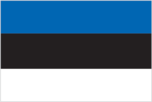
pre-1940 flag restored by Supreme Soviet in May 1990-three equal horizontal bands of blue (top), black, and white
Government type
parliamentary democracy
Independence
6 September 1991 (from Soviet Union)
International organization participation
BIS, CBSS, CCC, CE, EAPC, EBRD, ECE, EU (applicant), FAO, IAEA, IBRD, ICAO, ICFTU, ICRM, IFC, IFRCS, IHO (pending member), ILO, IMF, IMO, Interpol, IOC, ISO (correspondent), ITU, OSCE, PFP, UN, UNCTAD, UNESCO, UNMIBH, UNTSO, UPU, WEU (associate partner), WHO, WIPO, WMO, WTrO (applicant) Diplomatic representation in the US: chief of mission: Ambassador Grigore-Kalev STOICESCU chancery: 2131 Massachusetts Avenue NW, Washington, DC 20008 telephone: [1] (202) 588-0101
Judicial branch
National Court, chairman appointed by the Parliament for life Political parties and leaders: Coalition Party and Rural Union or KMU [Mart SIIMAN, chairman] made up of 4 parties: Coalition Party or EK, Country People's Party [Arnold RUUTEL, chairman]/Farmer's Assembly or EME, Rural Union or EM [Arvo SIRENDI, chairman] , and Pensioners' and Families' League or EPPL [Mai TREIAL, chairperson]; Reform Party or RE [Siim KALLAS, chairman]; Center Party or K [Edgar SAVISAAR, chairman]; Union of Pro Patria or Fatherland League (Isamaaliit) [Toivo JURGENSON, chairman]; National Independence Party or ERSP [Tunne KELAM, chairman]; Our Home is Estonia [Viktor ANDREJEV] made up of two parties: United Peoples Party and the Russian Party of Estonia; note-Our Home is Estonia split when two Russian Party of Estonia members withdrew; United Peoples Party [Viktor ANDREJEV, chairman]; Russian Party of Estonia [Nikolai MASPANOV, chairman]; Moderates or M [Andres TARAND] made up of two parties: Social Democratic Party or ESDP and Rural Center Party or EMK; Social Democratic Party [Eiki NESTOR, chairman]; Rural Center Party [Vambo KAAL, chairman]; Right-Wingers [Ulo NUGIS, chairman]; Republican Conservative [Vootele HANSEN]; Development/Progressive Party [Andra VEIDEMANN, chairwoman], note-party was created by defectors from Center Party in late spring 1996, Development Party faction split and now holds five independent seats
Legal system
based on civil law system; no judicial review of legislative acts
Legislative branch
unicameral Parliament or Riigikogu (101 seats; members are elected by popular vote to serve four-year terms) elections: last held 5 March 1995 (next to be held NA March 1999) election results: percent of vote by party-KMU 32.22%, RE 16.18%, K 14.17%, Pro Patria and ERSP 7.85%, M 5.98%, Our Home is Estonia and Right-Wingers 5.0%; seats by party-KMU 41, RE 19, K 16, Pro Patria 8, Our Home is Estonia 6, M 6, Right-Wingers 5
National capital
Tallinn
National holiday
Independence Day, 24 February (1918)
Suffrage
18 years of age; universal for all Estonian citizens
Economy
Agriculture-products
potatoes, fruits, vegetables; livestock and dairy products; fish
Budget
revenues: $1.7 billion expenditures: $1.8 billion, including capital expenditures of $214 million (1996 est.)
Currency
1 Estonian kroon (EEK) = 100 cents (introduced in August 1992)
Debt-external
$270 million (January 1996)
Economic aid
recipient: ODA, $147 million (1993) note: Western commitments $285 million (including international financial institutions)
Economy-overview
In 1997 Estonia's continued implementation of market economic reforms, disciplined fiscal and monetary policies, and a liberal free trade regime resulted in GDP growth of 10% and a drop in inflation to 11.2%. Estonia can point to its inclusion among the first group of Central and East European countries to begin EU accession talks in 1998 as its most significant economic achievement in 1997. Other economic strengths include solid investment grade rating from both Standard and Poors and Moody's, government revenue collection in excess of projections by more than 6%, growth in exports at a faster rate than imports, and record levels of foreign direct investment, among the highest per capita in Central and East Europe. Estonia privatized its shipping company in 1997, but failed to make as much progress privatizing other large infrastructure/utility companies, such as Eesti Energia and the Oil Shale company, which it plans to privatize in the next two years. The growing current account deficit, which stood at nearly 10% of GDP at yearend 1997, remains a serious concern. In 1998, GDP is expected to grow by 5.5% and inflation to fall 10%.
Electricity-capacity
3.287 million kW (1995)
Electricity-consumption per capita
4,355 kWh (1995)
Electricity-production
8.083 billion kWh (1995)
Exchange rates
krooni (EEK) per US$1-14.527 (January 1998), 13.882 (1997), 12.034 (1996), 11.465 (1995), 12.991 (1994), 13.223 (1993); note-krooni are tied to the German deutsche mark at a fixed rate of 8 to 1
Exports
total value: $2 billion (f.o.b., 1996) commodities: textiles 16%, food products 16%, machinery and equipment 16%, metals 9% (1995) partners: Finland, Russia, Sweden, Germany, Latvia (1995)
Fiscal year
calendar year Communications
GDP
purchasing power parity-$9.34 billion (1997 est.)
GDP-composition by sector
agriculture: 7.1% industry: 24.9% services: 68% (1995 est.)
GDP-per capita
purchasing power parity-$6,450 (1997 est.)
GDP-real growth rate
10% (1997 est.)
Imports
total value: $3.2 billion (c.i.f., 1996) commodities: machinery and equipment 29%, foodstuffs 14%, minerals 13%, textiles 13%, metals 12% (1995) partners: Finland, Russia, Sweden, Germany (1995)
Industrial production growth rate
3% (1996 est.)
Industries
oil shale, shipbuilding, phosphates, electric motors, excavators, cement, furniture, clothing, textiles, paper, shoes, apparel
Inflation rate-consumer price index
11.2% (1997 est.)
Labor force
total: 785,000 (1996 est.) by occupation: industry and construction 42%, agriculture and forestry 20%, other 38% (1990)
Radio broadcast stations
3 commercial broadcast stations, 1 government broadcast station (1994)
Radios
710,000 (1992 est.)
Telephone system
system is antiquated; improvements are being made piecemeal, with emphasis on business needs and international connections; there are still about 150,000 unfulfilled requests for subscriber service domestic: substantial investment has been made in cellular systems which are operational throughout Estonia international: international traffic is carried to the other former Soviet republics by landline or microwave radio relay and to other countries partly by leased connection to the Moscow international gateway switch and partly by a new Tallinn-Helsinki fiber-optic, submarine cable which gives Estonia access to international circuits everywhere; access to the international packet-switched digital network via Helsinki
Telephones
400,000 (1994 est.)
Television broadcast stations
4 (1993) note: provide Estonian programs as well as Moscow Ostenkino's first and second programs
Televisions
600,000 (1993 est.)
Unemployment rate
3.6% (1997 est.)
Transportation
Airports
5 (1997 est.) Airports-with paved runways: total: 5 over 3,047 m: 1 2,438 to 3,047 m : 1 914 to 1,523 m: 3 (1997 est.)
Highways
total: 15,304 km paved: 8,142 km (including 65 km of expressways) unpaved: 7,162 km (1996 est.)
Merchant marine
total: 53 ships (1,000 GRT or over) totaling 368,340 GRT/455,696 DWT ships by type: bulk 6, cargo 27, combination bulk 1, container 5, oil tanker 2, roll-on/roll-off cargo 7, short-sea passenger 5 (1997 est.)
Pipelines
natural gas 420 km (1992) Ports and harbors: Haapsalu, Narva, Paldiski, Parnu, Tallinn
Railways
total: 1,018 km common carrier lines only; does not include dedicated industrial lines broad gauge: 1,018 km 1.520-m gauge (132 km electrified) (1995)
Waterways
500 km perennially navigable
Military and Security
Military branches
Ground Forces, Navy/Coast Guard, Air and Air Defense Force (not officially sanctioned), Maritime Border Guard, Volunteer Defense League (Kaitseliit), Security Forces (internal and border troops)
Military expenditures-dollar figure
$35 million (1995)
Military expenditures-percent of GDP
1.5% (1995)
Military manpower-availability
males age 15-49: 351,148 (1998 est.) Military manpower-fit for military service: males: 275,610 (1998 est.)
Military manpower-military age
18 years of age
Military manpower-reaching military age annually
males: 10,424 (1998 est.)
Transnational Issues
Disputes-international
Estonian and Russian negotiators reached a technical border agreement in December 1996 which has not been ratified; Estonia claimed over 2,000 sq km territory in the Narva and Pechory regions of Russia-based on boundary established under the 1920 Peace Treaty of Tartu
Historical perspective
On 28 May 1991 the Ethiopian People's Revolutionary Democratic Front (EPRDF) toppled the authoritarian government of MENGISTU Haile-Mariam and took control in Addis Ababa; a new constitution was promulgated in December 1994 and national and regional popular elections were held in May and June 1995.
Illicit drugs
transshipment point for opiates and cannabis from Southwest Asia and the Caucasus, and cocaine from Latin America to Western Europe and Scandinavia Introduction