1995 Edition
CIA World Factbook 1995 (Project Gutenberg)
Geography
Area
total area: 45,100 sq km land area: 43,200 sq km comparative area: slightly larger than New Hampshire and Vermont combined note: includes 1,520 islands in the Baltic Sea
Climate
maritime, wet, moderate winters, cool summers
Coastline
1,393 km
Environment
current issues: air heavily polluted with sulfur dioxide from oil-shale burning power plants in northeast; contamination of soil and groundwater with petroleum products, chemicals at military bases natural hazards: flooding occurs frequently in the spring international agreements: party to - Biodiversity, Climate Change, Endangered Species, Hazardous Wastes, Ship Pollution, Wetlands
International disputes
claims over 2,000 sq km of Russian territory in the Narva and Pechora regions - based on boundary established under the 1921 Peace Treaty of Tartu
Irrigated land
110 sq km (1990)
Land boundaries
total 557 km, Latvia 267 km, Russia 290 km
Land use
arable land: 22% permanent crops: 0% meadows and pastures: 11% forest and woodland: 31% other: 36%
Location
Eastern Europe, bordering the Baltic Sea and Gulf of Finland, between Latvia and Russia
Map references
Europe
Maritime claims
exclusive economic zone: limits to be fixed in coordination with neighboring states territorial sea: 12 nm
Natural resources
shale oil, peat, phosphorite, amber
Terrain
marshy, lowlands
People and Society
Age structure
0-14 years: 22% (female 174,304; male 181,101) 15-64 years: 65% (female 549,473; male 515,426) 65 years and over: 13% (female 139,722; male 65,373) (July 1995 est.)
Birth rate
13.9 births/1,000 population (1995 est.)
Death rate
11.93 deaths/1,000 population (1995 est.)
Ethnic divisions
Estonian 61.5%, Russian 30.3%, Ukrainian 3.17%, Byelorussian 1.8%, Finn 1.1%, other 2.13% (1989)
Infant mortality rate
18.7 deaths/1,000 live births (1995 est.)
Labor force
750,000 (1992) by occupation: industry and construction 42%, agriculture and forestry 20%, other 38% (1990)
Languages
Estonian (official), Latvian, Lithuanian, Russian, other
Life expectancy at birth
total population: 70.17 years male: 65.2 years female: 75.39 years (1995 est.)
Literacy
age 15 and over can read and write (1989) total population: 100% male: 100% female: 100%
Nationality
noun: Estonian(s) adjective: Estonian
Net migration rate
3.31 migrant(s)/1,000 population (1995 est.)
Population
1,625,399 (July 1995 est.)
Population growth rate
0.53% (1995 est.)
Religions
Lutheran
Total fertility rate
1.98 children born/woman (1995 est.)
Government
Administrative divisions
15 counties (maakonnad, singular - maakond): Harju maakond (Tallinn), Hiiu maakond (Kardla), Ida-Viru maakond (Johvi), Jarva maakond (Paide), Jogeva maakond (Jogeva), Laane maakond (Haapsalu), Laane-Viru maakond (Rakvere), Parnu maakond (Parnu), Polva maakond (Polva), Rapla maakond (Rapla), Saare maakond (Kuessaare), Tartu maakond (Tartu), Valga maakond (Valga), Viljandi maakond (Viljandi), Voru maakond (Voru) note: county centers are in parentheses
Capital
Tallinn
Constitution
adopted 28 June 1992
Digraph
EN
Diplomatic representation in US
chief of mission: Ambassador Toomas Hendrik ILVES chancery: 1030 15th Street NW, Washington, DC 20005, Suite 1000 telephone: [1] (202) 789-0320
Executive branch
chief of state: President Lennart MERI (since 21 October 1992); election last held 20 September 1992; (next to be held fall 1996); results - no candidate received majority; newly elected Parliament elected Lennart MERI (21 October 1992) head of government: Prime Minister Andres TARAND (since NA October 1994) cabinet: Council of Ministers; appointed by the prime minister, authorized by the legislature
FAX
- [1] (202) 789-0471 consulate(s) general: New York
- [372] (2) 312-025
Flag
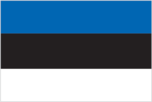
pre-1940 flag restored by Supreme Soviet in May 1990 - three equal horizontal bands of blue (top), black, and white
Independence
6 September 1991 (from Soviet Union)
Judicial branch
Supreme Court
Legal system
based on civil law system; no judicial review of legislative acts
Legislative branch
unicameral
Member of
BIS, CBSS, CCC, CE, EBRD, ECE, FAO, IAEA, IBRD, ICAO, ICFTU, ICRM, IFC, ILO, IMF, IMO, INTERPOL, IOC, ISO (correspondent), ITU, NACC, OSCE, PFP, UN, UNCTAD, UNESCO, UPU, WEU (associate partner), WHO, WIPO, WMO
Names
conventional long form: Republic of Estonia conventional short form: Estonia local long form: Eesti Vabariik local short form: Eesti former: Estonian Soviet Socialist Republic
National holiday
Independence Day, 24 February (1918)
Parliament (Riigikogu)
elections last held 5 March 1995 (next to be held NA 1998); results - KMU 32.22%, RE 16.18%, K 14.17%, Pro Patria and ERSP 7.85%, M 5.98%, Our Home is Estonia and Right-Wingers 5.0%; seats - (101 total) KMU 41, RE 19, K 16, Pro Patria 8, Our Home is Estonia 6, M 6, Right-Wingers 5
Political parties and leaders
Coalition Party and Rural Union (KMU) made up of 4 parties: Coalition Party, Country People's Party, Farmer's Assembly, and Pensioners' and Families' League; Coalition Party, Tiit VAHI, chairman; Country People's Party, Arnold RUUTEL, chairman; Farmer's Assembly, Jaak-Hans KUKS, chairman; Pensioners' and Families' League; Reform Party-Liberals (RE), Siim KALLAS, chairman; Center Party (K), Edgar SAVISAAR, chairman; Union of Pro Patria (Isaama of Fatherland), Mart LAAR, chairman; National Independence Party (ERSP), Kelam TUNNE, chairman; Our Home is Estonia made up of 2 parties: United Peoples Party and the Russian Party in Estonia; United Peoples Party, Viktor ANDREJEV, chairman; Russian Party in Estonia, Sergei KUZNETSOV, chairman; Moderates (M) made up of 2 parties: Social Democratic Party and Rural Center Party; Social Democratic Party, Eiki NESTOR, chairman; Rural Center Party, Vambo KAAL, chairman; Right-Wingers, Ulo NUGIS, chairman
Suffrage
18 years of age; universal
Type
republic
US diplomatic representation
chief of mission: (vacant); Charge d'Affaires Keith SMITH embassy: Kentmanni 20, Tallinn EE 0001 mailing address: use embassy street address telephone: [372] (2) 312-021 through 024
Economy
Agriculture
accounts for 10% of GDP; employs 20% of work force; very efficient by Soviet standards; net exports of meat, fish, dairy products, and potatoes; imports of feedgrains for livestock; fruits and vegetables
Budget
revenues: $643 million expenditures: $639 million, including capital expenditures of $NA (1993 est.)
Currency
1 Estonian kroon (EEK) = 100 cents (introduced in August 1992)
Economic aid
recipient: US commitments, including Ex-Im (1992), $10 million
Electricity
capacity: 3,420,000 kW production: 11.3 billion kWh consumption per capita: 6,528 kWh (1993)
Exchange rates
kroons (EEK) per US$1 - 12.25 (January 1995); note - kroons are tied to the German Deutschmark at a fixed rate of 8 to 1
Exports
$1.65 billion (f.o.b., 1994) commodities: textile 14%, food products 11%, vehicles 11%, metals 11% (1993) partners: Russia, Finland, Sweden, Germany
External debt
$650 million (end of 1991)
Fiscal year
calendar year
Illicit drugs
transshipment point for illicit drugs from Central and Southwest Asia and Latin America to Western Europe; very limited illicit opium producer; mostly for domestic consumption
Imports
$1 billion (c.i.f., 1994) commodities: machinery 18%, fuels 15%, vehicles 14%, textiles 10% (1993) partners: Finland, Russia, Germany, Sweden
Industrial production
growth rate -27% (1993)
Industries
oil shale, shipbuilding, phosphates, electric motors, excavators, cement, furniture, clothing, textiles, paper, shoes, apparel
Inflation rate (consumer prices)
3.3% per month (1994 average)
National product
GDP - purchasing power parity - $10.4 billion (1994 estimate as extrapolated from World Bank estimate for 1992)
National product per capita
$6,460 (1994 est.)
National product real growth rate
4% (1994 est.)
Overview
Bolstered by a widespread national desire to reintegrate into Western Europe, the Estonian government has pursued an ambitious program of market reforms and stabilization measures, which is rapidly transforming the economy. Three years after independence - and two years after the introduction of the kroon - Estonians are beginning to reap tangible benefits; inflation, though still high, was brought down to about 2% per month in second half 1994; production declines have bottomed out with estimated growth of 4% in 1994; and living standards are rising. Economic restructuring has been dramatic. By 1994 the service sector accounted for over 55% of GDP, while the once-dominant heavy industrial sector continues to shrink. The private sector is growing rapidly; the share of the state enterprises in the economy has steadily declined and by late 1994 accounted for only about 40% of GDP. Estonia's foreign trade has shifted rapidly from East to West; the Western industrialized countries now account for two-thirds of foreign trade.
Unemployment rate
about 2% in 1994 (official estimate but large number of underemployed workers)
Communications
Radio
broadcast stations: AM NA, FM NA, shortwave 0 radios: NA
Telephone system
about 400,000 telephones; 246 telephones/1,000 persons; telephone system is antiquated; improvements are being made piecemeal, with emphasis on business needs and international connections; there are still about 150,000 unfulfilled requests for telephone service local: NA intercity: NA international: international traffic is carried to the other former USSR republics by land line or microwave and to other countries partly by leased connection to the Moscow international gateway switch, and partly by a new Tallinn-Helsinki fiber optic submarine cable which gives Estonia access to international circuits everywhere; substantial investment has been made in cellular systems which are operational throughout Estonia and also Latvia and which have access to the international packet switched digital network via Helsinki
Television
broadcast stations: 3; note - provide Estonian programs as well as Moscow Ostenkino's first and second programs televisions: NA
Transportation
Airports
total: 22 with paved runways 2,438 to 3,047 m: 7 with paved runways 914 to 1,523 m: 3 with unpaved runways 2,438 to 3,047 m: 1 with unpaved runways 1,524 to 2,438 m: 2 with unpaved runways 914 to 1,523 m: 4 with unpaved runways under 914 m: 5
Highways
total: 30,300 km paved or graveled: 29,200 km unpaved: earth 1,100 km (1990)
Inland waterways
500 km perennially navigable
Merchant marine
total: 65 ships (1,000 GRT or over) totaling 415,332 GRT/532,749 DWT ships by type: bulk 6, cargo 44, container 2, oil tanker 2, roll-on/roll-off cargo 7, short-sea passenger 4
Pipelines
natural gas 420 km (1992)
Ports
Haapsalu, Narva, Novotallin, Paldiski, Parnu, Tallinn
Railroads
total: 1,030 km common carrier lines only; does not include dedicated industrial lines broad gauge: 1,030 km 1.520-m gauge (1990)
Military and Security
Branches
Ground Forces, Navy, Air and Air Defense Force (not officially sanctioned), Maritime Border Guard, Volunteer Defense League (Kaitseliit), Security Forces (internal and border troops), Coast Guard
Defense expenditures
exchange rate conversion - $34.1 million, almost 5% of the overall State budget and 1.5% of GDP (1995) ________________________________________________________________________ ETHIOPIA
Manpower availability
males age 15-49 396,588; males fit for military service 311,838; males reach military age (18) annually 11,915 (1995 est.)