1993 Edition
CIA World Factbook 1993 (Project Gutenberg)
Geography
Area
total area: 45,100 km2 land area: 43,200 km2 comparative area: slightly larger than New Hampshire and Vermont combined note: includes 1,520 islands in the Baltic Sea
Climate
maritime, wet, moderate winters
Coastline
1,393 km
Environment
air heavily polluted with sulphur dioxide from oil-shale burning power plants in northeast; radioactive wastes dumped in open reservoir in Sillamae, a few dozen meters from Baltic Sea; contamination of soil and ground water with petroleum products, chemicals at military bases
International disputes
international small border strips along the northern (Narva) and southern (Petseri) sections of eastern border with Russia ceded to Russia in 1945 by the Estonian SSR
Irrigated land
110 km2 (1990)
Land boundaries
total 557 km, Latvia 267 km, Russia 290 km
Land use
arable land: 22% permanent crops: 0% meadows and pastures: 11% forest and woodland: 31% other: 36%
Location
Northeastern Europe, bordering the Baltic Sea, between Sweden and Russia
Map references
Arctic Region, Asia, Europe, Standard Time Zones of the World
Maritime claims
territorial sea: 12 nm
Natural resources
shale oil, peat, phosphorite, amber
Terrain
marshy, lowlands
People and Society
Birth rate
14.05 births/1,000 population (1993 est.)
Death rate
12.13 deaths/1,000 population (1993 est.)
Ethnic divisions
Estonian 61.5%, Russian 30.3%, Ukrainian 3.17%, Belarusian 1.8%, Finn 1.1%, other 2.13% (1989)
Infant mortality rate
19.5 deaths/1,000 live births (1993 est.)
Labor force
796,000 by occupation: industry and construction 42%, agriculture and forestry 20%, other 38% (1990)
Languages
Estonian (official), Latvian, Lithuanian, Russian, other
Life expectancy at birth
total population: 69.75 years male: 64.75 years female: 74.99 years (1993 est.)
Literacy
age 9-49 can read and write (1970) total population: 100% male: 100% female: 100%
Nationality
noun: Estonian(s) adjective: Estonian
Net migration rate
3.28 migrant(s)/1,000 population (1993 est.)
Population
1,608,469 (July 1993 est.)
Population growth rate
0.52% (1993 est.)
Religions
Lutheran
Total fertility rate
2.01 children born/woman (1993 est.)
Government
Administrative divisions
none (all districts are under direct republic jurisdiction)
Capital
Tallinn
Chief of State
President Lennart MERI (since NA October 1992)
Congress of Estonia
last held March 1990 (next to be held NA); note - Congress of Estonia was a quasi-governmental structure which disbanded itself October 1992 after the new Parliament and government were installed
Constitution
adopted 28 June 1992
Digraph
EN
Diplomatic representation in US
chief of mission: Ambassador Toomas Hendrik IIVES chancery: (temporary) 630 Fifth Avenue, Suite 2415, New York, NY 10111 telephone: (212) 247-2131 consulate general: New York
Executive branch
president, prime minister, cabinet
Flag
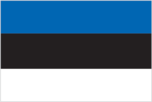
pre-1940 flag restored by Supreme Soviet in May 1990 - three equal horizontal bands of blue (top), black, and white
Head of Government
Prime Minister Mart LAAR (since NA October 1992)
Independence
6 September 1991 (from Soviet Union)
Judicial branch
Supreme Court
Legal system
based on civil law system; no judicial review of legislative acts
Legislative branch
unicameral Parliament (Riigikogu)
Member of
CBSS, CSCE, EBRD, ECE, FAO, IAEA, IBRD, ICAO, ICFTU, ILO, IMF, IMO, NACC, UN, UNCTAD, UNESCO, UPU
Names
conventional long form: Republic of Estonia conventional short form: Estonia local long form: Eesti Vabariik local short form: Eesti former: Estonian Soviet Socialist Republic
National holiday
Independence Day, 24 February (1918)
Parliament
last held 20 September 1992; (next to be held NA); results - Fatherland 21%, Safe Home 14%, Popular Front 13%, Moderates 10%, Estonian National Independence Party 8%, Royalists 7%, Estonian Citizen 7%, Estonian Entrepreneurs 2%, other 18%; seats - (101 total) Fatherland 29, Safe Home 18, Popular Front 15, Moderates 12, ENIP 10, Royalists 8, Estonian Citizen 8, Estonian Entrepreneurs 1
Political parties and leaders
Popular Front of Estonia (Rahvarinne), NA chairman; Estonian Christian Democratic Party, Aivar KALA, chairman; Estonian Christian Democratic Union, Illar HALLASTE, chairman; Estonian Heritage Society (EMS), Trivimi VELLISTE, chairman; Estonian National Independence Party (ENIP), Lagle PAREK, chairman; Estonian Social Democratic Party, Marju LAURISTIN, chairman; Estonian Green Party, Tonu OJA; Independent Estonian Communist Party, Vaino VALJAS; People's Centrist Party, Edgar SAVISAAR, chairman; Estonian Royalist Party (ERP), Kalle KULBOK, chairman; Entrpreneurs' Party (EP), Tiit MADE; Estonian Fatherland Party, Mart LAAR, chairman; Safe Home; Moderates; Estonian Citizen
President
last held 20 September 1992; (next to be held NA); results - no candidate received majority; newly elected Parliament elected Lennart MERI (NA October 1992)
Suffrage
18 years of age; universal
Type
republic
US diplomatic representation
chief of mission: Ambassador Robert C. FRASURE embassy: Kentmanni 20, Tallin EE 0001 mailing address: use embassy street address telephone: 011-[358] (49) 303-182 (cellular) FAX: [358] (49) 306-817 (cellular) note: dialing to Baltics still requires use of an international operator unless you use the cellular phone lines
Economy
Agriculture
employs 20% of work force; very efficient; net exports of meat, fish, dairy products, and potatoes; imports of feedgrains for livestock; fruits and vegetables
Budget
revenues $223 million; expenditures $142 million, including capital expenditures of $NA (1992)
Currency
1 Estonian kroon (EEK) = 100 NA; (introduced in August 1992)
Economic aid
US commitments, including Ex-Im (1992), $10 million
Electricity
3,700,000 kW capacity; 22,900 million kWh produced, 14,245 kWh per capita (1992)
Exchange rates
kroons (EEK) per US$1 - 12 (January 1993)
Exports
$NA commodities: textile 11%, wood products and timber 9%, dairy products 9% partners: Russia and the other former Soviet republics 50%, West 50% (1992)
External debt
$650 million (end of 1991)
Fiscal year
calendar year
Illicit drugs
transshipment point for illicit drugs from Central and Southwest Asia to Western Europe; limited illicit opium producer; mostly for domestic production
Imports
$NA commodities: machinery 45%, oil 13%, chemicals 12% partners: Finland 15%, Russia 18%
Industrial production
growth rate -40% (1992)
Industries
accounts for 30% of labor force; oil shale, shipbuilding, phosphates, electric motors, excavators, cement, furniture, clothing, textiles, paper, shoes, apparel
Inflation rate (consumer prices)
1%-2% per month (first quarter 1993)
National product
GDP $NA
National product per capita
$NA
National product real growth rate
-30% (1992 est.)
Overview
As of June 1993 Estonia ranks first among the 15 former Soviet republics in moving from its obsolete command economy to a modern market economy. Yet serious problems remain. In contrast to the estimated 30% drop in output in 1992, GDP should grow by a small percent in 1993. Of key importance has been the introduction of the kroon in August 1993 and the subsequent reductions in inflation to 1%-2% per month. Starting in July 1991, under a new law on private ownership, small enterprises, such as retail shops and restaurants, were sold to private owners. The auctioning of large-scale enterprises is progressing with the proceeds being held in escrow until the prior ownership (that is, Estonian or the Commonwealth of Independent States) can be established. Estonia ranks first in per capita consumption among the former Soviet republics. Agriculture is well developed, especially meat production, and provides a surplus for export. Only about one-fifth of the work force is in agriculture. The major share of the work force engages in manufacturing both capital and consumer goods based on raw materials and intermediate products from the other former Soviet republics. These manufactures are of high quality by ex-Soviet standards and are exported to the other republics. Estonia's mineral resources are limited to major deposits of shale oil (60% of the old Soviet total) and phosphorites (400 million tons). Estonia has a large, relatively modern port and produces more than half of its own energy needs at highly polluting shale oil power plants. It has advantages in the transition, not having suffered so long under the Soviet yoke and having better chances of developing profitable ties to the Nordic and West European countries. Like Latvia, but unlike Lithuania, the large portion of ethnic Russians (30%) in the population poses still another difficulty in the transition to an independent market economy.
Unemployment rate
3% (March 1993); but large number of underemployed workers
Communications
Airports
total: 29 useable: 18 with permanent-surface runways: 11 with runways over 3,659 m: with runways 2,440-3,659 m: 10 with runways 1,220-2,439 m: 8
Highways
30,300 km total (1990); 29,200 km hard surfaced; 1,100 km earth
Inland waterways
500 km perennially navigable
Merchant marine
68 ships (1,000 GRT or over) totaling 394,501 GRT/526,502 DWT; includes 52 cargo, 6 roll-on/roll-off, 2 short-sea passenger, 6 bulk, 2 container
Pipelines
natural gas 420 km (1992)
Ports
coastal - Tallinn, Novotallin, Parnu; inland - Narva
Railroads
1,030 km (includes NA km electrified); does not include industrial lines (1990)
Telecommunications
300,000 telephone subscribers in 1990 with international direct dial service available to Finland, Germany, Austria, UK and France; 21 telephone lines per 100 persons as of 1991; broadcast stations - 3 TV (provide Estonian programs as well as Moscow Ostenkino's first and second programs); international traffic is carried to the other former USSR republics by landline or microwave and to other countries by leased connection to the Moscow international gateway switch via 19 incoming/20 outgoing international channels, by the Finnish cellular net, and by an old copper submarine cable to Finland soon to be replaced by an undersea fiber optic cable system; there is also a new international telephone exchange in Tallinn handling 60 channels via Helsinki; 2 analog mobile cellular networks with international roaming capability to Scandinavia are operating in major cities
Military and Security
Branches
Ground Forces, Maritime Border Guard, National Guard (Kaitseliit), Security Forces (internal and border troops)
Defense expenditures
124.4 million kroons, NA% of GDP (forecast for 1993); note - conversion of the military budget into US dollars using the current exchange rate could produce misleading results
Manpower availability
males age 15-49 387,733; fit for military service 306,056; reach military age (18) annually 11,570 (1993 est.)