1999 Edition
CIA World Factbook 1999 (Internet Archive)
Introduction
Background
On 29 May 1991, ISAIAS Afworki, secretary general of the People's Front for Democracy and Justice (PFDJ), which then served as the country's legislative body, announced the formation of the Provisional Government in Eritrea (PGE) in preparation for the 23-25 April 1993 referendum on independence from Ethiopia. The referendum resulted in a landslide vote for independence, which became effective on 24 May 1993.
Geography
Area
total: 121,320 sq km land: 121,320 sq km water: 0 sq km
Area--comparative
slightly larger than Pennsylvania
Climate
hot, dry desert strip along Red Sea coast; cooler and wetter in the central highlands (up to 61 cm of rainfall annually); semiarid in western hills and lowlands; rainfall heaviest during June-September except on coastal desert
Coastline
2,234 km total; mainland on Red Sea 1,151 km, islands in Red Sea 1,083 km
Elevation extremes
lowest point: near Kulul within the Denakil depression -75 m highest point: Soira 3,018 m
Environment--current issues
deforestation; desertification; soil erosion; overgrazing; loss of infrastructure from civil warfare
Environment--international agreements
party to: Biodiversity, Climate Change, Desertification, Endangered Species signed, but not ratified: none of the selected agreements
Geographic coordinates
15 00 N, 39 00 E
Geography--note
strategic geopolitical position along world's busiest shipping lanes; Eritrea retained the entire coastline of Ethiopia along the Red Sea upon de jure independence from Ethiopia on 27 April 1993
Irrigated land
280 sq km (1993 est.)
Land boundaries
total: 1,630 km border countries: Djibouti 113 km, Ethiopia 912 km, Sudan 605 km
Land use
arable land: 12% permanent crops: 1% permanent pastures: 48% forests and woodland: 20% other: 19% (1993 est.)
Location
Eastern Africa, bordering the Red Sea, between Djibouti and Sudan
Map references
Africa
Maritime claims
NA
Natural hazards
frequent droughts
Natural resources
gold, potash, zinc, copper, salt, probably oil and natural gas (currently under exploration), fish
Terrain
dominated by extension of Ethiopian north-south trending highlands, descending on the east to a coastal desert plain, on the northwest to hilly terrain and on the southwest to flat-to-rolling plains
People and Society
Age structure
0-14 years: 43% (male 859,899; female 852,329) 15-64 years: 54% (male 1,061,921; female 1,078,102) 65 years and over: 3% (male 67,969; female 64,503) (1999 est.)
Birth rate
42.56 births/1,000 population (1999 est.)
Death rate
12.32 deaths/1,000 population (1999 est.)
Ethnic groups
ethnic Tigrinya 50%, Tigre and Kunama 40%, Afar 4%, Saho (Red Sea coast dwellers) 3%
Infant mortality rate
76.84 deaths/1,000 live births (1999 est.)
Languages
Afar, Amharic, Arabic, Tigre and Kunama, Tigrinya, minor ethnic group languages
Life expectancy at birth
total population: 55.74 years male: 53.61 years female: 57.95 years (1999 est.)
Literacy
NA
Nationality
noun: Eritrean(s) adjective: Eritrean
Net migration rate
8.53 migrant(s)/1,000 population (1999 est.) note: it is estimated that approximately 315,000 Eritrean refugees were still living in Sudan by the end of 1997 according to the UNHCR
Population
3,984,723 (July 1999 est.)
Population growth rate
3.88% (1999 est.)
Religions
Muslim, Coptic Christian, Roman Catholic, Protestant
Sex ratio
at birth: 1.03 male(s)/female under 15 years: 1.01 male(s)/female 15-64 years: 0.98 male(s)/female 65 years and over: 1.05 male(s)/female total population: 1 male(s)/female (1999 est.)
Total fertility rate
5.96 children born/woman (1999 est.)
Government
Administrative divisions
8 provinces (singular--awraja); Akale Guzay, Barka, Denkel, Hamasen, Sahil, Semhar, Senhit, Seraye note: in May 1995 the National Assembly adopted a resolution stating that the administrative structure of Eritrea, which had been established by former colonial powers, would consist of only six provinces when the new constitution, then being drafted, became effective in 1997; the new provinces, the names of which had not been recommended by the US Board on Geographic Names for recognition by the US Government, pending acceptable definition of the boundaries, were: Anseba, Debub, Debubawi Keyih Bahri, Gash-Barka, Maakel, and Semanawi Keyih Bahri; more recently, it has been reported that these provinces have been redesignated regions and renamed Southern Red Sea, Northern Red Sea, Anseba, Gash-Barka, Southern, and Central
Capital
Asmara (formerly Asmera)
Constitution
the transitional constitution, decreed on 19 May 1993, was replaced by a new constitution that was promulgated in May 1997
Country name
conventional long form: State of Eritrea conventional short form: Eritrea local long form: Hagere Ertra local short form: Ertra former: Eritrea Autonomous Region in Ethiopia
Data code
ER
Executive branch
chief of state: President ISAIAS Afworki (since 8 June 1993); note--the president is both the chief of state and head of government head of government: President ISAIAS Afworki (since 8 June 1993); note--the president is both the chief of state and head of government cabinet: State Council is the collective executive authority note: the president is head of the State Council and National Assembly elections: president elected by the National Assembly; election last held 8 June 1993 (next to be held NA) election results: ISAIAS Afworki elected president; percent of National Assembly vote--ISAIAS Afworki 95%
Flag description
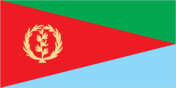
red isosceles triangle (based on the hoist side) dividing the flag into two right triangles; the upper triangle is green, the lower one is blue; a gold wreath encircling a gold olive branch is centered on the hoist side of the red triangle
Government type
transitional government note: following a successful referendum on independence for the Autonomous Region of Eritrea on 23-25 April 1993, a National Assembly, composed entirely of the People's Front for Democracy and Justice or PFDJ, was established as a transitional legislature; a Constitutional Commission was also established to draft a constitution; ISAIAS Afworki was elected president by the transitional legislature
Independence
24 May 1993 (from Ethiopia; formerly the Eritrea Autonomous Region)
International organization participation
ACP, AfDB, CCC, ECA, FAO, G-77, IBRD, ICAO, ICFTU, IDA, IFAD, IFC, IGAD, ILO, IMF, IMO, Intelsat (nonsignatory user), ITU, NAM, OAU, UN, UNCTAD, UNESCO, UNIDO, UPU, WFTU, WHO, WIPO, WMO, WToO Diplomatic representation in the US: chief of mission: Ambassador SEMERE Russom chancery: 1708 New Hampshire Avenue NW, Washington, DC 20009 Diplomatic representation from the US: chief of mission: Ambassador William CLARK embassy: Franklin D. Roosevelt Street, Asmara mailing address: P.O. Box 211, Asmara
Judicial branch
the Supreme Court; 10 provincial courts; 29 district courts Political parties and leaders: People's Front for Democracy and Afworki, PETROS Solomon] Political pressure groups and leaders: Eritrean Islamic Jihad or NAWUD]; Eritrean Liberation Front-Revolutionary Council or ELF-RC
Legal system
NA
Legislative branch
unicameral National Assembly (150 seats; term limits not established) elections: in May 1997, following the adoption of the new constitution, 75 members of the PFDJ Central Committee (the old Central Committee of the EPLF), 60 members of the 527-member Constituent Assembly which had been established in 1997 to discuss and ratify the new constitution, and 15 representatives of Eritreans living abroad were formed into a Transitional National Assembly to serve as the country's legislative body until country-wide elections to a National Assembly are held; only 75 members will be elected to the National Assembly--the other 75 will be members of the Central Committee of the PFDJ
National holiday
National Day (independence from Ethiopia), 24 May (1993)
Suffrage
NA; note--it seems likely that the final version of the constitution would follow the example set in the referendum of 1993 and extend suffrage to all persons 18 years of age or older
Economy
Agriculture--products
sorghum, lentils, vegetables, maize, cotton, tobacco, coffee, sisal; livestock, goats; fish
Budget
revenues: $226 million expenditures: $453 million, including capital expenditures of $88 million (1996 est.)
Currency
1 nafka = 100 cents
Debt--external
$46 million (1996 est.)
Economic aid--recipient
$149.9 million (1995)
Economy--overview
With independence from Ethiopia on 24 May 1993, Eritrea faced the bitter economic problem of a small, desperately poor African country. The economy is largely based on subsistence agriculture, with over 70% of the population involved in farming and herding. The small industrial sector consists mainly of light industries with outmoded technologies. Domestic output (GDP) is substantially augmented by worker remittances from abroad. Government revenues come from custom duties and taxes on income and sales. Road construction is a top domestic priority. Eritrea has long-term prospects for revenues from the development of offshore oil, offshore fishing, and tourism. Eritrea's economic future depends on its ability to master fundamental social and economic problems, e.g., overcoming illiteracy, promoting job creation, expanding technical training, attracting foreign investment, and streamlining the bureaucracy. The most immediate threat to the economy, however, is the possible expansion of the armed conflict with Ethiopia.
Electricity--consumption
NA kWh
Electricity--exports
NA kWh
Electricity--imports
NA kWh
Electricity--production
NA kWh
Electricity--production by source
fossil fuel: NA% hydro: NA% nuclear: NA% other: NA%
Exchange rates
nakfa per US$1 = 7.6 (January 1999), 7.2 (March 1998 est.) note: following independence from Ethiopia, Eritrea continued to use Ethiopian currency until November 1997 when Eritrea issued its own currency, the nakfa, at approximately the same rate as the birr, i.e., 7.2 nakfa per US$1
Exports
$95 million (1996 est.)
Exports--commodities
livestock, sorghum, textiles, food, small manufactures
Exports--partners
Ethiopia 67%, Sudan 10%, US 8%, Italy 4%, Saudi Arabia, Yemen (1996)
Fiscal year
calendar year
GDP
purchasing power parity--$2.5 billion (1998 est.)
GDP--composition by sector
agriculture: 18% industry: 20% services: 62% (1995 est.)
GDP--per capita
purchasing power parity?$660 (1998 est.)
GDP--real growth rate
5% (1998 est.)
Household income or consumption by percentage share
lowest 10%: NA% highest 10%: NA%
Imports
$514 million (1996 est.)
Imports--commodities
processed goods, machinery, petroleum products
Imports--partners
Ethiopia, Saudi Arabia, Italy, United Arab Emirates (1996)
Industrial production growth rate
NA%
Industries
food processing, beverages, clothing and textiles
Inflation rate (consumer prices)
8% (1998 est.)
Labor force
NA
Population below poverty line
NA%
Unemployment rate
NA%
Communications
Radio broadcast stations
AM 2, FM 0, shortwave 1
Radios
NA
Telephone system
domestic: very inadequate; about 4 telephones per 100 families, most of which are in Asmara; government is seeking international tenders to improve the system international: NA
Telephones
NA
Television broadcast stations
1 (government controlled) (1997)
Televisions
NA
Transportation
Airports
20 (1998 est.) Airports--with paved runways: total: 2 over 3,047 m: 1 2,438 to 3,047 m: 1 (1998 est.) Airports--with unpaved runways: total: 18 over 3,047 m: 2 2,438 to 3,047 m: 2 1,524 to 2,437 m: 5 914 to 1,523 m: 6 under 914 m: 3 (1998 est.)
Highways
total: 4,010 km paved: 874 km unpaved: 3,136 km (1996 est.) Ports and harbors: Assab (Aseb), Massawa (Mits'iwa)
Merchant marine
total: 2 ships (1,000 GRT or over) totaling 5,947 GRT/5,747 DWT ships by type: oil tanker 1, roll-on/roll-off cargo 1 (1998 est.)
Railways
total: 307 km narrow gauge: 307 km 0.950-m gauge (1995 est.) note: nonoperational since 1978 except for about a 5 km stretch that was reopened in Massawa in 1994; rehabilitation of the remainder and of the rolling stock is under way; links Ak'ordat and Asmara (formerly Asmera) with the port of Massawa (formerly Mits'iwa)
Military and Security
Military branches
Army, Navy, Air Force
Military expenditures--dollar figure
$196 million (1997)
Military expenditures--percent of GDP
28.6% (1997)
Transnational Issues
Disputes--international
dispute over alignment of boundary with Ethiopia led to armed conflict in 1998, which is still unresolved despite arbitration efforts; Hanish Islands dispute with Yemen resolved by arbitral tribunal in October 1998