1995 Edition
CIA World Factbook 1995 (Project Gutenberg)
Geography
Area
total area: 121,320 sq km land area: 121,320 sq km comparative area: slightly larger than Pennsylvania
Climate
hot, dry desert strip along Red Sea coast; cooler and wetter in the central highlands (up to 61 cm of rainfall annually); semiarid in western hills and lowlands; rainfall heaviest during June-September except on coastal desert
Coastline
1,151 km (land and island coastline is 2,234 km)
Environment
current issues: famine; deforestation; desertification; soil erosion; overgrazing; loss of infrastructure from civil warfare natural hazards: frequent droughts international agreements: party to - Endangered Species; signed, but not ratified - Desertification
International disputes
none
Irrigated land
NA sq km
Land boundaries
total 1,630 km, Djibouti 113 km, Ethiopia 912 km, Sudan 605 km
Land use
arable land: 3% permanent crops: 2% (coffee) meadows and pastures: 40% forest and woodland: 5% other: 50%
Location
Eastern Africa, bordering the Red Sea, between Djibouti and Sudan
Map references
Africa
Maritime claims
NA
Natural resources
gold, potash, zinc, copper, salt, probably oil (petroleum geologists are prospecting for it), fish
Note
strategic geopolitical position along world's busiest shipping lanes; Eritrea retained the entire coastline of Ethiopia along the Red Sea upon de jure independence from Ethiopia on 27 April 1993
Terrain
dominated by extension of Ethiopian north-south trending highlands, descending on the east to a coastal desert plain, on the northwest to hilly terrain and on the southwest to flat-to-rolling plains
People and Society
Age structure
0-14 years: 43% (female 763,416; male 774,922) 15-64 years: 54% (female 965,124; male 965,435) 65 years and over: 3% (female 52,950; male 56,862) (July 1995 est.)
Birth rate
44.34 births/1,000 population (1995 est.)
Death rate
15.67 deaths/1,000 population (1995 est.)
Ethnic divisions
ethnic Tigrays 50%, Tigre and Kunama 40%, Afar 4%, Saho (Red Sea coast dwellers) 3%
Infant mortality rate
120.6 deaths/1,000 live births (1995 est.)
Labor force
NA
Languages
Tigre and Kunama, Cushitic dialects, Tigre, Nora Bana, Arabic
Life expectancy at birth
total population: 50 years male: 48.28 years female: 51.78 years (1995 est.)
Nationality
noun: Eritrean(s) adjective: Eritrean
Net migration rate
NA migrant(s)/1,000 population (1995 est.) note: repatriation of up to a half million Eritrean refugees in Sudan is now underway; 100,000 are expected to return during 1995
Population
3,578,709 (July 1995 est.)
Population growth rate
9.04% (1995 est.)
Religions
Muslim, Coptic Christian, Roman Catholic, Protestant
Total fertility rate
6.53 children born/woman (1995 est.)
Government
Administrative divisions
9 provinces; Akole Guzay, Baraka, Danakil, Hamasen, Sahil, Samhar, Senhit, Seraye, Sahil
Capital
Asmara (formerly Asmera)
Constitution
transitional "constitution" decreed 19 May 1993
Digraph
ER
Diplomatic representation in US
chief of mission: Ambassador AMDEMICHAEL Berhane Khasai chancery: Suite 400, 910 17th Street NW, Washington, DC 20006 telephone: [1] (202) 429-1991
Executive branch
chief of state and head of government: President ISAIAS Afworke (since 22 May 1993) cabinet: State Council; the collective executive authority note: election to be held before 20 May 1997
FAX
- [1] (202) 429-9004
- [291] (1) 127584
Flag
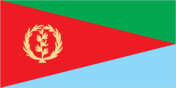
red isosceles triangle (based on the hoist side) dividing the flag into two right triangles; the upper triangle is green, the lower one is blue; a gold wreath encircling a gold olive branch is centered on the hoist side of the red triangle
Independence
27 May 1993 (from Ethiopia; formerly the Eritrea Autonomous Region)
Judicial branch
Judiciary
Legal system
NA
Legislative branch
unicameral
Member of
ACP, ECA, FAO, IBRD, ICAO, IDA, IFAD, IGADD, ILO, IMF, IMO, INTELSAT (nonsignatory user), ITU, OAU, UN, UNCTAD, UNESCO, UPU, WFTU
Names
conventional long form: State of Eritrea conventional short form: Eritrea local long form: none local short form: none former: Eritrea Autonomous Region in Ethiopia
National Assembly
PFDJ Central Committee serves as the country's legislative body until country-wide elections are held (before 20 May 1997)
National holiday
National Day (independence from Ethiopia), 24 May (1993)
Other political or pressure groups
Eritrean Islamic Jihad (EIJ); Islamic Militant Group; Eritrean Liberation Front (ELF), ABDULLAH Muhammed; Eritrean Liberation Front - United Organization (ELF-UO), Mohammed Said NAWUD; Eritrean Liberation Front - Revolutionary Council (ELF-RC), Ahmed NASSER
Political parties and leaders
People's Front for Democracy and Justice (PFDJ), ISAIAS Afworke, PETROS Solomon (the only party recognized by the government)
Suffrage
NA
Type
transitional government note: on 29 May 1991 ISAIAS Afworke, secretary general of the Peoples' Front for Democracy and Justice (PFDJ), which then served and still serves as the country's legislative body, announced the formation of the Provisional Government in Eritrea (PGE) in preparation for the 23-25 April 1993 referendum on independence for the autonomous region of Eritrea; the result was a landslide vote for independence which was proclaimed on 27 April 1993
US diplomatic representation
chief of mission: Ambassador Robert G. HOUDEK embassy: 34 Zera Yacob St., Asmara mailing address: P.O. Box 211, Asmara telephone: [291] (1) 120004
Economy
Agriculture
products - sorghum, livestock (including goats), fish, lentils, vegetables, maize, cotton, tobacco, coffee, sisal (for making rope)
Budget
revenues: $NA expenditures: $NA, including capital expenditures of $NA
Currency
1 birr (Br) = 100 cents; at present, Ethiopian currency used
Economic aid
$NA
Electricity
capacity: NA kW production: NA kWh consumption per capita: NA kWh
Exchange rates
1 birr (Br) per US$1 - 5.9500 (January 1995), 5.9500 (1994), 5.000 (fixed rate 1992-93); note - official rate pegged to US$
Exports
$NA commodities: NA partners: NA
External debt
$NA
Fiscal year
NA
Imports
$NA commodities: NA partners: NA
Industrial production
growth rate NA%
Industries
food processing, beverages, clothing and textiles
Inflation rate (consumer prices)
NA%
National product
GDP - purchasing power parity - $1.8 billion (1994 est.)
National product per capita
$500 (1994 est.)
National product real growth rate
2% (1994 est.)
Overview
With independence from Ethiopia on 27 April 1993, Eritrea faces the bitter economic problems of a small, desperately poor African country. Most of the population will continue to depend on subsistence farming. Domestic output is substantially augmented by worker remittances from abroad. Government revenues come from custom duties and income and sales taxes. Eritrea has inherited the entire coastline of Ethiopia and has long-term prospects for revenues from the development of offshore oil, offshore fishing, and tourism. For the time being, Ethiopia will be largely dependent on Eritrean ports for its foreign trade.
Unemployment rate
NA%
Communications
Radio
broadcast stations: AM NA, FM NA, shortwave 0 radios: NA
Telephone system
NA local: NA intercity: NA international: NA
Television
broadcast stations: NA televisions: NA
Transportation
Airports
total: 20 with paved runways over 3,047 m: 1 with paved runways 2,438 to 3,047 m: 1 with paved runways under 914 m: 2 with unpaved runways over 3,047 m: 1 with unpaved runways 2,438 to 3,047 m: 2 with unpaved runways 1,524 to 2,438 m: 6 with unpaved runways 914 to 1,523 m: 7
Highways
total: 3,845 km paved: 807 km unpaved: gravel 840 km; improved earth 402 km; unimproved earth 1,796 km
Merchant marine
none
Ports
Assab (Aseb), Massawa (Mits'iwa)
Railroads
total: 307 km; note - nonoperational since 1978; links Ak'ordat and Asmara (formerly Asmera) with the port of Massawa (formerly Mits'iwa) narrow gauge: 307 km 1.000-m gauge (1993 est.)
Military and Security
Branches
Eritrean People's Liberation Front (EPLF)
Defense expenditures
$NA, NA% of GDP ________________________________________________________________________ ESTONIA