1998 Edition
CIA World Factbook 1998 (Internet Archive)
Geography
Area
total: 21,040 sq km land: 20,720 sq km water: 320 sq km
Area-comparative
slightly smaller than Massachusetts
Climate
tropical; rainy season (May to October); dry season (November to April)
Coastline
307 km
Elevation extremes
lowest point: Pacific Ocean 0 m highest point: Cerro El Pital 2,730 m
Environment-current issues
deforestation; soil erosion; water pollution; contamination of soils from disposal of toxic wastes
Environment-international agreements
party to: Biodiversity, Climate Change, Desertification, Endangered Species, Hazardous Wastes, Nuclear Test Ban, Ozone Layer Protection signed, but not ratified: Law of the Sea
Geographic coordinates
13 50 N, 88 55 W
Geography-note
smallest Central American country and only one without a coastline on Caribbean Sea
Irrigated land
1,200 sq km (1993 est.)
Land boundaries
total: 545 km border countries: Guatemala 203 km, Honduras 342 km
Land use
arable land: 27% permanent crops: 8% permanent pastures: 29% forests and woodland: 5% other: 31% (1993 est.)
Location
Middle America, bordering the North Pacific Ocean, between Guatemala and Honduras
Map references
Central America and the Caribbean
Maritime claims
territorial sea: 200 nm
Natural hazards
known as the Land of Volcanoes; frequent and sometimes very destructive earthquakes and volcanic activity
Natural resources
hydropower, geothermal power, petroleum
Terrain
mostly mountains with narrow coastal belt and central plateau
People and Society
Age structure
0-14 years: 37% (male 1,088,579; female 1,042,087) 15-64 years: 58% (male 1,575,806; female 1,748,250) 65 years and over: 5% (male 135,556; female 161,789) (July 1998 est.)
Birth rate
26.71 births/1,000 population (1998 est.)
Death rate
6.32 deaths/1,000 population (1998 est.)
Ethnic groups
mestizo 94%, Amerindian 5%, white 1%
Infant mortality rate
29.07 deaths/1,000 live births (1998 est.)
Languages
Spanish, Nahua (among some Amerindians)
Life expectancy at birth
total population: 69.66 years male: 66.31 years female: 73.17 years (1998 est.)
Literacy
definition: age 15 and over can read and write total population: 71.5% male: 73.5% female: 69.8% (1995 est.)
Nationality
noun: Salvadoran(s) adjective: Salvadoran
Net migration rate
-4.73 migrant(s)/1,000 population (1998 est.)
Population
5,752,067 (July 1998 est.)
Population growth rate
1.57% (1998 est.)
Religions
Roman Catholic 75% note: there is extensive activity by Protestant groups throughout the country; by the end of 1992, there were an estimated 1 million Protestant evangelicals in El Salvador
Sex ratio
at birth: 1.05 male(s)/female under 15 years: 1.04 male(s)/female 15-64 years: 0.9 male(s)/female 65 years and over: 0.84 male(s)/female (1998 est.)
Total fertility rate
3.06 children born/woman (1998 est.)
Government
Administrative divisions
14 departments (departamentos, singular-departamento); Ahuachapan, Cabanas, Chalatenango, Cuscatlan, La Libertad, La Paz, La Union, Morazan, San Miguel, San Salvador, Santa Ana, San Vicente, Sonsonate, Usulutan
Constitution
20 December 1983
Country name
conventional long form: Republic of El Salvador conventional short form: El Salvador local long form: Republica de El Salvador local short form: El Salvador
Data code
ES
Executive branch
chief of state: President Armando CALDERON Sol (since 1 June 1994); Vice President Enrique BORGO Bustamante (since 1 June 1994); note-the president is both the chief of state and head of government head of government: President Armando CALDERON Sol (since 1 June 1994); Vice President Enrique BORGO Bustamante (since 1 June 1994); note-the president is both the chief of state and head of government cabinet: Council of Ministers elections: president and vice president elected on the same ticket by popular vote for five-year terms; election last held 20 March 1994, with a run-off election held 24 April 1994 (next to be held NA March 1999) election results: Armando CALDERON Sol elected president; percent of vote-Armando CALDERON Sol (ARENA) 49.03%, Ruben ZAMORA Rivas (CD/FMLN/MNR) 24.09%, Fidel CHAVEZ Mena (PDC) 16.39%, other 10.49%; because no candidate received a majority, a run-off election was held and the results were as follows-Armando CALDERON Sol (ARENA) 68.35%, Ruben ZAMORA Rivas (CD/FMLN/MNR) 31.65%
FAX
[503] 278-6011
Flag description
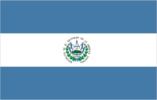
three equal horizontal bands of blue (top), white, and blue with the national coat of arms centered in the white band; the coat of arms features a round emblem encircled by the words REPUBLICA DE EL SALVADOR EN LA AMERICA CENTRAL; similar to the flag of Nicaragua, which has a different coat of arms centered in the white band-it features a triangle encircled by the words REPUBLICA DE NICARAGUA on top and AMERICA CENTRAL on the bottom; also similar to the flag of Honduras, which has five blue stars arranged in an X pattern centered in the white band
Government type
republic
Independence
15 September 1821 (from Spain)
International organization participation
BCIE, CACM, ECLAC, FAO, G-77, IADB, IAEA, IBRD, ICAO, ICFTU, ICRM, IDA, IFAD, IFC, IFRCS, ILO, IMF, IMO, Intelsat, Interpol, IOC, IOM, ITU, LAES, LAIA (observer), MINURSO, NAM (observer), OAS, OPANAL, PCA, UN, UNCTAD, UNESCO, UNIDO, UPU, WCL, WFTU, WHO, WIPO, WMO, WToO, WTrO Diplomatic representation in the US: chief of mission: Ambassador Rene A. LEON chancery: 2308 California Street NW, Washington, DC 20008 telephone: [1] (202) 265-9671, 9672 consulate(s) general: Chicago, Dallas, Houston, Los Angeles, Miami, New Orleans, New York, and San Francisco consulate(s): Boston Diplomatic representation from the US: chief of mission: Ambassador Anne W. PATTERSON embassy: Final Boulevard Santa Elena, Station Antiguo Cuscatlan, San Salvador mailing address: Unit 3116, APO AA 34023 telephone: [503] 278-4444
Judicial branch
Supreme Court (Corte Suprema), judges are selected by the Legislative Assembly Political parties and leaders: National Republican Alliance or ARENA [Alfredo CRISTIANI]; Farabundo Marti National Liberation Front or FMLN [Facundo GUARDADO, general coordinator]; Christian Democratic Party or PDC [Ronal UMANA, secretary general; title in dispute]; National Conciliation Party or PCN [Ciro CRUZ Zepeda, secretary general]; Democratic Convergence or CD [Ruben ZAMORA, secretary general]; Popular Labor Party or PPL [Jose VILANOVA, secretary general]; Liberal Democratic Party or PLD [Kirio Waldo SALGADO, president]; Social Christian Union or USC (formed by union of the PRSC, MU, and MSN) [Abraham RODRIGUEZ, president]; Democratic Party or PD [Ana Guadeloupe MARTINEZ, president] Political pressure groups and leaders: labor organizations: National Confederation of Salvadoran Workers (CNTS)National Union of Salvadoran Workers (UNTS); Federation of the Construction Industry, Similar, Transport and other activities (FESINCONTRANS); Salvadoran Workers Central (CTS); Port Industry Union of El Salvador (SIPES); Electrical Industry Union of El Salvador (SIES); Workers Union of Electrical Corporation (STCEL) business organizations: Salvadoran Industrial Association (ASI)Salvadoran Assembly Industry Association (ASIC); National Association of Small Enterprise (ANEP)
Legal system
based on civil and Roman law, with traces of common law; judicial review of legislative acts in the Supreme Court; accepts compulsory ICJ jurisdiction, with reservations note: Legislative Assembly passed landmark judicial reforms in 1996
Legislative branch
unicameral Legislative Assembly or Asamblea Legislativa (84 seats; members are elected by direct popular vote to serve three-year terms) elections: last held 16 March 1997 (next to be held NA March 2000) election results: percent of vote by party-ARENA 35.4%, FMLN 34.3%, PCN 8.1%, PDC 7.9%, CD 3.8%, PRSC 3.4%, PLD 3.2%, MU 2.1%, PD 1.0%, other 0.8%; seats by party - ARENA 28, FMLN 27, PCN 9, PDC 8, PRSC 3, CD 2, PLD 2, MU 1, PD 1, independent 3
National capital
San Salvador
National holiday
Independence Day, 15 September (1821)
Suffrage
18 years of age; universal
Economy
Agriculture-products
coffee, sugarcane, corn, rice, beans, oilseed, cotton, sorghum; beef, dairy products; shrimp
Budget
revenues: $1.75 billion expenditures: $1.82 billion, including capital expenditures of $317 million (1997 est.)
Currency
1 Salvadoran colon (C) = 100 centavos
Debt-external
$2.6 billion (yearend 1997)
Economic aid
recipient: ODA, $763 million (1996) note: US has committed $280 million in economic assistance to El Salvador for 1995-97 (excludes military aid)
Economy-overview
In 1997 the government emphasized a fixed exchange rate, along with conservative monetary and fiscal policies to promote foreign investment. Inflation fell to an unprecedented low of 2%. Exports reached a record level and were the main engine of growth. Productivity in other sectors remained weaker, however. For the last few years, El Salvador has experienced sizable deficits in both its trade and its fiscal accounts. The trade deficit has been offset by remittances from the large number of Salvadorans living abroad and from external aid. The deficit is expected to increase in 1998 as imports continue to rise. San Salvador is stepping up its privatization efforts in 1998 to increase revenues. Late in 1997 the legislative assembly approved a privatization law that will facilitate the sale of the state-owned telephone company sometime in 1998. The government also plans to privatize pension funds later in the year.
Electricity-capacity
900,000 kW (1996)
Electricity-consumption per capita
603 kWh (1997 est.)
Electricity-production
3.5 billion kWh (1997)
Exchange rates
Salvadoran colones (C) per US$1 (end of period)-8.755 (January 1998-1995), 8.750 (1994), 8.670 (1993) note: as of 1 June 1990, the rate is based on the average of the buying and selling rates, set on a weekly basis, for official receipts and payments, imports of petroleum, and coffee exports; prior to that date, a system of floating was in effect
Exports
total value: $1.96 billion (f.o.b., 1997 est.) commodities: coffee, sugar; shrimp; textiles partners: US, Guatemala, Germany, Costa Rica, Honduras
Fiscal year
calendar year Communications
GDP
purchasing power parity-$17.8 billion (1997 est.)
GDP-composition by sector
agriculture: 15% industry: 24% services: 61% (1997 est.)
GDP-per capita
purchasing power parity-$3,000 (1997 est.)
GDP-real growth rate
4% (1997 est.)
Imports
total value: $3.5 billion (c.i.f., 1997 est.) commodities: raw materials, consumer goods, capital goods, fuels partners: US, Guatemala, Mexico, Panama, Venezuela, Japan
Industrial production growth rate
7% (1997 est.)
Industries
food processing, beverages, petroleum, chemicals, fertilizer, textiles, furniture, light metals
Inflation rate-consumer price index
2% (1997)
Labor force
total: 2.26 million (1997 est.) by occupation: agriculture 40%, commerce 16%, manufacturing 15%, government 13%, financial services 9%, transportation 6%, other 1%
Radio broadcast stations
AM 18, FM 80, shortwave 2
Radios
1.5 million (1997 est.)
Telephone system
domestic: nationwide microwave radio relay system international: satellite earth station-1 Intelsat (Atlantic Ocean); connected to Central American Microwave System
Telephones
350,000 (1997 est.)
Television broadcast stations
11 (1996 est.)
Televisions
700,000 (1997 est.)
Unemployment rate
7.7% (1997 est.)
Transportation
Airports
88 (1997 est.) Airports-with paved runways: total: 4 over 3,047 m: 1 1,524 to 2,437 m: 1 914 to 1,523 m: 2 (1997 est.) Airports-with unpaved runways: total: 84 914 to 1,523 m: 18 under 914 m: 66 (1997 est.)
Heliports
1 (1997 est.)
Highways
total: 9,977 km paved: 1,985 km (including 266 km of expressways) unpaved: 7,992 km (1996 est.)
Merchant marine
none
Railways
total: 602 km (single track; note-some sections abandoned, unusable, or operating at reduced capacity) narrow gauge: 602 km 0.914-m gauge
Waterways
Rio Lempa partially navigable Ports and harbors: Acajutla, Puerto Cutuco, La Libertad, La Union, Puerto El Triunfo
Military and Security
Military branches
Army, Navy, Air Force
Military expenditures-dollar figure
$104 million (1997)
Military expenditures-percent of GDP
0.9% (1997)
Military manpower-availability
males age 15-49: 1,362,504 (1998 est.) Military manpower-fit for military service: males: 864,419 (1998 est.)
Military manpower-military age
18 years of age
Military manpower-reaching military age annually
males: 65,130 (1998 est.)
Transnational Issues
Disputes-international
land boundary dispute with Honduras mostly resolved by 11 September 1992 International Court of Justice (ICJ) decision; the presidents of Honduras and El Salvador signed in January 1998 an agreement allowing citizens in the 1992 demarcated areas to choose Honduran or Salvadoran citizenship; the two countries also agreed to a final demarcation of the border within one year; the agreement awaits ratification by the legislative assemblies of both countries; with respect to the maritime boundary in the Golfo de Fonseca, ICJ referred to an earlier agreement in this century and advised that some tripartite resolution among El Salvador, Honduras and Nicaragua likely would be required
Illicit drugs
transshipment point for cocaine; marijuana produced for local consumption