1991 Edition
CIA World Factbook 1991 (Project Gutenberg)
Geography
Climate
tropical; rainy season (May to October); dry season (November to April)
Coastline
307 km
Comparative area
slightly smaller than Massachusetts
Disputes
dispute with Honduras over several sections of the land boundary; dispute over Golfo de Fonseca maritime boundary because of disputed sovereignty of islands
Environment
The Land of Volcanoes; subject to frequent and sometimes very destructive earthquakes; deforestation; soil erosion; water pollution
Land boundaries
545 km total; Guatemala 203 km, Honduras 342 km
Land use
arable land 27%; permanent crops 8%; meadows and pastures 29%; forest and woodland 6%; other 30%; includes irrigated 5%
Maritime claims
Territorial sea: 200 nm (overflight and navigation permitted beyond 12 nm)
Natural resources
hydropower, geothermal power, crude oil
Note
smallest Central American country and only one without a coastline on Caribbean Sea
Terrain
mostly mountains with narrow coastal belt and central plateau
Total area
21,040 km2; land area: 20,720 km2
People and Society
Birth rate
34 births/1,000 population (1991)
Death rate
7 deaths/1,000 population (1991)
Ethnic divisions
mestizo 89%, Indian 10%, white 1%
Infant mortality rate
47 deaths/1,000 live births (1991)
Labor force
1,700,000 (1982 est.); agriculture 40%, commerce 16%, manufacturing 15%, government 13%, financial services 9%, transportation 6%, other 1%; shortage of skilled labor and a large pool of unskilled labor, but manpower training programs improving situation (1984 est.)
Language
Spanish, Nahua (among some Indians)
Life expectancy at birth
63 years male, 68 years female (1991)
Literacy
73% (male 76%, female 70%) age 15 and over can read and write (1990 est.)
Nationality
noun--Salvadoran(s); adjective--Salvadoran
Net migration rate
- 6 migrants/1,000 population (1991)
Organized labor
total labor force 15%; agricultural labor force 10%; urban labor force 7% (1987 est.)
Population
5,418,736 (July 1991), growth rate 2.0% (1991)
Religion
Roman Catholic about 75%, with extensive activity by Protestant groups throughout the country (more than 1 million Protestant evangelicals in El Salvador at the end of 1990)
Total fertility rate
4.1 children born/woman (1991)
Government
Administrative divisions
14 departments (departamentos, singular--departamento); Ahuachapan, Cabanas, Chalatenango, Cuscatlan, La Libertad, La Paz, La Union, Morazan, San Miguel, San Salvador, Santa Ana, San Vicente, Sonsonate, Usulutan
Capital
San Salvador
Constitution
20 December 1983
Diplomatic representation
Ambassador Miguel Angel SALAVERRIA; Chancery at 2308 California Street NW, Washington DC 20008; telephone (202) 265-3480 through 3482; there are Salvadoran Consulates General in Houston, Los Angeles, Miami, New Orleans, New York, and San Francisco; US--Ambassador William G. WALKER; Embassy at 25 Avenida Norte No. 1230, San Salvador (mailing address is APO Miami 34023); telephone [503] 26-7100
Elections
President--last held 19 March 1989 (next to be held March 1994); results--Alfredo CRISTIANI (ARENA) 53.8%, Fidel CHAVEZ Mena (PDC) 36.6%, other 9.6%; Legislative Assembly--last held 10 March 1991 (next to be held March 1994); results--ARENA 44.3%, PDC 27.96%, CD 12.16%, PCN 8.99%, MAC 3.23%, UDN 2.68%; seats--(84 total) ARENA 39, PDC 26, PCN 9, CD 8, UDN 1, MAC 1
Executive branch
president, vice president, Council of Ministers (cabinet)
Flag
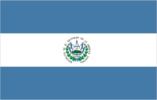
three equal horizontal bands of blue (top), white, and blue with the national coat of arms centered in the white band; the coat of arms features a round emblem encircled by the words REPUBLICA DE EL SALVADOR EN LA AMERICA CENTRAL; similar to the flag of Nicaragua which has a different coat of arms centered in the white band--it features a triangle encircled by the words REPUBLICA DE NICARAGUA on top and AMERICA CENTRAL on the bottom; also similar to the flag of Honduras which has five blue stars arranged in an X pattern centered in the white band
Independence
15 September 1821 (from Spain)
Judicial branch
Supreme Court (Corte Suprema)
Leaders
Chief of State and Head of Government--President Alfredo CRISTIANI (since 1 June 1989); Vice President Jose Francisco MERINO (since 1 June 1989)
Legal system
based on civil and Roman law, with traces of common law; judicial review of legislative acts in the Supreme Court; accepts compulsory ICJ jurisdiction, with reservations
Legislative branch
unicameral Legislative Assembly (Asamblea Legislativa)
Long-form name
Republic of El Salvador
Member of
BCIE, CACM, ECLAC, FAO, G-77, IADB, IAEA, IBRD, ICAO, ICFTU, IDA, IFAD, IFC, ILO, IMF, IMO, INTELSAT, IOC, IOM, ITU, LAES, LORCS, NAM (observer), OAS, OPANAL, PCA, UN, UNCTAD, UNESCO, UNIDO, UPU, WCL, WFTU, WHO, WIPO, WMO
National holiday
Independence Day, 15 September (1821)
Other political or pressure groups
Leftist revolutionary movement--Farabundo Marti National Liberation Front (FMLN), leadership body of the insurgency, four factions--Popular Liberation Forces (FPL), Armed Forces of National Resistance (FARN), People's Revolutionary Army (ERP), Salvadoran Communist Party/Armed Forces of Liberation (PCES/FAL), and Central American Workers' Revolutionary Party (PRTC)/Popular Liberation Revolutionary Armed Forces (FARLP); Leftist political parties--National Democratic Union (UDN), National Revolutionary Movement (MNR), and Popular Social Movement (MPSC); FMLN front organizations: Labor fronts include--National Union of Salvadoran Workers (UNTS), leftist umbrella front group, leads FMLN front network; National Federation of Salvadoran Workers (FENASTRAS), best organized of front groups and controlled by FMLN's National Resistance (RN); Social Security Institute Workers Union (STISSS), one of the most militant fronts, is controlled by FMLN'S Armed Forces of National Resistance (FARN) and RN; Association of Telecommunications Workers (ASTTEL); Centralized Union Federation of El Salvador (FUSS); Treasury Ministry Employees (AGEMHA); Nonlabor fronts include--Committee of Mothers and Families of Political Prisoners, Disappeared Persons, and Assassinated of El Salvador (COMADRES); Nongovernmental Human Rights Commission (CDHES); Committee of Dismissed and Unemployed of El Salvador (CODYDES); General Association of Salvadoran University Students (AGEUS); National Association of Salvadoran Educators (ANDES-21 DE JUNIO); Salvadoran Revolutionary Student Front (FERS), associated with the Popular Forces of Liberation (FPL); Association of National University Educators (ADUES); Salvadoran University Students Front (FEUS); Christian Committee for the Displaced of El Salvador (CRIPDES), an FPL front; The Association for Communal Development in El Salvador (PADECOES), controlled by the People's Revolutionary Army (ERP); Confederation of Cooperative Associations of El Salvador (COACES); Labor organizations--Federation of Construction and Transport Workers Unions (FESINCONSTRANS), independent; Salvadoran Communal Union (UCS), peasant association; Unitary Federation of Salvadoran Unions (FUSS), leftist; National Federation of Salvadoran Workers (FENASTRAS), leftist; Democratic Workers Central (CTD), moderate; General Confederation of Workers (CGT), moderate; National Unity of Salvadoran Workers (UNTS), leftist; National Union of Workers and Peasants (UNOC), moderate labor coalition of democratic labor organizations; United Workers Front (FUT); Business organizations--National Association of Private Enterprise (ANEP), conservative; Productive Alliance (AP), conservative; National Federation of Salvadoran Small Businessmen (FENAPES), conservative
Political parties and leaders
National Republican Alliance (ARENA), Armando CALDERON Sol; Christian Democratic Party (PDC), Fidel CHAVEZ Mena; National Conciliation Party (PCN), Ciro CRUZ Zepeda; National Democratic Union (UDN), Mario AGUINADA Carranza; the Democratic Convergence (CD) is a coalition of three parties--the Social Democratic Party (PSD), Wilfredo BARILLAS; the National Revolutionary Movement (MNR), Rene FLORES; and the Popular Social Christian Movement (MPSC), Ruben ZAMORA; Authentic Christian Movement (MAC), Julio REY PRENDES; Democratic Action (AD), Ricardo GONZALEZ Camacho
Suffrage
universal at age 18
Type
republic
Economy
Agriculture
accounts for 25% of GDP and 40% of labor force (including fishing and forestry); coffee most important commercial crop; other products--sugarcane, corn, rice, beans, oilseeds, beef, dairy products, shrimp; not self-sufficient in food
Budget
revenues $751 million; expenditures $790 million, including capital expenditures of $NA (1990 est.)
Currency
Salvadoran colon (plural--colones); 1 Salvadoran colon (C) = 100 centavos
Economic aid
US commitments, including Ex-Im (FY70-90), $2.95 billion; Western (non-US) countries, ODA and OOF bilateral commitments (1970-88), $455 million
Electricity
682,000 kW capacity; 1,849 million kWh produced, 350 kWh per capita (1990)
Exchange rates
Salvadoran colones (C) per US$1--8.0 (April 1991, floating rate since mid-1990); 5.0000 (fixed rate 1986 to mid-1990)
Exports
$571 million (f.o.b., 1990 est.); commodities--coffee 45%, sugar, cotton, shrimp; partners--US 49%, FRG 24%, Guatemala 7%, Costa Rica 4%, Japan 4%
External debt
$2.1 billion (December 1990 est.)
Fiscal year
calendar year
GDP
$5.4 billion, per capita $1,030; real growth rate 2.8% (1990 est.)
Imports
$1.2 billion (c.i.f., 1990 est.); commodities--petroleum products, consumer goods, foodstuffs, machinery, construction materials, fertilizer; partners--US 40%, Guatemala 12%, Venezuela 7%, Mexico 7%, FRG 5%, Japan 4%
Industrial production
growth rate 2.4% (1990); accounts for 22% of GDP
Industries
food processing, textiles, clothing, beverages, petroleum, tobacco products, chemicals, furniture
Inflation rate (consumer prices)
20% (1990)
Overview
The agricultural sector accounts for 25% of GDP, employs about 40% of the labor force, and contributes about 66% to total exports. Coffee is the major commercial crop, accounting for 45% of export earnings. The manufacturing sector, based largely on food and beverage processing, accounts for 18% of GDP and 15% of employment. Economic losses because of guerrilla sabotage total more than $2.0 billion since 1979. The costs of maintaining a large military seriously constrain the government's efforts to provide essential social services. Nevertheless, growth in national output last year exceeded growth in population for the first time since 1987.
Unemployment rate
10% (1989)
Communications
Airports
116 total, 82 usable; 6 with permanent-surface runways; none with runways over 3,659 m; 1 with runways 2,440-3,659 m; 5 with runways 1,220-2,439 m
Civil air
7 major transport aircraft
Highways
10,000 km total; 1,500 km paved, 4,100 km gravel, 4,400 km improved and unimproved earth
Inland waterways
Rio Lempa partially navigable
Ports
Acajutla, Cutuco
Railroads
602 km 0.914-meter gauge, single track
Telecommunications
nationwide trunk radio relay system; connection into Central American Microwave System; 116,000 telephones; stations--77 AM, no FM, 5 TV, 2 shortwave; 1 Atlantic Ocean INTELSAT earth station
Military and Security
Branches
Army, Navy, Air Force, National Guard, National Police, Treasury Police
Defense expenditures
$220 million, 3.6% of GDP (1990) _%_
Manpower availability
males 15-49, 1,220,088; 780,108 fit for military service; 71,709 reach military age (18) annually