2018 Edition
CIA World Factbook 2018 Archive (Wayback Machine)
Introduction
Background
The regularity and richness of the annual Nile River flood, coupled with semi-isolation provided by deserts to the east and west, allowed for the development of one of the world's great civilizations. A unified kingdom arose circa 3200 B.C., and a series of dynasties ruled in Egypt for the next three millennia. The last native dynasty fell to the Persians in 341 B.C., who in turn were replaced by the Greeks, Romans, and Byzantines. It was the Arabs who introduced Islam and the Arabic language in the 7th century and who ruled for the next six centuries. A local military caste, the Mamluks took control about 1250 and continued to govern after the conquest of Egypt by the Ottoman Turks in 1517. Completion of the Suez Canal in 1869 elevated Egypt as an important world transportation hub. Ostensibly to protect its investments, Britain seized control of Egypt's government in 1882, but nominal allegiance to the Ottoman Empire continued until 1914. Partially independent from the UK in 1922, Egypt acquired full sovereignty from Britain in 1952. The completion of the Aswan High Dam in 1971 and the resultant Lake Nasser have reaffirmed the time-honored place of the Nile River in the agriculture and ecology of Egypt. A rapidly growing population (the largest in the Arab world), limited arable land, and dependence on the Nile all continue to overtax resources and stress society. The government has struggled to meet the demands of Egypt's population through economic reform and massive investment in communications and physical infrastructure. Inspired by the 2010 Tunisian revolution, Egyptian opposition groups led demonstrations and labor strikes countrywide, culminating in President Hosni MUBARAK's ouster in 2011. Egypt's military assumed national leadership until a new parliament was in place in early 2012; later that same year, Muhammad MURSI won the presidential election. Following often violent protests throughout the spring of 2013 against MURSI's government and the Muslim Brotherhood, the Egyptian Armed Forces intervened and removed MURSI from power in July 2013 and replaced him with interim president Adly MANSOUR. In January 2014, voters approved a new constitution by referendum and in May 2014 elected former defense minister Abdelfattah ELSISI president. Egypt elected a new legislature in December 2015, its first parliament since 2012. ELSISI was reelected to a second four-year term in March 2018.
Geography
Area
- land
- 995,450 sq km
- total
- 1,001,450 sq km
- water
- 6,000 sq km
Area Comparative
more than eight times the size of Ohio; slightly more than three times the size of New Mexico
Climate
desert; hot, dry summers with moderate winters
Coastline
2,450 km
Elevation
- elevation extremes
- -133 m lowest point: Qattara Depression
- mean elevation
- 321 m
- note
- 2629 highest point: Mount Catherine
Environment Current Issues
agricultural land being lost to urbanization and windblown sands; increasing soil salination below Aswan High Dam; desertification; oil pollution threatening coral reefs, beaches, and marine habitats; other water pollution from agricultural pesticides, raw sewage, and industrial effluents; limited natural freshwater resources away from the Nile, which is the only perennial water source; rapid growth in population overstraining the Nile and natural resources
Environment International Agreements
- party to
- Biodiversity, Climate Change, Climate Change-Kyoto Protocol, Desertification, Endangered Species, Environmental Modification, Hazardous Wastes, Law of the Sea, Marine Dumping, Ozone Layer Protection, Ship Pollution, Tropical Timber 83, Tropical Timber 94, Wetlands
- signed, but not ratified
- none of the selected agreements
Geographic Coordinates
27 00 N, 30 00 E
Geography Note
controls Sinai Peninsula, the only land bridge between Africa and remainder of Eastern Hemisphere; controls Suez Canal, a sea link between Indian Ocean and Mediterranean Sea; size, and juxtaposition to Israel, establish its major role in Middle Eastern geopolitics; dependence on upstream neighbors; dominance of Nile basin issues; prone to influxes of refugees from Sudan and the Palestinian territories
Irrigated Land
36,500 sq km (2012)
Land Boundaries
- border countries (4)
- Gaza Strip 13 km, Israel 208 km, Libya 1115 km, Sudan 1276 km
- total
- 2,612 km
Land Use
- arable land: 2.8% (2011 est.) / permanent crops: 0.8% (2011 est.) / permanent pasture: 0% (2011 est.)
- agricultural land
- 3.6% (2011 est.)
- forest
- 0.1% (2011 est.)
- other
- 96.3% (2011 est.)
Location
Northern Africa, bordering the Mediterranean Sea, between Libya and the Gaza Strip, and the Red Sea north of Sudan, and includes the Asian Sinai Peninsula
Map References
Africa
Maritime Claims
- contiguous zone
- 24 nm
- continental shelf
- 200 nm
- exclusive economic zone
- 200 nm or the equidistant median line with Cyprus
- territorial sea
- 12 nm
Natural Hazards
periodic droughts; frequent earthquakes; flash floods; landslides; hot, driving windstorms called khamsin occur in spring; dust storms; sandstorms
Natural Resources
petroleum, natural gas, iron ore, phosphates, manganese, limestone, gypsum, talc, asbestos, lead, rare earth elements, zinc
Population Distribution
approximately 95% of the population lives within 20 km of the Nile River and its delta; vast areas of the country remain sparsely populated or uninhabited
Terrain
vast desert plateau interrupted by Nile valley and delta
People and Society
Age Structure
- 0-14 years
- 33.38% (male 17,177,977 /female 16,007,877)
- 15-24 years
- 18.65% (male 9,551,309 /female 8,988,006)
- 25-54 years
- 37.71% (male 19,053,300 /female 18,431,808)
- 55-64 years
- 5.99% (male 2,956,535 /female 2,995,497)
- 65 years and over
- 4.28% (male 2,058,217 /female 2,192,791) (2018 est.)
Birth Rate
28.8 births/1,000 population (2018 est.)
Children Under The Age Of 5 Years Underweight
7% (2014)
Contraceptive Prevalence Rate
58.5% (2014)
Death Rate
4.5 deaths/1,000 population (2018 est.)
Demographic Profile
Egypt is the most populous country in the Arab world and the third most populous country in Africa, behind Nigeria and Ethiopia. Most of the country is desert, so about 95% of the population is concentrated in a narrow strip of fertile land along the Nile River, which represents only about 5% of Egypt’s land area. Egypt’s rapid population growth – 46% between 1994 and 2014 – stresses limited natural resources, jobs, housing, sanitation, education, and health care.Although the country’s total fertility rate (TFR) fell from roughly 5.5 children per woman in 1980 to just over 3 in the late 1990s, largely as a result of state-sponsored family planning programs, the population growth rate dropped more modestly because of decreased mortality rates and longer life expectancies. During the last decade, Egypt’s TFR decline stalled for several years and then reversed, reaching 3.6 in 2011, and has plateaued the last few years. Contraceptive use has held steady at about 60%, while preferences for larger families and early marriage may have strengthened in the wake of the recent 2011 revolution. The large cohort of women of or nearing childbearing age will sustain high population growth for the foreseeable future (an effect called population momentum).Nevertheless, post-MUBARAK governments have not made curbing population growth a priority. To increase contraceptive use and to prevent further overpopulation will require greater government commitment and substantial social change, including encouraging smaller families and better educating and empowering women. Currently, literacy, educational attainment, and labor force participation rates are much lower for women than men. In addition, the prevalence of violence against women, the lack of female political representation, and the perpetuation of the nearly universal practice of female genital cutting continue to keep women from playing a more significant role in Egypt’s public sphere.Population pressure, poverty, high unemployment, and the fragmentation of inherited land holdings have historically motivated Egyptians, primarily young men, to migrate internally from rural and smaller urban areas in the Nile Delta region and the poorer rural south to Cairo, Alexandria, and other urban centers in the north, while a much smaller number migrated to the Red Sea and Sinai areas. Waves of forced internal migration also resulted from the 1967 Arab-Israeli War and the floods caused by the completion of the Aswan High Dam in 1970. Limited numbers of students and professionals emigrated temporarily prior to the early 1970s, when economic problems and high unemployment pushed the Egyptian Government to lift restrictions on labor migration. At the same time, high oil revenues enabled Saudi Arabia, Iraq, and other Gulf states, as well as Libya and Jordan, to fund development projects, creating a demand for unskilled labor (mainly in construction), which attracted tens of thousands of young Egyptian men.Between 1970 and 1974 alone, Egyptian migrants in the Gulf countries increased from approximately 70,000 to 370,000. Egyptian officials encouraged legal labor migration both to alleviate unemployment and to generate remittance income (remittances continue to be one of Egypt’s largest sources of foreign currency and GDP). During the mid-1980s, however, depressed oil prices resulting from the Iran-Iraq War, decreased demand for low-skilled labor, competition from less costly South Asian workers, and efforts to replace foreign workers with locals significantly reduced Egyptian migration to the Gulf States. The number of Egyptian migrants dropped from a peak of almost 3.3 million in 1983 to about 2.2 million at the start of the 1990s, but numbers gradually recovered.In the 2000s, Egypt began facilitating more labor migration through bilateral agreements, notably with Arab countries and Italy, but illegal migration to Europe through overstayed visas or maritime human smuggling via Libya also rose. The Egyptian Government estimated there were 6.5 million Egyptian migrants in 2009, with roughly 75% being temporary migrants in other Arab countries (Libya, Saudi Arabia, Jordan, Kuwait, and the United Arab Emirates) and 25% being predominantly permanent migrants in the West (US, UK, Italy, France, and Canada).During the 2000s, Egypt became an increasingly important transit and destination country for economic migrants and asylum seekers, including Palestinians, East Africans, and South Asians and, more recently, Iraqis and Syrians. Egypt draws many refugees because of its resettlement programs with the West; Cairo has one of the largest urban refugee populations in the world. Many East African migrants are interned or live in temporary encampments along the Egypt-Israel border, and some have been shot and killed by Egyptian border guards.
Dependency Ratios
- elderly dependency ratio
- 8.2 (2015 est.)
- potential support ratio
- 12.2 (2015 est.)
- total dependency ratio
- 61.8 (2015 est.)
- youth dependency ratio
- 53.6 (2015 est.)
Drinking Water Source
- improved: urban: 100% of population
- rural: 99% of population
- total: 99.4% of population
- unimproved: urban: 0% of population
- rural: 1% of population
- total: 0.6% of population (2015 est.)
Education Expenditures
3.8% of GDP (2008)
Ethnic Groups
- Egyptian 99.7%, other 0.3% (2006 est.)
- note
- data represent respondents by nationality
Health Expenditures
5.6% of GDP (2014)
Hiv Aids Adult Prevalence Rate
<.1% (2017 est.)
Hiv Aids Deaths
<500 (2017 est.)
Hiv Aids People Living With Hiv Aids
16,000 (2017 est.)
Hospital Bed Density
1.6 beds/1,000 population (2014)
Infant Mortality Rate
- female
- 17 deaths/1,000 live births (2018 est.)
- male
- 19.5 deaths/1,000 live births (2018 est.)
- total
- 18.3 deaths/1,000 live births (2018 est.)
Languages
Arabic (official), Arabic, English, and French widely understood by educated classes
Life Expectancy At Birth
- female
- 74.7 years (2018 est.)
- male
- 71.8 years (2018 est.)
- total population
- 73.2 years (2018 est.)
Literacy
- definition
- age 15 and over can read and write (2015 est.)
- female
- 65.4% (2015 est.)
- male
- 82.2% (2015 est.)
- total population
- 73.8% (2015 est.)
Major Infectious Diseases
- degree of risk
- intermediate (2016)
- food or waterborne diseases
- bacterial diarrhea, hepatitis A, and typhoid fever (2016)
- water contact diseases
- schistosomiasis (2016)
Major Urban Areas Population
20.076 million CAIRO (capital), 5.086 million Alexandria (2018)
Maternal Mortality Rate
33 deaths/100,000 live births (2015 est.)
Median Age
- female
- 24.3 years (2018 est.)
- male
- 23.6 years
- total
- 23.9 years
Mother S Mean Age At First Birth
- 22.7 years (2014 est.)
- note
- median age at first birth among women 25-29
Nationality
- adjective
- Egyptian
- noun
- Egyptian(s)
Net Migration Rate
-0.5 migrant(s)/1,000 population (2017 est.)
Obesity Adult Prevalence Rate
32% (2016)
Physicians Density
0.81 physicians/1,000 population (2014)
Population
99,413,317 (July 2018 est.)
Population Growth Rate
2.38% (2018 est.)
Religions
Muslim (predominantly Sunni) 90%, Christian (majority Coptic Orthodox, other Christians include Armenian Apostolic, Catholic, Maronite, Orthodox, and Anglican) 10% (2015 est.)
Sanitation Facility Access
- improved: urban: 96.8% of population (2015 est.)
- rural: 93.1% of population (2015 est.)
- total: 94.7% of population (2015 est.)
- unimproved: urban: 3.2% of population (2015 est.)
- rural: 6.9% of population (2015 est.)
- total: 5.3% of population (2015 est.)
School Life Expectancy Primary To Tertiary Education
- female
- 13 years (2014)
- male
- 13 years (2014)
- total
- 13 years (2014)
Sex Ratio
- 0-14 years
- 1.07 male(s)/female (2017 est.)
- 15-24 years
- 1.06 male(s)/female (2017 est.)
- 25-54 years
- 1.03 male(s)/female (2017 est.)
- 55-64 years
- 0.98 male(s)/female (2017 est.)
- 65 years and over
- 0.82 male(s)/female (2017 est.)
- at birth
- 1.06 male(s)/female (2017 est.)
- total population
- 1.05 male(s)/female (2017 est.)
Total Fertility Rate
3.41 children born/woman (2018 est.)
Unemployment Youth Ages 15 24
- female
- 38.5% (2016 est.)
- male
- 27.2% (2016 est.)
- total
- 30.8% (2016 est.)
Urbanization
- rate of urbanization
- 1.86% annual rate of change (2015-20 est.)
- urban population
- 42.7% of total population (2018)
Government
Administrative Divisions
27 governorates (muhafazat, singular - muhafazat); Ad Daqahliyah, Al Bahr al Ahmar (Red Sea), Al Buhayrah, Al Fayyum, Al Gharbiyah, Al Iskandariyah (Alexandria), Al Isma'iliyah (Ismailia), Al Jizah (Giza), Al Minufiyah, Al Minya, Al Qahirah (Cairo), Al Qalyubiyah, Al Uqsur (Luxor), Al Wadi al Jadid (New Valley), As Suways (Suez), Ash Sharqiyah, Aswan, Asyut, Bani Suwayf, Bur Sa'id (Port Said), Dumyat (Damietta), Janub Sina' (South Sinai), Kafr ash Shaykh, Matruh, Qina, Shamal Sina' (North Sinai), Suhaj
Capital
- geographic coordinates
- 30 03 N, 31 15 E
- name
- Cairo
- time difference
- UTC+2 (7 hours ahead of Washington, DC, during Standard Time)
Citizenship
- citizenship by birth
- no
- citizenship by descent only
- if the father was born in Egypt
- dual citizenship recognized
- only with prior permission from the government
- residency requirement for naturalization
- 10 years
Constitution
- amendments
- proposed by the president of the republic or by one-fifth of the House of Representatives members; a decision to accept the proposal requires majority vote by House members; passage of amendment requires a two-thirds majority vote by House members and passage by majority vote in a referendum; articles of reelection of the president and principles of freedom not amendable unless the amendment "brings more guarantees" (2017)
- history
- several previous; latest approved by a constitutional committee in December 2013, approved by referendum held on 14-15 January 2014, ratified by interim president on 19 January 2014 (2017)
Country Name
- conventional long form
- Arab Republic of Egypt
- conventional short form
- Egypt
- etymology
- the English name "Egypt" derives from the ancient Greek name for the country "Aigyptos"; the Arabic name "Misr" can be traced to the ancient Akkadian "misru" meaning border or frontier
- former
- United Arab Republic (with Syria)
- local long form
- Jumhuriyat Misr al-Arabiyah
- local short form
- Misr
Diplomatic Representation From The Us
- chief of mission
- Ambassador (vacant); Charge d'Affaires Thomas H. GOLDBERGER (since 30 June 2017)
- embassy
- 5 Tawfik Diab St., Garden City, Cairo
- FAX
- [20-2] 2797-3200
- mailing address
- Unit 64900, Box 15, APO AE 09839-4900; 5 Tawfik Diab Street, Garden City, Cairo
- telephone
- [20-2] 2797-3300
Diplomatic Representation In The Us
- chancery
- 3521 International Court NW, Washington, DC 20008
- chief of mission
- Ambassador Yasser REDA (since 19 September 2015)
- consulate(s) general
- Chicago, Houston, Los Angeles, New York
- FAX
- [1] (202) 244-5131
- telephone
- [1] (202) 895-5400
Executive Branch
- cabinet
- Cabinet ministers nominated by the executive authorities and approved by the House of Representtives
- chief of state
- President Abdelfattah ELSISI (since 8 June 2014)
- election results
- Abdelfattah Said ELSISI relected president in first round; percent of valid votes case - Abdelfattah Said ELSISI (independent) 97.8%, Moussa Mostafa MOUSSA (El Ghad Party) 2.3%; note - over 7% of ballots cast were deemed invalid
- elections/appointments
- president elected by absolute majority popular vote in 2 rounds if needed for a 4-year term (eligible for a second term); election last held on 26-28 March 2018 (next to be held in 2022); prime minister appointed by the president, approved by the House of Representatives
- head of government
- Prime Minister Mostafa MADBOULY (since 7 June 2018); note - Prime Minister Sherif ISMAIL (since 12 September 2015) resigned 6 June 2018
Flag Description
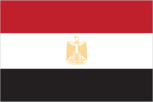
- three equal horizontal bands of red (top), white, and black; the national emblem (a gold Eagle of Saladin facing the hoist side with a shield superimposed on its chest above a scroll bearing the name of the country in Arabic) centered in the white band; the band colors derive from the Arab Liberation flag and represent oppression (black), overcome through bloody struggle (red), to be replaced by a bright future (white)
- note
- similar to the flag of Syria, which has two green stars in the white band, Iraq, which has an Arabic inscription centered in the white band, and Yemen, which has a plain white band
Government Type
presidential republic
Independence
28 February 1922 (from UK protectorate status; the revolution that began on 23 July 1952 led to a republic being declared on 18 June 1953 and all British troops withdrawn on 18 June 1956); note - it was ca. 3200 B.C. that the Two Lands of Upper (southern) and Lower (northern) Egypt were first united politically
International Law Organization Participation
accepts compulsory ICJ jurisdiction with reservations; non-party state to the ICCt
International Organization Participation
ABEDA, AfDB, AFESD, AMF, AU, BSEC (observer), CAEU, CD, CICA, COMESA, D-8, EBRD, FAO, G-15, G-24, G-77, IAEA, IBRD, ICAO, ICC (national committees), ICRM, IDA, IDB, IFAD, IFC, IFRCS, IHO, ILO, IMF, IMO, IMSO, Interpol, IOC, IOM, IPU, ISO, ITSO, ITU, LAS, MIGA, MINURSO, MINUSMA, MONUSCO, NAM, OAPEC, OAS (observer), OIC, OIF, OSCE (partner), PCA, UN, UNAMID, UNCTAD, UNESCO, UNHCR, UNIDO, UNMISS, UNOCI, UNRWA, UNWTO, UPU, WCO, WFTU (NGOs), WHO, WIPO, WMO, WTO
Judicial Branch
- highest courts
- Supreme Constitutional Court or SCC (consists of the court president and 10 justices); the SCC serves as the final court of arbitration on the constitutionality of laws and conflicts between lower courts regarding jurisdiction and rulings; Court of Cassation (CC) (consists of the court president and 550 judges organized in circuits with cases heard by panels of 5 judges); the CC is the highest appeals body for civil and criminal cases, also known as "ordinary justices"; Supreme Administrative Court (SAC) - consists of the court president and organized in circuits with cases heard by panels of 5 judges); the SAC is the highest court of the State Council
- judge selection and term of office
- under the 2014 constitution, all judges and justices selected by the Supreme Judiciary Council and appointed by the president of the Republic; judges appointed for life
- subordinate courts
- Courts of Appeal; Courts of First Instance; courts of limited jurisdiction; Family Court (established in 2004)
Legal System
mixed legal system based on Napoleonic civil and penal law, Islamic religious law, and vestiges of colonial-era laws; judicial review of the constitutionality of laws by the Supreme Constitutional Court
Legislative Branch
- description
- unicameral House of Representatives (Majlis Al-Nowaab); 596 seats; 448 members directly elected by individual candidacy system, 120 members - with quotas for women, youth, Christians and workers - elected in party-list constituencies by simple majority popular vote, and 28 members appointed by the president; member term 5 years; note - inaugural session held on 10 January 2016
- election results
- percent of vote by party - NA; seats by party -- Free Egyptians Party 65, Future of the Nation 53, New Wafd Party 36, Homeland's Protector Party 18, Republican People's Party 13, Congress Party 12, Al-Nour Party 11, Conservative Party 6, Democratic Peace Party 5, Egyptian National Movement 4, Egyptian Social Democratic Party 4, Modern Egypt Party 4, Freedom Party 3, My Homeland Egypt Party 3, Reform and Development Party 3, National Progressive Unionist Party 2, Arab Democratic Nasserist Party 1, El Serh El Masry el Hor 1, Revolutionary Guards Party 1, independent 351; composition - men 507, women 89, percent of women 14.9%
- elections
- multi-phase election completed on 16 December 2015 (next to be held in 2020
National Anthem
- lyrics/music
- Younis-al QADI/Sayed DARWISH
- name
- "Bilady, Bilady, Bilady" (My Homeland, My Homeland, My Homeland)
- note
- adopted 1979; the current anthem, less militaristic than the previous one, was created after the signing of the 1979 peace treaty with Israel; Sayed DARWISH, commonly considered the father of modern Egyptian music, composed the anthem
National Holiday
Revolution Day, 23 July (1952)
National Symbol S
golden eagle, white lotus; national colors: red, white, black
Political Parties And Leaders
Al-Nour [Yunis MAKHYUN]Arab Democratic Nasserist Party [Sayed Abdel GHANY]Congress Party [Omar Al-Mokhtar SEMIDA]Conservative Party [Akmal KOURTAM]Democratic Peace Party [Ahmed FADALY]Egyptian National Movement Party [Gen. Raouf EL SAYED]Egyptian Social Democratic Party [Farid ZAHRAN]El Ghad Party [Moussa Mostafa MOUSSA]El Serh El Masry el Hor [Tarek Ahmed Abbas NADIM]Freedom Party [Salah HASSABALAH]Free Egyptians Party [Essam KHALIL]Homeland’s Protector Party [Lt. Gen. (retired) Galal AL-HARIDI]Modern Egypt Party [Nabil DEIBIS]Nation's Future Party (Mostaqbal Watan) [Mohamed Ashraf RASHAD]My Homeland Egypt Party [Qadry ABU HUSSEIN]National Progressive Unionist (Tagammu) Party [Sayed Abdel AAL]Reform and Development Party [Mohamad Anwar al-SADAT]Republican People’s Party [Hazim AMR]Wafd Party [Bahaa ABU SHOKA]Revolutionary Guards Party [Magdy EL-SHARIF]
Suffrage
18 years of age; universal and compulsory
Economy
Agriculture Products
cotton, rice, corn, wheat, beans, fruits, vegetables; cattle, water buffalo, sheep, goats
Budget
- expenditures
- 62.61 billion (2017 est.)
- revenues
- 42.32 billion (2017 est.)
Budget Surplus Or Deficit
-8.6% (of GDP) (2017 est.)
Central Bank Discount Rate
- 19.25% (9 July 2017)
- 15.25% (3 November 2016)
Commercial Bank Prime Lending Rate
- 18.18% (31 December 2017 est.)
- 13.6% (31 December 2016 est.)
Current Account Balance
- -$14.92 billion (2017 est.)
- -$19.83 billion (2016 est.)
Debt External
- $77.47 billion (31 December 2017 est.)
- $62.38 billion (31 December 2016 est.)
Distribution Of Family Income Gini Index
- 31.8 (2015)
- 29.8 (2012)
Economy Overview
Occupying the northeast corner of the African continent, Egypt is bisected by the highly fertile Nile valley where most economic activity takes place. Egypt's economy was highly centralized during the rule of former President Gamal Abdel NASSER but opened up considerably under former Presidents Anwar EL-SADAT and Mohamed Hosni MUBARAK. Agriculture, hydrocarbons, manufacturing, tourism, and other service sectors drove the country’s relatively diverse economic activity.Despite Egypt’s mixed record for attracting foreign investment over the past two decades, poor living conditions and limited job opportunities have contributed to public discontent. These socioeconomic pressures were a major factor leading to the January 2011 revolution that ousted MUBARAK. The uncertain political, security, and policy environment since 2011 has restricted economic growth and failed to alleviate persistent unemployment, especially among the young.In late 2016, persistent dollar shortages and waning aid from its Gulf allies led Cairo to turn to the IMF for a 3-year, $12 billion loan program. To secure the deal, Cairo floated its currency, introduced new taxes, and cut energy subsidies - all of which pushed inflation above 30% for most of 2017, a high that had not been seen in a generation. Since the currency float, foreign investment in Egypt’s high interest treasury bills has risen exponentially, boosting both dollar availability and central bank reserves. Cairo will be challenged to obtain foreign and local investment in manufacturing and other sectors without a sustained effort to implement a range of business reforms.
Exchange Rates
- Egyptian pounds (EGP) per US dollar -
- 18.05 (2017 est.)
- 8.8 (2016 est.)
- 10.07 (2015 est.)
- 7.7133 (2014 est.)
- 7.08 (2013 est.)
Exports
- $23.3 billion (2017 est.)
- $20.02 billion (2016 est.)
Exports Commodities
crude oil and petroleum products, fruits and vegetables, cotton, textiles, metal products, chemicals, processed food
Exports Partners
UAE 10.9%, Italy 10%, US 7.4%, UK 5.7%, Turkey 4.4%, Germany 4.3%, India 4.3% (2017)
Fiscal Year
1 July - 30 June
Gdp Composition By End Use
- exports of goods and services
- 16.3% (2017 est.)
- government consumption
- 10.1% (2017 est.)
- household consumption
- 86.8% (2017 est.)
- imports of goods and services
- -28.5% (2017 est.)
- investment in fixed capital
- 14.8% (2017 est.)
- investment in inventories
- 0.5% (2017 est.)
Gdp Composition By Sector Of Origin
- agriculture
- 11.7% (2017 est.)
- industry
- 34.3% (2017 est.)
- services
- 54% (2017 est.)
Gdp Official Exchange Rate
$236.5 billion (2017 est.) (2017 est.)
Gdp Per Capita Ppp
- $12,700 (2017 est.)
- $12,800 (2016 est.)
- $12,400 (2015 est.)
- note
- data are in 2017 dollars
Gdp Purchasing Power Parity
- $1.204 trillion (2017 est.)
- $1.155 trillion (2016 est.)
- $1.107 trillion (2015 est.)
- note
- data are in 2017 dollars
Gdp Real Growth Rate
- 4.2% (2017 est.)
- 4.3% (2016 est.)
- 4.4% (2015 est.)
Gross National Saving
- 9% of GDP (2017 est.)
- 9.1% of GDP (2016 est.)
- 10.6% of GDP (2015 est.)
Household Income Or Consumption By Percentage Share
- highest 10%
- 26.6% (2008)
- lowest 10%
- 26.6% (2008)
Imports
- $59.78 billion (2017 est.)
- $57.84 billion (2016 est.)
Imports Commodities
machinery and equipment, foodstuffs, chemicals, wood products, fuels
Imports Partners
China 7.9%, UAE 5.2%, Germany 4.8%, Saudi Arabia 4.6%, US 4.4%, Russia 4.3% (2017)
Industrial Production Growth Rate
3.5% (2017 est.)
Industries
textiles, food processing, tourism, chemicals, pharmaceuticals, hydrocarbons, construction, cement, metals, light manufactures
Inflation Rate Consumer Prices
- 23.5% (2017 est.)
- 10.2% (2016 est.)
Labor Force
29.95 million (2017 est.)
Labor Force By Occupation
- agriculture
- 25.8%
- industry
- 25.1%
- services
- 49.1% (2015 est.)
Market Value Of Publicly Traded Shares
- $27.35 billion (30 December 2016 est.)
- $25.07 billion (31 December 2015 est.)
- $26.33 billion (31 December 2014 est.)
Population Below Poverty Line
27.8% (2016 est.)
Public Debt
- 103% of GDP (2017 est.)
- 96.8% of GDP (2016 est.)
- note
- data cover central government debt and include debt instruments issued (or owned) by government entities other than the treasury; the data include treasury debt held by foreign entities; the data include debt issued by subnational entities, as well as intragovernmental debt; intragovernmental debt consists of treasury borrowings from surpluses in the social funds, such as for retirement, medical care, and unemployment; debt instruments for the social funds are sold at public auctions
Reserves Of Foreign Exchange And Gold
- $35.89 billion (31 December 2017 est.)
- $23.2 billion (31 December 2016 est.)
Stock Of Broad Money
- $43.4 billion (31 December 2017 est.)
- $34.51 billion (31 December 2016 est.)
Stock Of Direct Foreign Investment Abroad
- $7.426 billion (31 December 2017 est.)
- $7.257 billion (31 December 2016 est.)
Stock Of Direct Foreign Investment At Home
- $106.6 billion (31 December 2017 est.)
- $97.14 billion (31 December 2016 est.)
Stock Of Domestic Credit
- $193.4 billion (31 December 2017 est.)
- $178.7 billion (31 December 2016 est.)
Stock Of Narrow Money
- $43.4 billion (31 December 2017 est.)
- $34.51 billion (31 December 2016 est.)
Taxes And Other Revenues
17.9% (of GDP) (2017 est.)
Unemployment Rate
- 12.2% (2017 est.)
- 12.7% (2016 est.)
Energy
Carbon Dioxide Emissions From Consumption Of Energy
232.7 million Mt (2017 est.)
Crude Oil Exports
246,500 bbl/day (2017 est.)
Crude Oil Imports
64,760 bbl/day (2015 est.)
Crude Oil Production
589,400 bbl/day (2017 est.)
Crude Oil Proved Reserves
4.4 billion bbl (1 January 2018 est.)
Electricity Access
- electrification - rural areas
- 99.3% (2013)
- electrification - total population
- 99.6% (2013)
- electrification - urban areas
- 100% (2013)
- population without electricity
- 300,000 (2013)
Electricity Consumption
159.7 billion kWh (2016 est.)
Electricity Exports
1.158 billion kWh (2015 est.)
Electricity From Fossil Fuels
91% of total installed capacity (2016 est.)
Electricity From Hydroelectric Plants
6% of total installed capacity (2017 est.)
Electricity From Nuclear Fuels
0% of total installed capacity (2017 est.)
Electricity From Other Renewable Sources
2% of total installed capacity (2017 est.)
Electricity Imports
54 million kWh (2016 est.)
Electricity Installed Generating Capacity
45.12 million kW (2016 est.)
Electricity Production
183.5 billion kWh (2016 est.)
Natural Gas Consumption
57.71 billion cu m (2017 est.)
Natural Gas Exports
212.4 million cu m (2017 est.)
Natural Gas Imports
7.079 billion cu m (2017 est.)
Natural Gas Production
50.86 billion cu m (2017 est.)
Natural Gas Proved Reserves
2.186 trillion cu m (1 January 2018 est.)
Refined Petroleum Products Consumption
878,000 bbl/day (2016 est.)
Refined Petroleum Products Exports
47,360 bbl/day (2015 est.)
Refined Petroleum Products Imports
280,200 bbl/day (2015 est.)
Refined Petroleum Products Production
547,500 bbl/day (2015 est.)
Communications
Broadband Fixed Subscriptions
- subscriptions per 100 inhabitants
- 5 (2017 est.)
- total
- 5,223,311 (2017 est.)
Broadcast Media
mix of state-run and private broadcast media; state-run TV operates 2 national and 6 regional terrestrial networks, as well as a few satellite channels; dozens of private satellite channels and a large number of Arabic satellite channels are available for free; some limited satellite services are also available via subscription; state-run radio operates about 30 stations belonging to 8 networks (2018)
Communications Note
one of the largest and most famous libraries in the ancient world was the Great Library of Alexandria in Egypt (founded about 295 B.C., it may have survived in some form into the 5th century A.D.); seeking to resurrect the great center of learning and communication, the Egyptian Government in 2002 inaugurated the Bibliotheca Alexandrina, an Egyptian National Library on the site of the original Great Library, which commemorates the original archive and also serves as a center of cultural and scientific excellence
Internet Country Code
.eg
Internet Users
- percent of population
- 39.2% (July 2016 est.)
- total
- 37,122,537 (July 2016 est.)
Telephone System
- domestic
- fixed-line 7 per 100, mobile-cellular 106 per 100 (2017)
- general assessment
- largest fixed-line system in Africa and the Arab region; multiple mobile-cellular networks with a 100-percent penetration of the market; Telecom Egypt is mostly state owned; principal centers at Alexandria, Cairo, Al Mansurah, Ismailia, Suez, and Tanta are connected by coaxial cable and microwave radio relay; launch of LTE in late 2017 greatly helped the capabilities of mobile broadband services and will continue to do so for future development (2017)
- international
- country code - 20; landing point for Aletar, the SEA-ME-WE-3 and SEA-ME-WE-4 submarine cable networks, Link Around the Globe (FLAG) Falcon and FLAG FEA; satellite earth stations - 4 (2 Intelsat - Atlantic Ocean and Indian Ocean, 1 Arabsat, and 1 Inmarsat); tropospheric scatter to Sudan; microwave radio relay to Israel; a participant in Medarabtel; MENA subsea cable came into commercial use in late 2015, augmenting the country's considerable international bandwidth (2017)
Telephones Fixed Lines
- subscriptions per 100 inhabitants
- 7 (2017 est.)
- total subscriptions
- 6,604,849 (2017 est.)
Telephones Mobile Cellular
- subscriptions per 100 inhabitants
- 106 (2017 est.)
- total subscriptions
- 102,958,194 (2017 est.)
Transportation
Airports
83 (2013)
Airports With Paved Runways
- 1,524 to 2,437 m
- 15 (2017)
- 2,438 to 3,047 m
- 36 (2017)
- over 3,047 m
- 15 (2017)
- total
- 72 (2017)
- under 914 m
- 6 (2017)
Airports With Unpaved Runways
- 1,524 to 2,437 m
- 3 (2013)
- 2,438 to 3,047 m
- 1 (2013)
- 914 to 1,523 m
- 4 (2013)
- total
- 11 (2013)
- under 914 m
- 3 (2013)
Civil Aircraft Registration Country Code Prefix
SU (2016)
Heliports
7 (2013)
Merchant Marine
- by type
- bulk carrier 14, container ship 8, general cargo 33, oil tanker 36, other 308 (2017)
- total
- 399 (2017)
National Air Transport System
- annual freight traffic on registered air carriers
- 397,531,535 mt-km (2015)
- annual passenger traffic on registered air carriers
- 10,159,464 (2015)
- inventory of registered aircraft operated by air carriers
- 101 (2015)
- number of registered air carriers
- 14 (2015)
Pipelines
486 km condensate, 74 km condensate/gas, 7986 km gas, 957 km liquid petroleum gas, 5225 km oil, 37 km oil/gas/water, 895 km refined products, 65 km water (2013)
Ports And Terminals
- container port(s) (TEUs)
- Alexandria (1,633,600), Port Said (East) (3,035,900) (2016)
- LNG terminal(s) (export)
- Damietta, Idku (Abu Qir Bay)
- major seaport(s)
- Mediterranean Sea - Alexandria, Damietta, El Dekheila, Port Said
- note
- Gulf of Suez - Suez
- oil terminal(s)
- Ain Sukhna terminal, Sidi Kerir terminal
Railways
- standard gauge
- 5,085 km 1.435-m gauge (62 km electrified) (2014)
- total
- 5,085 km (2014)
Roadways
- paved
- 126,742 km (includes 838 km of expressways) (2010)
- total
- 137,430 km (2010)
- unpaved
- 10,688 km (2010)
Waterways
3,500 km (includes the Nile River, Lake Nasser, Alexandria-Cairo Waterway, and numerous smaller canals in Nile Delta; the Suez Canal (193.5 km including approaches) is navigable by oceangoing vessels drawing up to 17.68 m) (2011)
Military and Security
Military Branches
Army, Navy, Air Force, Air Defense Forces (2018)
Military Expenditures
- 2-3% of GDP according to President ELSISI (March 2017)
- 1.67% of GDP (2016)
- 1.72% of GDP (2015)
- 1.69% of GDP (2014)
- 1.61% of GDP (2013)
Military Service Age And Obligation
18-30 years of age for male conscript military service; service obligation - 18-36 months, followed by a 9-year reserve obligation; voluntary enlistment possible from age 15 (2017)
Transnational Issues
Disputes International
Sudan claims but Egypt de facto administers security and economic development of Halaib region north of the 22nd parallel boundaryEgypt no longer shows its administration of the Bir Tawil trapezoid in Sudan on its mapsGazan breaches in the security wall with Egypt in January 2008 highlight difficulties in monitoring the Sinai borderSaudi Arabia claims Egyptian-administered islands of Tiran and Sanafir
Illicit Drugs
transit point for cannabis, heroin, and opium moving to Europe, Israel, and North Africa; transit stop for Nigerian drug couriers; concern as money laundering site due to lax enforcement of financial regulations
Refugees And Internally Displaced Persons
- IDPs
- 82,000 (2017)
- refugees (country of origin)
- 70,018 (West Bank and Gaza Strip) (2017), 6,611 (Iraq) (refugees and asylum seekers), 6,561 (Somalia) (refugees and asylum seekers) (2017), 132,553 (Syria) (refugees and asylum seekers), 20,001 (Sudan) (refugees and asylum seekers), 11,769 (Ethiopia) (refugees and asylum seekers), 11,041 (Eritrea) (refugees and asylum seekers), 6,978 (South Sudan) (refugees and asylum seekers) (2018)
- stateless persons
- 19 (2016)
Trafficking In Persons
- current situation
- Egypt is a source, transit, and destination country for men, women, and children subjected to sex trafficking and forced labor; Egyptian children, including the large population of street children are vulnerable to forced labor in domestic service, begging and agriculture or may be victims of sex trafficking or child sex tourism, which occurs in Cairo, Alexandria, and Luxor; some Egyptian women and girls are sold into "temporary" or "summer" marriages with Gulf men, through the complicity of their parents or marriage brokers, and are exploited for prostitution or forced labor; Egyptian men are subject to forced labor in neighboring countries, while adults from South and Southeast Asia and East Africa – and increasingly Syrian refugees – are forced to work in domestic service, construction, cleaning, and begging in Egypt; women and girls, including migrants and refugees, from Asia, sub-Saharan Africa, and the Middle East are sex trafficked in Egypt; the Egyptian military cracked down on criminal group’s smuggling, abducting, trafficking, and extorting African migrants in the Sinai Peninsula, but the practice has reemerged along Egypt’s western border with Libya
- tier rating
- Tier 2 Watch List – Egypt does not fully comply with the minimum standards for the elimination of trafficking; however, it is making significant efforts to do so; the government gathered data nationwide on trafficking cases to better allocate and prioritize anti-trafficking efforts, but overall it did not demonstrate increased progress; prosecutions increased in 2014, but no offenders were convicted for the second consecutive year; fewer trafficking victims were identified in 2014, which represents a significant and ongoing decrease from the previous two reporting periods; the government relied on NGOs and international organizations to identify and refer victims to protective services, and focused on Egyptian victims and refused to provide some services to foreign victims, at times including shelter (2015)
Terrorism
Terrorist Groups Foreign Based
- al-Qa'ida (AQ)
- aim(s): overthrow the Egyptian Government and, ultimately, establish a pan-Islamic caliphate under a strict Salafi Muslim interpretation of shariaarea(s) of operation: maintains a longtime operational presence and established networks (April 2018)
- Army of Islam (AOI)
- aim(s): disrupt the Egyptian Government's efforts to provide security and, ultimately, establish an Islamic caliphatearea(s) of operation: operational mainly in Cairo and the Sinai Peninsula note: associated with ISIS Sinai Province (formerly known as Ansar Bayt al-Maqdis); targets Israeli Government interests, sometimes in collaboration with the Mujahidin Shura Council in the Environs of Jerusalem (April 2018)
Terrorist Groups Home Based
- Harakat Sawa’d Misr (HASM)
- aim(s): overthrow the Egyptian Governmentarea(s) of operation: Cairo, Nile Delta, Western Desert (April 2018)
- Islamic State of Iraq and ash-Sham (ISIS)-Sinai
- aim(s): spread the ISIS caliphate by eliminating the Egyptian Government, destroying Israel, and establishing an Islamic emirate in the Sinaiarea(s) of operation: operational throughout Egypt, primarily in North Sinainote: formerly known as Ansar Bayt al-Maqdis; core ISIS refers to Egypt as its Wilayat Sinai (April 2018)
- Liwa al-Thawra
- aim(s): overthrow the Egyptian Governmentarea(s) of operation: Nile Delta (April 2018)