2008 Edition
CIA World Factbook 2008 (Project Gutenberg)
Introduction
Background
The regularity and richness of the annual Nile River flood, coupled with semi-isolation provided by deserts to the east and west, allowed for the development of one of the world's great civilizations. A unified kingdom arose circa 3200 B.C., and a series of dynasties ruled in Egypt for the next three millennia. The last native dynasty fell to the Persians in 341 B.C., who in turn were replaced by the Greeks, Romans, and Byzantines. It was the Arabs who introduced Islam and the Arabic language in the 7th century and who ruled for the next six centuries. A local military caste, the Mamluks took control about 1250 and continued to govern after the conquest of Egypt by the Ottoman Turks in 1517. Following the completion of the Suez Canal in 1869, Egypt became an important world transportation hub, but also fell heavily into debt. Ostensibly to protect its investments, Britain seized control of Egypt's government in 1882, but nominal allegiance to the Ottoman Empire continued until 1914. Partially independent from the UK in 1922, Egypt acquired full sovereignty with the overthrow of the British-backed monarchy in 1952. The completion of the Aswan High Dam in 1971 and the resultant Lake Nasser have altered the time-honored place of the Nile River in the agriculture and ecology of Egypt. A rapidly growing population (the largest in the Arab world), limited arable land, and dependence on the Nile all continue to overtax resources and stress society. The government has struggled to meet the demands of Egypt's growing population through economic reform and massive investment in communications and physical infrastructure.
Geography
Area
total: 1,001,450 sq km land: 995,450 sq km water: 6,000 sq km
Area - comparative
slightly more than three times the size of New Mexico
Climate
desert; hot, dry summers with moderate winters
Coastline
2,450 km
Elevation extremes
lowest point: Qattara Depression -133 m highest point: Mount Catherine 2,629 m
Environment - current issues
agricultural land being lost to urbanization and windblown sands; increasing soil salination below Aswan High Dam; desertification; oil pollution threatening coral reefs, beaches, and marine habitats; other water pollution from agricultural pesticides, raw sewage, and industrial effluents; limited natural fresh water resources away from the Nile, which is the only perennial water source; rapid growth in population overstraining the Nile and natural resources
Environment - international agreements
party to: Biodiversity, Climate Change, Climate Change-Kyoto Protocol, Desertification, Endangered Species, Environmental Modification, Hazardous Wastes, Law of the Sea, Marine Dumping, Ozone Layer Protection, Ship Pollution, Tropical Timber 83, Tropical Timber 94, Wetlands signed, but not ratified: none of the selected agreements
Freshwater withdrawal (domestic/industrial/agricultural)
total: 68.3 cu km/yr (8%/6%/86%) per capita: 923 cu m/yr (2000)
Geographic coordinates
27 00 N, 30 00 E
Geography - note
controls Sinai Peninsula, only land bridge between Africa and remainder of Eastern Hemisphere; controls Suez Canal, a sea link between Indian Ocean and Mediterranean Sea; size, and juxtaposition to Israel, establish its major role in Middle Eastern geopolitics; dependence on upstream neighbors; dominance of Nile basin issues; prone to influxes of refugees
Irrigated land
34,220 sq km (2003)
Land boundaries
total: 2,665 km border countries: Gaza Strip 11 km, Israel 266 km, Libya 1,115 km, Sudan 1,273 km
Land use
arable land: 2.92% permanent crops: 0.5% other: 96.58% (2005)
Location
Northern Africa, bordering the Mediterranean Sea, between Libya and the Gaza Strip, and the Red Sea north of Sudan, and includes the Asian Sinai Peninsula
Map references
Africa
Maritime claims
territorial sea: 12 nm contiguous zone: 24 nm exclusive economic zone: 200 nm continental shelf: 200 m depth or to the depth of exploitation
Natural hazards
periodic droughts; frequent earthquakes, flash floods, landslides; hot, driving windstorm called khamsin occurs in spring; dust storms, sandstorms
Natural resources
petroleum, natural gas, iron ore, phosphates, manganese, limestone, gypsum, talc, asbestos, lead, zinc
Terrain
vast desert plateau interrupted by Nile valley and delta
Total renewable water resources
86.8 cu km (1997)
People and Society
Age structure
0-14 years: 31.8% (male 13,292,961/female 12,690,711) 15-64 years: 63.5% (male 26,257,440/female 25,627,390) 65 years and over: 4.7% (male 1,636,560/female 2,208,455) (2008 est.)
Birth rate
22.12 births/1,000 population (2008 est.)
Death rate
5.09 deaths/1,000 population (2008 est.)
Education expenditures
4.2% of GDP (2006)
Ethnic groups
Egyptian 99.6%, other 0.4% (2006 census)
HIV/AIDS - adult prevalence rate
less than 0.1% (2001 est.)
HIV/AIDS - deaths
700 (2003 est.)
HIV/AIDS - people living with HIV/AIDS
12,000 (2001 est.)
Infant mortality rate
total: 28.36 deaths/1,000 live births male: 30.06 deaths/1,000 live births female: 26.57 deaths/1,000 live births (2008 est.)
Languages
Arabic (official), English and French widely understood by educated classes
Life expectancy at birth
total population: 71.85 years male: 69.3 years female: 74.52 years (2008 est.)
Literacy
definition: age 15 and over can read and write total population: 71.4% male: 83% female: 59.4% (2005 est.)
Major infectious diseases
degree of risk: intermediate food or waterborne diseases: bacterial diarrhea, hepatitis A, and typhoid fever water contact disease: schistosomiasis note: highly pathogenic H5N1 avian influenza has been identified in this country; it poses a negligible risk with extremely rare cases possible among US citizens who have close contact with birds (2008)
Median age
total: 24.5 years male: 24.1 years female: 24.9 years (2008 est.)
Nationality
noun: Egyptian(s) adjective: Egyptian
Net migration rate
-0.21 migrant(s)/1,000 population (2008 est.)
Population
81,713,520 (July 2008 est.)
Population growth rate
1.682% (2008 est.)
Religions
Muslim (mostly Sunni) 90%, Coptic 9%, other Christian 1%
Sex ratio
at birth: 1.05 male(s)/female under 15 years: 1.05 male(s)/female 15-64 years: 1.02 male(s)/female 65 years and over: 0.74 male(s)/female total population: 1.02 male(s)/female (2008 est.)
Total fertility rate
2.72 children born/woman (2008 est.)
Government
Administrative divisions
26 governorates (muhafazat, singular - muhafazah); Ad Daqahliyah, Al Bahr al Ahmar (Red Sea), Al Buhayrah (El Beheira), Al Fayyum (El Faiyum), Al Gharbiyah, Al Iskandariyah (Alexandria), Al Isma'iliyah (Ismailia), Al Jizah (Giza), Al Minufiyah (El Monofia), Al Minya, Al Qahirah (Cairo), Al Qalyubiyah, Al Wadi al Jadid (New Valley), As Suways (Suez), Ash Sharqiyah, Aswan, Asyut, Bani Suwayf (Beni Suef), Bur Sa'id (Port Said), Dumyat (Damietta), Janub Sina' (South Sinai), Kafr ash Shaykh, Matruh (Western Desert), Qina (Qena), Shamal Sina' (North Sinai), Suhaj (Sohag)
Capital
name: Cairo geographic coordinates: 30 03 N, 31 15 E time difference: UTC+2 (7 hours ahead of Washington, DC during Standard Time) daylight saving time: +1hr, begins last Friday in April; ends last Thursday in September
Constitution
11 September 1971; amended 22 May 1980, 25 May 2005, and 26 March 2007
Country name
conventional long form: Arab Republic of Egypt conventional short form: Egypt local long form: Jumhuriyat Misr al-Arabiyah local short form: Misr former: United Arab Republic (with Syria)
Diplomatic representation from the US
chief of mission: Ambassador Margaret SCOBEY embassy: 8 Kamal El Din Salah St., Garden City, Cairo mailing address: Unit 64900, Box 15, APO AE 09839-4900; 5 Tawfik Diab Street, Garden City, Cairo telephone: [20] (2) 2797-3300
Diplomatic representation in the US
chief of mission: Ambassador (designate) Sameh SHOUKRY chancery: 3521 International Court NW, Washington, DC 20008 telephone: [1] (202) 895-5400
Executive branch
chief of state: President Mohamed Hosni MUBARAK (since 14 October 1981) head of government: Prime Minister Ahmed Mohamed NAZIF (since 9 July 2004) cabinet: Cabinet appointed by the president elections: president elected by popular vote for six-year term (no term limits); note - a national referendum in May 2005 approved a constitutional amendment that changed the presidential election to a multicandidate popular vote; previously the president was nominated by the People's Assembly and the nomination was validated by a national, popular referendum; last referendum held 26 September 1999; first election under terms of constitutional amendment held 7 September 2005; next election scheduled for 2011 election results: Hosni MUBARAK reelected president; percent of vote - Hosni MUBARAK 88.6%, Ayman NOUR 7.6%, Noman GOMAA 2.9%
FAX
- [1] (202) 244-4319 consulate(s) general: Chicago, Houston, New York, San Francisco
- [20] (2) 2797-3200
Flag description
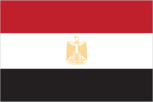
three equal horizontal bands of red (top), white, and black; the national emblem (a gold Eagle of Saladin facing the hoist side with a shield superimposed on its chest above a scroll bearing the name of the country in Arabic) centered in the white band; design is based on the Arab Liberation flag and similar to the flag of Syria, which has two green stars in the white band, Iraq, which has an Arabic inscription centered in the white band, and Yemen, which has a plain white band
Government type
republic
Independence
28 February 1922 (from UK)
International organization participation
ABEDA, ACCT, AfDB, AFESD, AMF, AU, BSEC (observer), CAEU, COMESA, EBRD, FAO, G-15, G-24, G-77, IAEA, IBRD, ICAO, ICC, ICCt (signatory), ICRM, IDA, IDB, IFAD, IFC, IFRCS, IHO, ILO, IMF, IMO, IMSO, Interpol, IOC, IOM, IPU, ISO, ITSO, ITU, LAS, MIGA, MINURCAT, MINURSO, MONUC, NAM, OAPEC, OAS (observer), OIC, OIF, OSCE (partner), PCA, UN, UNAMID, UNCTAD, UNESCO, UNHCR, UNIDO, UNMIL, UNMIS, UNOMIG, UNRWA, UNWTO, UPU, WCO, WFTU, WHO, WIPO, WMO, WTO
Judicial branch
Supreme Constitutional Court
Legal system
based on Islamic and civil law (particularly Napoleonic codes); judicial review by Supreme Court and Council of State (oversees validity of administrative decisions); accepts compulsory ICJ jurisdiction with reservations
Legislative branch
bicameral system consists of the People's Assembly or Majlis al-Sha'b (454 seats; 444 elected by popular vote, 10 appointed by the president; members serve five-year terms) and the Advisory Council or Majlis al-Shura that traditionally functions only in a consultative role but 2007 constitutional amendments could grant the Council new powers (264 seats; 176 elected by popular vote, 88 appointed by the president; members serve six-year terms; mid-term elections for half of the elected members) elections: People's Assembly - three-phase voting - last held 7 and 20 November, 1 December 2005;(next to be held November-December 2010); Advisory Council - last held June 2007 (next to be held May-June 2010) election results: People's Assembly - percent of vote by party - NA; seats by party - NDP 311, NWP 6, Tagammu 2, Tomorrow Party 1, independents 112 (12 seats to be determined by rerun elections, 10 seats appointed by President); Advisory Council - percent of vote by party - NA; seats by party - NDP 84, Tagammu 1, independents 3
National holiday
Revolution Day, 23 July (1952)
Political parties and leaders
National Democratic Party or NDP (governing party) [Mohamed Hosni MUBARAK]; National Progressive Unionist Grouping or Tagammu [Rifaat EL-SAID]; New Wafd Party or NWP [Mahmoud ABAZA]; Tomorrow Party [Moussa Mustafa MOUSSA] note: formation of political parties must be approved by the government; only parties with representation in elected bodies are listed
Political pressure groups and leaders
Muslim Brotherhood (technically illegal) note: despite a constitutional ban against religious-based parties and political activity, the technically illegal Muslim Brotherhood constitutes Hosni MUBARAK's potentially most significant political opposition
Suffrage
18 years of age; universal and compulsory
Economy
Agriculture - products
cotton, rice, corn, wheat, beans, fruits, vegetables; cattle, water buffalo, sheep, goats
Budget
revenues: $35.05 billion expenditures: $44.83 billion (2007 est.)
Central bank discount rate
9% (31 December 2007)
Commercial bank prime lending rate
12.51% (31 December 2007)
Currency (code)
Egyptian pound (EGP)
Currency code
EGP
Current account balance
$500.9 million (2007 est.)
Debt - external
$29.2 billion (30 June 2007)
Distribution of family income - Gini index
34.4 (2001)
Economic aid - recipient
ODA, $925.9 million (2005)
Economy - overview
Occupying the northeast corner of the African continent, Egypt is bisected by the highly fertile Nile valley, where most economic activity takes place. In the last 30 years, the government has reformed the highly centralized economy it inherited from President Gamel Abdel NASSER. In 2005, Prime Minister Ahmed NAZIF's government reduced personal and corporate tax rates, reduced energy subsidies, and privatized several enterprises. The stock market boomed, and GDP grew about 5% per year in 2005-06, and topped 7% in 2007. Despite these achievements, the government has failed to raise living standards for the average Egyptian, and has had to continue providing subsidies for basic necessities. The subsidies have contributed to a sizeable budget deficit - roughly 7.5% of GDP in 2007 - and represent a significant drain on the economy. Foreign direct investment has increased significantly in the past two years, but the NAZIF government will need to continue its aggressive pursuit of reforms in order to sustain the spike in investment and growth and begin to improve economic conditions for the broader population. Egypt's export sectors - particularly natural gas - have bright prospects.
Electricity - consumption
96.2 billion kWh (2006 est.)
Electricity - exports
557 million kWh (2006 est.)
Electricity - imports
208 million kWh (2006 est.)
Electricity - production
109.1 billion kWh (2006 est.)
Electricity - production by source
fossil fuel: 81% hydro: 19% nuclear: 0% other: 0% (2001)
Exchange rates
Egyptian pounds (EGP) per US dollar - 5.67 (2007), 5.725 (2006), 5.78 (2005), 6.1962 (2004), 5.8509 (2003)
Exports
$24.45 billion f.o.b. (2007 est.)
Exports - commodities
crude oil and petroleum products, cotton, textiles, metal products, chemicals
Exports - partners
US 9.7%, Italy 9.5%, Spain 7.6%, Syria 5.5%, Saudi Arabia 4.9%, UK 4.2% (2007)
Fiscal year
1 July - 30 June
GDP - composition by sector
agriculture: 13.8% industry: 38.1% services: 48% (2007 est.)
GDP - per capita (PPP)
$5,000 (2007 est.)
GDP - real growth rate
7.1% (2007 est.)
GDP (official exchange rate)
$127.9 billion (2007 est.)
GDP (purchasing power parity)
$405.4 billion (2007 est.)
Household income or consumption by percentage share
lowest 10%: 3.7% highest 10%: 29.5% (2000)
Imports
$44.95 billion f.o.b. (2007 est.)
Imports - commodities
machinery and equipment, foodstuffs, chemicals, wood products, fuels
Imports - partners
US 11.7%, China 9.7%, Italy 6.4%, Germany 6.3%, Saudi Arabia 4.7%, Russia 4.3% (2007)
Industrial production growth rate
7.5% (2007 est.)
Industries
textiles, food processing, tourism, chemicals, pharmaceuticals, hydrocarbons, construction, cement, metals, light manufactures
Inflation rate (consumer prices)
9.5% (2007 est.)
Investment (gross fixed)
21.2% of GDP (2007 est.)
Labor force
22.1 million (2007 est.)
Labor force - by occupation
agriculture: 32% industry: 17% services: 51% (2001 est.)
Market value of publicly traded shares
$93.48 billion (2006)
Natural gas - consumption
31.8 billion cu m (2007 est.)
Natural gas - exports
15.7 billion cu m (2007 est.)
Natural gas - imports
0 cu m (2007 est.)
Natural gas - production
47.5 billion cu m (2007 est.)
Natural gas - proved reserves
1.656 trillion cu m (1 January 2008 est.)
Oil - consumption
652,700 bbl/day (2006 est.)
Oil - exports
204,700 bbl/day (2005 est.)
Oil - imports
140,000 bbl/day (2005)
Oil - production
664,000 bbl/day (2007 est.)
Oil - proved reserves
3.7 billion bbl (1 January 2008 est.)
Population below poverty line
20% (2005 est.)
Public debt
105.8% of GDP (2007 est.)
Reserves of foreign exchange and gold
$31.37 billion (31 December 2007 est.)
Stock of direct foreign investment - abroad
$1.295 billion (2007 est.)
Stock of direct foreign investment - at home
$48.46 billion (2007 est.)
Stock of domestic credit
$113.9 billion (31 December 2007)
Stock of money
$27.6 billion (31 December 2007)
Stock of quasi money
$102.6 billion (31 December 2007)
Unemployment rate
9.1% (2007 est.)
Communications
Internet country code
.eg
Internet hosts
175,342 (2008)
Internet Service Providers (ISPs)
50 (2000)
Internet users
8.62 million (2007)
Radio broadcast stations
AM 42 (plus 15 repeaters), FM 14, shortwave 3 (1999)
Radios
20.5 million (1997)
Telephone system
general assessment: large system; underwent extensive upgrading during 1990s and is reasonably modern; Telecom Egypt, the landline monopoly, has been increasing service availability and in 2007 fixed-line density stood at 14 per 100 persons; as of 2007 there were three mobile-cellular networks and service is expanding rapidly domestic: principal centers at Alexandria, Cairo, Al Mansurah, Ismailia, Suez, and Tanta are connected by coaxial cable and microwave radio relay international: country code - 20; landing point for both the SEA-ME-WE-3 and SEA-ME-WE-4 submarine cable networks; linked to the international submarine cable FLAG (Fiber-Optic Link Around the Globe); satellite earth stations - 4 (2 Intelsat - Atlantic Ocean and Indian Ocean, 1 Arabsat, and 1 Inmarsat); tropospheric scatter to Sudan; microwave radio relay to Israel; a participant in Medarabtel (2007)
Telephones - main lines in use
11.229 million (2007)
Telephones - mobile cellular
30.065 million (2007)
Television broadcast stations
98 (September 1995)
Televisions
7.7 million (1997)
Transportation
Airports
88 (2007)
Airports - with paved runways
total: 72 over 3,047 m: 15 2,438 to 3,047 m: 36 1,524 to 2,437 m: 16 under 914 m: 5 (2007)
Airports - with unpaved runways
total: 16 2,438 to 3,047 m: 1 1,524 to 2,437 m: 3 914 to 1,523 m: 5 under 914 m: 7 (2007)
Heliports
3 (2007)
Merchant marine
total: 67 by type: bulk carrier 11, cargo 28, container 2, passenger/cargo 4, petroleum tanker 13, roll on/roll off 9 foreign-owned: 10 (Denmark 1, Greece 8, Lebanon 1) registered in other countries: 58 (Cambodia 13, Georgia 12, Honduras 3, North Korea 1, Malta 1, Moldova 1, Panama 17, Saint Kitts and Nevis 2, Saint Vincent and the Grenadines 3, Saudi Arabia 1, Sierra Leone 3, Togo 1) (2008)
Pipelines
condensate 483 km; condensate/gas 74 km; gas 6,466 km; liquid petroleum gas 957 km; oil 5,518 km; oil/gas/water 37 km; refined products 895 km (2007)
Ports and terminals
Ayn Sukhnah, Alexandria, Damietta, El Dekheila, Sidi Kurayr, Suez
Railways
total: 5,063 km standard gauge: 5,063 km 1.435-m gauge (62 km electrified) (2006)
Roadways
total: 92,370 km paved: 74,820 km unpaved: 17,550 km (2004)
Waterways
3,500 km note: includes Nile River, Lake Nasser, Alexandria-Cairo Waterway, and numerous smaller canals in delta; Suez Canal (193.5 km including approaches) navigable by oceangoing vessels drawing up to 17.68 m (2006)
Military and Security
Manpower available for military service
males age 16-49: 21,247,777 females age 16-49: 20,406,408 (2008 est.)
Manpower fit for military service
males age 16-49: 18,153,158 females age 16-49: 17,405,837 (2008 est.)
Manpower reaching militarily significant age annually
male: 825,300 female: 786,590 (2008 est.)
Military branches
Army, Navy, Air Force, Air Defense Command
Military expenditures
3.4% of GDP (2005 est.)
Military service age and obligation
18-30 years of age for male conscript military service; service obligation 12-36 months, followed by a 9-year reserve obligation (2008)
Transnational Issues
Disputes - international
while Sudan retains claim to the Hala'ib Triangle north of the 1899 Treaty boundary along the 22nd Parallel, both states withdrew their military presence in the 1990s and Egypt has invested in and effectively administers the area; Egypt no longer shows its administration of the Bir Tawil trapezoid in Sudan on its maps; Gazan breaches in the security wall with Egypt in January 2008 highlight difficulties in monitoring the Sinai border
Illicit drugs
transit point for cannabis, heroin, and opium moving to Europe, Israel, and North Africa; transit stop for Nigerian drug couriers; concern as money laundering site due to lax enforcement of financial regulations This page was last updated on 18 December, 2008
Refugees and internally displaced persons
refugees (country of origin): 60,000 - 80,000 (Iraq); 70,198 (Palestinian Territories); 12,157 (Sudan) (2007)
Trafficking in persons
current situation: Egypt is a transit country for women trafficked from Eastern European countries to Israel for sexual exploitation, and is a source for children trafficked within the country for commercial sexual exploitation and domestic servitude, although the extent to which children are trafficked internally is unknown; children were also recruited for domestic and agricultural work; some of these children face conditions of involuntary servitude, such as restrictions on movement, non-payment of wages, threats, and physical or sexual abuse tier rating: Tier 2 Watch List - Egypt is on the Tier 2 Watch List for the third year in a row because it did not provide evidence of increasing efforts to investigate and prosecute traffickers; however, in July 2007, the government established the "National Coordinating Committee to Combat and Prevent Trafficking in Persons," which improved inter-governmental coordination on anti-trafficking initiatives; Egypt made no discernible efforts to punish trafficking crimes in 2007 and the Egyptian penal code does not prohibit all forms of trafficking; Egypt did not increase its services to trafficking victims during the reporting period (2008)