1996 Edition
CIA World Factbook 1996 (Project Gutenberg)
Introduction
Description
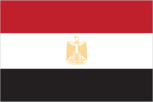
three equal horizontal bands of red (top), white, and black with the national emblem (a shield superimposed on a golden eagle facing the hoist side above a scroll bearing the name of the country in Arabic) centered in the white band; similar to the flag of Yemen, which has a plain white band; also similar to the flag of Syria that has two green stars and to the flag of Iraq, which has three green stars (plus an Arabic inscription) in a horizontal line centered in the white band
Location
27 00 N, 30 00 E -- Northern Africa, bordering the Mediterranean Sea, between Libya and the Gaza Strip Flag ----
Geography
Area
- comparative area
- slightly more than three times the size of New Mexico
- land area
- 995,450 sq km
- total area
- 1,001,450 sq km
Climate
desert; hot, dry summers with moderate winters
Coastline
2,450 km
Environment
- current issues
- agricultural land being lost to urbanization and windblown sands; increasing soil salinization below Aswan High Dam; desertification; oil pollution threatening coral reefs, beaches, and marine habitats; other water pollution from agricultural pesticides, raw sewage, and industrial effluents; very limited natural fresh water resources away from the Nile which is the only perennial water source; rapid growth in population overstraining natural resources
- international agreements
- party to - Biodiversity, Climate Change, Desertification, Endangered Species, Environmental Modification, Hazardous Wastes, Law of the Sea, Marine Dumping, Nuclear Test Ban, Ozone Layer Protection, Ship Pollution, Tropical Timber 83, Wetlands, Whaling; signed, but not ratified - Tropical Timber 94
- natural hazards
- periodic droughts; frequent earthquakes, flash floods, landslides, volcanic activity; hot, driving windstorm called khamsin occurs in spring; dust storms, sandstorms
Geographic coordinates
27 00 N, 30 00 E
Geographic note
controls Sinai Peninsula, only land bridge between Africa and remainder of Eastern Hemisphere; controls Suez Canal, shortest sea link between Indian Ocean and Mediterranean Sea; size, and juxtaposition to Israel, establish its major role in Middle Eastern geopolitics
International disputes
administrative boundary with Sudan does not coincide with international boundary creating the "Hala'ib Triangle," a barren area of 20,580 sq km, tensions over this disputed area began to escalate in 1992 and remain high
Irrigated land
25,850 sq km (1989 est.)
Land boundaries
- border countries
- Gaza Strip 11 km, Israel 255 km, Libya 1,150 km, Sudan 1,273 km
- total
- 2,689 km
Land use
- arable land
- 3%
- forest and woodland
- 0%
- meadows and pastures
- 0%
- other
- 95%
- permanent crops
- 2%
Location
Northern Africa, bordering the Mediterranean Sea, between Libya and the Gaza Strip
Map references
Africa
Maritime claims
- contiguous zone
- 24 nm
- continental shelf
- 200-m depth or to the depth of exploitation
- exclusive economic zone
- 200 nm
- territorial sea
- 12 nm
Natural resources
petroleum, natural gas, iron ore, phosphates, manganese, limestone, gypsum, talc, asbestos, lead, zinc
Terrain
- vast desert plateau interrupted by Nile valley and delta
- highest point
- Mount Catherine 2,629 m
- lowest point
- Qattara Depression -133 m
People and Society
Age structure
0-14 years: 37% (male 11,970,197; female 11,462,689) 15-64 years: 60% (male 19,127,696; female 18,738,304) 65 years and over: 3% (male 1,028,916; female 1,247,305) (July 1996 est.)
Birth rate
28.18 births/1,000 population (1996 est.)
Death rate
8.7 deaths/1,000 population (1996 est.)
Ethnic divisions
Eastern Hamitic stock (Egyptians, Bedouins, and Berbers) 99%, Greek, Nubian, Armenian, other European (primarily Italian and French) 1%
Infant mortality rate
72.8 deaths/1,000 live births (1996 est.)
Languages
Arabic (official), English and French widely understood by educated classes
Life expectancy at birth
- female
- 63.46 years (1996 est.)
- male
- 59.51 years
- total population
- 61.43 years
Literacy
- age 15 and over can read and write (1995 est.)
- female
- 38.8%
- male
- 63.6%
- total population
- 51.4%
Nationality
- adjective
- Egyptian
- noun
- Egyptian(s)
Net migration rate
-0.35 migrant(s)/1,000 population (1996 est.)
Population
63,575,107 (July 1996 est.)
Population growth rate
1.91% (1996 est.)
Religions
Muslim (mostly Sunni) 94% (official estimate), Coptic Christian and other 6% (official estimate)
Sex ratio
- all ages
- 1.02 male(s)/female (1996 est.)
- at birth
- 1.05 male(s)/female
- under 15 years
- 1.04 male(s)/female 15-64 years: 1.02 male(s)/female 65 years and over: 0.82 male(s)/female
Total fertility rate
3.58 children born/woman (1996 est.)
Government
Administrative divisions
26 governorates (muhafazat, singular - muhafazah); Ad Daqahliyah, Al Bahr al Ahmar, Al Buhayrah, Al Fayyum, Al Gharbiyah, Al Iskandariyah, Al Isma'iliyah, Al Jizah, Al Minufiyah, Al Minya, Al Qahirah, Al Qalyubiyah, Al Wadi al Jadid, Ash Sharqiyah, As Suways, Aswan, Asyut, Bani Suwayf, Bur Sa'id, Dumyat, Janub Sina, Kafr ash Shaykh, Matruh, Qina, Shamal Sina, Suhaj
Advisory Council (Majlis al-Shura)
functions only in a consultative role; elections last held 7 June 1995 (next to be held NA); results - NDP 99%, independents 1%; seats - (264 total, 176 elected, 88 appointed by the president) seats by party NA
Capital
Cairo
Constitution
11 September 1971
Data code
EG
Diplomatic representation in US
- chancery
- 3521 International Court NW, Washington, DC 20008
- chief of mission
- Ambassador Ahmed Maher El SAYED
- telephone
- [1] (202) 895-5400
Executive branch
- cabinet
- Cabinet was appointed by the president
- chief of state
- President Mohammed Hosni MUBARAK (sworn in as president 14 October 1981, eight days after the assassination of President SADAT); national referendum held 4 October 1993 validated MUBARAK's nomination by the People's Assembly to a third six-year presidential term; note - the president is nominated by the People's Assembly and that nomination must then be validated by a national, popular referendum
- head of government
- Prime Minister Kamal Ahmed al-GANZOURI (since 4 January 1996) was appointed by the president
FAX
- [1] (202) 244-4319, 5131
- [20] (2) 3573200
- branch office
- Alexandria
- consulate(s) general
- Chicago, Houston, New York, and San Francisco
Flag
three equal horizontal bands of red (top), white, and black with the national emblem (a shield superimposed on a golden eagle facing the hoist side above a scroll bearing the name of the country in Arabic) centered in the white band; similar to the flag of Yemen, which has a plain white band; also similar to the flag of Syria that has two green stars and to the flag of Iraq, which has three green stars (plus an Arabic inscription) in a horizontal line centered in the white band
Independence
28 February 1922 (from UK)
International organization participation
ABEDA, ACC, ACCT (associate), AfDB, AFESD, AG (observer), AL, AMF, BSEC (observer), CAEU, CCC, EBRD, ECA, ESCWA, FAO, G-15, G-19, G-24, G-77, IAEA, IBRD, ICAO, ICC, ICRM, IDA, IDB, IFAD, IFC, IFRCS, ILO, IMF, IMO, Intelsat, Interpol, IOC, IOM, ISO, ITU, MINURSO, NAM, OAPEC, OAS (observer), OAU, OIC, OSCE (partner), PCA, UN, UNAVEM III, UNCRO, UNCTAD, UNESCO, UNIDO, UNOMIG, UNOMIL, UNPREDEP, UNPROFOR, UNRWA, UPU, WFTU, WHO, WIPO, WMO, WToO, WTrO
Judicial branch
Supreme Constitutional Court
Legal system
based on English common law, Islamic law, and Napoleonic codes; judicial review by Supreme Court and Council of State (oversees validity of administrative decisions); accepts compulsory ICJ jurisdiction, with reservations
Legislative branch
bicameral
Name of country
- conventional long form
- Arab Republic of Egypt
- conventional short form
- Egypt
- former
- United Arab Republic (with Syria)
- local long form
- Jumhuriyat Misr al-Arabiyah
- local short form
- none
National holiday
Anniversary of the Revolution, 23 July (1952)
Other political or pressure groups
despite a constitutional ban against religious-based parties, the technically illegal Muslim Brotherhood constitutes MUBARAK's potentially most significant political opposition; MUBARAK tolerated limited political activity by the Brotherhood for his first two terms, but has moved more aggressively in the past year to block its influence; trade unions and professional associations are officially sanctioned
People's Assembly (Majlis al-Cha'b)
elections last held 29 November 1995 (next to be held NA 2000); results - NDP 72%, idependents 25%, opposition 3%; seats - (454 total, 444 elected, 10 appointed by the president) NDP 317, independents 114, NWP 6, NPUG 5, Nasserist Arab Democratic Party 1, Liberals 1
Political parties and leaders
- National Democratic Party (NDP), President Mohammed Hosni MUBARAK, leader, is the dominant party;
- legal opposition parties are as follows
- New Wafd Party (NWP), Fu'ad SIRAJ AL-DIN; Socialist Labor Party (SLP), Ibrahim SHUKRI; National Progressive Unionist Grouping (NPUG), Khalid Muhi al-DIN; Socialist Liberal Party, Mustafa Kamal MURAD; Democratic Unionist Party, Mohammed 'Abd-al-Mun'im TURK; Umma Party, Ahmad al-SABAHI; Misr al-Fatah Party (Young Egypt Party), leader NA; Nasserist Arab Democratic Party, Dia' al-din DAWUD; Democratic Peoples' Party, Anwar AFIFI; The Greens Party, Kamal KIRAH; Social Justice Party, Muhammad 'ABD-AL-'AL
- note
- formation of political parties must be approved by government
Suffrage
18 years of age; universal and compulsory
Type of government
republic
US diplomatic representation
- chief of mission
- Ambassador Edward S. WALKER, Jr.
- embassy
- (North Gate) 8, Kamel El-Din Salah Street, Garden City, Cairo
- mailing address
- APO AE 09839-4900, Unit 64900, Cairo
- telephone
- [20] (2) 3557371
Economy
Agriculture
cotton, rice, corn, wheat, beans, fruits, vegetables; cattle, water buffalo, sheep, goats; annual fish catch about 140,000 metric tons
Budget
- expenditures
- $19.4 billion, including capital expenditures of $3.8 billion (FY94/95 est.)
- revenues
- $18 billion
Currency
1 Egyptian pound (LE) = 100 piasters
Economic aid
- recipient
- ODA, $1.713 billion (1993)
Economic overview
Half of Egypt's GDP originates in the public sector, most industrial plants being owned by the government. Overregulation holds back technical modernization and foreign investment. Even so, the economy grew rapidly during the late 1970s and early 1980s, but in 1986 the collapse of world oil prices and an increasingly heavy burden of debt servicing led Egypt to begin negotiations with the IMF for balance-of-payments support. Egypt's first IMF standby arrangement, concluded in mid-1987, was suspended in early 1988 because of the government's failure to adopt promised reforms. Egypt signed a follow-on program with the IMF and also negotiated a structural adjustment loan with the World Bank in 1991. In 1991-93 the government made solid progress on administrative reforms such as liberalizing exchange and interest rates, but resisted implementing major structural reforms like streamlining the public sector. As a result, the economy has not gained enough momentum to tackle the growing problem of unemployment. Egypt made uneven progress in implementing the successor programs it signed onto in late 1993 with the IMF and World Bank; currently it is negotiating another successor program with the IMF. President MUBARAK has cited population growth as the main cause of the country's economic troubles. The addition of about 1.2 million people a year to the already huge population of 63 million exerts enormous pressure on the 5% of the land area available for agriculture along the Nile.
Electricity
- capacity
- 11,830,000 kW
- consumption per capita
- 695 kWh (1993)
- production
- 44.5 billion kWh
Exchange rates
- Egyptian pounds (LE) per US$1 - 3.4 (November 1994), 3.369 (November 1993), 3.345 (November 1992), 2.7072 (1990);
- market rate
- 3.3920 (January 1996), 3.3900 (1995), 3.3910 (1994), 3.3718 (1993), 3.3386 (1992), 3.3322 (1991)
Exports
- $5.4 billion (f.o.b., FY94/95 est.)
- commodities
- crude oil and petroleum products, cotton yarn, raw cotton, textiles, metal products, chemicals
- partners
- EU, US, Japan
External debt
$33.6 billion (FY93/94 est.)
Fiscal year
1 July - 30 June
GDP
purchasing power parity - $171 billion (1995 est.)
GDP composition by sector
- agriculture
- NA%
- industry
- NA%
- services
- NA%
GDP per capita
$2,760 (1995 est.)
GDP real growth rate
4% (1995 est.)
Illicit drugs
a transit point for Southwest Asian and Southeast Asian heroin and opium moving to Europe and the US; popular transit stop for Nigerian couriers; large domestic consumption of hashish from Lebanon and Syria
Imports
- $15.2 billion (c.i.f., FY94/95 est.)
- commodities
- machinery and equipment, foods, fertilizers, wood products, durable consumer goods, capital goods
- partners
- US, EU, Japan
Industrial production growth rate
NA%
Industries
textiles, food processing, tourism, chemicals, petroleum, construction, cement, metals
Inflation rate (consumer prices)
9.4% (yearend 1995)
Labor force
- 16 million (1994 est.)
- by occupation
- government, public sector enterprises, and armed forces 36%, agriculture 34%, privately owned service and manufacturing enterprises 20% (1984)
- note
- shortage of skilled labor; 2.5 million Egyptians work abroad, mostly in Saudi Arabia and the Gulf Arab states (1993 est.)
Unemployment rate
20% (1995 est.)
Communications
Branches
Army, Navy, Air Force, Air Defense Command
Defense expenditures
exchange rate conversion - $3.5 billion, 8.2% of GDP (FY94/95 est.)
Manpower availability
- males age 15-49
- 16,530,460
- males fit for military service
- 10,723,011
- males reach military age (20) annually
- 660,453 (1996 est.)
Radio broadcast stations
AM 39, FM 6, shortwave 0
Radios
NA
Telephone system
- large system by Third World standards but inadequate for present requirements and undergoing extensive upgrading
- domestic
- principal centers at Alexandria, Cairo, Al Mansurah, Ismailia, Suez, and Tanta are connected by coaxial cable and microwave radio relay
- international
- satellite earth stations - 2 Intelsat (Atlantic Ocean and Indian Ocean), 1 Arabsat, and 1 Inmarsat; 5 coaxial submarine cables; tropospheric scatter to Sudan; microwave radio relay to Israel; participant in Medarabtel
Telephones
2.2 million (1993)
Television broadcast stations
41
Televisions
5 million (1993 est.) Defense
Transportation
Airports
- total
- 80
- with paved runways 1 524 to 2 437 m
- 16
- with paved runways 2 438 to 3 047 m
- 34
- with paved runways 914 to 1 523 m
- 2
- with paved runways over 3 047 m
- 11
- with paved runways under 914 m
- 9
- with unpaved runways 1 524 to 2 437 m
- 2
- with unpaved runways 2 438 to 3 047 m
- 2
- with unpaved runways 914 to 1 523 m
- 4 (1995 est.)
Heliports
2 (1995 est.)
Highways
- paved
- 34,593 km
- total
- 47,387 km
- unpaved
- 12,794 km (1992 est.)
Merchant marine
- ships by type
- bulk 22, cargo 74, liquefied gas tanker 1, oil tanker 14, passenger 33, refrigerated cargo 1, roll-on/roll-off cargo 15, short-sea passenger 4 (1995 est.)
- total
- 164 ships (1,000 GRT or over) totaling 1,187,290 GRT/1,833,108 DWT
Pipelines
crude oil 1,171 km; petroleum products 596 km; natural gas 460 km
Ports
Alexandria, Al Ghardaqah, Aswan, Asyut, Bur Safajah, Damietta, Marsa Matruh, Port Said, Suez
Railways
- standard gauge
- 4,751 km 1,435-m gauge (42 km electrified; 951 km double track)
- total
- 4,751 km
Waterways
3,500 km (including the Nile, Lake Nasser, Alexandria-Cairo Waterway, and numerous smaller canals in the delta); Suez Canal, 193.5 km long (including approaches), used by oceangoing vessels drawing up to 16.1 m of water