2016 Edition
CIA World Factbook 2016 Archive (HTML)
Introduction
Background
What is now Ecuador formed part of the northern Inca Empire until the Spanish conquest in 1533. Quito became a seat of Spanish colonial government in 1563 and part of the Viceroyalty of New Granada in 1717. The territories of the Viceroyalty - New Granada (Colombia), Venezuela, and Quito - gained their independence between 1819 and 1822 and formed a federation known as Gran Colombia. When Quito withdrew in 1830, the traditional name was changed in favor of the "Republic of the Equator." Between 1904 and 1942, Ecuador lost territories in a series of conflicts with its neighbors. A border war with Peru that flared in 1995 was resolved in 1999. Although Ecuador marked 30 years of civilian governance in 2004, the period was marred by political instability. Protests in Quito contributed to the mid-term ouster of three of Ecuador's last four democratically elected presidents. In late 2008, voters approved a new constitution, Ecuador's 20th since gaining independence. General elections were held in February 2013, and voters reelected President Rafael CORREA.
Geography
Area
- 283,561 sq km 276,841 sq km 6,720 sq km includes Galapagos Islands
- land
- 276,841 sq km
- note
- includes Galapagos Islands
- total
- 283,561 sq km
- water
- 6,720 sq km
Area - comparative
slightly smaller than Nevada
Climate
tropical along coast, becoming cooler inland at higher elevations; tropical in Amazonian jungle lowlands
Coastline
2,237 km
Elevation
- 1,117 m lowest point: Pacific Ocean 0 m highest point: Chimborazo 6,267 m because the earth is not a perfect sphere and has an equatorial bulge, the highest point on the planet farthest from its center is Mount Chimborazo not Mount Everest, which is merely the highest peak above sea level
- elevation extremes
- lowest point: Pacific Ocean 0 m
- highest point
- Chimborazo 6,267 m
- mean elevation
- 1,117 m
- note
- because the earth is not a perfect sphere and has an equatorial bulge, the highest point on the planet farthest from its center is Mount Chimborazo not Mount Everest, which is merely the highest peak above sea level
Environment - current issues
deforestation; soil erosion; desertification; water pollution; pollution from oil production wastes in ecologically sensitive areas of the Amazon Basin and Galapagos Islands
Environment - international agreements
- Antarctic-Environmental Protocol, Antarctic Treaty, Biodiversity, Climate Change, Climate Change-Kyoto Protocol, Desertification, Endangered Species, Hazardous Wastes, Ozone Layer Protection, Ship Pollution, Tropical Timber 83, Tropical Timber 94, Wetlands none of the selected agreements
- party to
- Antarctic-Environmental Protocol, Antarctic Treaty, Biodiversity, Climate Change, Climate Change-Kyoto Protocol, Desertification, Endangered Species, Hazardous Wastes, Ozone Layer Protection, Ship Pollution, Tropical Timber 83, Tropical Timber 94, Wetlands
- signed, but not ratified
- none of the selected agreements
Geographic coordinates
2 00 S, 77 30 W
Geography - note
Cotopaxi in Andes is highest active volcano in world
Irrigated land
15,000 sq km (2012)
Land boundaries
- 2,237 km Colombia 708 km, Peru 1,529 km
- border countries (2)
- Colombia 708 km, Peru 1,529 km
- total
- 2,237 km
Land use
- 29.7% arable land 4.7%; permanent crops 5.6%; permanent pasture 19.4% 38.9% 31.4% (2011 est.)
- agricultural land
- 29.7%
- forest
- 38.9%
- other
- 31.4% (2011 est.)
Location
Western South America, bordering the Pacific Ocean at the Equator, between Colombia and Peru
Map references
South America
Maritime claims
- 200 nm 100 nm from 2,500-m isobath
- continental shelf
- 100 nm from 2,500-m isobath
- territorial sea
- 200 nm
Natural hazards
- frequent earthquakes; landslides; volcanic activity; floods; periodic droughts volcanic activity concentrated along the Andes Mountains; Sangay (elev. 5,230 m), which erupted in 2010, is mainland Ecuador's most active volcano; other historically active volcanoes in the Andes include Antisana, Cayambe, Chacana, Cotopaxi, Guagua Pichincha, Reventador, Sumaco, and Tungurahua; Fernandina (elev. 1,476 m), a shield volcano that last erupted in 2009, is the most active of the many Galapagos volcanoes; other historically active Galapagos volcanoes include Wolf, Sierra Negra, Cerro Azul, Pinta, Marchena, and Santiago
- volcanism
- volcanic activity concentrated along the Andes Mountains; Sangay (elev. 5,230 m), which erupted in 2010, is mainland Ecuador's most active volcano; other historically active volcanoes in the Andes include Antisana, Cayambe, Chacana, Cotopaxi, Guagua Pichincha, Reventador, Sumaco, and Tungurahua; Fernandina (elev. 1,476 m), a shield volcano that last erupted in 2009, is the most active of the many Galapagos volcanoes; other historically active Galapagos volcanoes include Wolf, Sierra Negra, Cerro Azul, Pinta, Marchena, and Santiago
Natural resources
petroleum, fish, timber, hydropower
Population - distribution
nearly half of the population is concentrated in the interior in the Andean intermontane basins and valleys, with large concentrations also found along the western coastal strip; the rainforests of the east remain sparsely populated
Terrain
coastal plain (costa), inter-Andean central highlands (sierra), and flat to rolling eastern jungle (oriente)
People and Society
Age structure
- 27.52% (male 2,257,535/female 2,168,198) 18.47% (male 1,508,341/female 1,461,207) 39.38% (male 3,086,599/female 3,245,266) 7.39% (male 581,560/female 606,821) 7.25% (male 554,371/female 610,880) (2016 est.)
- 0-14 years
- 27.52% (male 2,257,535/female 2,168,198)
- 15-24 years
- 18.47% (male 1,508,341/female 1,461,207)
- 25-54 years
- 39.38% (male 3,086,599/female 3,245,266)
- 55-64 years
- 7.39% (male 581,560/female 606,821)
- 65 years and over
- 7.25% (male 554,371/female 610,880) (2016 est.)
Birth rate
18.2 births/1,000 population (2016 est.)
Child labor - children ages 5-14
- 227,599 8% (2008 est.)
- percentage
- 8% (2008 est.)
- total number
- 227,599
Children under the age of 5 years underweight
6.4% (2013)
Death rate
5.1 deaths/1,000 population (2016 est.)
Demographic profile
Ecuador's high poverty and income inequality most affect indigenous, mixed race, and rural populations. The government has increased its social spending to ameliorate these problems, but critics question the efficiency and implementation of its national development plan. Nevertheless, the conditional cash transfer program, which requires participants' children to attend school and have medical check-ups, has helped improve educational attainment and healthcare among poor children. Ecuador is stalled at above replacement level fertility and the population most likely will keep growing rather than stabilize. An estimated 2 to 3 million Ecuadorians live abroad, but increased unemployment in key receiving countries - Spain, the United States, and Italy - is slowing emigration and increasing the likelihood of returnees to Ecuador. The first large-scale emigration of Ecuadorians occurred between 1980 and 2000, when an economic crisis drove Ecuadorians from southern provinces to New York City, where they had trade contacts. A second, nationwide wave of emigration in the late 1990s was caused by another economic downturn, political instability, and a currency crisis. Spain was the logical destination because of its shared language and the wide availability of low-skilled, informal jobs at a time when increased border surveillance made illegal migration to the US difficult. Ecuador has a small but growing immigrant population and is Latin America's top recipient of refugees; 98% are neighboring Colombians fleeing violence in their country.
Dependency ratios
- 55.6% 45.1% 10.4% 9.6% (2015 est.)
- elderly dependency ratio
- 10.4%
- potential support ratio
- 9.6% (2015 est.)
- total dependency ratio
- 55.6%
- youth dependency ratio
- 45.1%
Drinking water source
- urban: 93.4% of population rural: 75.5% of population total: 86.9% of population urban: 6.6% of population rural: 24.5% of population total: 13.1% of population (2015 est.)
- rural
- 24.5% of population
- total
- 13.1% of population (2015 est.)
- urban
- 6.6% of population
Education expenditures
4.2% of GDP (2012)
Ethnic groups
mestizo (mixed Amerindian and white) 71.9%, Montubio 7.4%, Amerindian 7%, white 6.1%, Afroecuadorian 4.3%, mulato 1.9%, black 1%, other 0.4% (2010 est.)
Health expenditures
9.2% of GDP (2014)
HIV/AIDS - adult prevalence rate
0.29% (2015 est.)
HIV/AIDS - deaths
900 (2015 est.)
HIV/AIDS - people living with HIV/AIDS
29,100 (2015 est.)
Hospital bed density
1.6 beds/1,000 population (2011)
Infant mortality rate
- 16.9 deaths/1,000 live births 19.9 deaths/1,000 live births 13.7 deaths/1,000 live births (2016 est.)
- female
- 13.7 deaths/1,000 live births (2016 est.)
- male
- 19.9 deaths/1,000 live births
- total
- 16.9 deaths/1,000 live births
Languages
- Spanish (Castilian) 93% (official), Quechua 4.1%, other indigenous 0.7%, foreign 2.2% (Quechua and Shuar are official languages of intercultural relations; other indigenous languages are in official use by indigenous peoples in the areas they inhabit) (2010 est.)
- note
- (Quechua and Shuar are official languages of intercultural relations; other indigenous languages are in official use by indigenous peoples in the areas they inhabit) (2010 est.)
Life expectancy at birth
- 76.8 years 73.8 years 79.9 years (2016 est.)
- female
- 79.9 years (2016 est.)
- male
- 73.8 years
- total population
- 76.8 years
Literacy
- age 15 and over can read and write 94.5% 95.4% 93.5% (2015 est.)
- definition
- age 15 and over can read and write
- female
- 93.5% (2015 est.)
- male
- 95.4%
- total population
- 94.5%
Major infectious diseases
- high bacterial diarrhea, hepatitis A, and typhoid fever dengue fever and malaria active local transmission of Zika virus by Aedes species mosquitoes has been identified in this country (as of August 2016); it poses an important risk (a large number of cases possible) among US citizens if bitten by an infective mosquito; other less common ways to get Zika are through sex, via blood transfusion, or during pregnancy, in which the pregnant woman passes Zika virus to her fetus (2016)
- degree of risk
- high
- food or waterborne diseases
- bacterial diarrhea, hepatitis A, and typhoid fever
- note
- active local transmission of Zika virus by Aedes species mosquitoes has been identified in this country (as of August 2016); it poses an important risk (a large number of cases possible) among US citizens if bitten by an infective mosquito; other less common ways to get Zika are through sex, via blood transfusion, or during pregnancy, in which the pregnant woman passes Zika virus to her fetus (2016)
- vectorborne diseases
- dengue fever and malaria
Major urban areas - population
Guayaquil 2.709 million; QUITO (capital) 1.726 million (2015)
Maternal mortality rate
64 deaths/100,000 live births (2015 est.)
Median age
- 27.4 years 26.7 years 28.1 years (2016 est.)
- female
- 28.1 years (2016 est.)
- male
- 26.7 years
- total
- 27.4 years
Nationality
- Ecuadorian(s) Ecuadorian
- adjective
- Ecuadorian
- noun
- Ecuadorian(s)
Net migration rate
0 migrant(s)/1,000 population (2016 est.)
Obesity - adult prevalence rate
18% (2014)
Physicians density
1.72 physicians/1,000 population (2011)
Population
16,080,778 (July 2016 est.)
Population distribution
nearly half of the population is concentrated in the interior in the Andean intermontane basins and valleys, with large concentrations also found along the western coastal strip; the rainforests of the east remain sparsely populated
Population growth rate
1.31% (2016 est.)
Religions
- Roman Catholic 74%, Evangelical 10.4%, Jehovah's Witness 1.2%, other 6.4% (includes Mormon Buddhist, Jewish, Spiritualist, Muslim, Hindu, indigenous religions, African American religions, Pentecostal), atheist 7.9%, agnostic 0.1% data represents persons at least 16 years of age from five Ecuadoran cities (2012 est.)
- note
- data represents persons at least 16 years of age from five Ecuadoran cities (2012 est.)
Sanitation facility access
- urban: 87% of population rural: 80.7% of population total: 84.7% of population urban: 13% of population rural: 19.3% of population total: 15.3% of population (2015 est.)
- rural
- 19.3% of population
- total
- 15.3% of population (2015 est.)
- urban
- 13% of population
School life expectancy (primary to tertiary education)
- 14 years 14 years 15 years (2012)
- female
- 15 years (2012)
- male
- 14 years
- total
- 14 years
Sex ratio
- 1.05 male(s)/female 1.04 male(s)/female 1.03 male(s)/female 0.95 male(s)/female 0.96 male(s)/female 0.91 male(s)/female 0.99 male(s)/female (2016 est.)
- 0-14 years
- 1.04 male(s)/female
- 15-24 years
- 1.03 male(s)/female
- 25-54 years
- 0.95 male(s)/female
- 55-64 years
- 0.96 male(s)/female
- 65 years and over
- 0.91 male(s)/female
- at birth
- 1.05 male(s)/female
- total population
- 0.99 male(s)/female (2016 est.)
Total fertility rate
2.22 children born/woman (2016 est.)
Unemployment, youth ages 15-24
- 10.9% 8.4% 15.7% (2013 est.)
- female
- 15.7% (2013 est.)
- male
- 8.4%
- total
- 10.9%
Urbanization
- 63.7% of total population (2015) 1.9% annual rate of change (2010-15 est.)
- rate of urbanization
- 1.9% annual rate of change (2010-15 est.)
- urban population
- 63.7% of total population (2015)
Government
Administrative divisions
24 provinces (provincias, singular - provincia); Azuay, Bolivar, Canar, Carchi, Chimborazo, Cotopaxi, El Oro, Esmeraldas, Galapagos, Guayas, Imbabura, Loja, Los Rios, Manabi, Morona-Santiago, Napo, Orellana, Pastaza, Pichincha, Santa Elena, Santo Domingo de los Tsachilas, Sucumbios, Tungurahua, Zamora-Chinchipe
Capital
- Quito 0 13 S, 78 30 W UTC-5 (same time as Washington, DC, during Standard Time)
- geographic coordinates
- 0 13 S, 78 30 W
- name
- Quito
- time difference
- UTC-5 (same time as Washington, DC, during Standard Time)
Citizenship
- yes yes no 3 years
- citizenship by birth
- yes
- citizenship by descent
- yes
- dual citizenship recognized
- no
- residency requirement for naturalization
- 3 years
Constitution
many previous; latest approved 20 October 2008; amended 2011; note - a 2015 constitutional amendment lifting presidential term limits becomes effective in 2021 (2016)
Country name
- Republic of Ecuador Ecuador Republica del Ecuador Ecuador the country's position on the globe, straddling the Equator, accounts for its Spanish name
- conventional long form
- Republic of Ecuador
- conventional short form
- Ecuador
- etymology
- the country's position on the globe, straddling the Equator, accounts for its Spanish name
- local long form
- Republica del Ecuador
- local short form
- Ecuador
Diplomatic representation from the US
- Ambassador Todd CHAPMAN (since 14 April 2016) Avenida Avigiras E12-170 y Avenida Eloy Alfaro, Quito Avenida Guayacanes N52-205 y Avenida Avigiras [593] (2) 398-5000 [593] (2) 398-5100 Guayaquil
- chief of mission
- Ambassador Todd CHAPMAN (since 14 April 2016)
- consulate(s) general
- Guayaquil
- embassy
- Avenida Avigiras E12-170 y Avenida Eloy Alfaro, Quito
- FAX
- [593] (2) 398-5100
- mailing address
- Avenida Guayacanes N52-205 y Avenida Avigiras
- telephone
- [593] (2) 398-5000
Diplomatic representation in the US
- Ambassador Jose Francisco BORJA Cevallos (since 18 May 2015) 2535 15th Street NW, Washington, DC 20009 [1] (202) 234-7200 [1] (202) 667-3482 Atlanta, Chicago, Houston, Los Angeles, Miami, Minneapolis, New Haven (CT), New Orleans, New York, Newark (NJ), Phoenix, San Francisco
- chancery
- 2535 15th Street NW, Washington, DC 20009
- chief of mission
- Ambassador Jose Francisco BORJA Cevallos (since 18 May 2015)
- consulate(s) general
- Atlanta, Chicago, Houston, Los Angeles, Miami, Minneapolis, New Haven (CT), New Orleans, New York, Newark (NJ), Phoenix, San Francisco
- FAX
- [1] (202) 667-3482
- telephone
- [1] (202) 234-7200
Executive branch
- President Rafael CORREA Delgado (since 15 January 2007); Vice President Jorge GLAS Espinel (since 24 May 2013); note - the president is both chief of state and head of government President Rafael CORREA Delgado (since 15 January 2007); Vice President Jorge GLAS Espinel (since 24 May 2013) Cabinet appointed by the president president and vice president directly elected on the same ballot by absolute majority popular vote in 2 rounds if needed for a 4-year term (eligible for a second term); election last held on 17 February 2013 (next to be held in 2017) President Rafael CORREA Delgado reelected president; percent of vote - Rafael CORREA Delgado (Alianza PAIS Movement) 57.2%, Guillermo LASSO (CREO) 22.7%, Lucio GUTIERREZ (PSP) 6.8%, Mauricio RODAS (SUMA) 3.9%, other 9.4%
- cabinet
- Cabinet appointed by the president
- chief of state
- President Rafael CORREA Delgado (since 15 January 2007); Vice President Jorge GLAS Espinel (since 24 May 2013); note - the president is both chief of state and head of government
- election results
- President Rafael CORREA Delgado reelected president; percent of vote - Rafael CORREA Delgado (Alianza PAIS Movement) 57.2%, Guillermo LASSO (CREO) 22.7%, Lucio GUTIERREZ (PSP) 6.8%, Mauricio RODAS (SUMA) 3.9%, other 9.4%
- elections/appointments
- president and vice president directly elected on the same ballot by absolute majority popular vote in 2 rounds if needed for a 4-year term (eligible for a second term); election last held on 17 February 2013 (next to be held in 2017)
- head of government
- President Rafael CORREA Delgado (since 15 January 2007); Vice President Jorge GLAS Espinel (since 24 May 2013)
Flag description
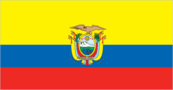
- three horizontal bands of yellow (top, double width), blue, and red with the coat of arms superimposed at the center of the flag; the flag retains the three main colors of the banner of Gran Colombia, the South American republic that broke up in 1830; the yellow color represents sunshine, grain, and mineral wealth, blue the sky, sea, and rivers, and red the blood of patriots spilled in the struggle for freedom and justice similar to the flag of Colombia, which is shorter and does not bear a coat of arms
- note
- similar to the flag of Colombia, which is shorter and does not bear a coat of arms
Government type
presidential republic
Independence
24 May 1822 (from Spain)
International law organization participation
has not submitted an ICJ jurisdiction declaration; accepts ICCt jurisdiction
International organization participation
CAN, CD, CELAC, FAO, G-11, G-77, IADB, IAEA, IBRD, ICAO, ICC (national committees), ICCt, ICRM, IDA, IFAD, IFC, IFRCS, IHO, ILO, IMF, IMO, Interpol, IOC, IOM, IPU, ISO, ITSO, ITU, ITUC (NGOs), LAES, LAIA, Mercosur (associate), MIGA, MINUSTAH, NAM, OAS, OPANAL, OPCW, OPEC, Pacific Alliance (observer), PCA, SICA (observer), UN, UNAMID, UNASUR, UNCTAD, UNESCO, UNHCR, UNIDO, Union Latina, UNISFA, UNMIL, UNMISS, UNOCI, UNWTO, UPU, WCO, WFTU (NGOs), WHO, WIPO, WMO, WTO
Judicial branch
- National Court of Justice or Corte Nacional de Justicia (consists of 21 judges including the chief justice and organized into 5 specialized chambers); Constitutional Court or Corte Constitucional (consists of 9 judges) justices of National Court of Justice elected by the Judiciary Council, a 9-member independent body of law professionals; judges elected for 9-year, non-renewable terms, with one-third of the membership renewed every 3 years; Constitutional Court judges appointed by the executive, legislative, and Citizen Participation branches of government; judges appointed for 9-year non-renewable terms with one-third of the membership renewed every 3 years Fiscal Tribunal; Election Dispute Settlement Courts, provincial courts (one for each province); cantonal courts
- highest court(s)
- National Court of Justice or Corte Nacional de Justicia (consists of 21 judges including the chief justice and organized into 5 specialized chambers); Constitutional Court or Corte Constitucional (consists of 9 judges)
- judge selection and term of office
- justices of National Court of Justice elected by the Judiciary Council, a 9-member independent body of law professionals; judges elected for 9-year, non-renewable terms, with one-third of the membership renewed every 3 years; Constitutional Court judges appointed by the executive, legislative, and Citizen Participation branches of government; judges appointed for 9-year non-renewable terms with one-third of the membership renewed every 3 years
- subordinate courts
- Fiscal Tribunal; Election Dispute Settlement Courts, provincial courts (one for each province); cantonal courts
Legal system
civil law based on the Chilean civil code with modifications; traditional law in indigenous communities
Legislative branch
- unicameral National Assembly or Asamblea Nacional (137 seats; 116 members directly elected in single-seat constituencies by simple majority vote, 15 members directly elected in a single nationwide constituency by proportional representation vote, and 6 directly elected in multi-seat constituencies for Ecuadorians living abroad by simple majority vote; members serve 4-year terms) last held on 17 February 2013 (next to be held in 2017) percent of vote by party - NA; seats by party - PAIS 100, CREO 11, PSC 6, AVANZA 5, MUPP 5, PSP 5, other 5; note - defections by members of National Assembly are commonplace, resulting in frequent changes in the numbers of seats held by the various parties
- description
- unicameral National Assembly or Asamblea Nacional (137 seats; 116 members directly elected in single-seat constituencies by simple majority vote, 15 members directly elected in a single nationwide constituency by proportional representation vote, and 6 directly elected in multi-seat constituencies for Ecuadorians living abroad by simple majority vote; members serve 4-year terms)
- election results
- percent of vote by party - NA; seats by party - PAIS 100, CREO 11, PSC 6, AVANZA 5, MUPP 5, PSP 5, other 5; note - defections by members of National Assembly are commonplace, resulting in frequent changes in the numbers of seats held by the various parties
- elections
- last held on 17 February 2013 (next to be held in 2017)
National anthem
- "Salve, Oh Patria!" (We Salute You, Our Homeland) Juan Leon MERA/Antonio NEUMANE adopted 1948; Juan Leon MERA wrote the lyrics in 1865; only the chorus and second verse are sung
- lyrics/music
- Juan Leon MERA/Antonio NEUMANE
- name
- "Salve, Oh Patria!" (We Salute You, Our Homeland)
- note
- adopted 1948; Juan Leon MERA wrote the lyrics in 1865; only the chorus and second verse are sung
National holiday
Independence Day (independence of Quito), 10 August (1809)
National symbol(s)
- Andean condor; national colors: yellow, blue, red
- Andean condor; national colors
- yellow, blue, red
Political parties and leaders
Alianza PAIS movement [Rafael Vicente CORREA Delgado] Avanza Party or AVANZA [Ramiro GONZALEZ] Creating Opportunities Movement or CREO [Guillermo LASSO] Institutional Renewal and National Action Party or PRIAN [Alvaro NOBOA] Pachakutik Plurinational Unity Movement or MUPP [Rafael ANTUNI] Patriotic Society Party or PSP [Lucio GUTIERREZ Borbua] Popular Democracy Movement or MPD [Luis VILLACIS] Roldosist Party or PRE Social Christian Party or PSC [Pascual DEL CIOPPO] Socialist Party [Fabian SOLANO] Society United for More Action or SUMA [Mauricio RODAS] Warrior's Spirit Movement [Jaime NEBOT]
Political pressure groups and leaders
Confederation of Indigenous Nationalities of Ecuador or CONAIE [Humberto CHOLANGO] Federation of Indigenous Evangelists of Ecuador or FEINE [Manuel CHUGCHILAN, president] National Federation of Indigenous Afro-Ecuatorianos and Peasants or FENOCIN National Teacher's Union or UNE [Mariana PALLASCO]
Suffrage
18-65 years of age, universal and compulsory; 16-18, over 65, and other eligible voters, voluntary
Economy
Agriculture - products
bananas, coffee, cocoa, rice, potatoes, cassava (manioc, tapioca), plantains, sugarcane; cattle, sheep, pigs, beef, pork, dairy products; fish, shrimp; balsa wood
Budget
- $33.59 billion $38.68 billion (2015 est.)
- expenditures
- $38.68 billion (2015 est.)
- revenues
- $33.59 billion
Budget surplus (+) or deficit (-)
-5.2% of GDP (2015 est.)
Central bank discount rate
8.17% (31 December 2011) 8.68% (31 December 2010)
Commercial bank prime lending rate
8.33% (31 December 2015 est.) 8.12% (31 December 2014 est.)
Current account balance
-$2.819 billion (2015 est.) -$567 million (2014 est.)
Debt - external
$30.79 billion (31 December 2015 est.) $26.33 billion (31 December 2014 est.)
Distribution of family income - Gini index
- 48.5 (December 2013) 50.5 (December 2010) data are for urban households
- note
- data are for urban households
Economy - overview
Ecuador is substantially dependent on its petroleum resources, which have accounted for more than half of the country's export earnings and approximately 25% of public sector revenues in recent years. In 1999/2000, Ecuador's economy suffered from a banking crisis, with GDP contracting by 5.3% and poverty increasing significantly. In March 2000, the Congress approved a series of structural reforms that also provided for the adoption of the US dollar as legal tender. Dollarization stabilized the economy, and positive growth returned in the years that followed, helped by high oil prices, remittances, and increased non-traditional exports. The economy grew an average of 4.3% per year from 2002 to 2006, the highest five-year average in 25 years. After moderate growth in 2007, the economy reached a growth rate of 6.4% in 2008, buoyed by high global petroleum prices and increased public sector investment. President Rafael CORREA Delgado, who took office in January 2007, defaulted in December 2008 on Ecuador's sovereign debt, which, with a total face value of approximately US$3.2 billion, represented about 30% of Ecuador's public external debt. In May 2009, Ecuador bought back 91% of its "defaulted" bonds via an international reverse auction. Economic policies under the CORREA administration - for example, an announcement in late 2009 of its intention to terminate 13 bilateral investment treaties, including one with the US - have generated economic uncertainty and discouraged private investment. China has become Ecuador's largest foreign lender since Quito defaulted in 2008, allowing the government to maintain a high rate of social spending; Ecuador contracted with the Chinese government for more than $9.9 billion in forward oil sales, project financing, and budget support loans as of December 2013. The level of foreign investment in Ecuador continues to be one of the lowest in the region as a result of an unstable regulatory environment, weak rule of law, and the crowding-out effect of public investments. Faced with a 2013 trade deficit of $1.1 billion, Ecuador erected technical barriers to trade in December 2013, causing tensions with its largest trading partners. Ecuador also decriminalized intellectual property rights violations in February 2014. In March, 2015 Ecuador imposed tariff surcharges for 15 months from 5% to 45% on an estimated 32% of imports. In 2014, oil output increased slightly and production remained steady in 2015. In 2015, however, lower oil prices forced CORREA to cut the budget twice, and the government has considered further budget and subsidy cuts for 2016.
Exchange rates
the US dollar became Ecuador's currency in 2001
Exports
$19.05 billion (2015 est.) $26.6 billion (2014 est.)
Exports - commodities
petroleum, bananas, cut flowers, shrimp, cacao, coffee, wood, fish
Exports - partners
US 39.5%, Chile 6.2%, Peru 5.1%, Vietnam 4.3%, Colombia 4.3% (2015)
Fiscal year
calendar year
GDP - composition, by end use
- 61% 14.6% 27% 0.4% 21.1% -24.1% (2015 est.)
- exports of goods and services
- 21.1%
- government consumption
- 14.6%
- household consumption
- 61%
- imports of goods and services
- -24.1% (2015 est.)
- investment in fixed capital
- 27%
- investment in inventories
- 0.4%
GDP - composition, by sector of origin
- 6.1% 34.1% 59.7% (2015 est.)
- agriculture
- 6.1%
- industry
- 34.1%
- services
- 59.7% (2015 est.)
GDP - per capita (PPP)
- $11,300 (2015 est.) $11,400 (2014 est.) $11,200 (2013 est.) data are in 2015 US dollars
- note
- data are in 2015 US dollars
GDP - real growth rate
0% (2015 est.) 3.7% (2014 est.) 4.6% (2013 est.)
GDP (official exchange rate)
$98.83 billion (2015 est.)
GDP (purchasing power parity)
- $183.4 billion (2015 est.) $183.3 billion (2014 est.) $176.8 billion (2013 est.) data are in 2015 US dollars
- note
- data are in 2015 US dollars
Gross national saving
25.2% of GDP (2015 est.) 28.1% of GDP (2014 est.) 27.8% of GDP (2013 est.)
Household income or consumption by percentage share
- 1.4% 35.4% data for urban households only (2012 est.)
- highest 10%
- 35.4%
- lowest 10%
- 1.4%
- note
- data for urban households only (2012 est.)
Imports
$20.7 billion (2015 est.) $26.66 billion (2014 est.)
Imports - commodities
industrial materials, fuels and lubricants, nondurable consumer goods
Imports - partners
US 27.1%, China 15.3%, Colombia 8.3%, Panama 4.9% (2015)
Industrial production growth rate
- 0.3% excludes oil refining (2015 est.)
- note
- excludes oil refining (2015 est.)
Industries
petroleum, food processing, textiles, wood products, chemicals
Inflation rate (consumer prices)
4% (2015 est.) 3.6% (2014 est.)
Labor force
4.873 million (2015 est.)
Labor force - by occupation
- 27.8% 17.8% 54.4% (2012)
- agriculture
- 27.8%
- industry
- 17.8%
- services
- 54.4% (2012)
Market value of publicly traded shares
$5.911 billion (31 December 2012 est.) $5.779 billion (31 December 2011 est.) $5.263 billion (31 December 2010 est.)
Population below poverty line
25.6% (December 2013 est)
Public debt
30.5% of GDP (2015 est.) 27.7% of GDP (2014 est.)
Reserves of foreign exchange and gold
$2.496 billion (31 December 2015 est.) $3.949 billion (31 December 2014 est.)
Stock of broad money
$34.53 billion (31 December 2014 est.) $28.44 billion (31 December 2013 est.)
Stock of direct foreign investment - abroad
$6.33 billion (31 December 2012 est.) $6.33 billion (31 December 2011 est.)
Stock of direct foreign investment - at home
$15.63 billion (31 December 2015 est.) $14.57 billion (31 December 2014 est.)
Stock of domestic credit
$33.4 billion (31 December 2015 est.) $31.97 billion (31 December 2014 est.)
Stock of narrow money
$9.527 billion (31 December 2015 est.) $9.531 billion (31 December 2014 est.)
Taxes and other revenues
34% of GDP (2015 est.)
Unemployment rate
4.3% (2015 est.) 4.3% (2014 est.)
Energy
Carbon dioxide emissions from consumption of energy
38 million Mt (2013 est.)
Crude oil - exports
378,000 bbl/day (2013 est.)
Crude oil - imports
0 bbl/day (2013 est.)
Crude oil - production
543,100 bbl/day (2015 est.)
Crude oil - proved reserves
8.832 billion bbl (1 January 2016 es)
Electricity - consumption
21 billion kWh (2014 est.)
Electricity - exports
47 million kWh (2014 est.)
Electricity - from fossil fuels
57.3% of total installed capacity (2012 est.)
Electricity - from hydroelectric plants
41.5% of total installed capacity (2012 est.)
Electricity - from nuclear fuels
0% of total installed capacity (2012 est.)
Electricity - from other renewable sources
1.1% of total installed capacity (2012 est.)
Electricity - imports
800 million kWh (2014 est.)
Electricity - installed generating capacity
6.3 million kW (2014 est.)
Electricity - production
23 billion kWh (2014 est.)
Electricity access
- 500,000 97% 100% 92% (2013)
- electrification - rural areas
- 92% (2013)
- electrification - total population
- 97%
- electrification - urban areas
- 100%
- population without electricity
- 500,000
Natural gas - consumption
578 million cu m (2014 est.)
Natural gas - exports
0 cu m (2013 est.)
Natural gas - imports
0 cu m (2013 est.)
Natural gas - production
578 million cu m (2014 est.)
Natural gas - proved reserves
10.99 billion cu m (1 January 2016 es)
Refined petroleum products - consumption
282,000 bbl/day (2014 est.)
Refined petroleum products - exports
22,890 bbl/day (2013 est.)
Refined petroleum products - imports
133,300 bbl/day (2013 est.)
Refined petroleum products - production
207,300 bbl/day (2013 est.)
Communications
Broadcast media
multiple TV networks and many local channels, as well as more than 300 radio stations; many TV and radio stations are privately owned; the government owns or controls 5 national TV stations and multiple radio stations; broadcast media required by law to give the government free air time to broadcast programs produced by the state (2007)
Internet country code
.ec
Internet users
- 7.766 million 48.9% (July 2015 est.)
- percent of population
- 48.9% (July 2015 est.)
- total
- 7.766 million
Telephone system
- elementary fixed-line service but increasingly sophisticated mobile-cellular network fixed-line services provided by multiple telecommunications operators; fixed-line teledensity stands at about 15 per 100 persons; mobile-cellular use has surged and subscribership has reached 80 per 100 persons country code - 593; landing points for the PAN-AM and South America-1 submarine cables that provide links to the west coast of South America, Panama, Colombia, Venezuela, and extending onward to Aruba and the US Virgin Islands in the Caribbean; satellite earth station - 1 Intelsat (Atlantic Ocean) (2015)
- domestic
- fixed-line services provided by multiple telecommunications operators; fixed-line teledensity stands at about 15 per 100 persons; mobile-cellular use has surged and subscribership has reached 80 per 100 persons
- general assessment
- elementary fixed-line service but increasingly sophisticated mobile-cellular network
- international
- country code - 593; landing points for the PAN-AM and South America-1 submarine cables that provide links to the west coast of South America, Panama, Colombia, Venezuela, and extending onward to Aruba and the US Virgin Islands in the Caribbean; satellite earth station - 1 Intelsat (Atlantic Ocean) (2015)
Telephones - fixed lines
- 2,512,657 16 (July 2015 est.)
- subscriptions per 100 inhabitants
- 16 (July 2015 est.)
- total subscriptions
- 2,512,657
Telephones - mobile cellular
- 12.888 million 81 (July 2015 est.)
- subscriptions per 100 inhabitants
- 81 (July 2015 est.)
- total
- 12.888 million
Transportation
Airports
432 (2013)
Airports - with paved runways
- 51 (2013)
- 1,524 to 2,437 m
- 18
- 2,438 to 3,047 m
- 5
- 914 to 1,523 m
- 26
- over 3,047 m
- 4
- total
- 104
- under 914 m
- 51 (2013)
Airports - with unpaved runways
- 291 (2013)
- 914 to 1,523 m
- 37
- total
- 328
- under 914 m
- 291 (2013)
Civil aircraft registration country code prefix
HC (2016)
Heliports
2 (2013)
Merchant marine
- cargo 1, chemical tanker 4, liquefied gas 1, passenger 9, petroleum tanker 28, refrigerated cargo 1 4 (Panama 3, Peru 1) (2010)
- by type
- cargo 1, chemical tanker 4, liquefied gas 1, passenger 9, petroleum tanker 28, refrigerated cargo 1
- registered in other countries
- 4 (Panama 3, Peru 1) (2010)
- total
- 44
National air transport system
- 5,762,485 86,128,720 mt-km (2015)
- annual freight traffic on registered air carriers
- 86,128,720 mt-km (2015)
- annual passenger traffic on registered air carriers
- 5,762,485
- inventory of registered aircraft operated by air carriers
- 35
- number of registered air carriers
- 7
Pipelines
extra heavy crude 527 km; gas 71 km; oil 2,131 km; refined products 1,526 km (2013)
Ports and terminals
- Esmeraldas, Manta, Puerto Bolivar Guayaquil (Guayas) Guayaquil (1,405,762)
- container port(s) (TEUs)
- Guayaquil (1,405,762)
- major seaport(s)
- Esmeraldas, Manta, Puerto Bolivar
- river port(s)
- Guayaquil (Guayas)
Railways
- 965 km 965 km 1.067-m gauge (2014)
- narrow gauge
- 965 km 1.067-m gauge (2014)
- total
- 965 km
Roadways
- 43,670 km 6,472 km 37,198 km (2007)
- paved
- 6,472 km
- total
- 43,670 km
- unpaved
- 37,198 km (2007)
Transportation - note
the International Maritime Bureau continues to report the territorial and offshore waters as at risk for piracy and armed robbery against ships; vessels, including commercial shipping and pleasure craft, have been attacked and hijacked both at anchor and while underway; crews have been robbed and stores or cargoes stolen
Waterways
1,500 km (most inaccessible) (2012)
Military and Security
Military branches
- Ecuadorian Armed Forces: Ecuadorian Land Force (Fuerza Terrestre Ecuatoriana, FTE), Ecuadorian Navy (Fuerza Naval del Ecuador (FNE), includes Naval Infantry, Naval Aviation, Coast Guard), Ecuadorian Air Force (Fuerza Aerea Ecuatoriana, FAE) (2012)
- Ecuadorian Armed Forces
- Ecuadorian Land Force (Fuerza Terrestre Ecuatoriana, FTE), Ecuadorian Navy (Fuerza Naval del Ecuador (FNE), includes Naval Infantry, Naval Aviation, Coast Guard), Ecuadorian Air Force (Fuerza Aerea Ecuatoriana, FAE) (2012)
Military expenditures
2.83% of GDP (2012) 3.2% of GDP (2011) 2.83% of GDP (2010)
Military service age and obligation
18 years of age for selective conscript military service; conscription has been suspended; 18 years of age for voluntary military service; Air Force 18-22 years of age, Ecuadorian birth requirement; 1-year service obligation (2012)
Transnational Issues
Disputes - international
organized illegal narcotics operations in Colombia penetrate across Ecuador's shared border, which thousands of Colombians also cross to escape the violence in their home country
Illicit drugs
significant transit country for cocaine originating in Colombia and Peru, with much of the US-bound cocaine passing through Ecuadorian Pacific waters; importer of precursor chemicals used in production of illicit narcotics; attractive location for cash-placement by drug traffickers laundering money because of dollarization and weak anti-money-laundering regime; increased activity on the northern frontier by trafficking groups and Colombian insurgents (2008)
Refugees and internally displaced persons
- 120,685 (Colombia) (2015) 28,775 (earthquake April 2016) (2016)
- IDPs
- 28,775 (earthquake April 2016) (2016)
- refugees (country of origin)
- 120,685 (Colombia) (2015)