2009 Edition
CIA World Factbook 2009 (Project Gutenberg)
Introduction
Background
What is now Ecuador formed part of the northern Inca Empire until the Spanish conquest in 1533. Quito became a seat of Spanish colonial government in 1563 and part of the Viceroyalty of New Granada in 1717. The territories of the Viceroyalty - New Granada (Colombia), Venezuela, and Quito - gained their independence between 1819 and 1822 and formed a federation known as Gran Colombia. When Quito withdrew in 1830, the traditional name was changed in favor of the "Republic of the Equator." Between 1904 and 1942, Ecuador lost territories in a series of conflicts with its neighbors. A border war with Peru that flared in 1995 was resolved in 1999. Although Ecuador marked 25 years of civilian governance in 2004, the period has been marred by political instability. Protests in Quito have contributed to the mid-term ouster of Ecuador's last three democratically elected Presidents. In September 2008, voters approved a new constitution; Ecuador's twentieth since gaining independence. General elections, under the new constitutional framework, are expected in April 2009.
Geography
Area
total: 283,561 sq km country comparison to the world: 73 land: 276,841 sq km water: 6,720 sq km note: includes Galapagos Islands
Area - comparative
slightly smaller than Nevada
Climate
tropical along coast, becoming cooler inland at higher elevations; tropical in Amazonian jungle lowlands
Coastline
2,237 km
Elevation extremes
lowest point: Pacific Ocean 0 m highest point: Chimborazo 6,267 m note: due to the fact that the earth is not a perfect sphere and has an equatorial bulge, the highest point on the planet furthest from its center is Mount Chimborazo not Mount Everest, which is merely the highest point above sea-level
Environment - current issues
deforestation; soil erosion; desertification; water pollution; pollution from oil production wastes in ecologically sensitive areas of the Amazon Basin and Galapagos Islands
Environment - international agreements
party to: Antarctic-Environmental Protocol, Antarctic Treaty, Biodiversity, Climate Change, Climate Change-Kyoto Protocol, Desertification, Endangered Species, Hazardous Wastes, Ozone Layer Protection, Ship Pollution, Tropical Timber 83, Tropical Timber 94, Wetlands signed, but not ratified: none of the selected agreements
Freshwater withdrawal (domestic/industrial/agricultural)
total: 16.98 cu km/yr (12%/5%/82%) per capita: 1,283 cu m/yr (2000)
Geographic coordinates
2 00 S, 77 30 W
Geography - note
Cotopaxi in Andes is highest active volcano in world
Irrigated land
8,650 sq km (2003)
Land boundaries
total: 2,010 km border countries: Colombia 590 km, Peru 1,420 km
Land use
arable land: 5.71% permanent crops: 4.81% other: 89.48% (2005)
Location
Western South America, bordering the Pacific Ocean at the Equator, between Colombia and Peru
Map references
South America
Maritime claims
territorial sea: 200 nm continental shelf: 100 nm from 2,500-m isobath
Natural hazards
frequent earthquakes; landslides; volcanic activity; floods; periodic droughts
Natural resources
petroleum, fish, timber, hydropower
Terrain
coastal plain (costa), inter-Andean central highlands (sierra), and flat to rolling eastern jungle (oriente)
Total renewable water resources
432 cu km (2000)
People and Society
Age structure
0-14 years: 31.1% (male 2,312,610/female 2,220,378) 15-64 years: 62.7% (male 4,506,908/female 4,636,703) 65 years and over: 6.2% (male 432,144/female 464,358) (2009 est.)
Birth rate
20.77 births/1,000 population (2009 est.) country comparison to the world: 94
Death rate
4.99 deaths/1,000 population (July 2009 est.) country comparison to the world: 191
Education expenditures
1% of GDP (2001) country comparison to the world: 179
Ethnic groups
mestizo (mixed Amerindian and white) 65%, Amerindian 25%, Spanish and others 7%, black 3%
HIV/AIDS - adult prevalence rate
0.3% (2007 est.) country comparison to the world: 86
HIV/AIDS - deaths
1,400 (2007 est.) country comparison to the world: 68
HIV/AIDS - people living with HIV/AIDS
26,000 (2007 est.) country comparison to the world: 73
Infant mortality rate
total: 20.9 deaths/1,000 live births country comparison to the world: 103 male: 24.4 deaths/1,000 live births female: 17.24 deaths/1,000 live births (2009 est.)
Languages
Spanish (official), Amerindian languages (especially Quechua)
Life expectancy at birth
total population: 75.3 years country comparison to the world: 81 male: 72.37 years female: 78.37 years (2009 est.)
Literacy
definition: age 15 and over can read and write total population: 91% male: 92.3% female: 89.7% (2001 census)
Major infectious diseases
degree of risk: high food or waterborne diseases: bacterial diarrhea, hepatitis A, and typhoid fever vectorborne diseases: dengue fever and malaria water contact disease: leptospirosis (2009)
Median age
total: 25 years male: 24.4 years female: 25.6 years (2009 est.)
Nationality
noun: Ecuadorian(s) adjective: Ecuadorian
Net migration rate
-0.81 migrant(s)/1,000 population (2009 est.) country comparison to the world: 119
Population
14,573,101 (July 2009 est.) country comparison to the world: 64
Population growth rate
1.497% (2009 est.) country comparison to the world: 88
Religions
Roman Catholic 95%, other 5%
Sex ratio
at birth: 1.05 male(s)/female under 15 years: 1.04 male(s)/female 15-64 years: 0.97 male(s)/female 65 years and over: 0.93 male(s)/female total population: 0.99 male(s)/female (2009 est.)
Total fertility rate
2.51 children born/woman (2009 est.) country comparison to the world: 93
Urbanization
urban population: 66% of total population (2008) rate of urbanization: 2.1% annual rate of change (2005-10 est.)
Government
Administrative divisions
24 provinces (provincias, singular - provincia); Azuay, Bolivar, Canar, Carchi, Chimborazo, Cotopaxi, El Oro, Esmeraldas, Galapagos, Guayas, Imbabura, Loja, Los Rios, Manabi, Morona-Santiago, Napo, Orellana, Pastaza, Pichincha, Santa Elena, Santo Domingo de los Tsachilas, Sucumbios, Tungurahua, Zamora-Chinchipe
Capital
name: Quito geographic coordinates: 0 13 S, 78 30 W time difference: UTC-5 (same time as Washington, DC during Standard Time)
Constitution
20 October 2008
Country name
conventional long form: Republic of Ecuador conventional short form: Ecuador local long form: Republica del Ecuador local short form: Ecuador
Diplomatic representation from the US
chief of mission: Ambassador Heather HODGES embassy: Avenida Avigiras E12-170 y Avenida Eloy Alfaro, Quito mailing address: Avenida Guayacanes N52-205 y Avenida Avigiras telephone: [593] (2) 398-5000
Diplomatic representation in the US
chief of mission: Ambassador Luis Benigno GALLEGOS Chiriboga chancery: 2535 15th Street NW, Washington, DC 20009 telephone: [1] (202) 234-7200
Executive branch
chief of state: President Rafael CORREA Delgado (since 15 January 2007); Vice President Lenin MORENO Garces (since 15 January 2007); note - the president is both the chief of state and head of
FAX
- [1] (202) 667-3482 consulate(s) general: Chicago, Houston, Los Angeles, Miami, New Orleans, New York, Newark (New Jersey), San Francisco
- [593] (2) 398-5100 consulate(s) general: Guayaquil
Flag description
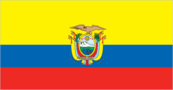
three horizontal bands of yellow (top, double width), blue, and red with the coat of arms superimposed at the center of the flag; similar to the flag of Colombia, which is shorter and does not bear a coat of arms
Government type
republic
Independence
24 May 1822 (from Spain)
International organization participation
CAN, FAO, G-77, IADB, IAEA, IBRD, ICAO, ICC, ICCt, ICRM, IDA, IFAD, IFC, IFRCS, IHO, ILO, IMF, IMO, Interpol, IOC, IOM, IPU, ISO, ITSO, ITU, ITUC, LAES, LAIA, Mercosur (associate), MIGA, MINURCAT, MINUSTAH, NAM, OAS, OPANAL, OPCW, OPEC, PCA, RG, UN, UNASUR, UNCTAD, UNESCO, UNHCR, UNIDO, Union Latina, UNMIL, UNMIS, UNOCI, UNWTO, UPU, WCL, WCO, WFTU, WHO, WIPO, WMO, WTO
Judicial branch
Supreme Court or Corte Suprema (according to the Constitution, new justices are elected by the full Supreme Court; in December 2004, however, Congress successfully replaced the entire court by a simple majority resolution)
Legal system
based on civil law system; has not accepted compulsory ICJ jurisdiction
Legislative branch
unicameral National Congress or Congreso Nacional (100 seats; members are elected through a party-list proportional representation system to serve four-year terms) elections: last held 15 October 2006 (next to be held 26 April 2009) election results: percent of vote by party - NA; seats by party - PRIAN 28; PSP 24; PSC 13; ID 7; PRE 6; MUPP-NP 6; RED 5; UDC 5; other 6; note - defections by members of National Congress are commonplace, resulting in frequent changes in the numbers of seats held by the various parties note: when a Constituent Assembly was convened to draft a new constitution, the National Congress was placed on indefinite recess and replaced by a legislative committee; the legislative committee will continue to function until a new National Assembly is elected in April 2009
National holiday
Independence Day (independence of Quito), 10 August (1809)
Political parties and leaders
Alianza PAIS Movement [Rafael Vicente CORREA Delgado]; Christian Democratic Union or UDC [Diego ORDONEZ Guerrero]; Democratic Left or ID [Andres PAEZ Benalcazar]; Ethical and Democratic Network or RED [Leon ROLDOS]; Institutional Renewal and National Action Party or PRIAN [Alvaro NOBOA]; Pachakutik Plurinational Unity Movement - New Country or MUPP-NP [Jorge GUAMAN]; Patriotic Society Party or PSP [Lucio GUTIERREZ Borbua]; Popular Democratic Movement or MPD [Ciro GUZMAN Aldaz]; Roldosist Party or PRE [Abdala BUCARAM Ortiz, director]; Social Christian Party or PSC [Pascual DEL CIOPPO]; Socialist Party - Broad Front or PS-FA [Gustavo AYALA Cruz]
Political pressure groups and leaders
Confederation of Indigenous Nationalities of Ecuador or CONAIE [Marlon SANTI, president]; Coordinator of Social Movements or CMS [F. Napoleon SANTOS]; Federation of Indigenous Evangelists of Ecuador or FEINE [Marco MURILLO, president]; National Federation of Indigenous Afro-Ecuatorianos and Peasants or FENOCIN [Pedro DE LA CRUZ, president]
Suffrage
18 years of age; universal, compulsory for literate persons ages 18-65, optional for other eligible voters
Economy
Agriculture - products
bananas, coffee, cocoa, rice, potatoes, manioc (tapioca), plantains, sugarcane; cattle, sheep, pigs, beef, pork, dairy products; balsa wood; fish, shrimp
Budget
revenues: $21.09 billion expenditures: planned $21.35 billion (2008 est.)
Central bank discount rate
9.14% (31 December 2008) country comparison to the world: 34 10.72% (31 December 2007)
Commercial bank prime lending rate
9.71% (31 December 2008)
Current account balance
$1.194 billion (2008 est.) country comparison to the world: 45 $1.65 billion (2007 est.)
Debt - external
$18.11 billion (31 December 2008) country comparison to the world: 74 $NA (31 December 2007)
Distribution of family income - Gini index
46 (2006) country comparison to the world: 39 43.7 (1995) note: data are for urban households
Economy - overview
Ecuador is substantially dependent on its petroleum resources, which have accounted for more than half of the country's export earnings and one-fourth of public sector revenues in recent years. In 1999/2000, Ecuador suffered a severe economic crisis, with GDP contracting by more than 6%. Poverty increased significantly, the banking system collapsed, and Ecuador defaulted on its external debt later that year. In March 2000, Congress approved a series of structural reforms that also provided for the adoption of the US dollar as legal tender. Dollarization stabilized the economy, and positive growth returned in the years that followed, helped by high oil prices, remittances, and increased non-traditional exports. From 2002-06 the economy grew 5.5%, the highest five-year average in 25 years. The poverty rate declined but remained high at 38% in 2006. In 2006 the government imposed a windfall revenue tax on foreign oil companies, leading to the suspension of free trade negotiations with the US. These measures led to a drop in petroleum production in 2007. President Rafael CORREA raised the specter of debt default and followed through on those threats in December 2008 by defaulting on some commercial bond obligations. He also decreed a higher windfall revenue tax on private oil companies, then renegotiated their contracts to overcome the debilitating effect of the tax. This generated economic uncertainty; private investment has dropped and economic growth has slowed.
Electricity - consumption
9.888 billion kWh (2007 est.) country comparison to the world: 85
Electricity - exports
38.53 million kWh (2007 est.)
Electricity - imports
861 million kWh (2007 est.)
Electricity - production
16.75 billion kWh (2007 est.) country comparison to the world: 75
Exchange rates
the US dollar is used; the sucre was eliminated in 2000
Exports
$19.15 billion (2008 est.) country comparison to the world: 74 $14.87 billion (2007 est.)
Exports - commodities
petroleum, bananas, cut flowers, shrimp, cacao, coffee, hemp, wood, fish
Exports - partners
US 45.3%, Peru 9.2%, Chile 8.1%, Panama 4.8%, Colombia 4.2% (2008)
GDP - composition by sector
agriculture: 6.7% industry: 34.3% services: 59% (2008 est.)
GDP - per capita (PPP)
$7,500 (2008 est.) country comparison to the world: 123 $7,200 (2007 est.) $7,100 (2006 est.) note: data are in 2008 US dollars
GDP - real growth rate
6.5% (2008 est.) country comparison to the world: 46 2.5% (2007 est.) 3.9% (2006 est.)
GDP (official exchange rate)
$54.69 billion (2008 est.)
GDP (purchasing power parity)
$108 billion (2008 est.) country comparison to the world: 65 $101.4 billion (2007 est.) $98.93 billion (2006 est.) note: data are in 2008 US dollars
Household income or consumption by percentage share
lowest 10%: 1.2% highest 10%: 43.3% note: data for urban households only (2007)
Imports
$17.79 billion (2008 est.) country comparison to the world: 74 $13.05 billion (2007 est.)
Imports - commodities
industrial materials, fuels and lubricants, nondurable consumer goods
Imports - partners
US 19.1%, Venezuela 13.8%, Colombia 9.9%, China 8.4%, Brazil 4.8%, Japan 4.1% (2008)
Industrial production growth rate
5.5% (2008 est.) country comparison to the world: 44
Industries
petroleum, food processing, textiles, wood products, chemicals
Inflation rate (consumer prices)
8.3% (2008 est.) country comparison to the world: 128 2.3% (2007 est.)
Investment (gross fixed)
22.1% of GDP (2008 est.) country comparison to the world: 80
Labor force
4.64 million (urban) (2008 est.) country comparison to the world: 79
Labor force - by occupation
agriculture: 8.3% industry: 21.2% services: 70.4% (2005)
Market value of publicly traded shares
$4.562 billion (31 December 2008) country comparison to the world: 89 $4.266 billion (31 December 2007) $4.04 billion (31 December 2006)
Natural gas - consumption
260 million cu m (2008 est.) country comparison to the world: 99
Natural gas - exports
0 cu m (2008) country comparison to the world: 187
Natural gas - imports
0 cu m (2008 est.) country comparison to the world: 88
Natural gas - production
260 million cu m (2008 est.) country comparison to the world: 73
Natural gas - proved reserves
8.919 billion cu m (1 January 2009 est.) country comparison to the world: 80
Oil - consumption
178,000 bbl/day (2008 est.) country comparison to the world: 62
Oil - exports
417,000 bbl/day (2007 est.) country comparison to the world: 33
Oil - imports
54,190 bbl/day (2007 est.) country comparison to the world: 85
Oil - production
505,100 bbl/day (2008 est.) country comparison to the world: 31
Oil - proved reserves
4.66 billion bbl (1 January 2009 est.) country comparison to the world: 25
Population below poverty line
38.3% (2006)
Public debt
25.1% of GDP (2008 est.) country comparison to the world: 82
Reserves of foreign exchange and gold
$4.473 billion (31 December 2008 est.) country comparison to the world: 82 $3.521 billion (31 December 2007 est.)
Stock of direct foreign investment - abroad
$8.487 billion (31 December 2008 est.) country comparison to the world: 48 $10.77 billion (31 December 2007 est.)
Stock of direct foreign investment - at home
$16.99 billion (31 December 2008 est.) country comparison to the world: 65 $16.31 billion (31 December 2007 est.)
Stock of domestic credit
$10.13 billion (31 December 2008) country comparison to the world: 71 $8.926 billion (31 December 2007)
Stock of money
$5.907 billion (31 December 2008) country comparison to the world: 53 $4.395 billion (31 December 2007)
Stock of quasi money
$9.383 billion (31 December 2008) country comparison to the world: 53 $7.974 billion (31 December 2007)
Unemployment rate
7.3% (2008 est.) country comparison to the world: 92 8.8% (2007 est.)
Communications
Internet country code
.ec
Internet hosts
57,785 (2009) country comparison to the world: 80
Internet users
1.31 million (2008) country comparison to the world: 80
Radio broadcast stations
AM 392, FM 35, shortwave 29 (2001)
Telephone system
general assessment: generally elementary but being expanded domestic: fixed-line services provided by three state-owned enterprises; plans to transfer the state-owned operators to private ownership have repeatedly failed; fixed-line density stands at about 14 per 100 persons; mobile cellular use has surged and has a subscribership of nearly 85 per 100 persons international: country code - 593; landing point for the PAN-AM submarine telecommunications cable that provides links to the west coast of South America, Panama, Colombia, Venezuela, and extending onward to Aruba and the US Virgin Islands in the Caribbean; satellite earth station - 1 Intelsat (Atlantic Ocean) (2008)
Telephones - main lines in use
1.91 million (2008) country comparison to the world: 58
Telephones - mobile cellular
11.595 million (2008) country comparison to the world: 52
Television broadcast stations
7 (plus 14 repeaters) (2000)
Transportation
Airports
420 (2009) country comparison to the world: 19
Airports - with paved runways
total: 103 over 3,047 m: 3 2,438 to 3,047 m: 3 1,524 to 2,437 m: 18 914 to 1,523 m: 25 under 914 m: 54 (2009)
Airports - with unpaved runways
total: 317 914 to 1,523 m: 38 under 914 m: 279 (2009)
Heliports
2 (2009)
Merchant marine
total: 37 country comparison to the world: 80 by type: cargo 1, chemical tanker 1, liquefied gas 1, passenger 8, petroleum tanker 24, refrigerated cargo 1, specialized tanker 1 foreign-owned: 1 (US 1) registered in other countries: 5 (China 1, Panama 4) (2008)
Pipelines
extra heavy crude 435 km; gas 5 km; oil 1,374 km; refined products 1,301 km (2008)
Ports and terminals
Esmeraldas, Guayaquil, Manta, Puerto Bolivar
Railways
total: 965 km country comparison to the world: 90 narrow gauge: 965 km 1.067-m gauge (2008)
Roadways
total: 43,670 km country comparison to the world: 84 paved: 6,472 km unpaved: 37,198 km (2006)
Waterways
1,500 km (most inaccessible) (2008) country comparison to the world: 54
Military and Security
Manpower available for military service
males age 16-49: 3,536,602 females age 16-49: 3,559,188 (2008 est.)
Manpower fit for military service
males age 16-49: 2,708,470 females age 16-49: 3,165,489 (2009 est.)
Manpower reaching militarily significant age annually
male: 148,010 female: 143,291 (2009 est.)
Military branches
Army, Navy (includes Naval Infantry, Naval Aviation, Coast Guard), Air Force (Fuerza Aerea Ecuatoriana, FAE) (2007)
Military expenditures
2.8% of GDP (2006) country comparison to the world: 55
Military service age and obligation
20 years of age for selective conscript military service; 12-month service obligation (2008)
Transnational Issues
Disputes - international
organized illegal narcotics operations in Colombia penetrate across Ecuador's shared border, which thousands of Colombians also cross to escape the violence in their home country
Illicit drugs
significant transit country for cocaine originating in Colombia and Peru, with much of the US-bound cocaine passing through Ecuadorian Pacific waters; importer of precursor chemicals used in production of illicit narcotics; attractive location for cash-placement by drug traffickers laundering money because of dollarization and weak anti-money-laundering regime; increased activity on the northern frontier by trafficking groups and Colombian insurgents (2008) page last updated on November 11, 2009
Refugees and internally displaced persons
refugees (country of origin): 11,526 (Colombia); note - UNHCR estimates as many as 250,000 Columbians are seeking asylum in Ecuador, many of whom do not register as refugees for fear of deportation (2007)