1996 Edition
CIA World Factbook 1996 (Project Gutenberg)
Introduction
Description
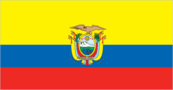
three horizontal bands of yellow (top, double width), blue, and red with the coat of arms superimposed at the center of the flag; similar to the flag of Colombia that is shorter and does not bear a coat of arms
Location
2 00 S, 77 30 W -- Western South America, bordering the Pacific Ocean at the Equator, between Colombia and Peru Flag ----
Geography
Area
- comparative area
- slightly smaller than Nevada
- land area
- 276,840 sq km
- note
- includes Galapagos Islands
- total area
- 283,560 sq km
Climate
tropical along coast becoming cooler inland
Coastline
2,237 km
Environment
- current issues
- deforestation; soil erosion; desertification; water pollution
- international agreements
- party to - Antarctic-Environmental Protocol, Antarctic Treaty, Biodiversity, Climate Change, Desertification, Endangered Species, Hazardous Wastes, Nuclear Test Ban, Ozone Layer Protection, Ship Pollution, Tropical Timber 83, Tropical Timber 94, Wetlands, Whaling
- natural hazards
- frequent earthquakes, landslides, volcanic activity; periodic droughts
Geographic coordinates
2 00 S, 77 30 W
Geographic note
Cotopaxi in Andes is highest active volcano in world
International disputes
three sections of the boundary with Peru are in dispute
Irrigated land
5,500 sq km (1989 est.)
Land boundaries
- border countries
- Colombia 590 km, Peru 1,420 km
- total
- 2,010 km
Land use
- arable land
- 6%
- forest and woodland
- 51%
- meadows and pastures
- 17%
- other
- 23%
- permanent crops
- 3%
Location
Western South America, bordering the Pacific Ocean at the Equator, between Colombia and Peru
Map references
South America
Maritime claims
- continental shelf
- claims continental shelf between mainland and Galapagos Islands
- territorial sea
- 200 nm
Natural resources
petroleum, fish, timber
Terrain
- coastal plain (costa), inter-Andean central highlands (sierra), and flat to rolling eastern jungle (oriente)
- highest point
- Chimborazo 6,267 m
- lowest point
- Pacific Ocean 0 m
People and Society
Age structure
0-14 years: 35% (male 2,062,468; female 1,996,679) 15-64 years: 60% (male 3,403,197; female 3,489,728) 65 years and over: 5% (male 241,217; female 273,002) (July 1996 est.)
Birth rate
25.06 births/1,000 population (1996 est.)
Death rate
5.5 deaths/1,000 population (1996 est.)
Ethnic divisions
mestizo (mixed Indian and Spanish) 55%, Indian 25%, Spanish 10%, black 10%
Infant mortality rate
34.8 deaths/1,000 live births (1996 est.)
Languages
Spanish (official), Indian languages (especially Quechua)
Life expectancy at birth
- female
- 73.82 years (1996 est.)
- male
- 68.49 years
- total population
- 71.09 years
Literacy
- age 15 and over can read and write (1995 est.)
- female
- 88.2%
- male
- 92%
- total population
- 90.1%
Nationality
- adjective
- Ecuadorian
- noun
- Ecuadorian(s)
Net migration rate
0 migrant(s)/1,000 population (1996 est.)
Population
11,466,291 (July 1996 est.)
Population growth rate
1.96% (1996 est.)
Religions
Roman Catholic 95%
Sex ratio
- all ages
- 0.99 male(s)/female (1996 est.)
- at birth
- 1.05 male(s)/female
- under 15 years
- 1.03 male(s)/female 15-64 years: 0.98 male(s)/female 65 years and over: 0.88 male(s)/female
Total fertility rate
2.89 children born/woman (1996 est.)
Government
Administrative divisions
21 provinces (provincias, singular - provincia); Azuay, Bolivar, Canar, Carchi, Chimborazo, Cotopaxi, El Oro, Esmeraldas, Galapagos, Guayas, Imbabura, Loja, Los Rios, Manabi, Morona-Santiago, Napo, Pastaza, Pichincha, Sucumbios, Tungurahua, Zamora-Chinchipe
Capital
Quito
Center-Left parties
Democratic Left (ID), Andres VALLEJO Arcos, Rodrigo BORJA Cevallos, leaders; Popular Democracy (DP), Rodrigo PAZ, leader; Ecuadorian Radical Liberal Party (PLRE), Medardo MORA, leader; Radical Alfarista Front (FRA), Jaime ASPIAZU Seminario, director
Center-Right parties
Republican Unity Party (PUR); Social Christian Party (PSC), Jaime NEBOT Saadi, president; Ecuadorian Conservative Party (PCE), President Sixto DURAN-BALLEN (two parties merged in 1995)
Communists
Communist Party of Ecuador (PCE, pro-North Korea), Rene Mauge MOSQUERA, Secretary General; Communist Party of Ecuador/Marxist-Leninist (PCMLE, Maoist)
Constitution
10 August 1979
Data code
EC
Diplomatic representation in US
- chancery
- 2535 15th Street NW, Washington, DC 20009
- chief of mission
- Ambassador Edgar TERAN Teran
- consulate(s)
- Newark
- consulate(s) general
- Chicago, Houston, Los Angeles, Miami, New Orleans, New York, and San Francisco
- telephone
- [1] (202) 234-7200
Executive branch
- cabinet
- Cabinet was appointed by the president
- chief of state and head of government
- President Sixto DURAN-BALLEN Cordovez (since 10 August 1992); Vice President Eduardo PENA Trivino (since 18 October 1995); president and vice president were elected for four-year terms by universal suffrage; runoff election held 5 July 1992; results - Sixto DURAN-BALLEN elected as president (next election was held 19 May 1996; no presidential candidate received more than 50% of the vote; a runoff election between BUCARAM and NEBOT will be held on 7 July 1996); note - former Vice President DAHIK resigned 11 October 1995 and left the country to escape arrest on corruption charges; National Congress chose PENA as his successor in accordance with the constitution
Far-Left parties
Popular Democratic Movement (MPD), Juan Jose CASTELLO, leader; Ecuadorian Socialist Party (PSE), Leon ROLDOS, leader; Broad Leftist Front (FADI), Rene Mauge MOSQUERA, chairman; Ecuadorian National Liberation (LN), Alfredo CASTILLO, director
FAX
- [593] (2) 502-052
- consulate(s) general
- Guayaquil
Flag
three horizontal bands of yellow (top, double width), blue, and red with the coat of arms superimposed at the center of the flag; similar to the flag of Colombia that is shorter and does not bear a coat of arms
Independence
24 May 1822 (from Spain)
International organization participation
AG, ECLAC, FAO, G-11, G-77, IADB, IAEA, IBRD, ICAO, ICC, ICFTU, ICRM, IDA, IFAD, IFC, IFRCS, ILO, IMF, IMO, Intelsat, Interpol, IOC, IOM, ITU, LAES, LAIA, NAM, OAS, OPANAL, PCA, RG, UN, UNCTAD, UNESCO, UNIDO, UPU, WCL, WFTU, WHO, WIPO, WMO, WToO, WTrO (applicant)
Judicial branch
Supreme Court (Corte Suprema), judges are elected by the Chamber of Representatives
Legal system
based on civil law system; has not accepted compulsory ICJ jurisdiction
Legislative branch
unicameral
Name of country
- conventional long form
- Republic of Ecuador
- conventional short form
- Ecuador
- local long form
- Republica del Ecuador
- local short form
- Ecuador
National Congress (Congreso Nacional)
elections last held 19 May 1996; results - percent of vote by party NA; seats - (82 total) PSC 27, PRE 21, DP 10, Pachakutik Movement 7, ID 5, PLRE 3, MPD 2, APRE 2, CFP 1, independent and other 4
National holiday
Independence Day, 10 August (1809) (independence of Quito)
Populist parties
Roldosist Party (PRE), Abdala BUCARAM Ortiz, director; Concentration of Popular Forces (CFP), Rodolfo BAQUERIZO Nazur, leader; Popular Revolutionary Action (APRE), Frank VARGAS Passos, leader
Suffrage
18 years of age; universal, compulsory for literate persons ages 18-65, optional for other eligible voters
Type of government
republic
US diplomatic representation
- chief of mission
- Ambassador Peter F. ROMERO
- embassy
- Avenida 12 de Octubre y Avenida Patria, Quito
- mailing address
- APO AA 34039
- telephone
- [593] (2) 562-890
Economy
Agriculture
bananas, coffee, cocoa, rice, potatoes, manioc, plantains, sugarcane; cattle, sheep, pigs, beef, pork, dairy products; balsa wood; fish, shrimp
Budget
- expenditures
- $3.3 billion, including capital expenditures of $NA (1996 est.)
- revenues
- $3.3 billion
Currency
1 sucre (S/) = 100 centavos
Economic aid
- note
- received $12.7 million from the US and $160 million from other countries in 1995
- recipient
- ODA, $153 million (1993)
Economic overview
Ecuador has substantial oil resources and rich agricultural areas. Growth has been uneven in recent years because of fluctuations in prices for Ecuador's primary exports - oil and bananas - as well as because of government policies designed to curb inflation. President Sixto DURAN-BALLEN launched a series of macroeconomic reforms when he came into office in August 1992, which included raising domestic fuel prices and utility rates, eliminating most subsidies, and bringing the government budget into balance. These measures helped to reduce inflation from 55% in 1992 to 25% in 1995. DURAN-BALLEN has a much more favorable attitude toward foreign investment than his predecessor and has supported several laws designed to encourage foreign investment. Ecuador has implemented free or complementary trade agreements with Bolivia, Chile, Colombia, Peru, and Venezuela, as well as joined the World Trade Organization. Growth slowed to 2.3% in 1995 due in part to high domestic interest rates and shortages of electric power.
Electricity
- capacity
- 2,230,000 kW
- consumption per capita
- 612 kWh (1993)
- production
- 6.9 billion kWh
Exchange rates
sucres (S/) per US$1 - 2914.8 (31 December 1995), 2,564.5 (1995), 2,196.7 (1994), 1,919.1 (1993), 1,534.0 (1992), 1,046.25 (1991)
Exports
- $4 billion (f.o.b., 1994)
- commodities
- petroleum 39%, bananas 17%, shrimp 16%, cocoa 3%, coffee 6%
- partners
- US 42%, Latin America 29%, Caribbean, EU countries 17%
External debt
$12.6 billion (1995 est.)
Fiscal year
calendar year
GDP
purchasing power parity - $44.6 billion (1995 est.)
GDP composition by sector
- agriculture
- 13%
- industry
- 39%
- services
- 48% (1992 est.)
GDP per capita
$4,100 (1995 est.)
GDP real growth rate
2.3% (1995 est.)
Illicit drugs
significant transit country for derivatives of coca originating in Colombia, Bolivia, and Peru; minor illicit producer of coca; importer of precursor chemicals used in production of illicit narcotics; important money-laundering hub
Imports
- $3.7 billion (c.i.f., 1994)
- commodities
- transport equipment, consumer goods, vehicles, machinery, chemicals
- partners
- US 28%, EU 17%, Latin America 31%, Caribbean, Japan
Industrial production growth rate
6.4% (1993)
Industries
petroleum, food processing, textiles, metal work, paper products, wood products, chemicals, plastics, fishing, lumber
Inflation rate (consumer prices)
25% (1995)
Labor force
- 2.8 million
- by occupation
- agriculture 35%, manufacturing 21%, commerce 16%, services and other activities 28% (1982)
Unemployment rate
7.1% (1994)
Communications
Branches
Army (Ejercito Ecuatoriano), Navy (Armada Ecuatoriana, includes Marines), Air Force (Fuerza Aerea Ecuatoriana), National Police
Defense expenditures
exchange rate conversion - $386 million, 2.1% of GDP (1995)
Manpower availability
- males age 15-49
- 2,968,361
- males fit for military service
- 2,006,509
- males reach military age (20) annually
- 121,241 (1996 est.)
Radio broadcast stations
AM 272, FM 0, shortwave 39
Radios
NA
Telephone system
- domestic
- facilities generally inadequate and unreliable
- international
- satellite earth station - 1 Intelsat (Atlantic Ocean)
Telephones
586,300 (1994 est.)
Television broadcast stations
33
Televisions
940,000 (1992 est.) Defense
Transportation
Airports
- total
- 188
- with paved runways 1 524 to 2 437 m
- 8
- with paved runways 2 438 to 3 047 m
- 7
- with paved runways 914 to 1 523 m
- 13
- with paved runways over 3 047 m
- 2
- with paved runways under 914 m
- 121
- with unpaved runways 1 524 to 2 437 m
- 5
- with unpaved runways 914 to 1 523 m
- 32 (1995 est.)
Heliports
1 (1995 est.)
Highways
- paved
- 5,245 km
- total
- 43,709 km
- unpaved
- 38,464 km (1991 est.)
Merchant marine
- ships by type
- container 2, liquefied gas tanker 1, oil tanker 12, passenger 3, refrigerated cargo 1 (1995 est.)
- total
- 19 ships (1,000 GRT or over) totaling 114,701 GRT/171,240 DWT
Pipelines
crude oil 800 km; petroleum products 1,358 km
Ports
Esmeraldas, Guayaquil, La Libertad, Manta, Puerto Bolivar, San Lorenzo
Railways
- narrow gauge
- 965 km 1.067-m gauge
- total
- 965 km (single track)
Waterways
1,500 km