2017 Edition
CIA World Factbook 2017 Archive (HTML)
Introduction
Background
Dominica was the last of the Caribbean islands to be colonized by Europeans due chiefly to the fierce resistance of the native Caribs. France ceded possession to Great Britain in 1763, which colonized the island in 1805. In 1980, two years after independence, Dominica's fortunes improved when a corrupt and tyrannical administration was replaced by that of Mary Eugenia CHARLES, the first female prime minister in the Caribbean, who remained in office for 15 years. On 18 September 2017, Hurricane Maria passed over the island causing extensive damage to structures, roads, communications, and the power supply, and largely destroying critical agricultural areas.
Geography
Area
- 751 sq km 751 sq km 0 sq km
- land
- 751 sq km
- total
- 751 sq km
- water
- 0 sq km
Area - comparative
slightly more than four times the size of Washington, DC
Climate
tropical; moderated by northeast trade winds; heavy rainfall
Coastline
148 km
Elevation
- NA lowest point: Caribbean Sea 0 m highest point: Morne Diablotins 1,447 m
- elevation extremes
- lowest point: Caribbean Sea 0 m
- highest point
- Morne Diablotins 1,447 m
- mean elevation
- NA
Environment - current issues
water shortages a continuing concern; pollution from chemicals used in farming and from untreated sewage; forests endangered by the expansion of farming activities
Environment - international agreements
- Biodiversity, Climate Change, Climate Change-Kyoto Protocol, Desertification, Endangered Species, Environmental Modification, Hazardous Wastes, Law of the Sea, Ozone Layer Protection, Ship Pollution, Whaling none of the selected agreements
- party to
- Biodiversity, Climate Change, Climate Change-Kyoto Protocol, Desertification, Endangered Species, Environmental Modification, Hazardous Wastes, Law of the Sea, Ozone Layer Protection, Ship Pollution, Whaling
- signed, but not ratified
- none of the selected agreements
Geographic coordinates
15 25 N, 61 20 W
Geography - note
known as "The Nature Island of the Caribbean" due to its spectacular, lush, and varied flora and fauna, which are protected by an extensive natural park system; the most mountainous of the Lesser Antilles, its volcanic peaks are cones of lava craters and include Boiling Lake, the second-largest, thermally active lake in the world
Irrigated land
NA
Land boundaries
0 km
Land use
- 34.7% arable land 8%; permanent crops 24%; permanent pasture 2.7% 59.2% 6.1% (2011 est.)
- agricultural land
- 34.7%
- forest
- 59.2%
- other
- 6.1% (2011 est.)
Location
Caribbean, island between the Caribbean Sea and the North Atlantic Ocean, about halfway between Puerto Rico and Trinidad and Tobago
Map references
Central America and the Caribbean
Maritime claims
- 12 nm 24 nm 200 nm
- contiguous zone
- 24 nm
- exclusive economic zone
- 200 nm
- territorial sea
- 12 nm
Natural hazards
- flash floods are a constant threat; destructive hurricanes can be expected during the late summer months Dominica was the last island to be formed in the Caribbean some 26 million years ago, it lies in the middle of the volcanic island arc of the Lesser Antilles that extends from the island of Saba in the north to Grenada in the south; of the 16 volcanoes that make up this arc, five are located on Dominica, more than any other island in the Caribbean: Morne aux Diables (861 m), Morne Diablotins (1,430 m), Morne Trois Pitons (1,387 m), Watt Mountain (1,224 m), which last erupted in 1997, and Morne Plat Pays (940 m); the two best known volcanic features on Dominica, the Valley of Desolation and the Boiling Lake thermal areas, lie on the flanks of Watt Mountain and both are popular tourist destinations
- volcanism
- Dominica was the last island to be formed in the Caribbean some 26 million years ago, it lies in the middle of the volcanic island arc of the Lesser Antilles that extends from the island of Saba in the north to Grenada in the south; of the 16 volcanoes that make up this arc, five are located on Dominica, more than any other island in the Caribbean: Morne aux Diables (861 m), Morne Diablotins (1,430 m), Morne Trois Pitons (1,387 m), Watt Mountain (1,224 m), which last erupted in 1997, and Morne Plat Pays (940 m); the two best known volcanic features on Dominica, the Valley of Desolation and the Boiling Lake thermal areas, lie on the flanks of Watt Mountain and both are popular tourist destinations
Natural resources
timber, hydropower, arable land
Population - distribution
population is mostly clustered along the coast, with roughly a third living in the parish of St. George, in or around the capital of Roseau; the volcanic interior is sparsely populated
Terrain
rugged mountains of volcanic origin
People and Society
Age structure
- 21.72% (male 8,210/female 7,843) 15.14% (male 5,758/female 5,428) 42.2% (male 15,809/female 15,372) 9.81% (male 3,860/female 3,387) 11.14% (male 3,679/female 4,551) (2017 est.)
- 0-14 years
- 21.72% (male 8,210/female 7,843)
- 15-24 years
- 15.14% (male 5,758/female 5,428)
- 25-54 years
- 42.2% (male 15,809/female 15,372)
- 55-64 years
- 9.81% (male 3,860/female 3,387)
- 65 years and over
- 11.14% (male 3,679/female 4,551) (2017 est.)
Birth rate
15.1 births/1,000 population (2017 est.)
Death rate
7.9 deaths/1,000 population (2017 est.)
Drinking water source
- urban: 95.7% of population urban: 4.3% of population (2015 est.)
- urban
- 4.3% of population (2015 est.)
Ethnic groups
black 86.6%, mixed 9.1%, indigenous 2.9%, other 1.3%, unspecified 0.2% (2001 est.)
Health expenditures
5.5% of GDP (2014)
HIV/AIDS - adult prevalence rate
NA
HIV/AIDS - deaths
NA
HIV/AIDS - people living with HIV/AIDS
NA
Hospital bed density
3.8 beds/1,000 population (2012)
Infant mortality rate
- 10.6 deaths/1,000 live births 14 deaths/1,000 live births 7 deaths/1,000 live births (2017 est.)
- female
- 7 deaths/1,000 live births (2017 est.)
- male
- 14 deaths/1,000 live births
- total
- 10.6 deaths/1,000 live births
Languages
English (official), French patois
Life expectancy at birth
- 77.2 years 74.2 years 80.3 years (2017 est.)
- female
- 80.3 years (2017 est.)
- male
- 74.2 years
- total population
- 77.2 years
Major infectious diseases
- active local transmission of Zika virus by Aedes species mosquitoes has been identified in this country (as of August 2016); it poses an important risk (a large number of cases possible) among US citizens if bitten by an infective mosquito; other less common ways to get Zika are through sex, via blood transfusion, or during pregnancy, in which the pregnant woman passes Zika virus to her fetus (2016)
- note
- active local transmission of Zika virus by Aedes species mosquitoes has been identified in this country (as of August 2016); it poses an important risk (a large number of cases possible) among US citizens if bitten by an infective mosquito; other less common ways to get Zika are through sex, via blood transfusion, or during pregnancy, in which the pregnant woman passes Zika virus to her fetus (2016)
Major urban areas - population
ROSEAU (capital) 15,000 (2014)
Median age
- 33.5 years 33 years 34 years (2017 est.)
- female
- 34 years (2017 est.)
- male
- 33 years
- total
- 33.5 years
Nationality
- Dominican(s) Dominican
- adjective
- Dominican
- noun
- Dominican(s)
Net migration rate
-5.4 migrant(s)/1,000 population (2017 est.)
Obesity - adult prevalence rate
27.9% (2016)
People - note
some 3,000 Carib Indians still living on Dominica are the only pre-Columbian population remaining in the eastern Caribbean
Population
73,897 (July 2017 est.)
Population distribution
population is mosly clustered along the coast, with roughly a third living in the parish of St. George, in or around the capital of Roseau; the volcanic interior is sparsely populated
Population growth rate
0.18% (2017 est.)
Religions
Roman Catholic 61.4%, Protestant 28.6% (includes Evangelical 6.7%, Seventh Day Adventist 6.1%, Pentecostal 5.6%, Baptist 4.1%, Methodist 3.7%, Church of God 1.2%, other 1.2%), Rastafarian 1.3%, Jehovah's Witness 1.2%, other 0.3%, none 6.1%, unspecified 1.1% (2001 est.)
Sanitation facility access
- urban: 79.6% of population rural: 84.3% of population total: 81.1% of population urban: 20.4% of population rural: 15.7% of population total: 18.9% of population (2007 est.)
- rural
- 15.7% of population
- total
- 18.9% of population (2007 est.)
- urban
- 20.4% of population
Sex ratio
- 1.05 male(s)/female 1.05 male(s)/female 1.06 male(s)/female 1.03 male(s)/female 1.15 male(s)/female 0.79 male(s)/female 1.02 male(s)/female (2016 est.)
- 0-14 years
- 1.05 male(s)/female
- 15-24 years
- 1.06 male(s)/female
- 25-54 years
- 1.03 male(s)/female
- 55-64 years
- 1.15 male(s)/female
- 65 years and over
- 0.79 male(s)/female
- at birth
- 1.05 male(s)/female
- total population
- 1.02 male(s)/female (2016 est.)
Total fertility rate
2.03 children born/woman (2017 est.)
Urbanization
- 70.1% of total population (2017) 0.85% annual rate of change (2015-20 est.)
- rate of urbanization
- 0.85% annual rate of change (2015-20 est.)
- urban population
- 70.1% of total population (2017)
Government
Administrative divisions
10 parishes; Saint Andrew, Saint David, Saint George, Saint John, Saint Joseph, Saint Luke, Saint Mark, Saint Patrick, Saint Paul, Saint Peter
Capital
- Roseau 15 18 N, 61 24 W UTC-4 (1 hour ahead of Washington, DC, during Standard Time)
- geographic coordinates
- 15 18 N, 61 24 W
- name
- Roseau
- time difference
- UTC-4 (1 hour ahead of Washington, DC, during Standard Time)
Citizenship
- yes yes yes 5 years
- citizenship by birth
- yes
- citizenship by descent
- yes
- dual citizenship recognized
- yes
- residency requirement for naturalization
- 5 years
Constitution
previous 1967 (preindependence); latest presented 25 July 1978, entered into force 3 November 1978; amended several times, last in 2015 (2016)
Country name
- Commonwealth of Dominica Dominica the island was named by explorer Christopher COLUMBUS for the day of the week on which he spotted it, Sunday ("Domingo" in Latin), 3 November 1493
- conventional long form
- Commonwealth of Dominica
- conventional short form
- Dominica
- etymology
- the island was named by explorer Christopher COLUMBUS for the day of the week on which he spotted it, Sunday ("Domingo" in Latin), 3 November 1493
Diplomatic representation from the US
the US does not have an embassy in Dominica; the US Ambassador to Barbados is accredited to Dominica
Diplomatic representation in the US
- Ambassador Vince HENDERSON (since 18 January 2017) 3216 New Mexico Avenue NW, Washington, DC 20016 [1] (202) 364-6781 [1] (202) 364-6791 New York
- chancery
- 3216 New Mexico Avenue NW, Washington, DC 20016
- chief of mission
- Ambassador Vince HENDERSON (since 18 January 2017)
- consulate(s) general
- New York
- FAX
- [1] (202) 364-6791
- telephone
- [1] (202) 364-6781
Executive branch
- President Charles A. SAVARIN (since 2 October 2013) Prime Minister Roosevelt SKERRIT (since 8 January 2004) Cabinet appointed by the president on the advice of the prime minister president nominated by the prime minister and leader of the opposition party and elected by the House of Assembly for a 5-year term (eligible for a second term); election last held on 30 September 2013 (next to be held in October 2018); prime minister appointed by the president Charles A. SAVARIN (DLP) elected president; House of Assembly vote - 19-0
- cabinet
- Cabinet appointed by the president on the advice of the prime minister
- chief of state
- President Charles A. SAVARIN (since 2 October 2013)
- election results
- Charles A. SAVARIN (DLP) elected president; House of Assembly vote - 19-0
- elections/appointments
- president nominated by the prime minister and leader of the opposition party and elected by the House of Assembly for a 5-year term (eligible for a second term); election last held on 30 September 2013 (next to be held in October 2018); prime minister appointed by the president
- head of government
- Prime Minister Roosevelt SKERRIT (since 8 January 2004)
Flag description
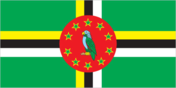
green with a centered cross of three equal bands - the vertical part is yellow (hoist side), black, and white and the horizontal part is yellow (top), black, and white; superimposed in the center of the cross is a red disk bearing a Sisserou parrot, unique to Dominica, encircled by 10 green, five-pointed stars edged in yellow; the 10 stars represent the 10 administrative divisions (parishes); green symbolizes the island's lush vegetation; the triple-colored cross represents the Christian Trinity; the yellow color denotes sunshine, the main agricultural products (citrus and bananas), and the native Carib Indians; black is for the rich soil and the African heritage of most citizens; white signifies rivers, waterfalls, and the purity of aspirations; the red disc stands for social justice
Government type
parliamentary republic
Independence
3 November 1978 (from the UK)
International law organization participation
accepts compulsory ICJ jurisdiction; accepts ICCt jurisdiction
International organization participation
ACP, AOSIS, C, Caricom, CD, CDB, CELAC, Commonwealth of Nations, ECCU, FAO, G-77, IAEA, IBRD, ICCt, ICRM, IDA, IFAD, IFC, IFRCS, ILO, IMF, IMO, Interpol, IOC, ISO (correspondent), ITU, ITUC (NGOs), MIGA, NAM, OAS, OECS, OIF, OPANAL, OPCW, Petrocaribe, UN, UNCTAD, UNESCO, UNIDO, UPU, WFTU, WHO, WIPO, WMO, WTO
Judicial branch
- the Eastern Caribbean Supreme Court (ECSC) is the superior court of the Organization of Eastern Caribbean States; the ECSC - headquartered on St. Lucia - consists of the Court of Appeal - headed by the chief justice and 4 judges - and the High Court with 18 judges; the Court of Appeal is itinerant, travelling to member states on a schedule to hear appeals from the High Court and subordinate courts; High Court judges reside at the member states with 2 in Dominica; note - Dominica is a member of the Caribbean Court of Justice chief justice of Eastern Caribbean Supreme Court appointed by the Her Majesty, Queen ELIZABETH II; other justices and judges appointed by the Judicial and Legal Services Commission, an independent body of judicial officials; Court of Appeal justices appointed for life with mandatory retirement at age 65; High Court judges appointed for life with mandatory retirement at age 62 Court of Summary Jurisdiction; magistrates' courts
- highest court(s)
- the Eastern Caribbean Supreme Court (ECSC) is the superior court of the Organization of Eastern Caribbean States; the ECSC - headquartered on St. Lucia - consists of the Court of Appeal - headed by the chief justice and 4 judges - and the High Court with 18 judges; the Court of Appeal is itinerant, travelling to member states on a schedule to hear appeals from the High Court and subordinate courts; High Court judges reside at the member states with 2 in Dominica; note - Dominica is a member of the Caribbean Court of Justice
- judge selection and term of office
- chief justice of Eastern Caribbean Supreme Court appointed by the Her Majesty, Queen ELIZABETH II; other justices and judges appointed by the Judicial and Legal Services Commission, an independent body of judicial officials; Court of Appeal justices appointed for life with mandatory retirement at age 65; High Court judges appointed for life with mandatory retirement at age 62
- subordinate courts
- Court of Summary Jurisdiction; magistrates' courts
Legal system
common law based on the English model
Legislative branch
- unicameral House of Assembly (32 seats; 21 representatives directly elected in single-seat constituencies by simple majority vote, 9 senators appointed by the Assembly, and 2 ex-officio members - the House Speaker and the Clerk of the House; members serve 5-year terms) last held on 8 December 2014 (next to be held in 2019); note - tradition dictates that the election is held within 5 years of the last election, but technically it is 5 years from the first seating of parliament plus a 90-day grace period percent of vote by party - DLP 57.0%, UWP 42.9%, other 0.1%; seats by party - DLP 15, UWP 6
- description
- unicameral House of Assembly (32 seats; 21 representatives directly elected in single-seat constituencies by simple majority vote, 9 senators appointed by the Assembly, and 2 ex-officio members - the House Speaker and the Clerk of the House; members serve 5-year terms)
- election results
- percent of vote by party - DLP 57.0%, UWP 42.9%, other 0.1%; seats by party - DLP 15, UWP 6
- elections
- last held on 8 December 2014 (next to be held in 2019); note - tradition dictates that the election is held within 5 years of the last election, but technically it is 5 years from the first seating of parliament plus a 90-day grace period
National anthem
- "Isle of Beauty" Wilfred Oscar Morgan POND/Lemuel McPherson CHRISTIAN adopted 1967
- lyrics/music
- Wilfred Oscar Morgan POND/Lemuel McPherson CHRISTIAN
- name
- "Isle of Beauty"
- note
- adopted 1967
National holiday
Independence Day, 3 November (1978)
National symbol(s)
- Sisserou parrot, Carib Wood flower; national colors: green, yellow, black, white, red
- Sisserou parrot, Carib Wood flower; national colors
- green, yellow, black, white, red
Political parties and leaders
Dominica Freedom Party or DFP [Judith PESTAINA] Dominica Labor Party or DLP [Roosevelt SKERRIT] Dominica United Workers Party or UWP [Lennox LINTON]
Political pressure groups and leaders
Dominica Trade Union [Harold SEALY] Dominca Public Service Union [Mervin ANTHONY]
Suffrage
18 years of age; universal
Economy
Agriculture - products
- bananas, citrus, mangos, root crops, coconuts, cocoa forest and fishery potential not exploited
- note
- forest and fishery potential not exploited
Budget
- $148.1 million $148.1 million (2016 est.)
- expenditures
- $148.1 million (2016 est.)
- revenues
- $148.1 million
Budget surplus (+) or deficit (-)
0% of GDP (2016 est.)
Central bank discount rate
6.5% (31 December 2010) 6.5% (31 December 2009)
Commercial bank prime lending rate
8.33% (31 December 2016 est.) 8.67% (31 December 2015 est.)
Current account balance
$5 million (2016 est.) $-85.6 million (2015 est.)
Debt - external
$288.6 million (31 December 2016 est.) $314.2 million (31 December 2015 est.)
Economy - overview
The Dominican economy has been dependent on agriculture - primarily bananas - in years past, but increasingly has been driven by tourism as the government seeks to promote Dominica as an "ecotourism" destination. Moreover, Dominica has an offshore medical education sector. In order to diversify the island's economy, the government is also attempting to foster an offshore financial industry and plans to sign agreements with the private sector to develop geothermal energy resources. In 2003, the government began a comprehensive restructuring of the economy - including the elimination of price controls, privatization of the state banana company, and tax increases - to address an economic and financial crisis and to meet IMF requirements. In 2009 and 2013, the economy contracted as a result of the global recession; growth remains anemic. Although public debt levels continue to exceed pre-recession levels, the debt burden declined from 78% of GDP in 2011 to approximately 70% in 2012.
Exchange rates
East Caribbean dollars (XCD) per US dollar - 2.7 (2016 est.) 2.7 (2015 est.) 2.7 (2014 est.) 2.7 (2013 est.) 2.7 (2012 est.)
Exports
$43.7 million (2016 est.) $44.9 million (2015 est.)
Exports - commodities
bananas, soap, bay oil, vegetables, grapefruit, oranges
Exports - partners
Trinidad and Tobago 15.4%, Jamaica 13.3%, Saudi Arabia 13%, St. Kitts and Nevis 11.8%, Guyana 9.3%, Barbados 5.1%, US 5.1%, Antigua and Barbuda 4.5%, Egypt 4.1% (2016)
Fiscal year
1 July - 30 June
GDP - composition, by end use
- 73.8% 22.8% 12.5% 0% 39.1% -48.2% (2016 est.)
- exports of goods and services
- 39.1%
- government consumption
- 22.8%
- household consumption
- 73.8%
- imports of goods and services
- -48.2% (2016 est.)
- investment in fixed capital
- 12.5%
- investment in inventories
- 0%
GDP - composition, by sector of origin
- 14.7% 13.4% 71.9% (2016 est.)
- agriculture
- 14.7%
- industry
- 13.4%
- services
- 71.9% (2016 est.)
GDP - per capita (PPP)
- $11,300 (2016 est.) $11,000 (2015 est.) $11,300 (2014 est.) data are in 2016 dollars
- note
- data are in 2016 dollars
GDP - real growth rate
2.6% (2016 est.) -2.5% (2015 est.) 4.4% (2014 est.)
GDP (official exchange rate)
$581 million (2016 est.)
GDP (purchasing power parity)
- $805 million (2016 est.) $774 million (2015 est.) $786 million (2014 est.) data are in 2016 dollars
- note
- data are in 2016 dollars
Gross national saving
20.4% of GDP (2016 est.) 14.6% of GDP (2015 est.) 7.7% of GDP (2014 est.)
Household income or consumption by percentage share
- NA% NA%
- highest 10%
- NA%
- lowest 10%
- NA%
Imports
$186.4 million (2016 est.) $194.4 million (2015 est.)
Imports - commodities
manufactured goods, machinery and equipment, food, chemicals
Imports - partners
US 23.4%, Trinidad and Tobago 18.1%, Italy 8.7%, UK 5.4% (2016)
Industrial production growth rate
1.6% (2016 est.)
Industries
soap, coconut oil, tourism, copra, furniture, cement blocks, shoes
Inflation rate (consumer prices)
0% (2016 est.) -0.8% (2015 est.)
Labor force
25,000 (2000 est.)
Labor force - by occupation
- 40% 32% 28% (2002 est.)
- agriculture
- 40%
- industry
- 32%
- services
- 28% (2002 est.)
Population below poverty line
29% (2009 est.)
Public debt
81% of GDP (2016 est.) 83% of GDP (2015 est.)
Reserves of foreign exchange and gold
$221.9 million (31 December 2016 est.) $126.2 million (31 December 2015 est.)
Stock of broad money
$509.7 million (31 December 2016 est.) $480.9 million (31 December 2015 est.)
Stock of domestic credit
$195.9 million (31 December 2016 est.) $277.8 million (31 December 2015 est.)
Stock of narrow money
$112 million (31 December 2016 est.) $96.59 million (31 December 2015 est.)
Taxes and other revenues
28.5% of GDP (2016 est.)
Unemployment rate
23% (2000 est.)
Energy
Carbon dioxide emissions from consumption of energy
100,000 Mt (2013 est.)
Crude oil - exports
0 bbl/day (2014 est.)
Crude oil - imports
0 bbl/day (2014 est.)
Crude oil - production
0 bbl/day (2016 est.)
Crude oil - proved reserves
0 bbl (1 January 2017 es)
Electricity - consumption
87.42 million kWh (2015 est.)
Electricity - exports
0 kWh (2016 est.)
Electricity - from fossil fuels
60.2% of total installed capacity (2015 est.)
Electricity - from hydroelectric plants
18.1% of total installed capacity (2015 est.)
Electricity - from nuclear fuels
0% of total installed capacity (2015 est.)
Electricity - from other renewable sources
21.7% of total installed capacity (2015 est.)
Electricity - imports
0 kWh (2016 est.)
Electricity - installed generating capacity
33,200 kW (2015 est.)
Electricity - production
94 million kWh (2015 est.)
Electricity access
- 5,900 93% 99% 80% (2012)
- electrification - rural areas
- 80% (2012)
- electrification - total population
- 93%
- electrification - urban areas
- 99%
- population without electricity
- 5,900
Natural gas - consumption
0 cu m (2013 est.)
Natural gas - exports
0 cu m (2013 est.)
Natural gas - imports
0 cu m (2013 est.)
Natural gas - production
0 cu m (2013 est.)
Natural gas - proved reserves
0 cu m (1 January 2014 es)
Refined petroleum products - consumption
1,000 bbl/day (2015 est.)
Refined petroleum products - exports
0 bbl/day (2014 est.)
Refined petroleum products - imports
978.2 bbl/day (2014 est.)
Refined petroleum products - production
0 bbl/day (2014 est.)
Communications
Broadcast media
no terrestrial TV service available; subscription cable TV provider offers some locally produced programming plus channels from the US, Latin America, and the Caribbean; state-operated radio broadcasts on 6 stations; privately owned radio broadcasts on about 15 stations (2007)
Internet country code
.dm
Internet users
- 49,439 67.0% (July 2016 est.)
- percent of population
- 67.0% (July 2016 est.)
- total
- 49,439
Telephone system
- fully automatic network fixed-line connections continued to decline slowly with the two active operators providing about 18 fixed-line connections per 100 persons; subscribership among the three mobile-cellular providers is about 105 per 100 persons country code - 1-767; landing points for the East Caribbean Fiber Optic System (ECFS) and the Global Caribbean Network (GCN) submarine cables providing connectivity to other islands in the eastern Caribbean extending from the British Virgin Islands to Trinidad; microwave radio relay and SHF radiotelephone links to Martinique and Guadeloupe; VHF and UHF radiotelephone links to Saint Lucia (2016)
- domestic
- fixed-line connections continued to decline slowly with the two active operators providing about 18 fixed-line connections per 100 persons; subscribership among the three mobile-cellular providers is about 105 per 100 persons
- general assessment
- fully automatic network
- international
- country code - 1-767; landing points for the East Caribbean Fiber Optic System (ECFS) and the Global Caribbean Network (GCN) submarine cables providing connectivity to other islands in the eastern Caribbean extending from the British Virgin Islands to Trinidad; microwave radio relay and SHF radiotelephone links to Martinique and Guadeloupe; VHF and UHF radiotelephone links to Saint Lucia (2016)
Telephones - fixed lines
- 13,328 18 (July 2016 est.)
- subscriptions per 100 inhabitants
- 18 (July 2016 est.)
- total subscriptions
- 13,328
Telephones - mobile cellular
- 78,444 106 (July 2016 est.)
- subscriptions per 100 inhabitants
- 106 (July 2016 est.)
- total
- 78,444
Transportation
Airports
2 (2013)
Airports - with paved runways
- 1 (2017)
- 1,524 to 2,437 m
- 1
- 914 to 1,523 m
- 1 (2017)
- total
- 2
Civil aircraft registration country code prefix
J7 (2016)
Merchant marine
- bulk carrier 11, cargo 22, chemical tanker 2, petroleum tanker 4, refrigerated cargo 3, roll on/roll off 1 32 (Australia 1, Estonia 6, Germany 5, Greece 4, India 2, Latvia 2, Norway 1, Russia 3, Saudi Arabia 2, Syria 4, Turkey 1, Ukraine 1) 1 (Saint Vincent and the Grenadines 1) (2010)
- by type
- bulk carrier 11, cargo 22, chemical tanker 2, petroleum tanker 4, refrigerated cargo 3, roll on/roll off 1
- foreign-owned
- 32 (Australia 1, Estonia 6, Germany 5, Greece 4, India 2, Latvia 2, Norway 1, Russia 3, Saudi Arabia 2, Syria 4, Turkey 1, Ukraine 1)
- registered in other countries
- 1 (Saint Vincent and the Grenadines 1) (2010)
- total
- 43
National air transport system
- 0 mt-km (2015)
- annual freight traffic on registered air carriers
- 0 mt-km (2015)
Ports and terminals
- Portsmouth, Roseau
- major seaport(s)
- Portsmouth, Roseau
Roadways
- 1,512 km 762 km 750 km (2010)
- paved
- 762 km
- total
- 1,512 km
- unpaved
- 750 km (2010)
Military and Security
Military branches
no regular military forces; Commonwealth of Dominica Police Force (includes Coast Guard) (2012)
Transnational Issues
Disputes - international
Dominica is the only Caribbean state to challenge Venezuela's sovereignty claim over Aves Island and joins the other island nations in challenging whether the feature sustains human habitation, a criterion under the UN Convention on the Law of the Sea, which permits Venezuela to extend its EEZ and continental shelf claims over a large portion of the eastern Caribbean Sea
Illicit drugs
transshipment point for narcotics bound for the US and Europe; minor cannabis producer