1992 Edition
CIA World Factbook 1992 (Project Gutenberg)
Geography
Climate
tropical; moderated by northeast trade winds; heavy rainfall
Coastline
148 km
Comparative area
slightly more than four times the size of Washington, DC
Contiguous zone
24 nm
Disputes
none
Environment
flash floods a constant hazard; occasional hurricanes
Exclusive economic zone
200 nm
Land area
750 km2
Land boundaries
none
Land use
arable land 9%; permanent crops 13%; meadows and pastures 3%; forest and woodland 41%; other 34%
Natural resources
timber
Note
located 550 km southeast of Puerto Rico in the Caribbean Sea
Terrain
rugged mountains of volcanic origin
Territorial sea
12 nm
Total area
750 km2
People and Society
Birth rate
24 births/1,000 population (1992)
Death rate
5 deaths/1,000 population (1992)
Ethnic divisions
mostly black; some Carib Indians
Infant mortality rate
11 deaths/1,000 live births (1992)
Labor force
25,000; agriculture 40%, industry and commerce 32%, services 28% (1984)
Languages
English (official); French patois widely spoken
Life expectancy at birth
74 years male, 79 years female (1992)
Literacy
94% (male 94%, female 94%) age 15 and over having ever attended school (1970)
Nationality
noun - Dominican(s); adjective - Dominican
Net migration rate
-3 migrants/1,000 population (1992)
Organized labor
25% of labor force
Population
87,035 (July 1992), growth rate 1.6% (1992)
Religions
Roman Catholic 77%, Protestant 15% (Methodist 5%, Pentecostal 3%, Seventh-Day Adventist 3%, Baptist 2%, other 2%), none 2%, unknown 1%, other 5%
Total fertility rate
2.4 children born/woman (1992)
Government
Administrative divisions
10 parishes; Saint Andrew, Saint David, Saint George, Saint John, Saint Joseph, Saint Luke, Saint Mark, Saint Patrick, Saint Paul, Saint Peter
Capital
Roseau
Chief of State
President Sir Clarence Augustus SEIGNORET (since 19 December 1983)
Constitution
3 November 1978
Diplomatic representation
there is no Chancery in the US US: no official presence since the Ambassador resides in Bridgetown (Barbados), but travels frequently to Dominica
Executive branch
president, prime minister, Cabinet
Flag
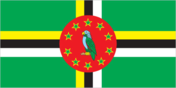
green with a centered cross of three equal bands - the vertical part is yellow (hoist side), black, and white - the horizontal part is yellow (top), black, and white; superimposed in the center of the cross is a red disk bearing a sisserou parrot encircled by 10 green five-pointed stars edged in yellow; the 10 stars represent the 10 administrative divisions (parishes)
Head of Government
Prime Minister (Mary) Eugenia CHARLES (since 21 July 1980, elected for a third term 28 May 1990)
House of Assembly
last held 28 May 1990 (next to be held May 1995); results - percent of vote by party NA; seats - (30 total; 9 appointed senators and 21 elected representatives) DFP 11, UWP 6, DLP 4
Independence
3 November 1978 (from UK)
Judicial branch
Eastern Caribbean Supreme Court
Legal system
based on English common law
Legislative branch
unicameral House of Assembly
Long-form name
Commonwealth of Dominica
Member of
ACCT, ACP, C, CARICOM, CDB, ECLAC, FAO, G-77, IBRD, ICFTU, IDA, IFAD, IFC, ILO, IMF, IMO, INTERPOL, LORCS, NAM (observer), OAS, OECS, UN, UNCTAD, UNESCO, UNIDO, UPU, WCL, WHO, WMO
National holiday
Independence Day, 3 November (1978)
Other political or pressure groups
Dominica Liberation Movement (DLM), a small leftist group
Political parties and leaders
Dominica Freedom Party (DFP), (Mary) Eugenia CHARLES; Dominica Labor Party (DLP), Pierre CHARLES; United Workers Party (UWP), Edison JAMES
President
last held 20 December 1988 (next to be held December 1993); results - President Sir Clarence Augustus SEIGNORET was reelected by the House of Assembly
Suffrage
universal at age 18
Type
parliamentary democracy
Economy
Agriculture
accounts for 30% of GDP; principal crops - bananas, citrus, mangoes, root crops, and coconuts; bananas provide the bulk of export earnings; forestry and fisheries potential not exploited
Budget
revenues $48 million; expenditures $85 million, including capital expenditures of $41 million (FY90)
Currency
East Caribbean dollar (plural - dollars); 1 EC dollar (EC$) = 100 cents
Economic aid
Western (non-US) countries, ODA and OOF bilateral commitments (1970-89), $120 million
Electricity
7,000 kW capacity; 16 million kWh produced, 185 kWh per capita (1991)
Exchange rates
East Caribbean dollars (EC$) per US$1 - 2.70 (fixed rate since 1976)
Exports
$59.9 million (f.o.b., 1990) commodities: bananas, coconuts, grapefruit, soap, galvanized sheets partners: UK 72%, Jamaica 10%, OECS 6%, US 3%, other 9%
External debt
$73 million (1990 est.)
Fiscal year
1 July - 30 June
GDP
purchasing power equivalent - $170 million, per capita $2,000; real growth rate 7.0% (1990 est.)
Imports
$103.9 million (c.i.f., 1990) commodities: food, oils and fats, chemicals, fuels and lubricants, manufactured goods, machinery and equipment partners: US 23%, UK 18%, CARICOM 15%, OECS 15%, Japan 5%, Canada 3%, other 21%
Industrial production
growth rate 4.5% in manufacturing (1988 est.); accounts for 11% of GDP
Industries
soap, beverages, tourism, food processing, furniture, cement blocks, shoes
Inflation rate (consumer prices)
4.7% (1990)
Overview
The economy is dependent on agriculture and thus is highly vulnerable to climatic conditions. Agriculture accounts for about 30% of GDP and employs 40% of the labor force. Principal products include bananas, citrus, mangoes, root crops, and coconuts. In 1990, GDP grew by 7%, bouncing back from the 1.6% decline of 1989. The tourist industry remains undeveloped because of a rugged coastline and the lack of an international airport.
Unemployment rate
10% (1989 est.)
Communications
Airports
2 total, 2 usable; 2 with permanent-surface runways; none with runways over 2,439 m; 1 with runways 1,220-2,439 m
Civil air
NA
Highways
750 km total; 370 km paved, 380 km gravel and earth
Ports
Roseau, Portsmouth
Telecommunications
4,600 telephones in fully automatic network; VHF and UHF link to Saint Lucia; new SHF links to Martinique and Guadeloupe; broadcast stations - 3 AM, 2 FM, 1 cable TV
Military and Security
Branches
Commonwealth of Dominica Police Force (including Coast Guard)
Defense expenditures
exchange rate conversion - $NA, NA% of GDP
Manpower availability
NA