1990 Edition
CIA World Factbook 1990 (Project Gutenberg)
Geography
Climate
tropical; moderated by northeast trade winds; heavy rainfall
Coastline
148 km
Comparative area
slightly more than four times the size of Washington, DC
Contiguous zone
24 nm;
Environment
flash floods a constant hazard; occasional hurricanes
Extended economic zone
200 nm;
Land boundaries
none
Land use
9% arable land; 13% permanent crops; 3% meadows and pastures; 41% forest and woodland; 34% other
Natural resources
timber
Note
located 550 km southeast of Puerto Rico in the Caribbean Sea
Terrain
rugged mountains of volcanic origin
Territorial sea
12 nm
Total area
750 km2; land area: 750 km2
People and Society
Birth rate
26 births/1,000 population (1990)
Death rate
5 deaths/1,000 population (1990)
Ethnic divisions
mostly black; some Carib indians
Infant mortality rate
13 deaths/1,000 live births (1990)
Labor force
25,000; 40% agriculture, 32% industry and commerce, 28% services (1984)
Language
English (official); French patois widely spoken
Life expectancy at birth
73 years male, 79 years female (1990)
Literacy
80% (est.)
Nationality
noun--Dominican(s); adjective--Dominican
Net migration rate
- 4 migrants/1,000 population (1990)
Organized labor
25% of labor force
Population
84,854 (July 1990), growth rate 1.7% (1990)
Religion
80% Roman Catholic; Anglican, Methodist
Total fertility rate
2.6 children born/woman (1990)
Government
Administrative divisions
10 parishes; Saint Andrew, Saint David, Saint George, Saint John, Saint Joseph, Saint Luke, Saint Mark, Saint Patrick, Saint Paul, Saint Peter
Capital
Roseau
Communists
negligible
Constitution
3 November 1978
Diplomatic representation
there is no Chancery in the US; US--no official presence since the Ambassador resides in Bridgetown (Barbados), but travels frequently to Dominica
Elections
President--last held 20 December 1988 (next to be held December 1993); the president is elected by the House of Assembly; House of Assembly--last held 1 July 1985 (next to be held July 1990); results--percent of vote by party NA; seats--(21 total) DFP 17, LPD 4
Executive branch
president, prime minister, Cabinet
Flag
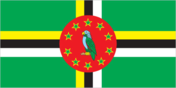
green with a centered cross of three equal bands--the vertical part is yellow (hoist side), black, and white--the horizontal part is yellow (top), black, and white; superimposed in the center of the cross is a red disk bearing a sisserou parrot encircled by 10 green five-pointed stars edged in yellow; the 10 stars represent the 10 administrative divisions (parishes)
Independence
3 November 1978 (from UK)
Judicial branch
Eastern Caribbean Supreme Court
Leaders
Chief of State--President Sir Clarence Augustus SEIGNORET (since 19 December 1983); Head of Government--Prime Minister (Mary) Eugenia CHARLES (since 21 July 1980)
Legal system
based on English common law
Legislative branch
unicameral House of Assembly (includes 9 appointed senators and 21 elected representatives)
Long-form name
Commonwealth of Dominica
Member of
ACP, CARICOM, Commonwealth, FAO, GATT (de facto), G-77, IBRD, IDA, IFAD, IFC, ILO, IMF, IMO, INTERPOL, OAS, OECS, UN, UNESCO, UPU, WHO, WMO
National holiday
Independence Day, 3 November (1978)
Other political or pressure groups
Dominica Liberation Movement (DLM), a small leftist group
Political parties and leaders
Dominica Freedom Party (DFP), (Mary) Eugenia Charles; Labor Party of Dominica (LPD, a leftist-dominated coalition), Michael Douglas; United Workers Party (UWP), Edison James
Suffrage
universal at age 18
Type
parliamentary democracy
Economy
Agriculture
accounts for 30% of GDP; principal crops--bananas, citrus fruit, coconuts, root crops; bananas provide the bulk of export earnings; forestry and fisheries potential not exploited
Aid
Western (non-US) countries, ODA and OOF bilateral commitments (1970-87), $109 million
Budget
revenues $60 million; expenditures $52 million, including capital expenditures of $18 million (FY88)
Currency
East Caribbean dollar (plural--dollars); 1 EC dollar (EC$) = 100 cents
Electricity
7,000 kW capacity; 16 million kWh produced, 190 kWh per capita (1989)
Exchange rates
East Caribbean dollars (EC$) per US$1--2.70 (fixed rate since 1976)
Exports
$46 million (f.o.b., 1987); commodities--bananas, coconuts, grapefruit, soap, galvanized sheets; partners--UK 72%, Jamaica 10%, OECS 6%, US 3%, other 9%
External debt
$63.6 million (December 1987)
Fiscal year
1 July-30 June
GDP
$137 million, per capita $1,408; real growth rate 5.6% (1988 est.)
Imports
$66.0 million (c.i.f., 1987); commodities--food, oils and fats, chemicals, fuels and lubricants, manufactured goods, machinery and equipment; partners--US 23%, UK 18%, CARICOM 15%, OECS 15%, Japan 5%, Canada 3%, other 21%
Industrial production
growth rate 5.9% in manufacturing (1987)
Industries
agricultural processing, tourism, soap and other coconut-based products, cigars, pumice mining
Inflation rate (consumer prices)
4.9% (1987)
Overview
The economy is dependent on agriculture and thus is highly vulnerable to climatic conditions. Agriculture accounts for about 30% of GDP and employs 40% of the labor force. Principal products include bananas, coconuts, citrus, and root crops. In 1988 the economy achieved a 5.6% growth in real GDP on the strength of a boost in construction, higher agricultural production, and growth of the small manufacturing sector based on soap and garment industries. The tourist industry remains undeveloped because of a rugged coastline and the lack of an international-class airport.
Unemployment rate
10% (1989 est.)
Communications
Airports
2 total, 2 usable; 2 with permanent-surface runways; none with runways over 2,439 m; 1 with runways 1,220-2,439 m
Civil air
NA
Highways
750 km total; 370 km paved, 380 km gravel and earth
Ports
Roseau, Portsmouth
Telecommunications
4,600 telephones in fully automatic network; VHF and UHF link to St. Lucia; new SHF links to Martinique and Guadeloupe; stations--3 AM, 2 FM, 1 cable TV
Military and Security
Branches
Commonwealth of Dominica Police Force
Defense expenditures
NA
Military manpower
NA