2013 Edition
CIA World Factbook 2013 Archive (HTML)
Introduction
Background
The French Territory of the Afars and the Issas became Djibouti in 1977. Hassan Gouled APTIDON installed an authoritarian one-party state and proceeded to serve as president until 1999. Unrest among the Afar minority during the 1990s led to a civil war that ended in 2001 with a peace accord between Afar rebels and the Somali Issa-dominated government. In 1999, Djibouti's first multiparty presidential elections resulted in the election of Ismail Omar GUELLEH as president; he was reelected to a second term in 2005 and extended his tenure in office via a constitutional amendment, which allowed him to begin a third term in 2011. Djibouti occupies a strategic geographic location at the intersection of the Red Sea and the Gulf of Aden and serves as an important shipping portal for goods entering and leaving the east African highlands and transshipments between Europe, the Middle East, and Asia. The government holds longstanding ties to France, which maintains a significant military presence in the country, and has strong ties with the United States. Djibouti hosts several thousand members of US armed services at US-run Camp Lemonnier.
Geography
Area
- 23,200 sq km 23,180 sq km 20 sq km
- total
- 23,200 sq km
- water
- 20 sq km
Area - comparative
slightly smaller than Massachusetts
Climate
desert; torrid, dry
Coastline
314 km
Elevation extremes
- Lac Assal -155 m Moussa Ali 2,028 m
- highest point
- Moussa Ali 2,028 m
- lowest point
- Lac Assal -155 m
Environment - current issues
inadequate supplies of potable water; limited arable land; desertification; endangered species
Environment - international agreements
- Biodiversity, Climate Change, Climate Change-Kyoto Protocol, Desertification, Endangered Species, Hazardous Wastes, Law of the Sea, Ozone Layer Protection, Ship Pollution, Wetlands none of the selected agreements
- party to
- Biodiversity, Climate Change, Climate Change-Kyoto Protocol, Desertification, Endangered Species, Hazardous Wastes, Law of the Sea, Ozone Layer Protection, Ship Pollution, Wetlands
- signed, but not ratified
- none of the selected agreements
Freshwater withdrawal (domestic/industrial/agricultural)
- 0.02 cu km/yr (84%/0%/16%) 24.84 cu m/yr (2000)
- per capita
- 24.84 cu m/yr (2000)
- total
- 0.02 cu km/yr (84%/0%/16%)
Geographic coordinates
11 30 N, 43 00 E
Geography - note
strategic location near world's busiest shipping lanes and close to Arabian oilfields; terminus of rail traffic into Ethiopia; mostly wasteland; Lac Assal (Lake Assal) is the lowest point in Africa and the saltiest lake in the world
Irrigated land
10.12 sq km (2003)
Land boundaries
- 516 km Eritrea 109 km, Ethiopia 349 km, Somalia 58 km
- border countries
- Eritrea 109 km, Ethiopia 349 km, Somalia 58 km
- total
- 516 km
Land use
- 0.09% 0% 99.91% (2011)
- arable land
- 0.09%
- other
- 99.91% (2011)
- permanent crops
- 0%
Location
Eastern Africa, bordering the Gulf of Aden and the Red Sea, between Eritrea and Somalia
Map references
Africa
Maritime claims
- 12 nm 24 nm 200 nm
- contiguous zone
- 24 nm
- exclusive economic zone
- 200 nm
- territorial sea
- 12 nm
Natural hazards
- earthquakes; droughts; occasional cyclonic disturbances from the Indian Ocean bring heavy rains and flash floods experiences limited volcanic activity; Ardoukoba (elev. 298 m) last erupted in 1978; Manda-Inakir, located along the Ethiopian border, is also historically active
- volcanism
- experiences limited volcanic activity; Ardoukoba (elev. 298 m) last erupted in 1978; Manda-Inakir, located along the Ethiopian border, is also historically active
Natural resources
potential geothermal power, gold, clay, granite, limestone, marble, salt, diatomite, gypsum, pumice, petroleum
Terrain
coastal plain and plateau separated by central mountains
Total renewable water resources
0.3 cu km (2011)
People and Society
Age structure
- 33.6% (male 133,401/female 132,836) 22% (male 82,174/female 92,321) 36.3% (male 119,588/female 167,711) 4.6% (male 17,416/female 19,269) 3.5% (male 12,352/female 15,130) (2013 est.)
- 0-14 years
- 33.6% (male 133,401/female 132,836)
- 15-24 years
- 22% (male 82,174/female 92,321)
- 25-54 years
- 36.3% (male 119,588/female 167,711)
- 55-64 years
- 4.6% (male 17,416/female 19,269)
- 65 years and over
- 3.5% (male 12,352/female 15,130) (2013 est.)
Birth rate
24.5 births/1,000 population (2013 est.)
Child labor - children ages 5-14
- 13,176 8 % (2006 est.)
- percentage
- 8 % (2006 est.)
- total number
- 13,176
Children under the age of 5 years underweight
29.6% (2006)
Contraceptive prevalence rate
17.8% (2006)
Death rate
7.96 deaths/1,000 population (2013 est.)
Dependency ratios
- 60.5 % 54.1 % 6.4 % 15.7 (2013)
- elderly dependency ratio
- 6.4 %
- potential support ratio
- 15.7 (2013)
- total dependency ratio
- 60.5 %
- youth dependency ratio
- 54.1 %
Drinking water source
- urban: 99% of population rural: 54% of population total: 88% of population urban: 1% of population rural: 46% of population total: 12% of population (2010 est.)
- rural
- 46% of population
- total
- 12% of population (2010 est.)
- urban
- 1% of population
Education expenditures
8.4% of GDP (2007)
Ethnic groups
Somali 60%, Afar 35%, other 5% (includes French, Arab, Ethiopian, and Italian)
Health expenditures
7.9% of GDP (2011)
HIV/AIDS - adult prevalence rate
2.5% (2009 est.)
HIV/AIDS - deaths
1,000 (2009 est.)
HIV/AIDS - people living with HIV/AIDS
14,000 (2009 est.)
Hospital bed density
1.4 beds/1,000 population (2010)
Infant mortality rate
- 51.77 deaths/1,000 live births 59.2 deaths/1,000 live births 44.11 deaths/1,000 live births (2013 est.)
- female
- 44.11 deaths/1,000 live births (2013 est.)
- total
- 51.77 deaths/1,000 live births
Languages
French (official), Arabic (official), Somali, Afar
Life expectancy at birth
- 61.99 years 59.52 years 64.52 years (2013 est.)
- female
- 64.52 years (2013 est.)
- total population
- 61.99 years
Literacy
- age 15 and over can read and write 67.9% 78% 58.4% (2003 est.)
- definition
- age 15 and over can read and write
- female
- 58.4% (2003 est.)
- male
- 78%
- total population
- 67.9%
Major infectious diseases
- high bacterial and protozoal diarrhea, hepatitis A, and typhoid fever dengue fever highly pathogenic H5N1 avian influenza has been identified in this country; it poses a negligible risk with extremely rare cases possible among US citizens who have close contact with birds (2013)
- degree of risk
- high
- food or waterborne diseases
- bacterial and protozoal diarrhea, hepatitis A, and typhoid fever
- vectorborne disease
- dengue fever
Major urban areas - population
DJIBOUTI (capital) 496,000 (2011)
Maternal mortality rate
200 deaths/100,000 live births (2010)
Median age
- 22.4 years 20.8 years 23.7 years (2013 est.)
- female
- 23.7 years (2013 est.)
- male
- 20.8 years
- total
- 22.4 years
Nationality
- Djiboutian(s) Djiboutian
- adjective
- Djiboutian
- noun
- Djiboutian(s)
Net migration rate
6.04 migrant(s)/1,000 population (2013 est.)
Obesity - adult prevalence rate
9.4% (2008)
Physicians density
0.23 physicians/1,000 population (2006)
Population
792,198 (July 2013 est.)
Population growth rate
2.26% (2013 est.)
Religions
Muslim 94%, Christian 6%
Sanitation facility access
- urban: 63% of population rural: 10% of population total: 50% of population urban: 37% of population rural: 90% of population total: 50% of population (2010 est.)
- rural
- 90% of population
- total
- 50% of population (2010 est.)
- urban
- 37% of population
School life expectancy (primary to tertiary education)
- 6 years 6 years 5 years (2011)
- female
- 5 years (2011)
- male
- 6 years
- total
- 6 years
Sex ratio
- 1.03 male(s)/female 1 male(s)/female 0.89 male(s)/female 0.72 male(s)/female 0.92 male(s)/female 0.82 male(s)/female 0.86 male(s)/female (2013 est.)
- 0-14 years
- 1 male(s)/female
- 15-24 years
- 0.89 male(s)/female
- 25-54 years
- 0.72 male(s)/female
- 55-64 years
- 0.92 male(s)/female
- 65 years and over
- 0.82 male(s)/female
- at birth
- 1.03 male(s)/female
- total population
- 0.86 male(s)/female (2013 est.)
Total fertility rate
2.55 children born/woman (2013 est.)
Urbanization
- 77.1% of total population (2011) 1.96% annual rate of change (2010-15 est.)
- rate of urbanization
- 1.96% annual rate of change (2010-15 est.)
- urban population
- 77.1% of total population (2011)
Government
Administrative divisions
6 districts (cercles, singular - cercle); Ali Sabieh, Arta, Dikhil, Djibouti, Obock, Tadjourah
Capital
- Djibouti 11 35 N, 43 09 E UTC+3 (8 hours ahead of Washington, DC during Standard Time)
- geographic coordinates
- 11 35 N, 43 09 E
- name
- Djibouti
- time difference
- UTC+3 (8 hours ahead of Washington, DC during Standard Time)
Constitution
approved by referendum 4 September 1992; amended 2006, 2008, 2010 (2010)
Country name
- Republic of Djibouti Djibouti Republique de Djibouti/Jumhuriyat Jibuti Djibouti/Jibuti French Territory of the Afars and Issas, French Somaliland
- conventional long form
- Republic of Djibouti
- conventional short form
- Djibouti
- former
- French Territory of the Afars and Issas, French Somaliland
- local long form
- Republique de Djibouti/Jumhuriyat Jibuti
- local short form
- Djibouti/Jibuti
Diplomatic representation from the US
- Ambassador Geeta PASI (since 29 August 2011) Lot 350-B, Haramouss, Djibouti B. P. 185, Djibouti [253] 21 45 30 00 [253] 21 45 30 20
- chief of mission
- Ambassador Geeta PASI (since 29 August 2011)
- embassy
- Lot 350-B, Haramouss, Djibouti
- FAX
- [253] 21 45 30 20
- mailing address
- B. P. 185, Djibouti
- telephone
- [253] 21 45 30 00
Diplomatic representation in the US
- Ambassador Roble OLHAYE Oudine (since 22 March 1988) Suite 515, 1156 15th Street NW, Washington, DC 20005 [1] (202) 331-0270 [1] (202) 331-0302
- chancery
- Suite 515, 1156 15th Street NW, Washington, DC 20005
- chief of mission
- Ambassador Roble OLHAYE Oudine (since 22 March 1988)
- FAX
- [1] (202) 331-0302
- telephone
- [1] (202) 331-0270
Executive branch
- President Ismail Omar GUELLEH (since 8 May 1999) Prime Minister Abdoulkader Kamil MOHAMED (since 1 April 2013) Council of Ministers responsible to the president president elected by popular vote for a five-year term; president is eligible to hold office until age 75; election last held on 8 April 2011 (next to be held by 2016); prime minister appointed by the president Ismail Omar GUELLEH reelected president for a third term; percent of vote - Ismail Omar GUELLEH 80.6%, Mohamed Warsama RAGUEH 19.4%
- cabinet
- Council of Ministers responsible to the president
- chief of state
- President Ismail Omar GUELLEH (since 8 May 1999)
- election results
- Ismail Omar GUELLEH reelected president for a third term; percent of vote - Ismail Omar GUELLEH 80.6%, Mohamed Warsama RAGUEH 19.4%
- elections
- president elected by popular vote for a five-year term; president is eligible to hold office until age 75; election last held on 8 April 2011 (next to be held by 2016); prime minister appointed by the president
- head of government
- Prime Minister Abdoulkader Kamil MOHAMED (since 1 April 2013)
Flag description
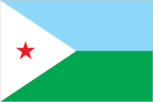
two equal horizontal bands of light blue (top) and light green with a white isosceles triangle based on the hoist side bearing a red five-pointed star in the center; blue stands for sea and sky and the Issa Somali people; green symbolizes earth and the Afar people; white represents peace; the red star recalls the struggle for independence and stands for unity
Government type
republic
Independence
27 June 1977 (from France)
International law organization participation
accepts compulsory ICJ jurisdiction with reservations; accepts ICCt jurisdiction
International organization participation
ACP, AfDB, AFESD, AMF, AU, CAEU (candidates), COMESA, FAO, G-77, IBRD, ICAO, ICRM, IDA, IDB, IFAD, IFC, IFRCS, IGAD, ILO, IMF, IMO, Interpol, IOC, IOM, IPU, ITU, ITUC (NGOs), LAS, MIGA, MINURSO, NAM, OIC, OIF, OPCW, UN, UNCTAD, UNESCO, UNHCR, UNIDO, UNWTO, UPU, WCO, WFTU (NGOs), WHO, WIPO, WMO, WTO
Judicial branch
- Supreme Court or Cour Supreme (consists of NA magistrates); Constitutional Council (consists of 6 magistrates) Supreme Court magistrates appointed by the president with the advice of the Superior Council of the Magistracy; magistrates appointed for life with retirement at age 65; Constitutional magistrates - 2 appointed by the president, 2 by the president of the National Assembly, and 2 by High Council of the Judiciary; magistrates appointed for 8-year, non-renewable terms High Court of Appeal; 5 Courts of First Instance; customary courts
- highest court(s)
- Supreme Court or Cour Supreme (consists of NA magistrates); Constitutional Council (consists of 6 magistrates)
- judge selection and term of office
- Supreme Court magistrates appointed by the president with the advice of the Superior Council of the Magistracy; magistrates appointed for life with retirement at age 65; Constitutional magistrates - 2 appointed by the president, 2 by the president of the National Assembly, and 2 by High Council of the Judiciary; magistrates appointed for 8-year, non-renewable terms
- subordinate courts
- High Court of Appeal; 5 Courts of First Instance; customary courts
Legal system
mixed legal system based primarily on the French civil code (as it existed in 1997), Islamic religious law (in matters of family law and successions), and customary law
Legislative branch
- unicameral Chamber of Deputies or Chambre des Deputes (65 seats; members elected by popular vote to serve five-year terms); note - constitutional amendments in 2010 provided for the establishment of a senate last held on 22 February 2013 (next to be held in 2018) percent of vote by party - NA; seats - UMP (coalition of parties associated with President Ismail Omar GUELLEH) 49, USN 16
- election results
- percent of vote by party - NA; seats - UMP (coalition of parties associated with President Ismail Omar GUELLEH) 49, USN 16
- elections
- last held on 22 February 2013 (next to be held in 2018)
National anthem
- "Jabuuti" (Djibouti) Aden ELMI/Abdi ROBLEH adopted 1977
- lyrics/music
- Aden ELMI/Abdi ROBLEH
- name
- "Jabuuti" (Djibouti)
National holiday
Independence Day, 27 June (1977)
Political parties and leaders
Democratic National Party or PND [ADEN Robleh Awaleh] Democratic Renewal Party or PRD [Abdillahi HAMARITEH] Djibouti Development Party or PDD [Mohamed Daoud CHEHEM] Front pour la Restauration de l'Unite Democratique or FRUD [Ali Mohamed DAOUD] Movement for Development and Liberty or MODEL [Sheikh Guirreh MEIDAL] People's Rally for Progress or RPP [Ismail Omar GUELLEH] (governing party) Peoples Social Democratic Party or PPSD [Moumin Bahdon FARAH] Republican Alliance for Democracy or ARD [Ahmed YOUSSOUF] Union for a Presidential Majority or UMP (a coalition of parties including RPP, FRUD, PND, and PPSD) Union for Democracy and Justice or UDJ [Ismail GUEDI Hared] Union for National Salvation or USN (an umbrella coalition comprising PRD, PDD, MODEL, ARD, and UDJ) [Ahmed Youssouf HOUMER]
Political pressure groups and leaders
NA
Suffrage
18 years of age; universal
Economy
Agriculture - products
fruits, vegetables; goats, sheep, camels, animal hides
Budget
- $465.9 million $503 million (2012 est.)
- expenditures
- $503 million (2012 est.)
- revenues
- $465.9 million
Budget surplus (+) or deficit (-)
-2.8% of GDP (2012 est.)
Commercial bank prime lending rate
12% (31 December 2012 est.) 10.61% (31 December 2011 est.)
Current account balance
$-216.2 million (2012 est.) $-171.8 million (2011 est.)
Debt - external
$773.9 million (31 December 2012 est.) $767 million (31 December 2011 est.)
Economy - overview
Djibouti's economy is based on service activities connected with the country's strategic location and status as a free trade zone in the Horn of Africa. Three-fourths of Djibouti's inhabitants live in the capital city; the remainder are mostly nomadic herders. Scant rainfall limits crop production to small quantities of fruits and vegetables, and most food must be imported. Djibouti provides services as both a transit port for the region and an international transshipment and refueling center. Imports, exports, and re-exports - primarily of coffee from landlocked neighbor Ethiopia - represent 70% of port activity at Djibouti's container terminal. Djibouti has few natural resources and little industry. The nation is, therefore, heavily dependent on foreign assistance to help support its balance of payments and to finance development projects. An unemployment rate of nearly 60% continues to be a major problem. While inflation is not a concern, due to the fixed tie of the Djiboutian franc to the US dollar, the artificially high value of the Djiboutian franc adversely affects Djibouti's balance of payments. Djibouti holds foreign reserves amounting to less than six months of import coverage. Per capita consumption dropped an estimated 35% between 1999 and 2006 because of recession, civil war, and a high population growth rate (including immigrants and refugees). Djibouti has experienced relatively minimal impact from the global economic downturn, but its reliance on diesel-generated electricity and imported food leave average consumers vulnerable to global price shocks. Djibouti in 2012 began construction of a third port to secure its position as a critical transshipment hub in the Horn of Africa and the principal conduit for Ethiopia's trade. Djibouti also received funding in late 2012 for a desalination plant to begin address the severe freshwater shortage affecting Djibouti City, and particularly its poorest residents.
Exchange rates
Djiboutian francs (DJF) per US dollar - 177.72 (2012 est.) 177.72 (2011 est.) 177.72 (2010 est.)
Exports
$87.9 million (2012 est.) $85 million (2011 est.)
Exports - commodities
reexports, hides and skins, coffee (in transit)
Exports - partners
Somalia 80.1%, UAE 4.4%, Yemen 4.1% (2012)
Fiscal year
calendar year
GDP - composition, by end use
- 59.2% 24.7% 33% -2.1% 38.3% -53.1% (2012 est.)
- exports of goods and services
- 38.3%
- government consumption
- 24.7%
- household consumption
- 59.2%
- imports of goods and services
- -53.1%
- investment in fixed capital
- 33%
- investment in inventories
- -2.1%
GDP - composition, by sector of origin
- 3.1% 16.9% 80% (2012 est.)
- agriculture
- 3.1%
- industry
- 16.9%
- services
- 80% (2012 est.)
GDP - per capita (PPP)
$2,600 (2012 est.) $2,600 (2011 est.) $2,600 (2010 est.) data are in 2012 US dollars
GDP - real growth rate
4.8% (2012 est.) 4.5% (2011 est.) 3.5% (2010 est.)
GDP (official exchange rate)
$1.336 billion (2012 est.)
GDP (purchasing power parity)
$2.354 billion (2012 est.) $2.245 billion (2011 est.) $2.149 billion (2010 est.) data are in 2012 US dollars
Gross national saving
17% of GDP (2012 est.) 16.2% of GDP (2011 est.) 34.8% of GDP (2010 est.)
Household income or consumption by percentage share
- 2.4% 30.9% (2002)
- highest 10%
- 30.9% (2002)
- lowest 10%
- 2.4%
Imports
$574.2 million (2012 est.) $510.6 million (2011 est.)
Imports - commodities
foods, beverages, transport equipment, chemicals, petroleum products
Imports - partners
China 24.4%, Saudi Arabia 16.4%, India 10.6%, Indonesia 7.3% (2012)
Industrial production growth rate
4.2% (2012 est.)
Industries
construction, agricultural processing
Inflation rate (consumer prices)
7.9% (2012 est.) 4.4% (2011 est.)
Labor force
351,700 (2007)
Labor force - by occupation
- NA% NA% NA%
- agriculture
- NA%
- industry
- NA%
- services
- NA%
Population below poverty line
42% (2007 est.)
Stock of broad money
$1.158 billion (31 December 2012 est.) $1.008 billion (31 December 2011 est.)
Stock of direct foreign investment - at home
$510.6 million (31 December 2012 est.) $410.6 million (31 December 2011 est.)
Stock of domestic credit
$483.4 million (31 December 2012 est.) $426.3 million (31 December 2011 est.)
Stock of narrow money
$758.9 million (31 December 2012 est.) $692.6 million (31 December 2011 est.)
Taxes and other revenues
34.9% of GDP (2012 est.)
Unemployment rate
59% (2007 est.) data are for urban areas, 83% in rural areas
Energy
Carbon dioxide emissions from consumption of energy
1.15 million Mt (2011 est.)
Crude oil - exports
0 bbl/day (2010 est.)
Crude oil - imports
0 bbl/day (2010 est.)
Crude oil - production
0 bbl/day (2012 est.)
Crude oil - proved reserves
0 bbl (1 January 2013 es)
Electricity - consumption
302.3 million kWh (2010 est.)
Electricity - exports
0 kWh (2012 est.)
Electricity - from fossil fuels
100% of total installed capacity (2010 est.)
Electricity - from hydroelectric plants
0% of total installed capacity (2010 est.)
Electricity - from nuclear fuels
0% of total installed capacity (2010 est.)
Electricity - from other renewable sources
0% of total installed capacity (2010 est.)
Electricity - imports
0 kWh (2012 est.)
Electricity - installed generating capacity
130,000 kW (2010 est.)
Electricity - production
325 million kWh (2010 est.)
Natural gas - consumption
0 cu m (2010 est.)
Natural gas - exports
0 cu m (2011 est.)
Natural gas - imports
0 cu m (2011 est.)
Natural gas - production
0 cu m (2011 est.)
Natural gas - proved reserves
0 cu m (1 January 2013 es)
Refined petroleum products - consumption
12,460 bbl/day (2011 est.)
Refined petroleum products - exports
19.18 bbl/day (2010 est.)
Refined petroleum products - imports
8,089 bbl/day (2010 est.)
Refined petroleum products - production
0 bbl/day (2010 est.)
Communications
Broadcast media
state-owned Radiodiffusion-Television de Djibouti (RTD) operates the sole terrestrial TV station as well as the only 2 domestic radio networks; no private TV or radio stations; transmissions of several international broadcasters are available (2007)
Internet country code
.dj
Internet hosts
215 (2012)
Internet users
25,900 (2009)
Telephone system
- telephone facilities in the city of Djibouti are adequate, as are the microwave radio relay connections to outlying areas of the country Djibouti Telecom is the sole provider of telecommunications services and utilizes mostly a microwave radio relay network; fiber-optic cable is installed in the capital; rural areas connected via wireless local loop radio systems; mobile cellular coverage is primarily limited to the area in and around Djibouti city country code - 253; landing point for the SEA-ME-WE-3 and EASSy fiber-optic submarine cable systems providing links to Asia, the Middle East, Europe and North America; satellite earth stations - 2 (1 Intelsat - Indian Ocean and 1 Arabsat); Medarabtel regional microwave radio relay telephone network (2009)
- domestic
- Djibouti Telecom is the sole provider of telecommunications services and utilizes mostly a microwave radio relay network; fiber-optic cable is installed in the capital; rural areas connected via wireless local loop radio systems; mobile cellular coverage is primarily limited to the area in and around Djibouti city
- general assessment
- telephone facilities in the city of Djibouti are adequate, as are the microwave radio relay connections to outlying areas of the country
- international
- country code - 253; landing point for the SEA-ME-WE-3 and EASSy fiber-optic submarine cable systems providing links to Asia, the Middle East, Europe and North America; satellite earth stations - 2 (1 Intelsat - Indian Ocean and 1 Arabsat); Medarabtel regional microwave radio relay telephone network (2009)
Telephones - main lines in use
18,000 (2012)
Telephones - mobile cellular
209,000 (2012)
Transportation
Airports
13 (2013)
Airports - with paved runways
- 1 (2013)
- 1,524 to 2,437 m
- 1 (2013)
- 2,438 to 3,047 m
- 1
- over 3,047 m
- 1
- total
- 3
Airports - with unpaved runways
- 2 (2013)
- 1,524 to 2,437 m
- 1
- 914 to 1,523 m
- 7
- total
- 10
Ports and terminals
- Djibouti
- major seaport(s)
- Djibouti
Railways
- 100 km (Djibouti segment of the 781 km Addis Ababa-Djibouti railway) 100 km 1.000-m gauge railway is under joint control of Djibouti and Ethiopia but is largely inoperable (2008)
- total
- 100 km (Djibouti segment of the 781 km Addis Ababa-Djibouti railway)
Roadways
- 3,065 km 1,226 km 1,839 km (2000)
- total
- 3,065 km
- unpaved
- 1,839 km (2000)
Transportation - note
while attacks decreased significantly in 2012, the International Maritime Bureau reports offshore waters in the Gulf of Aden remain a high risk for piracy; the presence of several naval task forces in the Gulf of Aden and additional anti-piracy measures on the part of ship operators, including the use of on-board armed security teams, contributed to the drop in incidents
Military and Security
Manpower available for military service
- 170,386 221,411 (2010 est.)
- females age 16-49
- 221,411 (2010 est.)
- males age 16-49
- 170,386
Manpower fit for military service
- 114,557 154,173 (2010 est.)
- females age 16-49
- 154,173 (2010 est.)
- males age 16-49
- 114,557
Manpower reaching militarily significant age annually
- 8,360 8,602 (2010 est.)
- female
- 8,602 (2010 est.)
- male
- 8,360
Military branches
- Djibouti Armed Forces (Forces Armees Djiboutiennes, FAD): Djibouti National Army (includes Navy, Djiboutian Air Force (Force Aerienne Djiboutienne, FAD), National Gendarmerie (GN)) (2013)
- Djibouti Armed Forces (Forces Armees Djiboutiennes, FAD)
- Djibouti National Army (includes Navy, Djiboutian Air Force (Force Aerienne Djiboutienne, FAD), National Gendarmerie (GN)) (2013)
Military expenditures
3.6% of GDP (2011)
Military service age and obligation
18 years of age for voluntary military service; 16-25 years of age for voluntary military training; no conscription (2012)
Transnational Issues
Disputes - international
Djibouti maintains economic ties and border accords with "Somaliland" leadership while maintaining some political ties to various factions in Somalia; Kuwait is chief investor in the 2008 restoration and upgrade of the Ethiopian-Djibouti rail link; in 2008, Eritrean troops moved across the border on Ras Doumera peninsula and occupied Doumera Island with undefined sovereignty in the Red Sea
Refugees and internally displaced persons
- 18,725 (Somalia) (2013)
- refugees (country of origin)
- 18,725 (Somalia) (2013)
Trafficking in persons
- Djibouti is a transit, source, and destination country for men, women, and children subjected to forced labor and sex trafficking; economic migrants from East Africa en route to Yemen and other Middle East locations are vulnerable to exploitation in Djibouti; some woman and girls may be forced into domestic servitude or prostitution after reaching Djibouti City, the Ethiopian-Djiboutian trucking corridor, or Obock - the main crossing point into Yemen; Djiboutian and foreign children may be forced to beg, to work as domestic servants, or to commit theft and other petty crimes Tier 2 Watch List - Djibouti does not fully comply with the minimum standards for the elimination of trafficking; however, it is making significant efforts to do so; outside of child prostitution, the government fails to investigate or prosecute any other trafficking offenses, including those allegedly committed by complicit officials; it has made no attempt to implement the protection or prevention components of its anti-trafficking law, and its working group on trafficking was inactive in 2012; a draft national action plan against human trafficking remains incomplete (2013)
- current situation
- Djibouti is a transit, source, and destination country for men, women, and children subjected to forced labor and sex trafficking; economic migrants from East Africa en route to Yemen and other Middle East locations are vulnerable to exploitation in Djibouti; some woman and girls may be forced into domestic servitude or prostitution after reaching Djibouti City, the Ethiopian-Djiboutian trucking corridor, or Obock - the main crossing point into Yemen; Djiboutian and foreign children may be forced to beg, to work as domestic servants, or to commit theft and other petty crimes
- tier rating
- Tier 2 Watch List - Djibouti does not fully comply with the minimum standards for the elimination of trafficking; however, it is making significant efforts to do so; outside of child prostitution, the government fails to investigate or prosecute any other trafficking offenses, including those allegedly committed by complicit officials; it has made no attempt to implement the protection or prevention components of its anti-trafficking law, and its working group on trafficking was inactive in 2012; a draft national action plan against human trafficking remains incomplete (2013)