1992 Edition
CIA World Factbook 1992 (Project Gutenberg)
Geography
Climate
desert; torrid, dry
Coastline
314 km
Comparative area
slightly larger than Massachusetts
Contiguous zone
24 nm
Disputes
possible claim by Somalia based on unification of ethnic Somalis
Environment
vast wasteland
Exclusive economic zone
200 nm
Land area
21,980 km2
Land boundaries
517 km; Ethiopia 459 km, Somalia 58 km
Land use
arable land 0%; permanent crops 0%; meadows and pastures 9%; forest and woodland NEGL%; other 91%
Natural resources
geothermal areas
Note
strategic location near world's busiest shipping lanes and close to Arabian oilfields; terminus of rail traffic into Ethiopia
Terrain
coastal plain and plateau separated by central mountains
Territorial sea
12 nm
Total area
22,000 km2
People and Society
Birth rate
43 births/1,000 population (1992)
Death rate
16 deaths/1,000 population (1992)
Ethnic divisions
Somali 60%, Afar 35%, French, Arab, Ethiopian, and Italian 5%
Infant mortality rate
115 deaths/1,000 live births (1992)
Labor force
NA, but a small number of semiskilled laborers at the port and 3,000 railway workers; 52% of population of working age (1983)
Languages
French and Arabic (both official); Somali and Afar widely used
Life expectancy at birth
47 years male, 50 years female (1992)
Literacy
48% (male 63%, female 34%) age 15 and over can read and write (1990)
Nationality
noun - Djiboutian(s); adjective - Djiboutian
Net migration rate
0 migrants/1,000 population (1992)
Organized labor
3,000 railway workers, General Union of Djiboutian Workers (UGTD), government affiliated; some smaller unions
Population
390,906 (July 1992), growth rate 2.7% (1992)
Religions
Muslim 94%, Christian 6%
Total fertility rate
6.3 children born/woman (1992)
Government
Administrative divisions
5 districts (cercles, singular - cercle); `Ali Sabih, Dikhil, Djibouti, Obock, Tadjoura
Capital
Djibouti
Chief of State
President Hassan GOULED Aptidon (since 24 June 1977)
Constitution
partial constitution ratified January 1981 by the National Assembly
Diplomatic representation
Ambassador Roble OLHAYE; Chancery at Suite 515, 1156 15th Street NW, Washington, DC 20005; telephone (202) 331-0270 US: Ambassador Charles R. BAQUET III; Embassy at Villa Plateau du Serpent, Boulevard Marechal Joffre, Djibouti (mailing address is B. P. 185, Djibouti); telephone [253] 35-39-95; FAX [253] 35-39-40
Executive branch
president, prime minister, Council of Ministers
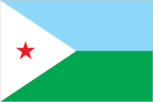
Flag
two equal horizontal bands of light blue (top) and light green with a white isosceles triangle based on the hoist side bearing a red five-pointed star in the center
Head of Government
Prime Minister BARKAT Gourad Hamadou (since 30 September 1978)
Independence
27 June 1977 (from France; formerly French Territory of the Afars and Issas)
Judicial branch
Supreme Court (Cour Supreme)
Legal system
based on French civil law system, traditional practices, and Islamic law
Legislative branch
National Assembly (Assemblee Nationale)
Long-form name
Republic of Djibouti
Member of
ACCT, ACP, AfDB, AFESD, AL, ECA, FAO, G-77, IBRD, ICAO, IDA, IDB, IFAD, IFC, IGADD, ILO, IMF, IMO, INTERPOL, IOC, ITU, LORCS, NAM, OAU, OIC, UN, UNESCO, UNCTAD, UPU, WHO, WMO
National Assembly
last held 24 April 1987 (next scheduled for May 1992 but post- poned); results - RPP is the only party; seats - (65 total) RPP 65
National holiday
Independence Day, 27 June (1977)
Other political or pressure groups
Front for the Restoration of Unity and Democracy and affiliates
Political parties and leaders
only party - People's Progress Assembly (RPP), Hassan GOULED Aptidon
President
last held 24 April 1987 (next to be held April 1993); results - President Hassan GOULED Aptidon was reelected without opposition
Suffrage
universal adult at age NA
Type
republic
Economy
Agriculture
accounts for only 5% of GDP; scanty rainfall limits crop production to mostly fruit and vegetables; half of population pastoral nomads herding goats, sheep, and camels; imports bulk of food needs
Budget
revenues $131 million; expenditures $154 million, including capital expenditures of $25 million (1990 est.)
Currency
Djiboutian franc (plural - francs); 1 Djiboutian franc (DF) = 100 centimes
Economic aid
US commitments, including Ex-Im (FY78-89), $39 million; Western (non-US) countries, including ODA and OOF bilateral commitments (1970-89), $1.1 billion; OPEC bilateral aid (1979-89), $149 million; Communist countries (1970-89), $35 million
Electricity
115,000 kW capacity; 200 million kWh produced, 580 kWh per capita (1991)
Exchange rates
Djiboutian francs (DF) per US$1 - 177.721 (fixed rate since 1973)
Exports
$190 million (f.o.b., 1990 est.) commodities: hides and skins, coffee (in transit) partners: Middle East 50%, Africa 43%, Western Europe 7%
External debt
$355 million (December 1990)
Fiscal year
calendar year
GDP
exchange rate conversion - $340 million, $1,000 per capita; real growth rate -1.0% (1989 est.)
Imports
$311 million (f.o.b., 1990 est.) commodities: foods, beverages, transport equipment, chemicals, petroleum products partners: EC 36%, Africa 21%, Asia 12%, US 2%
Industrial production
growth rate 0.1% (1989); manufacturing accounts for 4% of GDP
Industries
limited to a few small-scale enterprises, such as dairy products and mineral-water bottling
Inflation rate (consumer prices)
3.7% (1989)
Overview
The economy is based on service activities connected with the country's strategic location and status as a free trade zone in northeast Africa. Djibouti provides services as both a transit port for the region and an international transshipment and refueling center. It has few natural resources and little industry. The nation is, therefore, heavily dependent on foreign assistance to help support its balance of payments and to finance development projects. An unemployment rate of over 30% continues to be a major problem. Per capita consumption dropped an estimated 35% over the last five years because of recession and a high population growth rate (including immigrants and refugees).
Unemployment rate
over 30% (1989)
Communications
Airports
13 total, 11 usable; 2 with permanent-surface runways; none with runways over 3,659 m; 2 with runways 2,440-3,659 m; 5 with runways 1,220-2,439 m
Civil air
1 major transport aircraft
Highways
2,900 km total; 280 km paved; 2,620 km improved or unimproved earth (1982)
Ports
Djibouti
Railroads
the Ethiopian-Djibouti railroad extends for 97 km through Djibouti
Telecommunications
fair system of urban facilities in Djibouti and radio relay stations at outlying places; broadcast stations - 2 AM, 1 FM, 1 TV; 1 Indian Ocean INTELSAT earth station and 1 ARABSAT; 1 submarine cable to Saudi Arabia
Military and Security
Branches
Djibouti National Army (including Navy and Air Force), National Security Force (Force Nationale de Securite), National Police Force
Defense expenditures
exchange rate conversion - $29.9 million, NA% of GDP (1986)
Manpower availability
males 15-49, 96,150; 56,077 fit for military service