2003 Edition
CIA World Factbook 2003 (Project Gutenberg)
Introduction
Administrative divisions
13 regions (kraje, singular - kraj) and 1 capital city* (hlavni mesto); Jihocesky Kraj, Jihomoravsky Kraj, Karlovarsky Kraj, Kralovehradecky Kraj, Liberecky Kraj, Moravskoslezsky Kraj, Olomoucky Kraj, Pardubicky Kraj, Plzensky Kraj, Praha*, Stredocesky Kraj, Ustecky Kraj, Vysocina, Zlinsky Kraj
Age structure
0-14 years: 15.4% (male 809,697; female 768,747) 15-64 years: 70.6% (male 3,617,214; female 3,614,060) 65 years and over: 14% (male 554,922; female 884,576) (2003 est.)
Agriculture - products
wheat, potatoes, sugar beets, hops, fruit; pigs, poultry
Airports
144 (2002)
Airports - with paved runways
- total
- 44 2,438 to 3,047 m: 7 1,524 to 2,437 m: 16
- under 914 m
- 19 (2002) 914 to 1,523 m: 2
Airports - with unpaved runways
- total
- 100 1,524 to 2,437 m: 2 914 to 1,523 m: 36
- under 914 m
- 62 (2002)
Area
- land
- 77,276 sq km
- total
- 78,866 sq km
- water
- 1,590 sq km
Area - comparative
slightly smaller than South Carolina
Background
Following the First World War, the closely related Czechs and Slovaks of the former Austro-Hungarian Empire merged to form Czechoslovakia. During the interwar years, the new country's leaders were frequently preoccupied with meeting the demands of other ethnic minorities within the republic, most notably the Sudeten Germans and the Ruthenians (Ukrainians). After World War II, a truncated Czechoslovakia fell within the Soviet sphere of influence. In 1968, an invasion by Warsaw Pact troops ended the efforts of the country's leaders to liberalize Communist party rule and create "socialism with a human face." Anti-Soviet demonstrations the following year ushered in a period of harsh repression. With the collapse of Soviet authority in 1989, Czechoslovakia regained its freedom through a peaceful "Velvet Revolution." On 1 January 1993, the country underwent a "velvet divorce" into its two national components, the Czech Republic and Slovakia. Now a member of NATO, the Czech Republic has moved toward integration in world markets, a development that poses both opportunities and risks. In December 2002, the Czech Republic was invited to join the European Union (EU). It is expected that the Czech Republic will accede to the EU in 2004. Geography Czech Republic
Birth rate
9.01 births/1,000 population (2003 est.)
Budget
- expenditures
- $18 billion, including capital expenditures of $NA (2001 est.)
- revenues
- $16.7 billion
Capital
Prague
Climate
temperate; cool summers; cold, cloudy, humid winters
Coastline
0 km (landlocked)
Constitution
ratified 16 December 1992; effective 1 January 1993
Country name
- conventional long form
- Czech Republic
- conventional short form
- Czech Republic
- local long form
- Ceska Republika
- local short form
- Ceska Republika
Currency
Czech koruna (CZK)
Currency code
CZK
Death rate
10.74 deaths/1,000 population (2003 est.)
Debt - external
$23.8 billion (2002)
Diplomatic representation from the US
- chief of mission
- Ambassador Craig R. STAPLETON
- embassy
- Trziste 15, 11801 Prague 1
- mailing address
- use embassy street address
- telephone
- [420] (2) 5753-0663
Diplomatic representation in the US
- chancery
- 3900 Spring of Freedom Street NW, Washington, DC 20008
- chief of mission
- Ambassador Martin PALOUS
- consulate(s) general
- Los Angeles and New York
Disputes - international
Liechtenstein's royal family claims restitution for 1,600 sq km of land in the Czech Republic confiscated in 1918; individual Sudeten German claims for restitution of property confiscated in connection with their expulsion after World War II; Austria has minor dispute with Czech Republic over the Temelin nuclear power plant and post-World War II treatment of German-speaking minorities
Distribution of family income - Gini index
25.4 (1996)
Economic aid - recipient
$108 million; EU structural adjustment funds (2002)
Economy - overview
One of the most stable and prosperous of the post-Communist states, the Czech Republic has been recovering from recession since mid-1999. Growth in 2000-03 was supported by exports to the EU, primarily to Germany, and a near doubling of foreign direct investment. Domestic demand is playing an ever more important role in underpinning growth as interest rates drop and the availability of credit cards and mortgages increases. High current account deficits - averaging around 5% of GDP in the last several years - could be a persistent problem. Inflation is under control. The EU put the Czech Republic just behind Poland and Hungary in preparations for accession, which will give further impetus and direction to structural reform. Moves to complete banking, telecommunications, and energy privatization will encourage additional foreign investment, while intensified restructuring among large enterprises and banks and improvements in the financial sector should strengthen output growth. But revival in the European economies remains essential to stepped-up growth.
Electricity - consumption
55.6 billion kWh (2001)
Electricity - exports
18.92 billion kWh (2001)
Electricity - imports
9.38 billion kWh (2001)
Electricity - production
70.04 billion kWh (2001)
Electricity - production by source
- fossil fuel
- 76.1%
- hydro
- 2.9%
- nuclear
- 20%
- other
- 1% (2001)
Elevation extremes
- highest point
- Snezka 1,602 m
- lowest point
- Elbe River 115 m
Environment - current issues
air and water pollution in areas of northwest Bohemia and in northern Moravia around Ostrava present health risks; acid rain damaging forests; efforts to bring industry up to EU code should improve domestic pollution
Environment - international agreements
- party to
- Air Pollution, Air Pollution-Nitrogen Oxides, Air Pollution-Sulphur 85, Air Pollution-Sulphur 94, Air Pollution-Volatile Organic Compounds, Antarctic Treaty, Biodiversity, Climate Change, Climate Change-Kyoto Protocol, Desertification, Endangered Species, Environmental Modification, Hazardous Wastes, Law of the Sea, Nuclear Test Ban, Ozone Layer Protection, Ship Pollution, Wetlands
- signed, but not ratified
- Air Pollution-Persistent Organic Pollutants, Antarctic-Environmental Protocol
Ethnic groups
Czech 81.2%, Moravian 13.2%, Slovak 3.1%, Polish 0.6%, German 0.5%, Silesian 0.4%, Roma 0.3%, Hungarian 0.2%, other 0.5% (1991)
Exchange rates
koruny per US dollar - 32.74 (2002), 38.04 (2001), 38.6 (2000), 34.57 (1999), 32.28 (1998)
Executive branch
- cabinet
- Cabinet appointed by the president on the recommendation of the prime minister
- chief of state
- President Vaclav KLAUS (since 7 March 2003)
- election results
- Vaclav KLAUS elected president on 28 February 2003; Vaclav KLAUS 142 votes, Jan SOKOL 124 votes (third round; combined votes of both chambers of parliament)
- elections
- president elected by Parliament for a five-year term; last successful election held 28 February 2003 (after earlier elections held 15 and 24 January 2003 were inconclusive); prime minister appointed by the president
- head of government
- Prime Minister Vladimir SPIDLA (since 12 July 2002), Deputy Prime Ministers Bohuslav SOBOTKA (since 20 August 2003), Cyril SVOBODA (since July 2002), Stanislav GROSS (since July 2002), Petr MARES (since July 2002)
- note
- the Czech Republic's first president Vaclav HAVEL stepped down from office on 2 February 2003 having served exactly 10 years; parliament finally elected a successor on 28 February 2003 after two inconclusive elections in January 2003
Exports
$40.8 billion f.o.b. (2002)
Exports - commodities
machinery and transport equipment 44%, intermediate manufactures 25%, chemicals 7%, raw materials and fuel 7% (2000)
Exports - partners
Germany 40.2%, Slovakia 7.1%, Austria 5.8%, UK 5.1%, Poland 5%, France 4% (2002)
FAX
- [1] (202) 966-8540
- [420] (2) 5753-0583
- telephone
- [1] (202) 274-9100
Fiscal year
calendar year Communications Czech Republic
Flag description
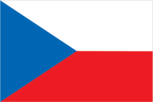
two equal horizontal bands of white (top) and red with a blue isosceles triangle based on the hoist side (identical to the flag of the former Czechoslovakia) Economy Czech Republic
GDP
purchasing power parity - $157.1 billion (2002 est.)
GDP - composition by sector
- agriculture
- 3.8%
- industry
- 41%
- services
- 55.2% (2001)
GDP - per capita
purchasing power parity - $15,300 (2002 est.)
GDP - real growth rate
2% (2002 est.)
Geographic coordinates
49 45 N, 15 30 E
Geography - note
landlocked; strategically located astride some of oldest and most significant land routes in Europe; Moravian Gate is a traditional military corridor between the North European Plain and the Danube in central Europe People Czech Republic
Government type
parliamentary democracy
Heliports
2 (2002) Military Czech Republic
Highways
- paved
- 55,408 km (including 499 km of expressways)
- total
- 55,408 km
- unpaved
- 0 km (2000)
HIV/AIDS - adult prevalence rate
less than 0.1% (2001 est.)
HIV/AIDS - deaths
less than 10 (2001 est.)
HIV/AIDS - people living with HIV/AIDS
500 (2001 est.)
Household income or consumption by percentage share
- highest 10%
- 22.4% (1996)
- lowest 10%
- 4.3%
Illicit drugs
transshipment point for Southwest Asian heroin and minor transit point for Latin American cocaine to Western Europe; producer of synthetic drugs for local and regional markets; susceptible to money laundering related to drug trafficking, organized crime This page was last updated on 18 December, 2003
Imports
$43.2 billion f.o.b. (2002)
Imports - commodities
machinery and transport equipment 40%, intermediate manufactures 21%, raw materials and fuels 13%, chemicals 11% (2000)
Imports - partners
Germany 39.1%, Slovakia 6%, Austria 5.6%, Italy 5.4%, France 5.3%, Poland 4.1%, UK 4.1%, Russia 4% (2002)
Independence
1 January 1993 (Czechoslovakia split into the Czech Republic and Slovakia)
Industrial production growth rate
3.5% (2002)
Industries
metallurgy, machinery and equipment, motor vehicles, glass, armaments
Infant mortality rate
- female
- 4.87 deaths/1,000 live births (2003 est.)
- male
- 5.85 deaths/1,000 live births
- total
- 5.37 deaths/1,000 live births
Inflation rate (consumer prices)
0.6% (2002 est.)
International organization participation
ACCT (observer), Australia Group, BIS, CE, CEI, CERN, EAPC, EBRD, ECE, EU (applicant), FAO, IAEA, IBRD, ICAO, ICC, ICCt (signatory), ICFTU, ICRM, IDA, IEA, IFC, IFRCS, ILO, IMF, IMO, Interpol, IOC, IOM, ISO, ITU, MONUC, NATO, NEA, NSG, OAS (observer), OECD, OPCW, OSCE, PCA, PFP, UN, UNAMSIL, UNCTAD, UNESCO, UNIDO, UNITAR, UNMEE, UNMIBH, UNMIK, UNMOP, UNMOT, UNOMIG, UPU, WCL, WCO, WEU (associate), WFTU, WHO, WIPO, WMO, WToO, WTrO, ZC
Internet country code
.cz
Internet Service Providers (ISPs)
more than 300 (2000)
Internet users
2.69 million (2001) Transportation Czech Republic
Irrigated land
240 sq km (1998 est.)
Judicial branch
Supreme Court; Constitutional Court; chairman and deputy chairmen are appointed by the president for a 10-year term
Labor force
5.203 million (1999 est.)
Labor force - by occupation
agriculture 5%, industry 35%, services 60% (2001 est.)
Land boundaries
- border countries
- Austria 362 km, Germany 646 km, Poland 658 km, Slovakia 215 km
- total
- 1,881 km
Land use
- arable land
- 40%
- other
- 56.96% (1998 est.)
- permanent crops
- 3.04%
Languages
Czech
Legal system
civil law system based on Austro-Hungarian codes; has not accepted compulsory ICJ jurisdiction; legal code modified to bring it in line with Organization on Security and Cooperation in Europe (OSCE) obligations and to expunge Marxist-Leninist legal theory
Legislative branch
- bicameral Parliament or Parlament consists of the Senate or Senat (81 seats; members are elected by popular vote to serve six-year terms; one-third elected every two years) and the Chamber of Deputies or Poslanecka Snemovna (200 seats; members are elected by popular vote to serve four-year terms)
- election results
- Senate - percent of vote by party - NA%; seats by party - ODS 26, KDU-CSL 14, CSSD 11, US 9, KSCM 3, independents 18; Chamber of Deputies - percent of vote by party - CSSD 30.2%, ODS 24.5%, KSCM 18.5%, KDU-CSL & US-DEU coalition 14.3%, other minor 12.5%; seats by party - CSSD 70, ODS 58, KSCM 41, KDU-CSL 21, US-DEU 10
- elections
- Senate - last held in two rounds 25-26 October and 1-2 November 2002 (next to be held NA November 2004); Chamber of Deputies - last held 14-15 June 2002 (next to be held by NA June 2006)
Life expectancy at birth
- female
- 78.87 years (2003 est.)
- male
- 71.69 years
- total population
- 75.18 years
Literacy
- definition
- NA
- female
- NA% Government Czech Republic
- male
- NA%
- total population
- 99.9% (1999 est.)
Location
Central Europe, southeast of Germany
Map references
Europe
Maritime claims
none (landlocked)
Median age
- female
- 40.2 years (2002)
- male
- 36.6 years
- total
- 38.4 years
Military branches
Army, Air and Air Defense Forces, Territorial Defense Force
Military expenditures - dollar figure
$1,190.2 million (FY01)
Military expenditures - percent of GDP
2.1% (FY01) Transnational Issues Czech Republic
Military manpower - availability
- males age 15-49
- 2,622,192 (2003 est.)
Military manpower - fit for military service
- males age 15-49
- 2,002,202 (2003 est.)
Military manpower - military age
18 years of age (2003 est.)
Military manpower - reaching military age annually
- males
- 67,777 (2003 est.)
National holiday
Czech Founding Day, 28 October (1918)
Nationality
- adjective
- Czech
- noun
- Czech(s)
Natural gas - consumption
9.892 billion cu m (2001 est.)
Natural gas - exports
1 million cu m (2001 est.)
Natural gas - imports
9.521 billion cu m (2001 est.)
Natural gas - production
160 million cu m (2001 est.)
Natural gas - proved reserves
3.057 billion cu m (37257)
Natural hazards
flooding
Natural resources
hard coal, soft coal, kaolin, clay, graphite, timber
Net migration rate
0.97 migrant(s)/1,000 population (2003 est.)
Oil - consumption
175,700 bbl/day (2001 est.)
Oil - exports
26,670 bbl/day (2001)
Oil - imports
192,300 bbl/day (2001)
Oil - production
7,419 bbl/day (2001 est.)
Oil - proved reserves
17.25 million bbl (37257)
Pipelines
gas 7,020 km; oil 547 km; refined products 94 km (2003)
Political parties and leaders
Christian and Democratic Union-Czechoslovak People's Party or KDU-CSL [Miroslav KALOUSEK, chairman]; Civic Democratic Alliance or ODA [Michael ZANTOVSKY, chairman]; Civic Democratic Party or ODS [Mirek TOPOLANEK, chairman]; Communist Party of Bohemia and Moravia or KSCM [Miroslav GREBENICEK, chairman]; Communist Party of Czechoslovakia or KSC [Miroslav STEPAN, chairman]; Czech National Social Party of CSNS [Jan SULA, chairman]; Czech Social Democratic Party or CSSD [Vladimir SPIDLA, chairman]; Freedom Union-Democratic Union or US-DEU [Petr MARES, chairman]; Quad Coalition [Karel KUHNL, chairman] (includes KDU-CSL, US, ODA, DEU)
Political pressure groups and leaders
Czech-Moravian Confederation of Trade Unions [Richard FALBR]
Population
10,249,216 (July 2003 est.)
Population below poverty line
NA%
Population growth rate
-0.08% (2003 est.)
Ports and harbors
Decin, Prague, Usti nad Labem
Radio broadcast stations
AM 31, FM 304, shortwave 17 (2000)
Radios
3,159,134 (December 2000)
Railways
- narrow gauge
- 99 km 0.760-m gauge (2002)
- standard gauge
- 9,363 km 1.435-m gauge (1,745 km electrified)
- total
- 9,462 km
Religions
Roman Catholic 39.2%, Protestant 4.6%, Orthodox 3%, other 13.4%, atheist 39.8%
Sex ratio
- at birth
- 1.06 male(s)/female
- total population
- 0.95 male(s)/female (2003 est.)
- under 15 years
- 1.05 male(s)/female 15-64 years: 1 male(s)/female 65 years and over: 0.63 male(s)/female
Suffrage
18 years of age; universal
Telephone system
- domestic
- 86% of exchanges now digital; existing copper subscriber systems now being enhanced with Asymmetric Digital Subscriber Line (ADSL) equipment to accommodate Internet and other digital signals; trunk systems include fiber-optic cable and microwave radio relay
- general assessment
- privatization and modernization of the Czech telecommunication system got a late start but is advancing steadily; growth in the use of mobile cellular telephones is particularly vigorous
- international
- satellite earth stations - 2 Intersputnik (Atlantic and Indian Ocean regions), 1 Intelsat, 1 Eutelsat, 1 Inmarsat, 1 Globalstar
Telephones - main lines in use
3.869 million (2000)
Telephones - mobile cellular
4.346 million (2000)
Television broadcast stations
150 (plus 1,434 repeaters) (2000)
Televisions
3,405,834 (December 2000)
Terrain
Bohemia in the west consists of rolling plains, hills, and plateaus surrounded by low mountains; Moravia in the east consists of very hilly country
Total fertility rate
1.18 children born/woman (2003 est.)
Unemployment rate
9.8% (2002)
Waterways
- 303 km
- note
- the Labe (Elbe) is the principal river (2000)