1998 Edition
CIA World Factbook 1998 (Internet Archive)
Geography
Area
total: 78,703 sq km land: 78,645 sq km water: 58 sq km
Area-comparative
slightly smaller than South Carolina
Climate
temperate; cool summers; cold, cloudy, humid winters
Coastline
0 km (landlocked)
Elevation extremes
lowest point: Elbe River 115 m highest point: Snezka 1,602 m
Environment-current issues
air and water pollution in areas of northwest Bohemia and in northern Moravia around Ostrava present health risks; acid rain damaging forests
Environment-international agreements
party to: Air Pollution, Air Pollution-Nitrogen Oxides, Air Pollution-Sulphur 85, Air Pollution-Sulphur 94, Air Pollution-Volatile Organic Compounds, Antarctic Treaty, Biodiversity, Climate Change, Endangered Species, Environmental Modification, Hazardous Wastes, Law of the Sea, Nuclear Test Ban, Ozone Layer Protection, Ship Pollution, Wetlands signed, but not ratified: Antarctic-Environmental Protocol
Geographic coordinates
49 45 N, 15 30 E
Geography-note
landlocked; strategically located astride some of oldest and most significant land routes in Europe; Moravian Gate is a traditional military corridor between the North European Plain and the Danube in central Europe
Irrigated land
240 sq km (1993 est.)
Land boundaries
total: 1,881 km border countries: Austria 362 km, Germany 646 km, Poland 658 km, Slovakia 215 km
Land use
arable land: 41% permanent crops: 2% permanent pastures: 11% forests and woodland: 34% other: 12% (1993 est.)
Location
Central Europe, southeast of Germany
Map references
Europe
Maritime claims
none (landlocked)
Natural hazards
NA
Natural resources
hard coal, soft coal, kaolin, clay, graphite
Terrain
Bohemia in the west consists of rolling plains, hills, and plateaus surrounded by low mountains; Moravia in the east consists of very hilly country
People and Society
Age structure
0-14 years: 17% (male 907,744; female 864,202) 15-64 years: 69% (male 3,555,822; female 3,548,548) 65 years and over: 14% (male 541,031; female 869,123) (July 1998 est.)
Birth rate
8.96 births/1,000 population (1998 est.)
Death rate
10.92 deaths/1,000 population (1998 est.)
Ethnic groups
Czech 94.4%, Slovak 3%, Polish 0.6%, German 0.5%, Gypsy 0.3%, Hungarian 0.2%, other 1%
Infant mortality rate
6.79 deaths/1,000 live births (1998 est.)
Languages
Czech, Slovak
Life expectancy at birth
total population: 74.11 years male: 70.75 years female: 77.65 years (1998 est.)
Literacy
definition: age NA and over can read and write total population: 99% (est.) male: NA% female: NA%
Nationality
noun: Czech(s) adjective: Czech note: 300,000 Slovaks declared themselves Czech citizens in 1994
Net migration rate
0.92 migrant(s)/1,000 population (1998 est.)
Population
10,286,470 (July 1998 est.)
Population growth rate
-0.11% (1998 est.)
Religions
atheist 39.8%, Roman Catholic 39.2%, Protestant 4.6%, Orthodox 3%, other 13.4%
Sex ratio
at birth: 1.05 male(s)/female under 15 years: 1.05 male(s)/female 15-64 years: 1 male(s)/female 65 years and over: 0.62 male(s)/female (1998 est.)
Total fertility rate
1.17 children born/woman (1998 est.)
Government
Administrative divisions
8 regions (kraje, kraj-singular); Jihocesky, Jihomoravsky, Praha, Severocesky, Severomoravsky, Stredocesky, Vychodocesky, Zapadocesky
Constitution
ratified 16 December 1992; effective 1 January 1993
Country name
conventional long form: Czech Republic conventional short form: Czech Republic local long form: Ceska Republika local short form: Ceska Republika
Data code
EZ
Executive branch
chief of state: President Vaclav HAVEL (since 2 February 1993) head of government: Prime Minister Josef TOSOVSKY (since 16 December 1997); Deputy Prime Ministers Josef LUX (since NA June 1992), Jaroslav SEDIVY (since NA January 1998), Jiri SKALICKY (since NA June 1997) cabinet: Cabinet appointed by the president on the recommendation of the prime minister elections: president elected by Parliament for a five-year term; election last held 20 January 1998 (next to be held NA January 2003); prime minister appointed by the president election results: Vaclav HAVEL elected president; percent of parliamentary vote-NA; Vaclav HAVEL received 47 of 81 votes in the Senate and 99 out of 200 votes in the Chamber of Deputies (second round of voting)
FAX
- [1] (202) 966-8540 consulate(s) general: Los Angeles Diplomatic representation from the US: chief of mission: Ambassador Jenonne R. WALKER embassy: Trziste 15, 11801 Prague 1 mailing address: Unit 28129, APO AE 09114; State pouch: American Embassy Prague, Washington, DC 20521-5630 telephone: [420] (2) 5732-0663, 5731-3814
- [420] (2) 5732-0584
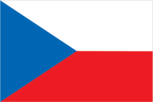
Flag description
two equal horizontal bands of white (top) and red with a blue isosceles triangle based on the hoist side (almost identical to the flag of the former Czechoslovakia)
Government type
parliamentary democracy
Independence
1 January 1993 (from Czechoslovakia)
International organization participation
Australia Group, BIS, CCC, CE (guest), CEI, CERN, EAPC, EBRD, ECE, EU (applicant), FAO, IAEA, IBRD, ICAO, ICFTU, ICRM, IDA, IFC, IFRCS, ILO, IMF, IMO, Inmarsat, Interpol, IOC, IOM, ISO, ITU, NSG, OECD, OSCE, PCA, PFP, UN, UNCTAD, UNESCO, UNIDO, UNMOP, UNOMIG, UNPREDEP, UPU, WEU (associate partner), WFTU, WHO, WIPO, WMO, WToO, WTrO, ZC Diplomatic representation in the US: chief of mission: Ambassador Aleksandr VONDRA chancery: 3900 Spring of Freedom Street NW, Washington, DC 20008 telephone: [1] (202) 274-9101, 9102
Judicial branch
Supreme Court, chairman and deputy chairmen are appointed by the president for life; Constitutional Court, chairman and deputy chairmen are appointed by the president for life Political parties and leaders: Civic Democratic Party or ODS [Vaclav KLAUS, chairman]; Civic Democratic Alliance or ODA [Jiri SKALICKY, chairman]; Christian Democratic Union-Czech People's Party or KDU-CSL [Josef LUX, chairman]; Czech Social Democrats or CSSD-left opposition [Milos ZEMAN, chairman]; Communist Party or KSCM - left opposition [Miroslav GREBENICEK, chairman]; Assembly for the Republic or SPR-RSC-extreme right radical [Miroslav SLADEK, chairman]; Democratic Union or DEU [Ratibor MAJZLIK, chairman] note: the governing coalition resigned in November 1997; a caretaker government, led by Prime Minister Josef TOSOVSKY, was appointed by President HAVEL in December 1997; new general elections will most likely be held in June 1998; there are three new parties that have not been voted into office, but were created in the wake of Prime Minister
KLAUS' resignation
Freedom Union or US [Jan RUML, chairman], Conservative Consensus Party [Ivan MASEK and Cestmir HOFHANZL], and Party of the Democratic Center [Josef WAGNER, chairman] Political pressure groups and leaders: Czech-Moravian Chamber of Trade Unions; Civic Movement
Legal system
civil law system based on Austro-Hungarian codes; has not accepted compulsory ICJ jurisdiction; legal code modified to bring it in line with Organization on Security and Cooperation in Europe (OSCE) obligations and to expunge Marxist-Leninist legal theory
Legislative branch
bicameral Parliament or Parlament consists of the Senate or Senat (81 seats; members are elected by popular vote to serve staggered two-, four-, and six-year terms) and the Chamber of Deputies or Snemovna Poslancu (200 seats; members are elected by popular vote to serve four-year terms) elections: Senate-last held 15-16 and 22-23 November 1996 (next to be held NA November 1998-to replace/re-elect 20 senators serving two-year terms); Chamber of Deputies-last held 31 May-1 June 1996 (early elections to be held NA June 1998) election results: Senate-percent of vote by party-NA; seats by party-governing coalition (ODS 32, KDU-CSL 13, ODA 7), opposition (CSSD 25, KCSM 2, DEU 1, independent 1); Chamber of Deputies-percent of vote by party-NA; seats by party - governing coalition (ODS 68, KDU-CSL 18, ODA 13), opposition (CSSD 61, KCSM 22, SPR-RSC 18)
National capital
Prague
National holiday
National Liberation Day, 8 May; Founding of the Republic, 28 October
Suffrage
18 years of age; universal
Economy
Agriculture-products
grains, potatoes, sugar beets, hops, fruit; pigs, cattle, poultry; forest products
Budget
revenues: $14.2 billion expenditures: $14.6 billion, including capital expenditures of $NA (1997)
Currency
1 koruna (Kc) = 100 haleru
Debt-external
$20.7 billion (1996)
Economic aid
$NA
Economy-overview
Political and financial crises in 1997 shattered the Czech Republic's image as one of the most stable and prosperous of post-Communist states. Delays in enterprise restructuring and failure to develop a well-functioning capital market played major roles in Czech economic troubles, which culminated in a currency crisis in May. The currency was forced out of its fluctuation band as investors worried that the current account deficit, which reached about 8% of GDP in 1996, would become unsustainable. After expending $3 billion in vain to support the currency, the central bank let it float. The growing current account imbalance reflected a surge in domestic demand and poor export performance, as wage increases outpaced productivity. The government was forced to introduce two austerity packages later in the spring which cut government spending by 2.5% of GDP. A tough 1998 budget continues the painful medicine. These problems were compounded in the summer of 1997 by unprecedented flooding which inundated much of the eastern part of the country. Czech difficulties in 1997 contrast with earlier achievements of strong GDP growth, a balanced budget, and inflation and unemployment that were among the lowest in the region. The Czech economy's transition problems continue to be too much direct and indirect government influence on the privatized economy, the sometimes ineffective management of privatized firms, and a shortage of experienced financial analysts for the banking system. Prague forecasts a balanced budget, 2.2% GDP growth, 5.2% unemployment, and 10% inflation for 1998.
Electricity-capacity
13.85 million kW (1994)
Electricity-consumption per capita
5,069 kWh (1995)
Electricity-production
53.285 billion kWh (1995)
Exchange rates
koruny (Kcs) per US$1-35.357 (January 1998), 31.698 (1997), 27.145 (1996), 26.541 (1995), 28.785 (1994), 29.153 (1993) note: values before 1993 reflect Czechoslovak exchange rates
Exports
total value: $21.7 billion (f.o.b., 1996) commodities: machinery and equipment 32.7%, manufactured goods 28.8%, raw materials and fuel 9.2%, food 4.1% (1996) partners: EU 60.9%, CEFTA 21.4%, Slovakia 13.9%, EFTA 1.7% (1996)
Fiscal year
calendar year Communications
GDP
purchasing power parity-$111.9 billion (1997 est.)
GDP-composition by sector
agriculture: 5% industry: 40.6% services: 54.4% (1996)
GDP-per capita
purchasing power parity-$10,800 (1997 est.)
GDP-real growth rate
0.7% (1997 est.)
Imports
total value: $27.7 billion (f.o.b., 1996) commodities: machinery and equipment 38.2%, manufactured goods 19.3%, raw materials and fuels 12.4%, and food 5.6% (1996) partners: EU 61.1%, CEFTA 16.3%, Slovakia 11.8%, EFTA 2.2% (1996)
Industrial production growth rate
6.9% (1996)
Industries
fuels, ferrous metallurgy, machinery and equipment, coal, motor vehicles, glass, armaments
Inflation rate-consumer price index
10% (1997)
Labor force
total: 5.124 million (1997) by occupation: industry 33.1%, agriculture 6.9%, construction 9.1%, transport and communications 7.2%, services 43.7% (1994)
Radio broadcast stations
AM NA, FM NA, shortwave NA
Radios
NA
Telephone system
domestic: NA international: satellite earth stations-2 Intersputnik (Atlantic and Indian Ocean regions)
Telephones
3,349,539 (1993 est.)
Television broadcast stations
NA
Televisions
NA
Unemployment rate
5% (1997 est.)
Transportation
Airports
66 (1997 est.) Airports-with paved runways: total: 33 over 3,047 m: 2 2,438 to 3,047 m: 7 1,524 to 2,437 m: 10 914 to 1,523 m: 1 under 914 m: 13 (1997 est.) Airports-with unpaved runways: total: 33 914 to 1,523 m: 17 under 914 m: 16 (1997 est.)
Heliports
1 (1997 est.)
Highways
total: 55,489 km paved: 55,489 km (including 423 km of expressways) unpaved: 0 km (1996 est.)
Merchant marine
total: 5 ships (1,000 GRT or over) totaling 110,233 GRT/192,998 DWT ships by type: bulk 3 under Maltese flag, cargo 2 under the Cypriot flag (1997 est.)
Pipelines
natural gas 5,400 km Ports and harbors: Decin, Prague, Usti nad Labem
Railways
total: 9,440 km standard gauge: 9,344 km 1.435-m standard gauge (2,688 km electrified at three voltages; 1,885 km double track) narrow gauge: 96 km 0.760-m narrow gauge (1996)
Waterways
NA km; the Elbe (Labe) is the principal river
Military and Security
Military branches
Army, Air Force, Civil Defense
Military expenditures-dollar figure
$1.22 billion (1996)
Military expenditures-percent of GDP
2.2% (1996)
Military manpower-availability
males age 15-49: 2,699,023 (1998 est.) Military manpower-fit for military service: males: 2,056,386 (1998 est.)
Military manpower-military age
18 years of age
Military manpower-reaching military age annually
males: 78,188 (1998 est.)
Transnational Issues
Disputes-international
Liechtenstein claims restitution for 1,600 sq km of territory in the Czech Republic confiscated from its royal family in 1918; the Czech Republic insists that restitution does not go back before February 1948, when the communists seized power; individual Sudeten German claims for restitution of property confiscated in connection with their expulsion after World War II; unresolved property issues with Slovakia over redistribution of former Czechoslovak federal property
Illicit drugs
transshipment point for Southwest Asian heroin and hashish and Latin American cocaine to Western Europe; domestic consumption-especially of locally produced synthetic drugs-on the rise