1995 Edition
CIA World Factbook 1995 (Project Gutenberg)
Geography
Area
total area: 78,703 sq km land area: 78,645 sq km comparative area: slightly smaller than South Carolina
Climate
temperate; cool summers; cold, cloudy, humid winters
Coastline
0 km (landlocked)
Environment
current issues: air and water pollution in areas of northwest Bohemia centered around Zeplica and in northern Moravia around Ostrava present health risks; acid rain damaging forests natural hazards: NA international agreements: party to - Air Pollution, Air Pollution-Nitrogen Oxides, Air Pollution-Sulphur 85, Antarctic Treaty, Biodiversity, Climate Change, Endangered Species, Environmental Modification, Hazardous Wastes, Nuclear Test Ban, Ozone Layer Protection, Ship Pollution, Wetlands; signed, but not ratified - Air Pollution-Sulphur 94, Antarctic-Environmental Protocol, Law of the Sea
International disputes
Liechtenstein claims restitution for l,600 square kilometers of Czech territory confiscated from its royal family in 1918; Sudeten German claims for restitution of property confiscated in connection with their expulsion after World War II versus the Czech Republic claims that restitution does not preceed before February 1948 when the Communists seized power; unresolved property issues with Slovakia over redistribution of property of the former Czechoslovak federal government
Irrigated land
NA sq km
Land boundaries
total 1,880 km, Austria 362 km, Germany 646 km, Poland 658 km, Slovakia 214 km
Land use
arable land: NA% permanent crops: NA% meadows and pastures: NA% forest and woodland: NA% other: NA%
Location
Central Europe, southeast of Germany
Map references
Ethnic Groups in Eastern Europe, Europe
Maritime claims
none; landlocked
Natural resources
hard coal, soft coal, kaolin, clay, graphite
Note
landlocked; strategically located astride some of oldest and most significant land routes in Europe; Moravian Gate is a traditional military corridor between the North European Plain and the Danube in central Europe
Terrain
two main regions: Bohemia in the west, consisting of rolling plains, hills, and plateaus surrounded by low mountains; and Moravia in the east, consisting of very hilly country
People and Society
Age structure
0-14 years: 19% (female 981,918; male 1,030,003) 15-64 years: 68% (female 3,529,411; male 3,530,112) 65 years and over: 13% (female 848,599; male 512,731) (July 1995 est.)
Birth rate
13.46 births/1,000 population (1995 est.)
Death rate
10.85 deaths/1,000 population (1995 est.)
Ethnic divisions
Czech 94.4%, Slovak 3%, Polish 0.6%, German 0.5%, Gypsy 0.3%, Hungarian 0.2%, other 1%
Infant mortality rate
8.9 deaths/1,000 live births (1995 est.)
Labor force
5.389 million by occupation: industry 37.9%, agriculture 8.1%, construction 8.8%, communications and other 45.2% (1990)
Languages
Czech, Slovak
Life expectancy at birth
total population: 73.54 years male: 69.87 years female: 77.41 years (1995 est.)
Literacy
can read and write total population: 99%
Nationality
noun: Czech(s) adjective: Czech note: 300,000 Slovaks declared themselves Czech citizens in 1994
Net migration rate
0 migrant(s)/1,000 population (1995 est.)
Population
10,432,774 (July 1995 est.)
Population growth rate
0.26% (1995 est.)
Religions
atheist 39.8%, Roman Catholic 39.2%, Protestant 4.6%, Orthodox 3%, other 13.4%
Total fertility rate
1.84 children born/woman (1995 est.)
Government
Administrative divisions
8 regions (kraje, kraj - singular); Jihocesky, Jihomoravsky, Praha, Severocesky, Severomoravsky, Stredocesky, Vychodocesky, Zapadocesky
Capital
Prague
Chamber of Deputies
elections last held 5-6 June 1992 (next to be held NA 1996); results - percent of vote by party NA given breakup and realignment of all parliamentary opposition parties since 1992; seats - (200 total) governing coalition: ODS 65, KDS 10, ODA 16, KDU-CSL 15, opposition: CSSD 18, LB 25, KSCM 10, LSU 9, LSNS 5, CMSS 9, SPR-RSC 6, independents 12
Constitution
ratified 16 December 1992; effective 1 January 1993
Digraph
EZ
Diplomatic representation in US
chief of mission: Ambassador Michael ZANTOVSKY chancery: 3900 Spring of Freedom Street NW, Washington, DC 20008 telephone: [1] (202) 363-6315, 6316
Executive branch
chief of state: President Vaclav HAVEL (since 26 January 1993); election last held 26 January 1993 (next to be held NA January 1998); results - Vaclav HAVEL elected by the National Council head of government: Prime Minister Vaclav KLAUS (since NA June 1992); Deputy Prime Ministers Ivan KOCARNIK, Josef LUX, Jan KALVODA (since NA June 1992) cabinet: Cabinet; appointed by the president on recommendation of the prime minister
FAX
- [1] (202) 966-8540
- [42] (2) 2451-1001
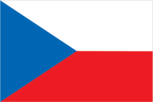
Flag
two equal horizontal bands of white (top) and red with a blue isosceles triangle based on the hoist side (almost identical to the flag of the former Czechoslovakia)
Independence
1 January 1993 (from Czechoslovakia)
Judicial branch
Supreme Court, Constitutional Court
Legal system
civil law system based on Austro-Hungarian codes; has not accepted compulsory ICJ jurisdiction; legal code modified to bring it in line with Organization on Security and Cooperation in Europe (OSCE) obligations and to expunge Marxist-Leninist legal theory
Legislative branch
bicameral National Council (Narodni rada)
Member of
Australia Group, BIS, CCC, CE (guest), CEI, CERN, EBRD, ECE, FAO, GATT, IAEA, IBRD, ICAO, ICFTU, ICRM, IDA, IFC, IFRCS, ILO, IMF, IMO, INMARSAT, INTELSAT, INTERPOL, IOC, IOM (observer), ISO, ITU, NACC, NSG, OSCE, PCA, PFP, UN, UNCTAD, UNESCO, UNIDO, UNOMIL, UNOMOZ, UNPROFOR, UPU, WEU (associate partner), WFTU, WHO, WIPO, WMO, WTO, ZC
Names
conventional long form: Czech Republic conventional short form: Czech Republic local long form: Ceska Republika local short form: Cechy
National holiday
National Liberation Day, 9 May; Founding of the Republic, 28 October
Other political or pressure groups
Czech-Moravian Chamber of Trade Unions; Civic Movement
Political parties and leaders
governing coalition: Civic Democratic Party (ODS), Vaclav KLAUS, chairman; Christian Democratic Party (KDS), Ivan PILIP, chairman; Civic Democratic Alliance (ODA), Jan KALVODA, chairman; Christian Democratic Union/Czech People's Party (KDU-CSL), Josef LUX, chairman opposition: Czech Social Democrats (CSSD - left opposition), Milos ZEMAN, chairman; Left Bloc (LB - left opposition), Marie STIBOROVA, chairman; Communist Party (KSCM - left opposition), Miroslav GREBENICEK, chairman; Liberal Social Union (LSU - left opposition), Frantisek TRNKA, chairman; Liberal National Social Party (LSNS - center party), Pavel HIRS, chairman; Bohemian-Moravian Center Party (CMSS - center party), Jan KYCER, chairman; Assembly for the Republic (SPR-RSC - right radical) , Miroslav SLADEK, chairman
Senate
elections not yet held; seats (81 total)
Suffrage
18 years of age; universal
Type
parliamentary democracy
US diplomatic representation
chief of mission: Ambassador Adrian A. BASORA embassy: Trziste 15, 11801 Prague 1 mailing address: Unit 1330; APO AE 09213-1330 telephone: [42] (2) 2451-0847
Economy
Agriculture
largely self-sufficient in food production; diversified crop and livestock production, including grains, potatoes, sugar beets, hops, fruit, hogs, cattle, and poultry; exporter of forest products
Budget
revenues: $14 billion expenditures: $13.6 billion, including capital expenditures of $NA (1994 est.)
Currency
1 koruna (Kc) = 100 haleru
Economic aid
donor: 1.4 million annually to IMF beginning in 1994
Electricity
capacity: 14.470,000 kW production: 56.3 billion kWh consumption per capita: 4,842 kWh (1993)
Exchange rates
koruny (Kcs) per US$1 - 27.762 (January 1995), 28.785 (1994), 29.153 (1993), 28.26 (1992), 29.53 (1991), 17.95 (1990) note: values before 1993 reflect Czechoslovak exchange rates
Exports
$13.4 billion (f.o.b., 1994 est.) commodities: manufactured goods, machinery and transport equipment, chemicals, fuels, minerals, metals, agricultural products (January-November 1994) partners: Germany 28.7%, Slovakia 15.5%, Austria 7.9%, Italy 6.4%, France 3.2%, Russia 3.2%, Poland 3.1%, UK 2.9%, Netherlands 2.4%, Hungary 2.2%, US 2.1%, Belgium 1.3% (January-June 1994)
External debt
$8.7 billion (October 1994)
Fiscal year
calendar year
Illicit drugs
transshipment point for Southwest Asian heroin and Latin American cocaine to Western Europe
Imports
$13.3 billion (f.o.b., 1994 est.) commodities: machinery and transport equipment, manufactured goods, chemicals, fuels and lubricants, raw materials, agricultural products (January-November 1994) partners: Germany 24.1%, Slovakia 15.6%, Russia 9.8%, Austria 7.6%, Italy 4.9%, France 3.6%, US 3.2%, Netherlands 2.9%, UK 2.8%, Poland 2.7%, Switzerland 2.2%, Belgium 2.0% (January-June 1994)
Industrial production
growth rate 4.9% (January-September 1994)
Industries
fuels, ferrous metallurgy, machinery and equipment, coal, motor vehicles, glass, armaments
Inflation rate (consumer prices)
10.2% (1994 est.)
National product
GDP - purchasing power parity - $76.5 billion (1994 est.)
National product per capita
$7,350 (1994 est.)
National product real growth rate
2.2% (1994 est.)
Overview
The government of the Czech Republic, using successful stabilization policies to bolster its claims to full membership in the western economic community, has reduced inflation to 10%, kept unemployment at 3%, balanced the budget, run trade surpluses, and reoriented exports to the EU since the breakup of the Czechoslovak federation on 1 January 1993. GDP grew 2% in 1994 after stagnating in 1993 and contracting nearly 20% since 1990. Prague's mass privatization program, including its innovative distribution of ownership shares to Czech citizens via 'coupon vouchers,' has made the most rapid progress in Eastern Europe. When coupon shares are distributed in early 1995, 75%-80% of the economy will be in private hands or partially privatized, according to the Czech government. Privatized companies still face major problems in restructuring; the number of annual bankruptcies quadrupled in 1994. In September 1994, Prague repaid $471 million in IMF loans five years ahead of schedule, making the Czech Republic the first East European country to pay off all IMF debts. Despite these outlays, hard-currency reserves in the banking system totaled more than $8.5 billion in October. Standard & Poor's boosted the Republic's credit rating to BBB+ in mid-1994 - up from a BBB rating that was already two steps higher than Hungary's and one step above Greece's rating. Prague forecasts a balanced budget, at least 3% GDP growth, 5% unemployment, and single-digit inflation for 1995. Inflationary pressures - primarily as a result of foreign bank lending to Czech enterprises but perhaps also due to eased currency convertibility controls - are likely to be the most troublesome issues in 1995. Continuing economic recovery in Western Europe should boost Czech exports and production but a substantial increase in prices could erode the Republic's comparative advantage in low wages and exchange rates. Prague already took steps in 1994 to increase control over banking policies to neutralize the impact of foreign inflows on the money supply. Although Czech unemployment is currently the lowest in Central Europe, it will probably increase 1-2 percentage points in 1995 as large state firms go bankrupt or are restructured and service sector growth slows.
Unemployment rate
3.2% (1994 est.)
Communications
Radio
broadcast stations: AM, FM, shortwave radios: NA
Telephone system
NA telephones local: NA intercity: NA international: NA
Television
broadcast stations: NA televisions: NA
Transportation
Airports
total: 116 with paved runways over 3,047 m: 2 with paved runways 2,438 to 3,047 m: 9 with paved runways 1,524 to 2,437 m: 13 with paved runways under 914 m: 5 with unpaved runways over 3,047 m: 1 with unpaved runways 2,438 to 3,047 m: 3 with unpaved runways 1,524 to 2,438 m: 10 with unpaved runways 914 to 1,523 m: 32 with unpaved runways under 914 m: 41
Highways
total: 55,890 km (1988) paved: NA unpaved: NA
Inland waterways
NA km; the Elbe (Labe) is the principal river
Merchant marine
total: 14 ships (1,000 GRT or over) totaling 181,646 GRT/282,296 DWT ships by type: bulk 5, cargo 9
Pipelines
natural gas 5,400 km
Ports
Decin, Prague, Usti nad Labem
Railroads
total: 9,434 km (include 1.520-m broad, 1.435-m standard, and several narrow gauges) (1988)
Military and Security
Branches
Army, Air and Air Defense Forces, Civil Defense, Railroad Units
Defense expenditures
27 billion koruny, NA% of GNP (1994 est.); note - conversion of defense expenditures into US dollars using the current exchange rate could produce misleading results ________________________________________________________________________ DENMARK
Manpower availability
males age 15-49 2,753,301; males fit for military service 2,095,661; males reach military age (18) annually 91,177 (1995 est.)