1993 Edition
CIA World Factbook 1993 (Project Gutenberg)
Geography
Area
total area: 78,703 km2 land area: 78,645 km2 comparative area: slightly smaller than South Carolina
Climate
temperate; cool summers; cold, cloudy, humid winters
Coastline
0 km (landlocked)
Environment
NA
International disputes
Liechtenstein claims 620 square miles of Czech territory confiscated from its royal family in 1918; the Czech Republic insists that restitution does not go back before February 1948, when the Communists seized power; unresolved property dispute issues with Slovakia over redistribution of Czech and Slovak Federal Republic's property; establishment of international border between Czech Republic and Slovakia
Irrigated land
NA km2
Land boundaries
total 1,880 km, Austria 362 km, Germany 646 km, Poland 658 km, Slovakia 214 km
Land use
arable land: NA% permanent crops: NA% meadows and pastures: NA% forest and woodland: NA% other: NA%
Location
Eastern Europe, between Germany and Slovakia
Map references
Ethnic Groups in Eastern Europe, Europe, Standard Time Zones of the World
Maritime claims
none; landlocked
Natural resources
hard coal, kaolin, clay, graphite
Note
landlocked; strategically located astride some of oldest and most significant land routes in Europe; Moravian Gate is a traditional military corridor between the North European Plain and the Danube in central Europe
Terrain
- and plateaus surrounded by low mountains; and Moravia in the east, consisting of very hilly country
- two main regions
- Bohemia in the west, consisting of rolling plains, hills,
People and Society
Birth rate
13 births/1,000 population (1993 est.)
Death rate
11.44 deaths/1,000 population (1993 est.)
Ethnic divisions
Czech 94.4%, Slovak 3%, Polish 0.6%, German 0.5%, Gypsy 0.3%, Hungarian 0.2%, other 1%
Infant mortality rate
9.7 deaths/1,000 live births (1993 est.)
Labor force
5.389 million by occupation: industry 37.9%, agriculture 8.1%, construction 8.8%, communications and other 45.2% (1990)
Languages
Czech, Slovak
Life expectancy at birth
total population: 72.64 years male: 68.9 years female: 76.58 years (1993 est.)
Literacy
total population: NA% male: NA% female: NA%
Nationality
noun: Czech(s) adjective: Czech
Net migration rate
0 migrant(s)/1,000 population (1993 est.)
Population
10,389,256 (July 1993 est.)
Population growth rate
0.16% (1993 est.)
Religions
atheist 39.8%, Roman Catholic 39.2%, Protestant 4.6%, Orthodox 3%, other 13.4%
Total fertility rate
1.85 children born/woman (1993 est.)
Government
Administrative divisions
7 regions (kraje, kraj - singular); Severocesky, Zapadocesky, Jihocesky, Vychodocesky, Praha, Severomoravsky, Jihomoravsky
Capital
Prague
Chamber of Deputies
last held 5-6 June 1992 (next to be held NA 1996); results - percent of vote by party NA; seats - (200 total) Civic Democratic Party/Christian Democratic Party 76, Left Bloc 35, Czechoslovak Social Democracy 16, Liberal Social Union 16, Christian Democratic Union/Czech People's Party 15, Assembly for the Republic/Republican Party 14, Civic Democratic Alliance 14, Movement for Self-Governing Democracy for Moravia and Silesia 14
Chief of State
President Vaclav HAVEL (since 26 January 1993)
Constitution
ratified 16 December 1992; effective 1 January 1993
Digraph
EZ
Diplomatic representation in US
chief of mission: Ambassador Michael ZANTOVSKY chancery: 3900 Spring of Freedom Street NW, Washington, DC 20008 telephone: (202) 363-6315 or 6316
Executive branch
president, prime minister, Cabinet
FAX
[42] (2) 532-457
Flag
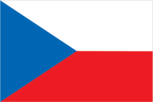
two equal horizontal bands of white (top) and red with a blue isosceles triangle based on the hoist side
Head of Government
Prime Minister Vaclav KLAUS (since NA June 1992); Deputy Prime Ministers Ivan KOCARNIK, Josef LUX, Jan KALVODA (since NA June 1992)
Independence
1 January 1993 (from Czechoslovakia)
Judicial branch
Supreme Court, Constitutional Court
Legal system
civil law system based on Austro-Hungarian codes; has not accepted compulsory ICJ jurisdiction; legal code modified to bring it in line with Conference on Security and Cooperation in Europe (CSCE) obligations and to expunge Marxist-Leninist legal theory
Legislative branch
bicameral National Council (Narodni rada) will consist of an upper house or Senate (which has not yet been established) and a lower house or Chamber of Deputies
Member of
BIS, CCC, CE, CEI, CERN, CSCE, EBRD, ECE, FAO, GATT, IAEA, IBRD, ICAO, IDA, IFC, IFCTU, ILO, IMF, IMO, INMARSAT, INTELSAT, INTERPOL, IOC, IOM (observer), ISO, ITU, LORCS, NACC, NAM (guest), NSG, PCA, UN (as of 8 January 1993), UNAVEM II, UNCTAD, UNESCO, UNIDO, UNOSOM, UNPROFOR, UPU, WHO, WIPO, WMO, WTO, ZC
Names
conventional long form: Czech Republic conventional short form: none local long form: Ceska Republika local short form: Cechy
National holiday
NA
Other political or pressure groups
Czech Democratic Left Movement; Civic Movement
Political parties and leaders
Civic Democratic Party, Vaclav KLAUS, chairman; Christian Democratic Union, leader NA; Civic Democratic Alliance, Jan KALVODA, chairman; Christian Democratic Party, Vaclav BENDA, chairman; Czech People's Party, Josef LUX; Czechoslovak Social Democracy, Milos ZEMAN, chairman; Left Bloc, leader NA; Republican Party, Miroslav SLADEK, chairman; Movement for Self-Governing Democracy for Moravia and Silesia, Jan STRYCER, chairman; Liberal Social Union, leader NA; Assembly for the Republic, leader NA
President
last held 26 January 1993 (next to be held NA January 1998); results - Vaclav HAVEL elected by the National Council
Senate
elections not yet held; seats (81 total)
Suffrage
18 years of age; universal
Type
parliamentary democracy
US diplomatic representation
chief of mission: Ambassador Adrian A. BASORA embassy: Trziste 15, 125 48, Prague 1 mailing address: Unit 25402; APO AE 09213-5630 telephone: [42] (2) 536-641/6
Economy
Agriculture
largely self-sufficient in food production; diversified crop and livestock production, including grains, potatoes, sugar beets, hops, fruit, hogs, cattle, and poultry; exporter of forest products
Budget
revenues $NA; expenditures $NA, including capital expenditures of $NA
Currency
1 koruna (Kc) = 100 haleru
Economic aid
the former Czechoslovakia was a donor - $4.2 billion in bilateral aid to non-Communist less developed countries (1954-89)
Electricity
16,500,000 kW capacity; 62,200 million kWh produced, 6,030 kWh per capita (1992)
Exchange rates
koruny (Kcs) per US$1 - 28.59 (December 1992), 28.26 (1992), 29.53 (1991), 17.95 (1990), 15.05 (1989), 14.36 (1988), 13.69 (1987)
Exports
$8.2 billion (f.o.b., 1992) commodities: manufactured goods, machinery and transport equipment, chemicals, fuels, minerals, and metals partners: Slovakia, Germany, Poland, Austria, Hungary, Italy, France, US, UK, CIS republics
External debt
$3.8 billion hard currency indebtedness (December 1992)
Fiscal year
calendar year
Illicit drugs
the former Czechoslovakia was a transshipment point for Southwest Asian heroin and was emerging as a transshipment point for Latin American cocaine (1992)
Imports
$8.9 billion (f.o.b., 1992) commodities: machinery and transport equipment, fuels and lubricants, manfactured goods, raw materials, chemicals, agricultural products partners: Slovakia, CIS republics, Germany Austria, Poland, Switzerland, Hungary, UK, Italy
Industrial production
growth rate -4% (November 1992 over November 1991); accounts for over 60% of GDP
Industries
fuels, ferrous metallurgy, machinery and equipment, coal, motor vehicles, glass, armaments
Inflation rate (consumer prices)
12.5% (1992 est.)
National product
GDP - purchasing power equivalent - $75.3 billion (1992 est.)
National product per capita
$7,300 (1992 est.)
National product real growth rate
-5% (1992 est.)
Overview
The dissolution of Czechoslovakia into two independent nation states - the Czech Republic and Slovakia - on 1 January 1993 has complicated the task of moving toward a more open and decentralized economy. The old Czechoslovakia, even though highly industrialized by East European standards, suffered from an aging capital plant, lagging technology, and a deficiency in energy and many raw materials. In January 1991, approximately one year after the end of communist control of Eastern Europe, theCzech and Slovak Federal Republic launched a sweeping program to convert its almost entirely state-owned and controlled economy to a market system. In 1991-92 these measures resulted in privatization of some medium- and small-scale economic activity and the setting of more than 90% of prices by the market - but at a cost in inflation, unemployment, and lower output. For Czechoslovakia as a whole inflation in 1991 was roughly 50% and output fell 15%. In 1992, in the Czech lands, inflation dropped to an estimated 12.5% and GDP was down a more moderate 5%. For 1993 the government of the Czech Republic anticipates inflation of 15-20% and a rise in unemployment to perhaps 12% as some large-scale enterprises go into bankruptcy; GDP may drop as much as 3%, mainly because of the disruption of trade links with Slovakia. Although the governments of the Czech Republic and Slovakia had envisaged retaining the koruna as a common currency, at least in the short term, the two countries ended the currency union in February 1993.
Unemployment rate
3.1% (1992 est.)
Communications
Airports
total: 75 usable: 75 with permanent-surface runways: 8 with runways over 3,659 m: with runways 2,440-3,659 m: 2 with runways 1,220-2,439 m: 4
Highways
55,890 km total (1988)
Inland waterways
NA km; the Elbe (Labe) is the principal river
Merchant marine
the former Czechoslovakia had 22 ships (1,000 GRT or over) totaling 290,185 GRT/437,291 DWT; includes 13 cargo, 9 bulk; may be shared with Slovakia
Pipelines
natural gas 5,400 km
Ports
coastal outlets are in Poland (Gdynia, Gdansk, Szczecin), Croatia (Rijeka), Slovenia (Koper), Germany (Hamburg, Rostock); principal river ports are Prague on the Vltava, Decin on the Elbe (Labe)
Railroads
9,434 km total (1988)
Telecommunications
NA
Military and Security
Branches
Army, Air and Air Defense Forces, Civil Defense, Railroad Units
Defense expenditures
23 billion koruny, NA% of GNP (1993 est.); note - conversion of defense expenditures into US dollars using the current exchange rate could produce misleading results
Manpower availability
males age 15-49 2,736,657; fit for military service 2,083,555; reach military age (18) annually 95,335 (1993 est.)