1995 Edition
CIA World Factbook 1995 (Project Gutenberg)
Geography
Area
total area: 110,860 sq km land area: 110,860 sq km comparative area: slightly smaller than Pennsylvania
Climate
tropical; moderated by trade winds; dry season (November to April); rainy season (May to October)
Coastline
3,735 km
Environment
current issues: pollution of Havana Bay; overhunting threatens wildlife populations; deforestation natural hazards: the east coast is subject to hurricanes from August to October (in general, the country averages about one hurricane every other year); droughts are common international agreements: party to - Antarctic Treaty, Biodiversity, Climate Change, Endangered Species, Environmental Modification, Hazardous Wastes, Law of the Sea, Marine Dumping, Ozone Layer Protection, Ship Pollution; signed, but not ratified - Antarctic-Environmental Protocol, Desertification, Marine Life Conservation
International disputes
US Naval Base at Guantanamo Bay is leased to US and only mutual agreement or US abandonment of the area can terminate the lease
Irrigated land
8,960 sq km (1989)
Land boundaries
total 29 km, US Naval Base at Guantanamo Bay 29 km note: Guantanamo Naval Base is leased by the US and thus remains part of Cuba
Land use
arable land: 23% permanent crops: 6% meadows and pastures: 23% forest and woodland: 17% other: 31%
Location
Caribbean, island between the Caribbean Sea and the North Atlantic Ocean, south of Florida
Map references
Central America and the Caribbean
Maritime claims
exclusive economic zone: 200 nm territorial sea: 12 nm
Natural resources
cobalt, nickel, iron ore, copper, manganese, salt, timber, silica, petroleum
Note
largest country in Caribbean
Terrain
mostly flat to rolling plains with rugged hills and mountains in the southeast
People and Society
Age structure
0-14 years: 22% (female 1,191,320; male 1,256,928) 15-64 years: 68% (female 3,732,434; male 3,751,464) 65 years and over: 10% (female 528,104; male 477,385) (July 1995 est.)
Birth rate
14.54 births/1,000 population (1995 est.)
Death rate
6.53 deaths/1,000 population (1995 est.)
Ethnic divisions
mulatto 51%, white 37%, black 11%, Chinese 1%
Infant mortality rate
8.1 deaths/1,000 live births (1995 est.)
Labor force
4,620,800 economically active population (1988); 3,578,800 in state sector by occupation: services and government 30%, industry 22%, agriculture 20%, commerce 11%, construction 10%, transportation and communications 7% (June 1990)
Languages
Spanish
Life expectancy at birth
total population: 77.05 years male: 74.86 years female: 79.37 years (1995 est.)
Literacy
age 15-49 and over can read and write (1981) total population: 98%
Nationality
noun: Cuban(s) adjective: Cuban
Net migration rate
-1.55 migrant(s)/1,000 population (1995 est.)
Population
10,937,635 (July 1995 est.)
Population growth rate
0.65% (1995 est.)
Religions
nominally Roman Catholic 85% prior to Castro assuming power
Total fertility rate
1.63 children born/woman (1995 est.)
Government
Administrative divisions
14 provinces (provincias, singular - provincia) and 1 special municipality* (municipio especial); Camaguey, Ciego de Avila, Cienfuegos, Ciudad de La Habana, Granma, Guantanamo, Holguin, Isla de la Juventud*, La Habana, Las Tunas, Matanzas, Pinar del Rio, Sancti Spiritus, Santiago de Cuba, Villa Clara
Capital
Havana
Constitution
24 February 1976
Digraph
CU
Diplomatic representation in US
chief of mission: Principal Officer Alfonso FRAGA PEREZ (since August 1992) represented by the Cuban Interests Section of the Swiss Embassy in Washington, DC chancery: 2630 and 2639 16th Street NW, Cuban Interests Section, Swiss Embassy, Washington, DC 20009 telephone: [1] (202) 797-8609, 8610, 8615
Executive branch
chief of state and head of government: President of the Council of State and President of the Council of Ministers Fidel CASTRO Ruz (Prime Minister from February 1959 until 24 February 1976 when office was abolished; President since 2 December 1976); First Vice President of the Council of State and First Vice President of the Council of Ministers Gen. Raul CASTRO Ruz (since 2 December 1976) cabinet: Council of Ministers; proposed by the president of the Council of State, appointed by the National Assembly
FAX
Telex 512206 note: protecting power in Cuba is Switzerland - US Interests Section, Swiss Embassy
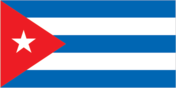
Flag
five equal horizontal bands of blue (top and bottom) alternating with white; a red equilateral triangle based on the hoist side bears a white five-pointed star in the center
Independence
20 May 1902 (from Spain 10 December 1898; administered by the US from 1898 to 1902)
Judicial branch
People's Supreme Court (Tribunal Supremo Popular)
Legal system
based on Spanish and American law, with large elements of Communist legal theory; does not accept compulsory ICJ jurisdiction
Legislative branch
unicameral
Member of
CCC, ECLAC, FAO, G-77, GATT, IAEA, ICAO, ICRM, IFAD, IFRCS, ILO, IMO, INMARSAT, INTELSAT (nonsignatory user), INTERPOL, IOC, ISO, ITU, LAES, LAIA (observer), NAM, OAS (excluded from formal participation since 1962), PCA, UN, UNCTAD, UNESCO, UNIDO, UPU, WCL, WFTU, WHO, WIPO, WMO, WTO
Names
conventional long form: Republic of Cuba conventional short form: Cuba local long form: Republica de Cuba local short form: Cuba
National Assembly of People's Power
(Asamblea Nacional del Poder Popular) elections last held February 1993 (next to be held NA); seats - 589 total, elected directly from slates approved by special candidacy commissions
National holiday
Rebellion Day, 26 July (1953)
Political parties and leaders
only party - Cuban Communist Party (PCC), Fidel CASTRO Ruz, first secretary
Suffrage
16 years of age; universal
Type
Communist state
US diplomatic representation
chief of mission: Principal Officer Joseph G. SULLIVAN
US Interests Section
USINT, Swiss Embassy, Calzada Entre L Y M, Vedado Seccion, Havana mailing address: use street address telephone: 33-3551 through 3559, 33-3543 through 3547, 33-3700 (operator assistance required)
Economy
Agriculture
key commercial crops - sugarcane, tobacco, and citrus fruits; other products - coffee, rice, potatoes, meat, beans; world's largest sugar exporter; not self-sufficient in food (excluding sugar); sector hurt by persistent shortages of fuels and parts
Budget
revenues: $9.3 billion expenditures: $12.5 billion, including capital expenditures of $NA (1994 est.)
Currency
1 Cuban peso (Cu$) = 100 centavos
Economic aid
recipient: Western (non-US) countries, ODA and OOF bilateral commitments (1970-89), $710 million; Communist countries (1970-89), $18.5 billion
Electricity
capacity: 3,990,000 kW production: 12 billion kWh consumption per capita: 1,022 kWh (1993)
Exchange rates
Cuban pesos (Cu$) per US$1 - 1.0000 (non-convertible, official rate, linked to the US dollar)
Exports
$1.6 billion (f.o.b., 1994 est.) commodities: sugar, nickel, shellfish, tobacco, medical products, citrus, coffee partners: Russia 15%, Canada 9%, China 8%, Egypt 6%, Spain 5%, Japan 4%, Morocco 4% (1994 est.)
External debt
$10.8 billion (convertible currency, December 1993)
Fiscal year
calendar year
Imports
$1.7 billion (c.i.f., 1994 est.) commodities: petroleum, food, machinery, chemicals partners: Spain 17%, Mexico 10%, France 8%, China 8%, Venezuela 7%, Italy 4%, Canada 3%, (1994 est.)
Industrial production
growth rate NA%
Industries
sugar milling and refining, petroleum refining, food and tobacco processing, textiles, chemicals, paper and wood products, metals (particularly nickel), cement, fertilizers, consumer goods, agricultural machinery
Inflation rate (consumer prices)
NA%
National product
GDP - purchasing power parity - $14 billion (1994 est.)
National product per capita
$1,260 (1994 est.)
National product real growth rate
0.4% (1994 est.)
Overview
Cuba's heavily statist economy remains severely depressed as the result of its own inefficiencies and the loss of massive amounts of economic aid from the former Soviet Bloc. Total output in 1994 was only about half the output of 1989. The fall in output and in imports is reflected in the deterioration of food supplies, shortages of electricity, inability to get spare parts, and the replacement of motor-driven vehicles by bicycles and draft animals. Higher world market prices for sugar and nickel in 1994, however, resulted in a slight increase in export earnings for the first time in six years, despite lower production of both commodities. The growth of tourism slowed in late 1994 as a result of negative publicity surrounding the exodus of Cubans from the island and other international factors. The government continued its aggressive search for foreign investment and announced preliminary agreements to form large joint ventures with Mexican investors in telecommunications and oil refining. In mid-1994, the National Assembly began introducing several new taxes and price increases to stem growing excess liquidity and restore some of the peso's value as a monetary instrument. In October the government attempted to stimulate food production by permitting the sale of any surplus production (over state quotas) at unrestricted prices at designated markets. Similar but much smaller markets were also introduced for the sale of manufactured goods in December. The various government measures have influenced a remarkable appreciation of the black market value of the peso, from more than 100 pesos to the dollar in September 1994 to 40 pesos to the dollar in early 1995. Policy discussions continue in the bureaucracy over the proper pace and scope of economic reform.
Unemployment rate
NA%
Communications
Radio
broadcast stations: AM 150, FM 5, shortwave 0 radios: 2.14 million
Telephone system
229,000 telephones; 20.7 telephones/1,000 persons; among the world's least developed telephone systems local: NA intercity: NA international: 1 INTELSAT (Atlantic Ocean) earth station
Television
broadcast stations: 58 televisions: 1.53 million
Transportation
Airports
total: 181 with paved runways over 3,047 m: 7 with paved runways 2,438 to 3,047 m: 8 with paved runways 1,524 to 2,437 m: 13 with paved runways 914 to 1,523 m: 10 with paved runways under 914 m: 106 with unpaved runways 1,524 to 2,438 m: 1 with unpaved runways 914 to 1,523 m: 36
Highways
total: 26,477 km paved: 14,477 km unpaved: gravel or earth 12,000 km (1989)
Inland waterways
240 km
Merchant marine
total: 48 ships (1,000 GRT or over) totaling 278,103 GRT/396,138 DWT ships by type: bulk 1, cargo 22, chemical tanker 1, liquefied gas tanker 4, oil tanker 10, passenger-cargo 1, refrigerated cargo 9 note: Cuba beneficially owns an additional 24 ships (1,000 GRT or over) totaling 215,703 DWT under the registry of Panama, Cyprus, Malta, and Mauritius
Ports
Cienfuegos, La Habana, Manzanillo, Mariel, Matanzas, Nuevitas, Santiago de Cuba
Railroads
total: 12,623 km standard gauge: 4,881 km 1.435-m gauge (151.7 km electrified) other: 7,742 km 0.914- and 1.435-m gauge for sugar plantation lines
Military and Security
Branches
Revolutionary Armed Forces (FAR) includes ground forces, Revolutionary Navy (MGR), Air and Air Defense Force (DAAFAR), Territorial Militia Troops (MTT), and Youth Labor Army (EJT); Interior Ministry Border Guards (TGF),
Defense expenditures
exchange rate conversion - approx. $600 million, 4% of GSP (gross social product) in 1994 was for defense
Manpower availability
males age 15-49 3,065,751; females age 15-49 3,023,997; males fit for military service 1,909,901; females fit for military service 1,878,768; males reach military age (17) annually 72,582; females reach military age (17) annually 69,361 (1995 est.)
Note
Moscow, for decades the key military supporter and supplier of Cuba, cut off military aid by 1993 ________________________________________________________________________ CYPRUS