1990 Edition
CIA World Factbook 1990 (Project Gutenberg)
Geography
Climate
tropical; moderated by trade winds; dry season (November to April); rainy season (May to October)
Coastline
3,735 km
Comparative area
slightly smaller than Pennsylvania
Disputes
US Naval Base at Guantanamo is leased to US and only mutual agreement or US abandonment of the area can terminate the lease
Environment
averages one hurricane every other year
Extended economic zone
200 nm;
Land boundary
29.1 km with US Naval Base at Guantanamo; note--Guantanamo is leased and as such remains part of Cuba
Land use
23% arable land; 6% permanent crops; 23% meadows and pastures; 17% forest and woodland; 31% other; includes 10% irrigated
Natural resources
cobalt, nickel, iron ore, copper, manganese, salt, timber, silica
Note
largest country in Caribbean; 145 km south of Florida
Terrain
mostly flat to rolling plains with rugged hills and mountains in the southeast
Territorial sea
12 nm
Total area
110,860 km2; land area: 110,860 km2
People and Society
Birth rate
18 births/1,000 population (1990)
Death rate
7 deaths/1,000 population (1990)
Ethnic divisions
51% mulatto, 37% white, 11% black, 1% Chinese
Infant mortality rate
12 deaths/1,000 live births (1990)
Labor force
3,400,000 in state sector; 30% services and government, 22% industry, 20% agriculture, 11% commerce, 10% construction, 7% transportation and communications (1988); economically active population 4,500,000 (1987)
Language
Spanish
Life expectancy at birth
73 years male, 78 years female (1990)
Literacy
98.5%
Nationality
noun--Cuban(s); adjective--Cuban
Net migration rate
- 1 migrant/1,000 population (1990)
Organized labor
Workers Central Union of Cuba (CTC), only labor federation approved by government; 2,910,000 members; the CTC is an umbrella organization composed of 17 member unions
Population
10,620,099 (July 1990), growth rate 1.1% (1990)
Religion
at least 85% nominally Roman Catholic before Castro assumed power
Total fertility rate
1.9 children born/woman (1990)
Government
Administrative divisions
14 provinces (provincias, singular--provincia) and 1 special municipality* (municipio especial); Camaguey, Ciego de Avila, Cienfuegos, Ciudad de La Habana, Granma, Guantanamo, Holguin, Isla de la Juventud*, La Habana, Las Tunas, Matanzas, Pinar del Rio, Sancti Spiritus, Santiago de Cuba, Villa Clara
Capital
Havana
Communists
about 600,000 full and candidate members
Constitution
24 February 1976
Diplomatic representation
none; protecting power in the US is Czechoslovakia--Cuban Interests Section; Counselor Jose Antonio Arbesu FRAGA; 2630 and 2639 16th Street NW, Washington DC 20009; telephone (202) 797-8518 or 8519, 8520, 8609, 8610; US--protecting power in Cuba is Switzerland--US Interests Section; Principal Officer John J. TAYLOR; Calzada entre L y M, Vedado Seccion, Havana; telephone 320551 or 320543
Elections
National Assembly of the People's Power--last held NA December 1986 (next to be held December 1991); results--PCC is the only party; seats--(510 total) PCC 510 (indirectly elected)
Executive branch
president of the Council of State, first vice president of the Council of State, Council of State, president of the Council of Ministers, first vice president of the Council of Ministers, Council of Ministers
Flag
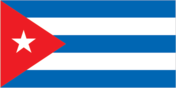
five equal horizontal bands of blue (top and bottom) alternating with white; a red equilateral triangle based on the hoist side bears a white five-pointed star in the center
Independence
20 May 1902 (from Spain 10 December 1898; administered by the US from 1898 to 1902)
Judicial branch
People's Supreme Court
Leaders
Chief of State and Head of Government--President of the Council of State and President of the Council of Ministers Fidel CASTRO Ruz (became Prime Minister in January 1959 and President since 2 December 1976); First Vice President of the Council of State and First Vice President of the Council of Ministers Gen. Raul CASTRO Ruz (since 2 December 1976)
Legal system
based on Spanish and American law, with large elements of Communist legal theory; does not accept compulsory ICJ jurisdiction
Legislative branch
unicameral National Assembly of the People's Power (Asamblea Nacional del Poder Popular)
Long-form name
Republic of Cuba
Member of
CEMA, ECLA, FAO, G-77, GATT, IADB (nonparticipant), IAEA, IBEC, ICAO, IFAD, ICO, IHO, ILO, IMO, IRC, ISO, ITU, IWC--International Wheat Council, NAM, OAS (nonparticipant), PAHO, SELA, UN, UNESCO, UNIDO, UPU, WFTU, WHO, WIPO, WMO, WSG, WTO
National holiday
Revolution Day, 1 January (1959)
Political parties and leaders
only party--Cuban Communist Party (PCC), Fidel Castro Ruz, first secretary
Suffrage
universal at age 16
Type
Communist state
Economy
Agriculture
accounts for 11% of GNP (including fishing and forestry); key commercial crops--sugarcane, tobacco, and citrus fruits; other products--coffee, rice, potatoes, meat, beans; world's largest sugar exporter; not self-sufficient in food
Aid
Western (non-US) countries, ODA and OOF bilateral commitments (1970-87), $657.5 million; Communist countries (1970-88), $13.5 billion
Budget
revenues $11.7 billion; expenditures $13.5 billion, including capital expenditures of $NA (1989 est.)
Currency
Cuban peso (plural--pesos); 1 Cuban peso (Cu$) = 100 centavos
Electricity
3,991,000 kW capacity; 14,972 million kWh produced, 1,425 kWh per capita (1989)
Exchange rates
Cuban pesos (Cu$) per US$1--1.0000 (linked to the US dollar)
Exports
$5.5 billion (f.o.b., 1988); commodities--sugar, nickel, shellfish, citrus, tobacco, coffee; partners--USSR 67%, GDR 6%, China 4% (1988)
External debt
$6.8 billion (convertible currency, July 1989)
Fiscal year
calendar year
GNP
$20.9 billion, per capita $2,000; real growth rate - 1%
Imports
$7.6 billion (c.i.f., 1988); commodities--capital goods, industrial raw materials, food, petroleum; partners--USSR 71%, other Communist countries 15% (1988)
Industrial production
3% (1988)
Industries
sugar milling, petroleum refining, food and tobacco processing, textiles, chemicals, paper and wood products, metals (particularly nickel), cement, fertilizers, consumer goods, agricultural machinery
Inflation rate (consumer prices)
NA%
Overview
The Soviet-style economy, centrally planned and largely state owned, is highly dependent on the agricultural sector and foreign trade. Sugar provides about 75% of export revenues and is mostly exported to the USSR and other CEMA countries. The economy has stagnated since 1985 under a program that has deemphasized material incentives in the workplace, abolished farmers' informal produce markets, and raised prices of government-supplied goods and services. Castro has complained that the ongoing CEMA reform process has interfered with the regular flow of goods to Cuba. Recently the government has been trying to increase trade with Latin America and China. Cuba has had difficulty servicing its foreign debt since 1982. The government currently is encouraging foreign investment in tourist facilities. Other investment priorities include sugar, basic foods, and nickel. The annual $4 billion Soviet subsidy, a main prop to Cuba's threadbare economy, may be cut in view of the USSR's mounting economic problems.
Unemployment
6% overall, 10% for women (1989)
Communications
Airports
197 total, 168 usable; 72 with permanent-surface runways; 2 with runways over 3,659 m; 14 with runways 2,440-3,659 m; 17 with runways 1,220-2,439 m
Civil air
59 major transport aircraft
Highways
about 21,000 km total; 9,000 km paved, 12,000 km gravel and earth surfaced
Inland waterways
240 km
Merchant marine
91 ships (1,000 GRT or over) totaling 701,418 GRT/1,014,014 DWT; includes 62 cargo, 7 refrigerated cargo, 3 cargo/training, 10 petroleum, oils, and lubricants (POL) tanker, 1 chemical tanker, 2 liquefied gas, 6 bulk; note--Cuba beneficially owns an additional 34 ships (1,000 GRT and over) totaling 475,864 DWT under the registry of Panama, Cyprus, and Malta
Ports
Cienfuegos, Havana, Mariel, Matanzas, Santiago de Cuba; 7 secondary, 35 minor
Railroads
14,925 km total; Cuban National Railways operates 5,295 km of 1.435-meter gauge track; 199 km electrified; 9,630 km of sugar plantation lines of 0.914-1.435-meter gauge
Telecommunications
stations--150 AM, 5 FM, 58 TV; 1,530,000 TV sets; 2,140,000 radio receivers; 1 Atlantic Ocean INTELSAT earth station
Military and Security
Branches
Revolutionary Armed Forces (Ground Forces, Revolutionary Navy, Air and Air Defense Force), Ministry of Interior Special Troops, Border Guard Troops, Territorial Militia Troops, Youth Labor Army
Defense expenditures
about 6% of GNP, or $1.2-$1.4 billion
Military manpower
eligible 15-49, 6,027,131; of the 3,024,385 males 15-49, 1,897,175 are fit for military service; of the 3,002,746 females 15-49, 1,879,471 are fit for military service; 96,319 males and 92,765 females reach military age (17) annually