2008 Edition
CIA World Factbook 2008 (Project Gutenberg)
Introduction
Background
The lands that today comprise Croatia were part of the Austro-Hungarian Empire until the close of World War I. In 1918, the Croats, Serbs, and Slovenes formed a kingdom known after 1929 as Yugoslavia. Following World War II, Yugoslavia became a federal independent Communist state under the strong hand of Marshal TITO. Although Croatia declared its independence from Yugoslavia in 1991, it took four years of sporadic, but often bitter, fighting before occupying Serb armies were mostly cleared from Croatian lands. Under UN supervision, the last Serb-held enclave in eastern Slavonia was returned to Croatia in 1998.
Geography
Area
total: 56,542 sq km land: 56,414 sq km water: 128 sq km
Area - comparative
slightly smaller than West Virginia
Climate
Mediterranean and continental; continental climate predominant with hot summers and cold winters; mild winters, dry summers along coast
Coastline
5,835 km (mainland 1,777 km, islands 4,058 km)
Elevation extremes
lowest point: Adriatic Sea 0 m highest point: Dinara 1,830 m
Environment - current issues
air pollution (from metallurgical plants) and resulting acid rain is damaging the forests; coastal pollution from industrial and domestic waste; landmine removal and reconstruction of infrastructure consequent to 1992-95 civil strife
Environment - international agreements
party to: Air Pollution, Air Pollution-Sulfur 94, Biodiversity, Climate Change, Climate Change-Kyoto Protocol, Desertification, Endangered Species, Hazardous Wastes, Law of the Sea, Marine Dumping, Ozone Layer Protection, Ship Pollution, Wetlands, Whaling signed, but not ratified: Air Pollution-Persistent Organic Pollutants
Geographic coordinates
45 10 N, 15 30 E
Geography - note
controls most land routes from Western Europe to Aegean Sea and Turkish Straits; most Adriatic Sea islands lie off the coast of Croatia - some 1,200 islands, islets, ridges, and rocks
Irrigated land
110 sq km (2003)
Land boundaries
total: 1,982 km border countries: Bosnia and Herzegovina 932 km, Hungary 329 km, Serbia 241 km, Montenegro 25 km, Slovenia 455 km
Land use
arable land: 25.82% permanent crops: 2.19% other: 71.99% (2005)
Location
Southeastern Europe, bordering the Adriatic Sea, between Bosnia and Herzegovina and Slovenia
Map references
Europe
Maritime claims
territorial sea: 12 nm continental shelf: 200-m depth or to the depth of exploitation
Natural hazards
destructive earthquakes
Natural resources
oil, some coal, bauxite, low-grade iron ore, calcium, gypsum, natural asphalt, silica, mica, clays, salt, hydropower
Terrain
geographically diverse; flat plains along Hungarian border, low mountains and highlands near Adriatic coastline and islands
Total renewable water resources
105.5 cu km (1998)
People and Society
Age structure
0-14 years: 15.8% (male 363,551/female 345,132) 15-64 years: 67.2% (male 1,501,949/female 1,517,962) 65 years and over: 17% (male 295,229/female 467,720) (2008 est.)
Birth rate
9.64 births/1,000 population (2008 est.)
Death rate
11.66 deaths/1,000 population (2008 est.)
Education expenditures
4.5% of GDP (2004)
Ethnic groups
Croat 89.6%, Serb 4.5%, other 5.9% (including Bosniak, Hungarian, Slovene, Czech, and Roma) (2001 census)
HIV/AIDS - adult prevalence rate
less than 0.1% (2001 est.)
HIV/AIDS - deaths
fewer than 10 (2001 est.)
HIV/AIDS - people living with HIV/AIDS
200 (2001 est.)
Infant mortality rate
total: 6.49 deaths/1,000 live births male: 6.51 deaths/1,000 live births female: 6.46 deaths/1,000 live births (2008 est.)
Languages
Croatian 96.1%, Serbian 1%, other and undesignated 2.9% (including Italian, Hungarian, Czech, Slovak, and German) (2001 census)
Life expectancy at birth
total population: 75.13 years male: 71.49 years female: 78.97 years (2008 est.)
Literacy
definition: age 15 and over can read and write total population: 98.1% male: 99.3% female: 97.1% (2001 census)
Major infectious diseases
degree of risk: intermediate food or waterborne diseases: bacterial diarrhea and hepatitis A vectorborne diseases: tickborne encephalitis note: highly pathogenic H5N1 avian influenza has been identified in this country; it poses a negligible risk with extremely rare cases possible among US citizens who have close contact with birds (2008)
Median age
total: 40.8 years male: 38.9 years female: 42.6 years (2008 est.)
Nationality
noun: Croat(s), Croatian(s) adjective: Croatian
Net migration rate
1.58 migrant(s)/1,000 population (2008 est.)
Population
4,491,543 (July 2008 est.)
Population growth rate
-0.043% (2008 est.)
Religions
Roman Catholic 87.8%, Orthodox 4.4%, other Christian 0.4%, Muslim 1.3%, other and unspecified 0.9%, none 5.2% (2001 census)
School life expectancy (primary to tertiary education)
total: 14 years male: 13 years female: 14 years (2006)
Sex ratio
at birth: 1.06 male(s)/female under 15 years: 1.05 male(s)/female 15-64 years: 0.99 male(s)/female 65 years and over: 0.63 male(s)/female total population: 0.93 male(s)/female (2008 est.)
Total fertility rate
1.41 children born/woman (2008 est.)
Government
Administrative divisions
20 counties (zupanije, zupanija - singular) and 1 city* (grad - singular); Bjelovarsko-Bilogorska, Brodsko-Posavska, Dubrovacko-Neretvanska (Dubrovnik-Neretva), Istarska (Istria), Karlovacka, Koprivnicko-Krizevacka, Krapinsko-Zagorska, Licko-Senjska (Lika-Senj), Medimurska, Osjecko-Baranjska, Pozesko-Slavonska (Pozega-Slavonia), Primorsko-Goranska, Sibensko-Kninska, Sisacko-Moslavacka, Splitsko-Dalmatinska (Split-Dalmatia), Varazdinska, Viroviticko-Podravska, Vukovarsko-Srijemska, Zadarska, Zagreb*, Zagrebacka
Capital
name: Zagreb geographic coordinates: 45 48 N, 16 00 E time difference: UTC+1 (6 hours ahead of Washington, DC during Standard Time) daylight saving time: +1hr, begins last Sunday in March; ends last Sunday in October
Constitution
adopted on 22 December 1990; revised 2000, 2001
Country name
conventional long form: Republic of Croatia conventional short form: Croatia local long form: Republika Hrvatska local short form: Hrvatska former: People's Republic of Croatia, Socialist Republic of Croatia
Diplomatic representation from the US
chief of mission: Ambassador Robert A. BRADTKE embassy: 2 Thomas Jefferson Street, 10010 Zagreb mailing address: use street address telephone: [385] (1) 661-2200
Diplomatic representation in the US
chief of mission: Ambassador Kolinda GRABAR-KITAROVIC chancery: 2343 Massachusetts Avenue NW, Washington, DC 20008 telephone: [1] (202) 588-5899
Executive branch
chief of state: President Stjepan (Stipe) MESIC (since 18 February 2000) head of government: Prime Minister Ivo SANADER (since 9 December 2003); Deputy Prime Ministers Jadranka KOSOR (since 23 December 2003) and Damir POLANCEC (since 15 February 2005), Djurdja ADLESIC (since 12 January 2008), Slobodan UZELAC (since 12 January 2008) cabinet: Council of Ministers named by the prime minister and approved by the parliamentary Assembly elections: president elected by popular vote for a five-year term (eligible for a second term); election last held 16 January 2005 (next to be held in January 2010); the leader of the majority party or the leader of the majority coalition is usually appointed prime minister by the president and then approved by the Assembly election results: Stjepan MESIC reelected president; percent of vote - Stjepan MESIC 66%, Jadranka KOSOR 34% in the second round
FAX
- [1] (202) 588-8936 consulate(s) general: Chicago, Los Angeles, New York
- [385] (1) 661-2373
Flag description
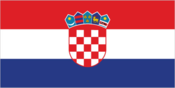
three equal horizontal bands of red (top), white, and blue superimposed by the Croatian coat of arms (red and white checkered)
Government type
presidential/parliamentary democracy
Independence
25 June 1991 (from Yugoslavia)
International organization participation
ACCT (observer), Australia Group, BIS, BSEC (observer), CE, CEI, EAPC, EBRD, FAO, IADB, IAEA, IBRD, ICAO, ICC, ICCt, ICRM, IDA, IFAD, IFC, IFRCS, IHO, ILO, IMF, IMO, IMSO, Interpol, IOC, IOM, IPU, ISO, ITSO, ITU, ITUC, MIGA, MINURSO, MINUSTAH, NAM (observer), NSG, OAS (observer), OIF (observer), OPCW, OSCE, PCA, PFP, SECI, UN, UN Security Council (temporary), UNCTAD, UNDOF, UNESCO, UNFICYP, UNIDO, UNIFIL, UNMIL, UNMIS, UNMOGIP, UNOCI, UNOMIG, UNWTO, UPU, WCO, WFTU, WHO, WIPO, WMO, WTO, ZC
Judicial branch
Supreme Court; Constitutional Court; judges for both courts appointed for eight-year terms by the Judicial Council of the Republic, which is elected by the Assembly
Legal system
based on Austro-Hungarian law system with Communist law influences; has not accepted compulsory ICJ jurisdiction
Legislative branch
unicameral Assembly or Sabor (153 seats; members elected from party lists by popular vote to serve four-year terms) elections: last held 25 November 2007 (next to be held in November 2011) election results: percent of vote by party - NA; number of seats by party - HDZ 66, SDP 56, HNS 7, HSS 6, HDSSB 3, IDS 3, SDSS 3, other 9
National holiday
Independence Day, 8 October (1991); note - 25 June 1991 was the day the Croatian Parliament voted for independence; following a three-month moratorium to allow the European Community to solve the Yugoslav crisis peacefully, Parliament adopted a decision on 8 October 1991 to sever constitutional relations with Yugoslavia
Political parties and leaders
Croatian Democratic Congress of Slavonia and Baranja or HDSSB [Vladimir SISLJAGIC]; Croatian Democratic Union or HDZ [Ivo SANADER]; Croatian Party of the Right or HSP [Anto DJAPIC]; Croatian Peasant Party or HSS [Josip FRISCIC]; Croatian Pensioner Party or HSU [Vladimir JORDAN]; Croatian People's Party or HNS [Vesna PUSIC]; Croatian Social Liberal Party or HSLS [Djurdja ADLESIC]; Independent Democratic Serb Party or SDSS [Vojislav STANIMIROVIC]; Istrian Democratic Assembly or IDS [Ivan JAKOVCIC]; Social Democratic Party of Croatia or SDP [Zoran MILANOVIC]
Political pressure groups and leaders
other: human rights groups
Suffrage
18 years of age; universal (16 years of age, if employed)
Economy
Agriculture - products
wheat, corn, sugar beets, sunflower seed, barley, alfalfa, clover, olives, citrus, grapes, soybeans, potatoes; livestock, dairy products
Budget
revenues: $22.56 billion expenditures: $23.92 billion (2007 est.)
Central bank discount rate
9% (31 December 2007)
Commercial bank prime lending rate
9.33% (31 December 2007)
Currency (code)
kuna (HRK)
Currency code
HRK
Current account balance
-$4.85 billion (2007 est.)
Debt - external
$46.3 billion (30 June 2007)
Distribution of family income - Gini index
29 (2001)
Economic aid - recipient
ODA, $125.4 million (2005)
Economy - overview
Once one of the wealthiest of the Yugoslav republics, Croatia's economy suffered badly during the 1991-95 war as output collapsed and the country missed the early waves of investment in Central and Eastern Europe that followed the fall of the Berlin Wall. Since 2000, however, Croatia's economic fortunes have begun to improve slowly, with moderate but steady GDP growth between 4% and 6% led by a rebound in tourism and credit-driven consumer spending. Inflation over the same period has remained tame and the currency, the kuna, stable. Nevertheless, difficult problems still remain, including a stubbornly high unemployment rate, a growing trade deficit and uneven regional development. The state retains a large role in the economy, as privatization efforts often meet stiff public and political resistance. While macroeconomic stabilization has largely been achieved, structural reforms lag because of deep resistance on the part of the public and lack of strong support from politicians. The EU accession process should accelerate fiscal and structural reform.
Electricity - consumption
15.57 billion kWh (2006 est.)
Electricity - exports
3.306 billion kWh (2006 est.)
Electricity - imports
8.374 billion kWh (2006 est.)
Electricity - production
12.41 billion kWh (2006 est.)
Electricity - production by source
fossil fuel: 33.6% hydro: 66% nuclear: 0% other: 0.4% (2001)
Exchange rates
kuna (HRK) per US dollar - 5.3735 (2007), 5.8625 (2006), 5.9473 (2005), 6.0358 (2004), 6.7035 (2003)
Exports
$12.62 billion f.o.b. (2007 est.)
Exports - commodities
transport equipment, textiles, chemicals, foodstuffs, fuels
Exports - partners
Italy 19.3%, Bosnia and Herzegovina 13.9%, Germany 10.2%, Slovenia 8.4%, Austria 6.2% (2007)
Fiscal year
calendar year
GDP - composition by sector
agriculture: 7.2% industry: 31.7% services: 61.2% (2007 est.)
GDP - per capita (PPP)
$15,500 (2007 est.)
GDP - real growth rate
5.7% (2007 est.)
GDP (official exchange rate)
$51.36 billion (2007 est.)
GDP (purchasing power parity)
$69.59 billion (2007 est.)
Household income or consumption by percentage share
lowest 10%: 3.4% highest 10%: 24.5% (2003 est.)
Imports
$25.99 billion f.o.b. (2007 est.)
Imports - commodities
machinery, transport and electrical equipment; chemicals, fuels and lubricants; foodstuffs
Imports - partners
Italy 16.1%, Germany 14.4%, Russia 10.1%, China 6.2%, Slovenia 6%, Austria 5.3% (2007)
Industrial production growth rate
5.3% (2007 est.)
Industries
chemicals and plastics, machine tools, fabricated metal, electronics, pig iron and rolled steel products, aluminum, paper, wood products, construction materials, textiles, shipbuilding, petroleum and petroleum refining, food and beverages, tourism
Inflation rate (consumer prices)
4.5% (2007 est.)
Investment (gross fixed)
30.1% of GDP (2007 est.)
Labor force
1.749 million (2007 est.)
Labor force - by occupation
agriculture: 2.7% industry: 32.8% services: 64.5% (2004)
Market value of publicly traded shares
$29.01 billion (2006)
Natural gas - consumption
2.73 billion cu m (2006 est.)
Natural gas - exports
0 cu m (2007 est.)
Natural gas - imports
1.103 billion cu m (2005)
Natural gas - production
1.58 billion cu m (2006 est.)
Natural gas - proved reserves
28.54 billion cu m (1 January 2008 est.)
Oil - consumption
101,800 bbl/day (2006 est.)
Oil - exports
43,680 bbl/day (2005)
Oil - imports
112,200 bbl/day (2005)
Oil - production
23,620 bbl/day (2007 est.)
Oil - proved reserves
79.15 million bbl (1 January 2008 est.)
Population below poverty line
11% (2003)
Public debt
47.8% of GDP (2007 est.)
Reserves of foreign exchange and gold
$13.67 billion (31 December 2007 est.)
Stock of direct foreign investment - abroad
$3.161 billion (2007 est.)
Stock of direct foreign investment - at home
$23.13 billion (2007 est.)
Stock of domestic credit
$45.7 billion (31 December 2007)
Stock of money
$11.61 billion (31 December 2007)
Stock of quasi money
$31.86 billion (31 December 2007)
Unemployment rate
11.8% (2007 est.)
Communications
Internet country code
.hr
Internet hosts
1.111 million (2008)
Internet Service Providers (ISPs)
9 (2000)
Internet users
1.995 million (2007)
Radio broadcast stations
AM 16, FM 98, shortwave 5 (1999)
Radios
1.51 million (1997)
Telephone system
general assessment: the telecommunications network has improved steadily since the mid-1990s; the number of fixed telephone lines holding steady at about 40 per 100 persons; the number of cellular telephone subscriptions exceeds the population domestic: more than 90 percent of local lines are digital international: country code - 385; digital international service is provided through the main switch in Zagreb; Croatia participates in the Trans-Asia-Europe (TEL) fiber-optic project, which consists of 2 fiber-optic trunk connections with Slovenia and a fiber-optic trunk line from Rijeka to Split and Dubrovnik; the ADRIA-1 submarine cable provides connectivity to Albania and Greece (2007)
Telephones - main lines in use
1.825 million (2007)
Telephones - mobile cellular
5.035 million (2007)
Television broadcast stations
36 (plus 321 repeaters) (1995)
Televisions
1.22 million (1997)
Transportation
Airports
68 (2007)
Airports - with paved runways
total: 23 over 3,047 m: 2 2,438 to 3,047 m: 6 1,524 to 2,437 m: 2 914 to 1,523 m: 4 under 914 m: 9 (2007)
Airports - with unpaved runways
total: 45 1,524 to 2,437 m: 1 914 to 1,523 m: 7 under 914 m: 37 (2007)
Heliports
2 (2007)
Merchant marine
total: 80 by type: bulk carrier 25, cargo 11, chemical tanker 3, passenger/cargo 30, petroleum tanker 8, refrigerated cargo 1, roll on/roll off 2 registered in other countries: 30 (Bahamas 1, Belize 2, Liberia 2, Malta 9, Marshall Islands 6, Panama 3, Saint Vincent and the Grenadines 7) (2008)
Pipelines
gas 1,556 km; oil 583 km (2007)
Ports and terminals
Omisalj, Ploce, Rijeka, Sibenik, Vukovar (on Danube)
Railways
total: 2,726 km standard gauge: 2,726 km 1.435-m gauge (1,199 km electrified) (2006)
Roadways
total: 28,788 km (includes 877 km of expressways) (2006)
Waterways
785 km (2007)
Military and Security
Manpower available for military service
males age 16-49: 1,035,712 females age 16-49: 1,037,896 (2008 est.)
Manpower fit for military service
males age 16-49: 771,323 females age 16-49: 855,937 (2008 est.)
Manpower reaching militarily significant age annually
male: 27,500 female: 25,893 (2008 est.)
Military branches
Armed Forces of the Republic of Croatia (Oruzane Snage Republike Hrvatske, OSRH), consists of five major commands directly subordinate to a General Staff: Ground Forces (Hrvatska Kopnena Vojska, HKoV), Naval Forces (Hrvatska Ratna Mornarica, HRM), Air Force (Hrvatsko Ratno Zrakoplovstvo, HRZ), Joint Education and Training Command, Logistics Command; Military Police Force supports each of the three Croatian military forces (2008)
Military expenditures
2.39% of GDP (2005 est.)
Military service age and obligation
18-27 years of age for compulsory military service; 16 years of age with consent for voluntary service; 6-month conscript service obligation; full conversion to professional military service by 2010 (2006)
Transnational Issues
Disputes - international
dispute remains with Bosnia and Herzegovina over several small disputed sections of the boundary related to maritime access that hinders ratification of the 1999 border agreement; the Croatia-Slovenia land and maritime boundary agreement, which would have ceded most of Pirin Bay and maritime access to Slovenia and several villages to Croatia, remains un-ratified and in dispute; Slovenia also protests Croatia's 2003 claim to an exclusive economic zone in the Adriatic; as a European Union peripheral state, Slovenia imposed a hard border Schengen regime with non-member Croatia in December 2007
IDPs
2,900-7,000 (Croats and Serbs displaced in 1992-95 war) (2007)
Illicit drugs
transit point along the Balkan route for Southwest Asian heroin to Western Europe; has been used as a transit point for maritime shipments of South American cocaine bound for Western Europe This page was last updated on 18 December, 2008