1998 Edition
CIA World Factbook 1998 (Internet Archive)
Geography
Area
total: 56,538 sq km land: 56,410 sq km water: 128 sq km
Area-comparative
slightly smaller than West Virginia
Climate
Mediterranean and continental; continental climate predominant with hot summers and cold winters; mild winters, dry summers along coast
Coastline
5,790 km (mainland 1,778 km, islands 4,012 km)
Elevation extremes
lowest point: Adriatic Sea 0 m highest point: Dinara 1,830 m
Environment-current issues
air pollution (from metallurgical plants) and resulting acid rain is damaging the forests; coastal pollution from industrial and domestic waste; widespread casualties and destruction of infrastructure in border areas affected by civil strife
Environment-international agreements
party to: Air Pollution, Biodiversity, Climate Change, Hazardous Wastes, Law of the Sea, Marine Dumping, Nuclear Test Ban, Ozone Layer Protection, Ship Pollution, Wetlands signed, but not ratified: Air Pollution-Sulphur 94, Desertification
Geographic coordinates
45 10 N, 15 30 E
Geography-note
controls most land routes from Western Europe to Aegean Sea and Turkish Straits
Irrigated land
30 sq km (1993 est.)
Land boundaries
total: 2,197 km border countries: Bosnia and Herzegovina 932 km, Hungary 329 km, Serbia and Montenegro 266 km (241 km with Serbia; 25 km with Montenego), Slovenia 670 km
Land use
arable land: 21% permanent crops: 2% permanent pastures: 20% forests and woodland: 38% other: 19% (1993 est.)
Location
Southeastern Europe, bordering the Adriatic Sea, between Bosnia and Herzegovina and Slovenia
Map references
Europe
Maritime claims
continental shelf: 200-m depth or to the depth of exploitation territorial sea: 12 nm
Natural hazards
frequent and destructive earthquakes
Natural resources
oil, some coal, bauxite, low-grade iron ore, calcium, natural asphalt, silica, mica, clays, salt
Terrain
geographically diverse; flat plains along Hungarian border, low mountains and highlands near Adriatic coast, coastline, and islands
People and Society
Age structure
0-14 years: 17% (male 411,022; female 389,354) 15-64 years: 68% (male 1,591,716; female 1,592,485) 65 years and over: 15% (male 262,471; female 424,536) (July 1998 est.)
Birth rate
10.45 births/1,000 population (1998 est.)
Death rate
11.14 deaths/1,000 population (1998 est.)
Ethnic groups
Croat 78%, Serb 12%, Muslim 0.9%, Hungarian 0.5%, Slovenian 0.5%, others 8.1% (1991)
Infant mortality rate
8 deaths/1,000 live births (1998 est.)
Languages
Serbo-Croatian 96%, other 4% (including Italian, Hungarian, Czechoslovak, and German)
Life expectancy at birth
total population: 73.75 years male: 70.43 years female: 77.28 years (1998 est.)
Literacy
definition: age 15 and over can read and write total population: 97% male: 99% female: 95% (1991 est.)
Nationality
noun: Croat(s) adjective: Croatian
Net migration rate
1.94 migrant(s)/1,000 population (1998 est.)
Population
4,671,584 (July 1998 est.)
Population growth rate
0.13% (1998 est.)
Religions
Catholic 76.5%, Orthodox 11.1%, Slavic Muslim 1.2%, Protestant 0.4%, others and unknown 10.8%
Sex ratio
at birth: 1.07 male(s)/female under 15 years: 1.05 male(s)/female 15-64 years: 0.99 male(s)/female 65 years and over: 0.61 male(s)/female (1998 est.)
Total fertility rate
1.54 children born/woman (1998 est.)
Government
Administrative divisions
21 counties (zupanijas, zupanija-singular): Bjelovar-Bilogora, City of Zagreb, Dubrovnik-Neretva, Istra, Karlovac, Koprivnica-Krizevci, Krapina-Zagorje, Lika-Senj, Medimurje, Osijek-Baranja, Pozega-Slavonia, Primorje-Gorski Kotar, Sibenik, Sisak-Moslavina, Slavonski Brod-Posavina, Split-Dalmatia, Varazdin, Virovitica-Podravina, Vukovar-Srijem, Zadar-Knin, Zagreb
Constitution
adopted on 22 December 1990
Country name
conventional long form: Republic of Croatia conventional short form: Croatia local long form: Republika Hrvatska local short form: Hrvatska
Data code
HR
Executive branch
chief of state: President Franjo TUDJMAN (since 30 May 1990) head of government: Prime Minister Zlatko MATESA (since 7 November 1995); Deputy Prime Ministers Mate GRANIC (since 8 September 1992), Ivica KOSTOVIC (since 14 October 1993), Jure RADIC (since NA October 1994), Borislav SKEGRO (since 3 April 1993), and Ljerka MINTAS-HODAK (since November 1995) cabinet: Council of Ministers appointed by the president elections: president elected by popular vote for a five-year term; election last held 15 June 1997 (next to be held NA 2002); prime minister and deputy prime ministers appointed by the president election results: President Franjo TUDJMAN reelected; percent of vote-Franjo TUDJMAN 61%, Zdravko TOMAC 21%, Vlado GOTOVAC 18%
FAX
- [1] (202) 588-8936 consulate(s) general: Cleveland, Los Angeles, New York Diplomatic representation from the US: chief of mission: Ambassador William D. MONTGOMERY embassy: Andrije Hebranga 2, Zagreb mailing address: use street address telephone: [385] (1) 455-55-00
- [385] (1) 455-85-85
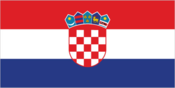
Flag description
red, white, and blue horizontal bands with Croatian coat of arms (red and white checkered)
Government type
presidential/parliamentary democracy
Independence
25 June 1991 (from Yugoslavia)
International organization participation
CCC, CE, CEI, EBRD, ECE, FAO, IADB, IAEA, IBRD, ICAO, ICRM, IDA, IFAD, IFC, IFRCS, IHO (pending member), ILO, IMF, IMO, Inmarsat, Intelsat, Interpol, IOC, IOM, ISO, ITU, NAM (observer), OSCE, UN, UNCTAD, UNESCO, UNIDO, UPU, WHO, WIPO, WMO, WToO, WTrO (applicant) Diplomatic representation in the US: chief of mission: Ambassador Miomir ZUZUL chancery: 2343 Massachusetts Avenue NW, Washington, DC 20008 telephone: [1] (202) 588-5899
Judicial branch
Supreme Court, judges appointed for eight-year terms by the Judicial Council of the Republic, which is elected by the House of Representatives; Constitutional Court, judges appointed for eight-year terms by the Judicial Council of the Republic, which is elected by the House of Representatives Political parties and leaders: Croatian Democratic Union or HDZ [Franjo TUDJMAN, president]; Croatian Democratic Independents or HND [Stjepan MESIC, president]; Croatian Social Liberal Party or HSLS [Drazen BUDISA, president]; Liberal Party or LP [Vlado GOTOVAC, president]; Social Democratic Party of Croatia or SDP [Ivica RACAN]; Croatian Party of Rights or HSP [Anto DJAPIC]; Croatian Party of Rights 1861 or HSP 1861 [Dobrislav PARAGA]; Croatian Peasants' Party or HSS [Zlatko TOMCIC]; Croatian People's Party or HNS [Radimir CACIC, president]; Serbian National Party or SNS [Milan DJUKIC]; Action of the Social Democrats of Croatia or ASH [Silvije DEGEN]; Croatian Christian Democratic Union or HKDU [Marko VESELICA, president]; Istrian Democratic Assembly or IDS [Ivan JAKOVCIC]; Slanvonsko-Baranja Croatian Party or SBHS [Damir JURIC]; Primorje Gorski Kotar Alliance; Independent Democratic Serb Party or SDSS [Vojislav STANIMIROVIC]; Party of Democratic Action or SDA [Semso TANKOVIC] Political pressure groups and leaders: NA
Legal system
based on civil law system
Legislative branch
bicameral Assembly or Sabor consists of the House of Districts or Zupanijski Dom (68 seats-63 directly elected by popular vote, 5 presidentially appointed; members serve four-year terms) and House of Representatives or the Zastupnicki Dom (127 seats; members are directly elected by popular vote to serve four-year terms) elections: House of Districts-last held 13 April 1997 (next to be held NA 2001); House of Representatives-last held 29 October 1995 (next to be held NA 1999) election results: House of Districts-percent of vote by party-NA; seats by party - HDZ 42, HDZ/HSS 11, HSS 2, IDS 2, SDP/PGS/HNS 2, SDP/HNS 2, HSLS/HSS/HNS 1, HSLS 1; note-in some districts certain parties ran as coalitions, while in others they ran alone; House of Representatives-percent of vote by party - HDZ 45.23%, HSS/IDS/HNS/HKDU/SBHS 18.26%, HSLS 11.55%, SDP 8.93%, HSP 5.01%; seats by party-HDZ 75, HSLS 12, HSS 10, SDP 10, IDS 4, HSP 4, HNS 2, SNS 2, HND 1, ASH 1, HKDU 1, SBHS 1, independents 4
National capital
Zagreb
National holiday
Statehood Day, 30 May (1990)
Suffrage
18 years of age; universal (16 years of age, if employed)
Economy
Agriculture-products
wheat, corn, sugar beets, sunflower seed, alfalfa, clover, olives, citrus, grapes, vegetables; livestock breeding, dairy farming
Budget
revenues: $5.3 billion expenditures: $6.3 billion, including capital expenditures of $78.5 million (1997 est.)
Currency
1 Croatian kuna (HRK) = 100 lipas
Debt-external
$5.904 billion (October 1997)
Economic aid
recipient: ODA, $NA note: IMF has given Croatia $192 million; World Bank has given Croatia $100 million
Economy-overview
Before the dissolution of Yugoslavia, the Republic of Croatia, after Slovenia, was the most prosperous and industrialized area, with a per capita output perhaps one-third above the Yugoslav average. Croatia faces considerable economic problems stemming from: the legacy of longtime communist mismanagement of the economy; damage during the internecine fighting to bridges, factories, power lines, buildings, and houses; the large refugee and displaced population, both Croatian and Bosnian; and the disruption of economic ties. Western aid and investment, especially in the tourist and oil industries, would help restore the economy. The government has been successful in some reform efforts-partially macroeconomic stabilization policies-and it has normalized relations with its creditors. Yet it still is struggling with privatization of large state enterprises and with bank reform.
Electricity-capacity
3.593 million kW (1995)
Electricity-consumption per capita
2,315 kWh (1995)
Electricity-production
7.15 billion kWh (1995)
Exchange rates
Croatian kuna per US$1-6.369 (January 1998), 6.101 (1997), 5.434 (1996), 5.230 (1995), 5.996 (1994), 3.577 (1993)
Exports
total value: $4.3 billion (f.o.b., 1997) commodities: machinery and transport equipment 13.6%, miscellaneous manufactures 27.6%, chemicals 14.2%, food and live animals 12.2%, raw materials 6.1%, fuels and lubricants 9.4%, beverages and tobacco 2.7% (1993) partners: Germany 22%, Italy 21%, Slovenia 18% (1994)
Fiscal year
calendar year Communications
GDP
purchasing power parity-$22.7 billion (1997 est.)
GDP-composition by sector
agriculture: 12% industry: 24% services: 64% (1995 est.)
GDP-per capita
purchasing power parity-$4,500 (1997 est.)
GDP-real growth rate
4.4% (1997 est.)
Imports
total value: $9.1 billion (c.i.f., 1997) commodities: machinery and transport equipment 23.1%, fuels and lubricants 8.8%, food and live animals 9.0%, chemicals 14.2%, miscellaneous manufactured articles 16.0%, raw materials 3.5%, beverages and tobacco 1.4% (1993) partners: Germany 21%, Italy 19%, Slovenia 10% (1994)
Industrial production growth rate
0% (1995)
Industries
chemicals and plastics, machine tools, fabricated metal, electronics, pig iron and rolled steel products, aluminum, paper, wood products, construction materials, textiles, shipbuilding, petroleum and petroleum refining, food and beverages; tourism
Inflation rate-consumer price index
3.7% (1997 est.)
Labor force
total: 1.444 million (1995) by occupation: industry and mining 31.1%, agriculture 4.3%, government 19.1% (including education and health), other 45.5% (1993)
Radio broadcast stations
AM 14, FM 8, shortwave 0
Radios
1.1 million
Telephone system
domestic: NA international: no satellite earth stations
Telephones
1.216 million (1993 est.)
Television broadcast stations
12 (repeaters 2)
Televisions
1.52 million (1992 est.)
Unemployment rate
15.9% (yearend 1997 est.)
Transportation
Airports
71 (1997 est.) Airports-with paved runways: total: 20 over 3,047 m: 2 2,438 to 3,047 m: 6 1,524 to 2,437 m: 2 914 to 1,523 m: 3 under 914 m: 7 (1997 est.) Airports-with unpaved runways: total: 51 1,524 to 2,437 m: 1 914 to 1,523 m: 8 under 914 m: 42 (1997 est.)
Heliports
2 (1997 est.)
Highways
total: 27,247 km paved: 22,206 km (including 318 km of expressways) unpaved: 5,041 km (1996 est.)
Merchant marine
total: 72 ships (1,000 GRT or over) totaling 793,114 GRT/1,187,908 DWT ships by type: bulk 13, cargo 31, chemical tanker 2, combination bulk 5, container 5, liquefied gas 1, multi-function large load carrier 3, oil tanker 2, passenger 2, roll-on/roll-off cargo 3, short-sea passenger 5 note: Croatia owns an additional 80 ships (1,000 GRT or over) totaling 2,057,523 DWT operating under the registries of Malta, Liberia, Cyprus, Panama, and Saint Vincent and the Grenadines (1997 est.)
Pipelines
crude oil 670 km; petroleum products 20 km; natural gas 310 km (1992); note-under repair following territorial dispute Ports and harbors: Dubrovnik, Omisalj, Ploce, Pula, Rijeka, Sibenik, Split, Zadar
Railways
total: 1,907 km standard gauge: 1,907 km 1.435-m gauge (769 km electrified) note: some lines remain inoperative or not in use; disrupted by territorial dispute (1997)
Waterways
785 km perennially navigable; Sava blocked by downed bridges
Military and Security
Military branches
Ground Forces, Naval Forces, Air and Air Defense Forces, Frontier Guard, Home Guard
Military expenditures-dollar figure
$1.5 billion (1997)
Military expenditures-percent of GDP
8.2% (1997)
Military manpower-availability
males age 15-49: 1,191,191 (1998 est.) Military manpower-fit for military service: males: 945,746 (1998 est.)
Military manpower-military age
19 years of age
Military manpower-reaching military age annually
males: 33,736 (1998 est.)
Transnational Issues
Disputes-international
Eastern Slavonia, which was held by ethnic Serbs during the ethnic conflict, was returned to Croatian control by the UN Transitional Administration for Eastern Slavonia on 15 January 1998; Croatia and Italy made progress toward resolving a bilateral issue dating from WWII over property and ethnic minority rights; significant progress has been made with Slovenia toward resolving a maritime border dispute over direct access to the sea in the Adriatic; Serbia and Montenegro is disputing Croatia's claim to the Prevlaka Peninsula in southern Croatia because it controls the entrance to Boka Kotorska in Montenegro; Prevlaka is currently under observation by the UN military observer mission in Prevlaka (UNMOP)
Illicit drugs
transit point along the Balkan route for Southwest Asian heroin to Western Europe; a minor transit point for maritime shipments of South American cocaine bound for Western Europe