1993 Edition
CIA World Factbook 1993 (Project Gutenberg)
Geography
Area
total area: 56,538 km2 land area: 56,410 km2 comparative area: slightly smaller than West Virginia
Climate
Mediterranean and continental; continental climate predominant with hot summers and cold winters; mild winters, dry summers along coast
Coastline
5,790 km (mainland 1,778 km, islands 4,012 km)
Environment
air pollution from metallurgical plants; damaged forest; coastal pollution from industrial and domestic waste; subject to frequent and destructive earthquakes
International disputes
Serbian enclaves in eastern Croatia and along the western Bosnia and Herzegovinian border; dispute with Slovenia over fishing rights in Adriatic
Irrigated land
NA km2
Land boundaries
total 1,843 km, Bosnia and Herzegovina (east) 751 km, Bosnia and Herzegovina (southeast) 91 km, Hungary 292 km, Serbia and Montenegro 254 km (239 km with Serbia; 15 km with Montenego), Slovenia 455 km
Land use
arable land: 32% permanent crops: 20% meadows and pastures: 18% forest and woodland: 15% other: 15%
Location
Southeastern Europe, on the Balkan Peninsula, bordering the Adriatic Sea, between Slovenia and Bosnia and Herzegovina
Map references
Africa, Ethnic Groups in Eastern Europe, Europe, Standard Time Zones of the World
Maritime claims
continental shelf: 200 m depth or to depth of exploitation exclusive economic zone: 12 nm exclusive fishing zone: 12 nm territorial sea: 12 nm
Natural resources
oil, some coal, bauxite, low-grade iron ore, calcium, natural asphalt, silica, mica, clays, salt
Note
controls most land routes from Western Europe to Aegean Sea and Turkish Straits
Terrain
geographically diverse; flat plains along Hungarian border, low mountains and highlands near Adriatic coast, coastline, and islands
People and Society
Birth rate
11.38 births/1,000 population (1993 est.)
Death rate
10.73 deaths/1,000 population (1993 est.)
Ethnic divisions
Croat 78%, Serb 12%, Muslim 0.9%, Hungarian 0.5%, Slovenian 0.5%, others 8.1%
Infant mortality rate
9 deaths/1,000 live births (1993 est.)
Labor force
1,509,489 by occupation: industry and mining 37%, agriculture 16% (1981 est.), government NA%, other
Languages
Serbo-Croatian 96%, other 4%
Life expectancy at birth
total population: 73.19 years male: 69.7 years female: 76.89 years (1993 est.)
Literacy
total population: NA% male: NA% female: NA%
Nationality
noun: Croat(s) adjective: Croatian
Net migration rate
0 migrant(s)/1,000 population (1993 est.)
Population
4,694,398 (July 1993 est.)
Population growth rate
0.07% (1993 est.)
Religions
Catholic 76.5%, Orthodox 11.1%, Slavic Muslim 1.2%, Protestant 1.4%, others and unknown 9.8%
Total fertility rate
1.66 children born/woman (1993 est.)
Government
Administrative divisions
100 districts (opcine, singular - opcina) Beli Manastir, Biograd (Biograd Na Moru), Bielovar, Bjelovar, Brac, Buje, Buzet, Cabar, Cakovec, Cazma, Cres Losinj, Crikvenica, Daruvar, Delnice, Djakovo (Dakovo), Donja Stubica, Donji Lapac, Dordevac, Drnis, Dubrovnik, Duga Resa, Dugo Selo, Dvor, Garesnica, Glina, Gospic, Gracac, Grubisno Polje, Hvar, Imotski, Ivanec, Ivanic-Grad, Jastrebarsko, Karlovac, Klanjec, Knin, Koprivnica, Korcula, Kostajnica, Krapina, Krizevci, Krk, Kutina, Labin, Lastovo, Ludbreg, Makarska, Metkovic, Nova Gradiska, Novi Marof, Novska, Obrovac, Ogulin, Omis, Opatija, Orahovica, Osijek, Otocac, Ozalj, Pag, Pazin, Petrinja, Ploce (Kardeljevo), Podravska Slatina, Porec, Pregrada, Pukrac, Pula, Rab, Rijeka, Rovinj, Samobor (part of Zagreb), Senj, Sesvete, Sibenik, Sinj, Sisak, Slavonska Pozega, Slavonski Brod, Slunj, Split (Solin, Kastela), Titova Korenica, Trogir, Valpovo, Varazdin, Vinkovci, Virovitica, Vukovar, Vis, Vojnic, Vrborsko, Vrbovec, Vrgin-Most, Vrgorac, Zabok, Zadar, Zagreb (Grad Zagreb), Zelina (Sveti Ivan Zelina), Zlatar Bistrica, Zupanja
Capital
Zagreb
Chamber of Deputies
last held NA August 1992 (next to be held NA August 1996); seats - (138 total) 87 HDZ
Chief of State
President Franjo TUDJMAN (since 30 May 1990)
Constitution
adopted on 2 December 1991
Digraph
HR
Diplomatic representation in US
chief of mission: Ambassador Peter A. SARCEVIC chancery: 2356 Massachusetts Avenue, NW, Washington, DC 20036 telephone: (202) 543-5586
Executive branch
president, prime minister, deputy prime ministers, cabinet
FAX
[38] (41) 440-235
Flag
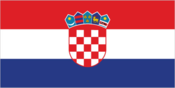
red, white, and blue horizontal bands with Croatian coat of arms (red and white checkered)
Head of Government
Prime Minister Nikica VALENTIC (since NA April 1993); Deputy Prime Ministers Mate GRANIC, Vladimir SEKS, Borislav SKEGRO (since NA)
House of Parishes
last held 7 February 1993 (next to be held NA February 1997); seats - (68 total; 63 elected, 5 presidentially appointed) HDZ 37, HSLS 16, HSS 5, IDS 3, SDP 1, PNS 1
Independence
NA June 1991 (from Yugoslavia)
Judicial branch
Supreme Court, Constitutional Court
Legal system
based on civil law system
Legislative branch
bicameral Parliament consists of an upper house or House of Parishes (Zupanije Dom) and a lower house or Chamber of Deputies (Predstavnicke Dom)
Member of
CEI, CSCE, ECE, ICAO, IMO, IOM (observer), UN, UNCTAD, UNESCO, UNIDO, UPU, WHO
Names
conventional long form: Republic of Croatia conventional short form: Croatia local long form: Republika Hrvatska local short form: Hrvatska
National holiday
Statehood Day, 30 May (1990)
Other political or pressure groups
NA
Political parties and leaders
Croatian Democratic Union (HDZ), Stjepan MESIC, chairman of the executive council; Croatian People's Party (HNS), Savka DABCEVIC-KUCAR, president; Croatian Christian Democratic Party (HKDS), Ivan CESAR, president; Croatian Party of Rights, Dobroslav PARAGA; Croatian Social Liberal Party (HSLS), Drazen BUDISA, president; Croatian Peasant Party (HSS), leader NA; Istrian Democratic Assembly (IDS), leader NA; Social-Democratic Party (SDP), leader NA; Croatian National Party (PNS), leader NA
President
last held 4 August 1992 (next to be held NA); Franjo TUDJMAN reelected with about 56% of the vote; Dobroslav PARAGA 5%
Suffrage
16 years of age, if employed; 18 years of age, universal
Type
parliamentary democracy
US diplomatic representation
chief of mission: (vacant) embassy: Andrije Hebranga 2, Zagreb mailing address: AMEMB Unit 25402, APO AE 09213-5080 telephone: [38] (41) 444-800
Economy
Agriculture
Croatia normally produces a food surplus; most agricultural land in private hands and concentrated in Croat-majority districts in Slavonia and Istria; much of Slavonia's land has been put out of production by fighting; wheat, corn, sugar beets, sunflowers, alfalfa, and clover are main crops in Slavonia; central Croatian highlands are less fertile but support cereal production, orchards, vineyards, livestock breeding, and dairy farming; coastal areas and offshore islands grow olives, citrus fruits, and vegetables
Budget
revenues $NA; expenditures $NA, including capital expenditures of $NA
Currency
1 Croatian dinar (CD) = 100 paras
Economic aid
$NA
Electricity
3,570,000 kW capacity; 11,500 million kWh produced, 2,400 kWh per capita (1992)
Exchange rates
Croatian dinar per US $1 - 60.00 (April 1992)
Exports
$2.9 billion (1990) commodities: machinery and transport equipment 30%, other manufacturers 37%, chemicals 11%, food and live animals 9%, raw materials 6.5%, fuels and lubricants 5% partners: principally the other former Yugoslav republics
External debt
$2.6 billion (will assume some part of foreign debt of former Yugoslavia)
Fiscal year
calendar year
Imports
$4.4 billion (1990) commodities: machinery and transport equipment 21%, fuels and lubricants 19%, food and live animals 16%, chemicals 14%, manufactured goods 13%, miscellaneous manufactured articles 9%, raw materials 6.5%, beverages and tobacco 1% partners: principally other former Yugoslav republics
Industrial production
growth rate -29% (1991 est.)
Industries
chemicals and plastics, machine tools, fabricated metal, electronics, pig iron and rolled steel products, aluminum reduction, paper, wood products (including furniture), building materials (including cement), textiles, shipbuilding, petroleum and petroleum refining, food processing and beverages
Inflation rate (consumer prices)
50% (monthly rate, December 1992)
National product
GDP - purchasing power equivalent - $26.3 billion (1991 est.)
National product per capita
$5,600 (1991 est.)
National product real growth rate
-25% (1991 est.)
Overview
- Before the dissolution of Yugoslavia, the republic of Croatia, after Slovenia, was the most prosperous and industrialized area, with a per capita output roughly comparable to that of Portugal and perhaps one-third above the Yugoslav average. Croatian Serb Nationalists control approximately one third of the Croatian territory, and one of the overriding determinants of Croatia's long-term political and economic prospects will be the resolution of this territorial dispute. Croatia faces monumental problems stemming
- foreign debt; damage during the fighting to bridges, factories, powerlines, buildings, and houses; the large refugee population, both Croatian and Bosnian; and the disruption of economic ties to Serbia and the other former Yugoslav republics, as well as within its own territory. At the minimum, extensive Western aid and investment, especially in the tourist and oil industries, would seem necessary to salvage a desperate economic situation. However, peace and political stability must come first. As of June 1993, fighting continues among Croats, Serbs, and Muslims, and national boundaries and final political arrangements are still in doubt.
- from
- the legacy of longtime Communist mismanagement of the economy; large
Unemployment rate
20% (December 1991 est.)
Communications
Airports
total: 75 usable: 72 with permanent-surface runways: 15 with runways over 3,659 m: with runways 2,440-3,659 m: 10 with runways 1,220-2,439 m: 5
Highways
32,071 km total; 23,305 km paved, 8,439 km gravel, 327 km earth (1990); note - key highways note disrupted because of territorial dispute
Inland waterways
785 km perennially navigable
Merchant marine
18 ships (1,000 GRT or over) totaling 77,074 GRT/93,052 DWT; includes 4 cargo, 1 roll-on/roll-off, 10 passenger ferries, 2 bulk, 1 oil tanker; note - also controlled by Croatian shipowners are 198 ships (1,000 GRT or over) under flags of convenience - primarily Malta and St. Vincent - totaling 2,602,678 GRT/4,070,852 DWT; includes 89 cargo, 9 roll-on/ roll-off, 6 refrigerated cargo, 14 container, 3 multifunction large load carriers, 51 bulk, 5 passenger, 11 oil tanker, 4 chemical tanker, 6 service vessel
Pipelines
crude oil 670 km, petroleum products 20 km, natural gas 310 km (1992); note - now disrupted because of territorial dispute
Ports
coastal - Rijeka, Split, Kardeljevo (Ploce); inland - Vukovar, Osijek, Sisak, Vinkovci
Railroads
2,592 km of standard guage (1.435 m) of which 864 km are electrified (1992); note - disrupted by territorial dispute
Telecommunications
350,000 telephones; broadcast stations - 14 AM, 8 FM, 12 (2 repeaters) TV; 1,100,000 radios; 1,027,000 TVs; NA submarine coaxial cables; satellite ground stations - none
Military and Security
Branches
Ground Forces, Naval Forces, Air and Air Defense Forces
Defense expenditures
337-393 billion Croatian dinars, NA% of GDP (1993 est.); note - conversion of defense expenditures into US dollars using the current exchange rate could produce misleading results
Manpower availability
males age 15-49 1,177,029; fit for military service 943,259; reach military age (19) annually 32,873 (1993 est.)