1992 Edition
CIA World Factbook 1992 (Project Gutenberg)
Geography
Climate
Mediterranean and continental; continental climate predominant with hot summers and cold winters; mild winters, dry summers along coast
Coastline
5,790 km; mainland 1,778 km, islands 4,012 km
Comparative area
slightly smaller than West Virginia
Contiguous zone
NA nm
Continental shelf
200-meter depth or to depth of exploitation
Disputes
Serbian enclaves in eastern Slavonia and along the western Bosnia and Hercegovinian border; dispute with Slovenia over fishing rights in Adriatic
Environment
air pollution from metallurgical plants; damaged forest; coastal pollution from industrial and domestic waste; subject to frequent and destructive earthquakes
Exclusive economic zone
12 nm
Exclusive fishing zone
12 nm
Land area
56,410 km2
Land boundaries
1,843 km; Bosnia and Hercegovina (east) 751 km, Bosnia and Hercegovina (southeast) 91 km, Hungary 292 km, Serbia and Montenegro 254 km, Slovenia 455 km
Land use
32% arable land; 20% permanent crops; 18% meadows and pastures; 15% forest and woodland; 9% other; includes 5% irrigated
Natural resources
oil, some coal, bauxite, low-grade iron ore, calcium, natural asphalt, silica, mica, clays, salt, fruit, livestock
Note
controls most land routes from Western Europe to Aegean Sea and Turkish Straits
Terrain
geographically diverse; flat plains along Hungarian border, low mountains and highlands near Adriatic coast, coastline, and islands
Territorial sea
12 nm
Total area
56,538 km2
People and Society
Birth rate
12.2 births/1,000 population (1991)
Death rate
11.3 deaths/1,000 population (1991)
Ethnic divisions
Croat 78%, Serb 12%, Muslims 0.9%, Hungarian 0.5%, Slovenian 0.5%, others 7.8%
Infant mortality rate
10 deaths/1,000 live births (1990)
Labor force
1,509,489; industry and mining 37%, agriculture 4%, government NA%, other
Languages
Serbo-Croatian 96%
Life expectancy at birth
67 years male, 74 years female (1980-82)
Literacy
96.5% (male 98.6%, female 94.5%) age 10 and over can read and write (1991 census)
Nationality
noun - Croat(s); adjective - Croatian
Net migration rate
NA migrants/1,000 population (1991)
Organized labor
NA
Population
4,784,000 (July 1991), growth rate 0.39% (for the period 1981-91)
Religions
Catholic 76.5%, Orthodox 11.1%, Slavic Muslim 1.2%, Protestant 1.4%, others and unknown 11%
Total fertility rate
NA children born/woman (1991)
Government
Administrative divisions
102 districts (opcine, singular - opcina)
Capital
Zagreb
Chief of State
President Franjo TUDJMAN (since April 1990), Vice President NA (since NA)
Constitution
promulgated on 22 December 1990
Diplomatic representation
Ambassador Dr. Franc Vinko GOLEM, Office of Republic of Croatia, 256 Massachusetts Avenue, NW, Washington, DC 20036; telephone (202) 543-5586 US: Ambassador NA; Embassy at NA (mailing address is APO New York is 09862); telephone NA
Executive branch
president, prime minister
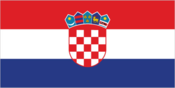
Flag
red, white, and blue with Croatian coat of arms (red and white checkered)
Head of Government
Prime Minister Franjo GREGURIC (since August 1991), Deputy Prime Minister Mila RAMLJAK (since NA )
Independence
June 1991 from Yugoslavia
Judicial branch
Supreme Court, Constitutional Court
Legal system
based on civil law system; judicial/no judicial review of legislative acts; does/does not accept compulsory ICJ jurisdiction
Legislative branch
bicameral
Long-form name
None
Member of
CSCE
National holiday
30 May, Statehood Day (1990)
Other political or pressure groups
NA
Parliament
last held May 1990 (next to be held NA); results - HDZ won 205 seats; seats - 349 (total)
Political parties and leaders
Christian Democratic Union, TUDJMAN; Croatian Democratic Union (HDZ), Stjepan Mesic; Croatian National Party, Savka DABCEVIC-KUCAR; Croatian Christian Democratic Party (HKDS), Ivan CESAR; Croatian Party of Rights, Dobroslav Paraga; Croatian Social Liberal Party (HSLS), Drazen BUDISA
President
NA
Suffrage
at age 16 if employed, universal at age 18
Type
parliamentary democracy
Economy
Agriculture
Croatia normally produces a food surplus; most agricultural land in private hands and concentrated in Croat-majority districts in Slavonia and Istria; much of Slavonia's land has been put out of production by fighting; wheat, corn, sugar beets, sunflowers, alfalfa, and clover are main crops in Slavonia; central Croatian highlands are less fertile but support cereal production, orchards, vineyards, livestock breeding, and dairy farming; coastal areas and offshore islands grow olives, citrus fruits, and vegetables
Budget
revenues $NA million; expenditures $NA million, including capital expenditures of $NA million
Currency
Croatian dinar(s)
Economic aid
NA
Electricity
3,570,000 kW capacity; 8,830 million kWh produced, 1,855 kWh per capita 1991)
Exchange rates
Croatian dinar per US $1 - 60.00 (April 1992)
Exports
$2.9 billion (1990) commodities: machinery and transport equipment (30%), other manufacturers (37%), chemicals (11%), food and live animals (9%), raw materials (6.5%), fuels and lubricants (5%) partners: principally the other former Yugoslav republics
External debt
$2.6 billion (may assume some part of foreign debt of former Yugoslavia)
Fiscal year
calendar year
GDP
NA - $26.3 billion, per capita $5,600; real growth rate -25% (1991 est.)
Imports
$4.4 billion (1990) commodities: machinery and transport equipment (21%), fuels and lubricants (19%), food and live animals (16%), chemicals (14%), manufactured goods (13%), miscellaneous manufactured articles (9%), raw materials (6.5%), beverages and tobacco (1%) partners: principally other former Yugoslav republics
Industrial production
declined as much as 11% in 1990 and probably another 29% in 1991
Industries
chemicals and plastics, machine tools, fabricated metal, electronics, pig iron and rolled steel products, aluminum reduction, paper, wood products (including furniture), building materials (including cement), textiles, shipbuilding, petroleum and petroleum refining, food processing and beverages
Inflation rate (consumer prices)
14.3% (March 1992)
Overview
- Before the political disintegration of Yugoslavia, the republic of Croatia stood next to Slovenia as the most prosperous and industrialized area, with a per capita output roughly comparable to that of Portugal and perhaps one-third above the Yugoslav average. Serbia and the Serb-dominated army of the old Yugoslavia, however, have seized Croatian territory, and the overriding determinant of Croatia's long-term economic prospects will be the final border settlement. Under the most favorable circumstances, Croatia will retain the Dalmatian coast with its major tourist attractions and Slavonia with its oilfields and rich agricultural land. Even so, Croatia
- Communist mismanagement of the economy; large foreign debt; damage during the fighting to bridges, factories, powerlines, buildings, and houses; and the disruption of economic ties to Serbia and the other former Yugoslav republics. At the minimum, extensive Western aid and investment, especially in the tourist and oil industries, would seem necessary to salvage a desperate economic situation. However, peace and political stability must come first.
- would face monumental problems stemming from
- the legacy of longtime
Unemployment rate
20% (December 1991)
Communications
Airports
8 total, NA usable; NA with permanent-surface runways; NA with runways over 3,659 m; 7 with runways 2,440-3,659 m; NA with runways 1,220-2,439 m; 1 with runways 900 m
Civil air
NA major transport aircraft
Highways
32,071 km total (1990); 23,305 km paved, 8,439 km gravel, 327 km earth
Inland waterways
785 km perennially navigable
Merchant marine
11 ships (1,000 GRT or over) totaling 60,802 GRT/65,560 DWT; includes 1 cargo, 3 roll-on/roll-off, 5 passenger ferries, 2 bulk carriers; note - also controlled by Croatian shipowners are 196 ships (1,000 GRT or over) under flags of convenience - primarily Malta and St. Vincent - totaling 2,593,429 GRT/4,101,119 DWT; includes 91 general cargo, 7 roll-on/ roll-off, 6 refrigerated cargo, 13 container ships, 3 multifunction large load carriers, 52 bulk carriers, 3 passenger ships, 11 petroleum tankers, 4 chemical tankers, 6 service vessels
Pipelines
crude oil 670 km, petroleum products 20 km, natural gas 310 km
Ports
maritime - Rijeka, Split, Kardeljevo (Ploce); inland - Vukovar, Osijek, Sisak, Vinkovci
Railroads
2,698 km (34.5% electrified)
Telecommunications
350,000 telephones; broadcast stations - 14 AM, 8 FM, 12 (2 repeaters) TV; 1,100,000 radios; 1,027,000 TVs; NA submarine coaxial cables; satellite ground stations - none
Military and Security
Branches
Ground Forces, Naval Forces, Air and Air Defense Forces, Frontier Guard, Home Guard, Civil Defense
Defense expenditures
$NA, NA% of GDP
Manpower availability
males 15-49, 1,188,576; NA fit for military service; 42,664 reach military age (18) annually