2023 Edition
CIA World Factbook 2023 (factbook.json @ 0d4fa4984ecb)
Introduction
Background
Bantu, Sudanic, and other migrants from West and Northeastern Africa arrived in the Congo River Basin between 2000 B.C. and A.D. 500. The territory that is now the Democratic Republic of the Congo is extremely diverse, with more than 200 ethnic groups that trace their histories to many communal organizations and kingdoms. The Kingdom of Kongo, for example, ruled the area around the mouth of the Congo River from the 14th to 19th centuries. Meanwhile, to the south and east, the Kingdoms of Luba and Lunda, respectively, were also notable political groupings in the territory and ruled from the 16th and 17th centuries to the 19th century. These kingdoms were invaded and splintered by European prospectors in the Congo Basin in the late 1800’s, sponsored by King LEOPOLD II of Belgium, and eventually were forced to grant Leopold the rights to the Congo territory to make it his private property. During this period, known as the Congo Free State, the king's private colonial military forced the local population to produce rubber. From 1885 to 1908, millions of Congolese people died as a result of disease, inhumane treatment, and exploitation. International condemnation finally forced LEOPOLD to cede the land to the state of Belgium, creating the Belgian Congo.The Republic of the Congo gained its independence from Belgium in 1960, but its early years were marred by political and social instability. Col. Joseph MOBUTU seized power and declared himself president in a November 1965 coup. He subsequently changed his name - to MOBUTU Sese Seko - as well as that of the country - to Zaire. MOBUTU retained his position for 32 years through several sham elections, as well as through brute force. Ethnic strife and civil war, touched off by a massive inflow of refugees in 1994 from conflict in Rwanda and Burundi, led in May 1997 to the toppling of the MOBUTU regime by a rebellion backed by Rwanda and Uganda and fronted by Laurent KABILA. KABILA renamed the country the Democratic Republic of the Congo (DRC), but in August 1998 his regime was itself challenged by a second insurrection again backed by Rwanda and Uganda. Troops from Angola, Chad, Namibia, Sudan, and Zimbabwe intervened to support KABILA's regime. In January 2001, KABILA was assassinated and his son, Joseph KABILA, was named head of state. In October 2002, the new president negotiated the withdrawal of Rwandan forces occupying the eastern DRC; two months later, the Pretoria Accord was signed by all remaining warring parties to end the fighting and establish a government of national unity. Presidential, National Assembly, and provincial elections took place in 2006, with Joseph KABILA elected to office. National elections were held in November 2011 and disputed results allowed Joseph KABILA to be reelected to the presidency. While the DRC constitution barred President KABILA from running for a third term, the DRC Government delayed national elections originally slated for November 2016, to 30 December 2018. This failure to hold elections as scheduled fueled significant civil and political unrest, with sporadic street protests by KABILA’s opponents and exacerbation of tensions in the tumultuous eastern DRC regions. Presidential, legislative, and provincial elections were held in late December 2018 and early 2019 across most of the country. The DRC Government canceled presidential elections in the cities of Beni and Butembo (citing concerns over an ongoing Ebola outbreak in the region) as well as Yumbi (which had recently experienced heavy violence). Opposition candidate Felix TSHISEKEDI was announced the election winner on 10 January 2019 and inaugurated two weeks later. This was the first transfer of power to an opposition candidate without significant violence or a coup since the DRC's independence. The DRC, particularly in the East, continues to experience violence perpetrated by more than 100 armed groups active in the region, including the March 23 rebel group, the ISIS-affiliated Allied Democratic Forces, the Democratic Forces for the Liberation of Rwanda, and assorted local militias known as Mai Mai militias. The UN Organization Stabilization Mission in the DRC (MONUSCO) has operated in the region since 1999 and is the largest and most expensive UN peacekeeping mission in the world.
Geography
Area
- land
- 2,267,048 sq km
- total
- 2,344,858 sq km
- water
- 77,810 sq km
Area - comparative
slightly less than one-fourth the size of the US
Climate
tropical; hot and humid in equatorial river basin; cooler and drier in southern highlands; cooler and wetter in eastern highlands; north of Equator - wet season (April to October), dry season (December to February); south of Equator - wet season (November to March), dry season (April to October)
Coastline
37 km
Elevation
- highest point
- Pic Marguerite on Mont Ngaliema (Mount Stanley) 5,110 m
- lowest point
- Atlantic Ocean 0 m
- mean elevation
- 726 m
Geographic coordinates
0 00 N, 25 00 E
Geography - note
note 1: second largest country in Africa (after Algeria) and largest country in Sub-Saharan Africa; straddles the equator; dense tropical rain forest in central river basin and eastern highlands; the narrow strip of land that controls the lower Congo River is the DRC's only outlet to the South Atlantic Ocean note 2: because of its speed, cataracts, rapids, and turbulence the Congo River, most of which flows through the DRC, has never been accurately measured along much of its length; nonetheless, it is conceded to be the deepest river in the world; estimates of its greatest depth vary between 220 and 250 meters
Irrigated land
110 sq km (2012)
Land boundaries
- border countries
- Angola 2,646 km (of which 225 km is the boundary of Angola's discontiguous Cabinda Province); Burundi 236 km; Central African Republic 1,747 km; Republic of the Congo 1,775 km; Rwanda 221 km; South Sudan 714 km; Tanzania 479 km; Uganda 877 km; Zambia 2,332 km
- total
- 11,027 km
Land use
- agricultural land
- 11.4% (2018 est.)
- agricultural land: arable land
- arable land: 3.1% (2018 est.)
- agricultural land: permanent crops
- permanent crops: 0.3% (2018 est.)
- agricultural land: permanent pasture
- permanent pasture: 8% (2018 est.)
- forest
- 67.9% (2018 est.)
- other
- 20.7% (2018 est.)
Location
Central Africa, northeast of Angola
Major aquifers
Congo Basin
Major lakes (area sq km)
- fresh water lake(s)
- Lake Tanganyika (shared with Burundi, Tanzania, and Zambia) - 32,000 sq km; Lake Albert (shared with Uganda) - 5,590 sq km; Lake Mweru (shared with Zambia) - 4,350 sq km; Lac Mai-Ndombe - 2,300 sq km; Lake Kivu (shared with Rwanda) - 2,220 sq km; Lake Edward (shared with Uganda) - 2,150 sq km; Lac Tumba - 500 sq km; Lac Upemba - 530 sq km
Major rivers (by length in km)
Zaïre (Congo) river mouth (shared with Zambia [s], Angola, and Republic of Congo) - 4,700 km; Ubangi river mouth (shared with Central African Republic [s] and Republic of Congo) - 2,270 km note – [s] after country name indicates river source; [m] after country name indicates river mouth
Major watersheds (area sq km)
Atlantic Ocean drainage: Congo (3,730,881 sq km), (Mediterranean Sea) Nile (3,254,853 sq km)Indian Ocean drainage: Zambezi (1,332,412 sq km)
Map references
Africa
Maritime claims
- exclusive economic zone
- since 2011, the DRC has had a Common Interest Zone agreement with Angola for the mutual development of off-shore resources
- territorial sea
- 12 nm
Natural hazards
periodic droughts in south; Congo River floods (seasonal); active volcanoes in the east along the Great Rift Valleyvolcanism: Nyiragongo (3,470 m), which erupted in 2002 and is experiencing ongoing activity, poses a major threat to the city of Goma, home to a quarter million people; the volcano produces unusually fast-moving lava, known to travel up to 100 km /hr; Nyiragongo has been deemed a Decade Volcano by the International Association of Volcanology and Chemistry of the Earth's Interior, worthy of study due to its explosive history and close proximity to human populations; its neighbor, Nyamuragira, which erupted in 2010, is Africa's most active volcano; Visoke is the only other historically active volcano
Natural resources
- cobalt, copper, niobium, tantalum, petroleum, industrial and gem diamonds, gold, silver, zinc, manganese, tin, uranium, coal, hydropower, timber
- note
- note 1: coltan, the industrial name for a columbite–tantalite mineral from which niobium and tantalum are extracted, is being linked to warfare in the Democratic Republic of the Congo; mining of coltan is mainly artisanal and small-scale and vulnerable to extortion and human trafficking; fighting over cassiterite deposits, a tin ore, is also a major cause of conflict in eastern parts of the Democratic Republic of the Congo; tantalum, tin, tungsten, and gold extracted from central Africa are considered "conflict minerals" and as such are subject to international monitoringnote 2: the DROC is the World's leading producer of cobalt, accounting for as much as 70% of the World's supply; between 20-30% of this cobalt is produced in artisanal and small-scale mining operations which are vulnerable to extortion, human trafficking, and exploitative working conditions including child labor
Population distribution
urban clusters are spread throughout the country, particularly in the northeast along the border with Uganda, Rwanda, and Burundi; the largest city is the capital, Kinshasha, located in the west along the Congo River; the south is least densely populated as shown in this population distribution map
Terrain
vast central basin is a low-lying plateau; mountains in east
People and Society
Age structure
- 0-14 years
- 45.99% (male 25,902,046/female 25,543,395)
- 15-64 years
- 51.52% (male 28,798,920/female 28,835,212)
- 65 years and over
- 2.49% (2023 est.) (male 1,211,966/female 1,568,389)
Alcohol consumption per capita
- beer
- 0.5 liters of pure alcohol (2019 est.)
- other alcohols
- 0 liters of pure alcohol (2019 est.)
- spirits
- 0.05 liters of pure alcohol (2019 est.)
- total
- 0.56 liters of pure alcohol (2019 est.)
- wine
- 0.01 liters of pure alcohol (2019 est.)
Birth rate
39.6 births/1,000 population (2023 est.)
Child marriage
- men married by age 18
- 5.6% (2018 est.)
- women married by age 15
- 8.4%
- women married by age 18
- 29.1%
Children under the age of 5 years underweight
23.1% (2017/18)
Contraceptive prevalence rate
28.1% (2017/18)
Current health expenditure
4.1% of GDP (2020)
Currently married women (ages 15-49)
55.3% (2023 est.)
Death rate
7.7 deaths/1,000 population (2023 est.)
Demographic profile
Despite a wealth of fertile soil, hydroelectric power potential, and mineral resources, the Democratic Republic of the Congo (DRC) struggles with many socioeconomic problems, including high infant and maternal mortality rates, malnutrition, poor vaccination coverage, lack of access to improved water sources and sanitation, and frequent and early fertility. Ongoing conflict, mismanagement of resources, and a lack of investment have resulted in food insecurity; almost 25% of children under the age of 5 were malnourished as of 2018. The overall coverage of basic public services – education, health, sanitation, and potable water – is very limited and piecemeal, with substantial regional and rural/urban disparities. Fertility remains high at more than 5 children per woman and is likely to remain high because of the low use of contraception and the cultural preference for larger families. The DRC is a source and host country for refugees. Between 2012 and 2014, more than 119,000 Congolese refugees returned from the Republic of Congo to the relative stability of northwest DRC, but more than 1 million Congolese refugees and asylum seekers were hosted by neighboring countries as of December 2022. In addition, an estimated 5.5 million Congolese were internally displaced as of October 2022, the vast majority fleeing violence between rebel group and Congolese armed forces. Thousands of refugees have come to the DRC from neighboring countries, including Rwanda, the Central African Republic, South Sudan, and Burundi.
Dependency ratios
- elderly dependency ratio
- 5.9
- potential support ratio
- 17.1 (2021 est.)
- total dependency ratio
- 98
- youth dependency ratio
- 92.1
Drinking water source
- improved: rural
- rural: 34.7% of population
- improved: total
- total: 59.4% of population
- improved: urban
- urban: 88.8% of population
- unimproved: rural
- rural: 65.3% of population
- unimproved: total
- total: 40.6% of population (2020 est.)
- unimproved: urban
- urban: 11.2% of population
Education expenditures
2.7% of GDP (2021 est.)
Ethnic groups
more than 200 African ethnic groups of which the majority are Bantu; the four largest groups - Mongo, Luba, Kongo (all Bantu), and the Mangbetu-Azande (Hamitic) - make up about 45% of the population
Gross reproduction rate
2.74 (2023 est.)
Infant mortality rate
- female
- 53.4 deaths/1,000 live births
- male
- 64.7 deaths/1,000 live births
- total
- 59.1 deaths/1,000 live births (2023 est.)
Languages
- Languages
- French (official), Lingala (a lingua franca trade language), Kingwana (a dialect of Kiswahili or Swahili), Kikongo, Tshiluba
- major-language sample(s)
- Buku oyo ya bosembo ya Mokili Mobimba Ezali na Makanisi ya Liboso Mpenza. (Lingala)The World Factbook, the indispensable source for basic information.
Life expectancy at birth
- female
- 64.1 years
- male
- 60.4 years
- total population
- 62.2 years (2023 est.)
Literacy
- definition
- age 15 and over can read and write French, Lingala, Kingwana, or Tshiluba
- female
- 70.8% (2021)
- male
- 89.5%
- total population
- 80%
Major infectious diseases
- animal contact diseases
- rabies
- degree of risk
- very high (2023)
- food or waterborne diseases
- bacterial and protozoal diarrhea, hepatitis A, and typhoid fever
- note
- note: on 31 August 2023, the US Centers for Disease Control and Prevention (CDC) issued a Travel Alert for polio in Africa; the Democratic Republic of the Congo is currently considered a high risk to travelers for circulating vaccine-derived polioviruses (cVDPV); vaccine-derived poliovirus (VDPV) is a strain of the weakened poliovirus that was initially included in oral polio vaccine (OPV) and that has changed over time and behaves more like the wild or naturally occurring virus; this means it can be spread more easily to people who are unvaccinated against polio and who come in contact with the stool or respiratory secretions, such as from a sneeze, of an “infected” person who received oral polio vaccine; the CDC recommends that before any international travel, anyone unvaccinated, incompletely vaccinated, or with an unknown polio vaccination status should complete the routine polio vaccine series; before travel to any high-risk destination, the CDC recommends that adults who previously completed the full, routine polio vaccine series receive a single, lifetime booster dose of polio vaccine
- vectorborne diseases
- malaria, dengue fever, and trypanosomiasis-gambiense (African sleeping sickness)
- water contact diseases
- schistosomiasis
Major urban areas - population
16.316 million KINSHASA (capital), 2.892 million Mbuji-Mayi, 2.812 million Lubumbashi, 1.664 million Kananga, 1.423 million Kisangani, 1.249 million Bukavu (2023)
Maternal mortality ratio
547 deaths/100,000 live births (2020 est.)
Median age
- female
- 16.9 years
- male
- 16.6 years
- total
- 16.8 years (2023 est.)
Mother's mean age at first birth
- 19.9 years (2013/14 est.)
- note
- note: data represents median age at first birth among women 20-49
Nationality
- adjective
- Congolese or Congo
- noun
- Congolese (singular and plural)
Net migration rate
-0.6 migrant(s)/1,000 population (2023 est.)
Obesity - adult prevalence rate
6.7% (2016)
Physicians density
0.38 physicians/1,000 population (2018)
Population
111,859,928 (2023 est.)
Population distribution
urban clusters are spread throughout the country, particularly in the northeast along the border with Uganda, Rwanda, and Burundi; the largest city is the capital, Kinshasha, located in the west along the Congo River; the south is least densely populated as shown in this population distribution map
Population growth rate
3.13% (2023 est.)
Religions
Roman Catholic 29.9%, Protestant 26.7%, other Christian 36.5%, Kimbanguist 2.8%, Muslim 1.3%, other (includes syncretic sects and indigenous beliefs) 1.2%, none 1.3%, unspecified 0.2% (2014 est.)
Sanitation facility access
- improved: rural
- rural: 20.5% of population
- improved: total
- total: 35.5% of population
- improved: urban
- urban: 53.4% of population
- unimproved: rural
- rural: 79.5% of population
- unimproved: total
- total: 64.5% of population (2020 est.)
- unimproved: urban
- urban: 46.6% of population
School life expectancy (primary to tertiary education)
- female
- 9 years (2013)
- male
- 10 years
- total
- 11 years
Sex ratio
- 0-14 years
- 1.01 male(s)/female
- 15-64 years
- 1 male(s)/female
- 65 years and over
- 0.77 male(s)/female
- at birth
- 1.03 male(s)/female
- total population
- 1 male(s)/female (2023 est.)
Tobacco use
- female
- 2.9% (2020 est.)
- male
- 22.7% (2020 est.)
- total
- 12.8% (2020 est.)
Total fertility rate
5.56 children born/woman (2023 est.)
Urbanization
- rate of urbanization
- 4.33% annual rate of change (2020-25 est.)
- urban population
- 47.4% of total population (2023)
Youth unemployment rate (ages 15-24)
- female
- 8.5%
- male
- 12%
- total
- 10.1% (2021 est.)
Government
Administrative divisions
26 provinces (provinces, singular - province); Bas-Uele (Lower Uele), Equateur, Haut-Katanga (Upper Katanga), Haut-Lomami (Upper Lomami), Haut-Uele (Upper Uele), Ituri, Kasai, Kasai-Central, Kasai-Oriental (East Kasai), Kinshasa, Kongo Central, Kwango, Kwilu, Lomami, Lualaba, Mai-Ndombe, Maniema, Mongala, Nord-Kivu (North Kivu), Nord-Ubangi (North Ubangi), Sankuru, Sud-Kivu (South Kivu), Sud-Ubangi (South Ubangi), Tanganyika, Tshopo, Tshuapa
Capital
- etymology
- founded as a trading post in 1881 and named Leopoldville in honor of King LEOPOLD II of the Belgians, who controlled the Congo Free State, the vast central African territory that became the Democratic Republic of the Congo in 1960; in 1966, Leopoldville was renamed Kinshasa, after a village of that name that once stood near the site
- geographic coordinates
- 4 19 S, 15 18 E
- name
- Kinshasa
- time difference
- UTC+1 (6 hours ahead of Washington, DC, during Standard Time)
- time zone note
- the DRC has two time zones
Citizenship
- citizenship by birth
- no
- citizenship by descent only
- at least one parent must be a citizen of the Democratic Republic of the Congo
- dual citizenship recognized
- no
- residency requirement for naturalization
- 5 years
Constitution
- amendments
- proposed by the president of the republic, by the government, by either house of Parliament, or by public petition; agreement on the substance of a proposed bill requires absolute majority vote in both houses; passage requires a referendum only if both houses in joint meeting fail to achieve three-fifths majority vote; constitutional articles, including the form of government, universal suffrage, judicial independence, political pluralism, and personal freedoms, cannot be amended; amended 2011
- history
- several previous; latest adopted 13 May 2005, approved by referendum 18-19 December 2005, promulgated 18 February 2006
Country name
- abbreviation
- DRC (or DROC)
- conventional long form
- Democratic Republic of the Congo
- conventional short form
- DRC
- etymology
- named for the Congo River, most of which lies within the DRC; the river name derives from Kongo, a Bantu kingdom that occupied its mouth and whose name stems from its people the Bakongo, meaning "hunters"
- former
- Congo Free State, Belgian Congo, Congo/Leopoldville, Congo/Kinshasa, Zaire
- local long form
- Republique Democratique du Congo
- local short form
- RDC
Diplomatic representation from the US
- chief of mission
- Ambassador Lucy TAMLYN (since 6 February 2023)
- email address and website
- ACSKinshasa@state.govhttps://cd.usembassy.gov/
- embassy
- 310 Avenue des Aviateurs, Kinshasa, Gombe
- FAX
- [243] 81 556-0175
- mailing address
- 2220 Kinshasa Place, Washington DC 20521-2220
- telephone
- [243] 081 556-0151
Diplomatic representation in the US
- chancery
- 1100 Connecticut Avenue NW, Suite 725, Washington DC 20036
- chief of mission
- Ambassador Marie-Hélène Mathey Boo LOWUMBA (since 7 June 2022)
- email address and website
- ambassade@ambardcusa.orghttps://www.ambardcusa.org/
- FAX
- [1] (202) 234-2609
- representative office
- New York
- telephone
- [1] (202) 234-7690
Executive branch
- cabinet
- Ministers of State appointed by the president
- chief of state
- President Felix TSHISEKEDI (since 24 January 2019)
- election results
- 2018: Felix TSHISEKEDI elected president; percent of vote - Felix TSHISEKEDI (UDPS) 38.6%, Martin FAYULU (Lamuka coalition) 34.8%, Emmanuel Ramazani SHADARY (PPRD) 23.9%, other 2.7%; note - election marred by serious voting irregularities2011: Joseph KABILA reelected president; percent of vote - Joseph KABILA (PPRD) 49%, Etienne TSHISEKEDI (UDPS) 32.3%, other 18.7%; note - election marred by serious voting irregularities
- elections/appointments
- president directly elected by simple majority vote for a 5-year term (eligible for a second term); election last held on 30 December 2018 (next to be held on 20 December 2023); prime minister appointed by the president
- head of government
- Prime Minister Jean-Michel Sama LUKONDE (since 15 February 2021); Deputy Prime Ministers Jose MAKILA, Leonard She OKITUNDU, Henri MOVA Sankanyi (since February 2018) Jean-Pierre BEMBBA (since 23 March 2023)
Flag description
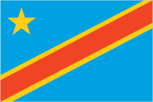
sky blue field divided diagonally from the lower hoist corner to upper fly corner by a red stripe bordered by two narrow yellow stripes; a yellow, five-pointed star appears in the upper hoist corner; blue represents peace and hope, red the blood of the country's martyrs, and yellow the country's wealth and prosperity; the star symbolizes unity and the brilliant future for the country
Government type
semi-presidential republic
Independence
30 June 1960 (from Belgium)
International law organization participation
accepts compulsory ICJ jurisdiction with reservations; accepts ICCt jurisdiction
International organization participation
ACP, AfDB, AU, CEMAC, CEPGL, COMESA, EAC, EITI (compliant country), FAO, G-24, G-77, IAEA, IBRD, ICAO, ICC (NGOs), ICCt, ICRM, IDA, IFAD, IFC, IFRCS, IHO, ILO, IMF, IMO, Interpol, IOC, IOM, IPU, ISO, ITSO, ITU, ITUC (NGOs), LCBC (observer), MIGA, NAM, OIF, OPCW, PCA, SADC, UN, UNCTAD, UNESCO, UNHCR, UNIDO, UNWTO, UPU, WCO, WFTU (NGOs), WHO, WIPO, WMO, WTO
Judicial branch
- highest court(s)
- Court of Cassation or Cour de Cassation (consists of 26 justices and organized into legislative and judiciary sections); Constitutional Court (consists of 9 judges)
- judge selection and term of office
- Court of Cassation judges nominated by the Judicial Service Council, an independent body of public prosecutors and selected judges of the lower courts; judge tenure NA; Constitutional Court judges - 3 nominated by the president, 3 by the Judicial Service Council, and 3 by the legislature; judges appointed by the president to serve 9-year non-renewable terms with one-third of the membership renewed every 3 years
- subordinate courts
- State Security Court; Court of Appeals (organized into administrative and judiciary sections); Tribunal de Grande; magistrates' courts; customary courts
Legal system
civil law system primarily based on Belgian law, but also customary and tribal law
Legislative branch
- description
- bicameral Parliament or Parlement consists of:Senate (109 seats; 109 members to include 108 indirectly elected by provincial assemblies by proportional representation vote to serve 5-year terms and a former president, appointed for life)National Assembly (500 seats; 439 members directly elected in multi-seat constituencies by proportional representation vote and 61 directly elected in single-seat constituencies by simple majority vote; members serve 5-year terms)
- election results
- Senate - percent of vote by party - NA; seats by party - PPRD 22, MLC 14, FR 7, RCD 7, PDC 6, CDC 3, MSR 3, PALU 2, other 18, independent 26; composition as of 2022 - men 83, women 26, percent of women 23.9%National Assembly - percent of vote by party - NA; seats by party - PPRD 62, UDPS 41, PPPD 29, MSR 27, MLC 22, PALU 19, UNC 17, ARC 16, AFDC 15, ECT 11, RRC 11, other 214 (includes numerous political parties that won 10 or fewer seats and 2 constituencies where voting was halted), independent 16; composition as of 2022 - men 436, women 64, percent of women 12.8%; total Parliament percent of women 14.8%
- elections
- Senate - last held on 14 March 2019National Assembly - last held on 30 December 2018 (first round), with a second round on 31 March 2019(next election held 20 December 2023)
National anthem
- lyrics/music
- Joseph LUTUMBA/Simon-Pierre BOKA di Mpasi Londi
- name
- "Debout Congolaise" (Arise Congolese)
- note
- note: adopted 1960; replaced when the country was known as Zaire; but readopted in 1997
National heritage
- selected World Heritage Site locales
- Garamba National Park; Kahuzi-Biega National Park; Okapi Wildlife Reserve; Salonga National Park; Virunga National Park
- total World Heritage Sites
- 5 (all natural)
National holiday
Independence Day, 30 June (1960)
National symbol(s)
leopard; national colors: sky blue, red, yellow
Political parties and leaders
Christian Democrat Party or PDC [Jose ENDUNDO]Congolese Rally for Democracy or RCD [Azarias RUBERWA]Convention of Christian Democrats or CDC [NA]Engagement for Citizenship and Development or ECiDe [Martin FAYULU]Forces of Renewal or FR [Mbusa NYAMWISI]Lamuka coalition [Martin FAYULU] (includes ECiDe, MLC, Together for Change, CNB, and Nouvel Elan)Movement for the Liberation of the Congo or MLC [Jean-Pierre BEMBA]Nouvel Elan [Adolphe MUZITO]Our Congo or CNB ("Congo Na Biso") [Freddy MATUNGULU]People's Party for Reconstruction and Democracy or PPRD [Henri MOVA Sakanyi]Social Movement for Renewal or MSR [Pierre LUMBI]Together for Change ("Ensemble") [Moise KATUMBI]Unified Lumumbist Party or PALU [NA]Union for the Congolese Nation or UNC [Vital KAMERHE]Union for Democracy and Social Progress or UDPS [Felix TSHISEKEDI]
Suffrage
18 years of age; universal and compulsory
Economy
Agricultural products
cassava, plantains, sugar cane, maize, oil palm fruit, rice, roots/tubers nes, bananas, sweet potatoes, groundnuts
Budget
- expenditures
- $6.382 billion (2019 est.)
- revenues
- $5.419 billion (2019 est.)
Budget surplus (+) or deficit (-)
-0.9% (of GDP) (2017 est.)
Credit ratings
- Moody's rating
- Caa1 (2019)
- note
- note: The year refers to the year in which the current credit rating was first obtained.
- Standard & Poors rating
- CCC+ (2017)
Current account balance
- Current account balance 2019
- -$1.693 billion (2019 est.)
- Current account balance 2020
- -$1.052 billion (2020 est.)
- Current account balance 2021
- -$587.407 million (2021 est.)
Debt - external
- Debt - external 31 December 2016
- $5.35 billion (31 December 2016 est.)
- Debt - external 31 December 2017
- $4.963 billion (31 December 2017 est.)
Economic overview
very poor, large, natural resource-rich sub-Saharan country; possesses the world’s second largest rainforest; increasing Chinese extractive sector trade; massive decrease in government investments; increasing current account deficit and public debts
Exchange rates
- Currency
- Congolese francs (CDF) per US dollar -
- Exchange rates 2017
- 1,464.418 (2017 est.)
- Exchange rates 2018
- 1,622.524 (2018 est.)
- Exchange rates 2019
- 1,647.76 (2019 est.)
- Exchange rates 2020
- 1,851.122 (2020 est.)
- Exchange rates 2021
- 1,989.391 (2021 est.)
Exports
- Exports 2019
- $15.173 billion (2019 est.)
- Exports 2020
- $13.932 billion (2020 est.)
- Exports 2021
- $22.354 billion (2021 est.)
- note
- note: Data are in current year dollars and do not include illicit exports or re-exports.
Exports - commodities
copper, cobalt, crude petroleum, tin, diamonds (2021)
Exports - partners
China 53%, United Arab Emirates 11%, Saudi Arabia 6%, South Korea 5% (2019)
Fiscal year
calendar year
GDP - composition, by end use
- exports of goods and services
- 25.7% (2017 est.)
- government consumption
- 12.7% (2017 est.)
- household consumption
- 78.5% (2017 est.)
- imports of goods and services
- -32.8% (2017 est.)
- investment in fixed capital
- 15.9% (2017 est.)
- investment in inventories
- 0% (2017 est.)
GDP - composition, by sector of origin
- agriculture
- 19.7% (2017 est.)
- industry
- 43.6% (2017 est.)
- services
- 36.7% (2017 est.)
GDP (official exchange rate)
$47.16 billion (2019 est.)
Gini Index coefficient - distribution of family income
- Gini Index coefficient - distribution of family income 2012
- 42.1 (2012 est.)
Household income or consumption by percentage share
- highest 10%
- 34.7% (2006)
- lowest 10%
- 2.3%
Imports
- Imports 2019
- $16.892 billion (2019 est.) note: data are in current year dollars
- Imports 2020
- $14.557 billion (2020 est.) note: data are in current year dollars
- Imports 2021
- $22.193 billion (2021 est.) note: data are in current year dollars
Imports - commodities
packaged medicines, refined petroleum, sulfuric acid, stone processing machines, delivery trucks (2019)
Imports - partners
China 29%, South Africa 15%, Zambia 12%, Rwanda 5%, Belgium 5%, India 5% (2019)
Industrial production growth rate
7.78% (2021 est.)
Industries
mining (copper, cobalt, gold, diamonds, coltan, zinc, tin, tungsten), mineral processing, consumer products (textiles, plastics, footwear, cigarettes), metal products, processed foods and beverages, timber, cement, commercial ship repair
Inflation rate (consumer prices)
- Inflation rate (consumer prices) 2016
- 18.2% (2016 est.)
- Inflation rate (consumer prices) 2017
- 41.5% (2017 est.)
Labor force
33.382 million (2021 est.)
Labor force - by occupation
- agriculture
- NA
- industry
- NA
- services
- NA
Population below poverty line
63% (2014 est.)
Public debt
- Public debt 2016
- 19.3% of GDP (2016 est.)
- Public debt 2017
- 18.1% of GDP (2017 est.)
Real GDP (purchasing power parity)
- note
- note: data are in 2017 dollars
- Real GDP (purchasing power parity) 2019
- $95.292 billion (2019 est.)
- Real GDP (purchasing power parity) 2020
- $96.945 billion (2020 est.)
- Real GDP (purchasing power parity) 2021
- $102.956 billion (2021 est.)
Real GDP growth rate
- Real GDP growth rate 2019
- 4.38% (2019 est.)
- Real GDP growth rate 2020
- 1.74% (2020 est.)
- Real GDP growth rate 2021
- 6.2% (2021 est.)
Real GDP per capita
- note
- note: data are in 2017 dollars
- Real GDP per capita 2019
- $1,100 (2019 est.)
- Real GDP per capita 2020
- $1,000 (2020 est.)
- Real GDP per capita 2021
- $1,100 (2021 est.)
Reserves of foreign exchange and gold
- Reserves of foreign exchange and gold 31 December 2019
- $1.194 billion (31 December 2019 est.)
- Reserves of foreign exchange and gold 31 December 2020
- $747.655 million (31 December 2020 est.)
- Reserves of foreign exchange and gold 31 December 2021
- $3.467 billion (31 December 2021 est.)
Taxes and other revenues
11.2% (of GDP) (2017 est.)
Unemployment rate
- note
- NA
- Unemployment rate 2019
- 4.45% (2019 est.)
- Unemployment rate 2020
- 5.27% (2020 est.)
- Unemployment rate 2021
- 5.43% (2021 est.)
Youth unemployment rate (ages 15-24)
- female
- 8.5%
- male
- 12%
- total
- 10.1% (2021 est.)
Energy
Carbon dioxide emissions
- from coal and metallurgical coke
- 44,000 metric tonnes of CO2 (2019 est.)
- from consumed natural gas
- 1,000 metric tonnes of CO2 (2019 est.)
- from petroleum and other liquids
- 2.608 million metric tonnes of CO2 (2019 est.)
- total emissions
- 2.653 million metric tonnes of CO2 (2019 est.)
Coal
- consumption
- 10,000 metric tons (2020 est.)
- exports
- 0 metric tons (2020 est.)
- imports
- 10,000 metric tons (2020 est.)
- production
- 0 metric tons (2020 est.)
- proven reserves
- 88 million metric tons (2019 est.)
Electricity
- consumption
- 7,181,700,000 kWh (2019 est.)
- exports
- 248 million kWh (2019 est.)
- imports
- 385 million kWh (2019 est.)
- installed generating capacity
- 2.919 million kW (2020 est.)
- transmission/distribution losses
- 2.142 billion kWh (2019 est.)
Electricity access
- electrification - rural areas
- 1% (2021)
- electrification - total population
- 20.7% (2021)
- electrification - urban areas
- 43.7% (2021)
- population without electricity
- 82 million (2020)
Electricity generation sources
- biomass and waste
- 0.3% of total installed capacity (2020 est.)
- fossil fuels
- 0.1% of total installed capacity (2020 est.)
- geothermal
- 0% of total installed capacity (2020 est.)
- hydroelectricity
- 99.6% of total installed capacity (2020 est.)
- nuclear
- 0% of total installed capacity (2020 est.)
- solar
- 0.1% of total installed capacity (2020 est.)
- tide and wave
- 0% of total installed capacity (2020 est.)
- wind
- 0% of total installed capacity (2020 est.)
Energy consumption per capita
- Total energy consumption per capita 2019
- 1.371 million Btu/person (2019 est.)
Natural gas
- consumption
- 368,000 cubic meters (2019 est.)
- exports
- 0 cubic meters (2021 est.)
- imports
- 0 cubic meters (2021 est.)
- production
- 368,000 cubic meters (2019 est.)
- proven reserves
- 991 million cubic meters (2021 est.)
Petroleum
- crude oil and lease condensate exports
- 21,300 bbl/day (2018 est.)
- crude oil and lease condensate imports
- 0 bbl/day (2018 est.)
- crude oil estimated reserves
- 180 million barrels (2021 est.)
- refined petroleum consumption
- 17,900 bbl/day (2019 est.)
- total petroleum production
- 22,000 bbl/day (2021 est.)
Refined petroleum products - exports
0 bbl/day (2015 est.)
Refined petroleum products - imports
21,140 bbl/day (2015 est.)
Refined petroleum products - production
0 bbl/day (2017 est.)
Communications
Broadband - fixed subscriptions
- subscriptions per 100 inhabitants
- 0.03 (2020 est.)
- total
- 31,000 (2020 est.)
Broadcast media
state-owned TV broadcast station with near national coverage; more than a dozen privately owned TV stations - 2 with near national coverage; 2 state-owned radio stations are supplemented by more than 100 private radio stations; transmissions of at least 2 international broadcasters are available
Internet country code
.cd
Internet users
- percent of population
- 23.2% (2021 est.)
- total
- 21,102,720 (2021 est.)
Telecommunication systems
- domestic
- inadequate fixed-line infrastructure with fixed-line connections less than 1 per 100 persons; mobile-cellular subscriptions over 49 per 100 persons (2021)
- general assessment
- the telecom system remains one of the least developed in the region; the government can only loosely regulate the sector; the investment made in infrastructure is derived from donor countries or from the efforts of foreign (particularly Chinese) companies and banks; efforts have been made to improve the regulation of the telecom sector; the limited fixed-line infrastructure has become the principal providers of basic telecom services; the development of the DRC’s internet and broadband market has been held back by the poorly developed national and international infrastructure; the country was finally connected to international bandwidth through the WACS submarine cable in 2013; breakages in the WACS cable have exposed the vulnerability of international bandwidth, which is still limited; the Equiano submarine cable, and has also completed a 5,000km cable running through the DRC to link to cable systems landing in countries facing the Atlantic and Indian Oceans; the first commercial LTE networks were launched in May 2018 soon after LTE licenses were issued; mobile operators are keen to develop mobile data services, capitalizing on the growth of smartphones usage; there has been some progress with updating technologies, most of the GSM network has been upgraded to 3G by 2021 (2022)
- international
- country code - 243; ACE and WACS submarine cables to West and South Africa and Europe; satellite earth station - 1 Intelsat (Atlantic Ocean) (2019)
Telephones - fixed lines
- subscriptions per 100 inhabitants
- (2021 est.) less than 1
- total subscriptions
- (2021 est.) less than 1
Telephones - mobile cellular
- subscriptions per 100 inhabitants
- 49 (2021 est.)
- total subscriptions
- 47 million (2021 est.)
Transportation
Airports
198 (2021)
Airports - with paved runways
- 26
- note
- note: paved runways have a concrete or asphalt surface but not all have facilities for refueling, maintenance, or air traffic control; the length of a runway required for aircraft to safely operate depends on a number of factors including the type of aircraft, the takeoff weight (including passengers, cargo, and fuel), engine types, flap settings, landing speed, elevation of the airport, and average maximum daily air temperature; paved runways can reach a length of 5,000 m (16,000 ft.), but the “typical” length of a commercial airline runway is between 2,500-4,000 m (8,000-13,000 ft.)
Airports - with unpaved runways
- 172
- note
- note: unpaved runways have a surface composition such as grass or packed earth and are most suited to the operation of light aircraft; unpaved runways are usually short, often less than 1,000 m (3,280 ft.) in length; airports with unpaved runways often lack facilities for refueling, maintenance, or air traffic control
Civil aircraft registration country code prefix
9Q
Heliports
1 (2021)
Merchant marine
- by type
- general cargo 5, oil tanker 2, other 16
- total
- 23 (2022)
National air transport system
- annual freight traffic on registered air carriers
- 890,000 (2018) mt-km
- annual passenger traffic on registered air carriers
- 932,043 (2018)
- inventory of registered aircraft operated by air carriers
- 13
- number of registered air carriers
- 8 (2020)
Pipelines
62 km gas, 77 km oil, 756 km refined products (2013)
Ports and terminals
- major seaport(s)
- Banana
- river or lake port(s)
- Boma, Bumba, Kinshasa, Kisangani, Matadi, Mbandaka (Congo); Kindu (Lualaba); Bukavu, Goma (Lake Kivu); Kalemie (Lake Tanganyika)
Railways
- narrow gauge
- 3,882 km (2014) 1.067-m gauge (858 km electrified)
- note
- 125 1.000-mm gauge
- total
- 4,007 km (2014)
Roadways
- non-urban
- 144,973 km
- paved
- 3,047 km (2015)
- total
- 152,373 km (2015)
- unpaved
- 149,326 km (2015)
- urban
- 7,400 km (2015)
Waterways
15,000 km (2011) (including the Congo River, its tributaries, and unconnected lakes)
Military and Security
Military - note
the FARDC’s primary focus is internal security; while the FARDC is large on paper, with an estimated 18 operational infantry brigades, it struggles to provide security in large portions of the country; the FARDC is widely assessed to suffer from insufficient training, low equipment readiness, poor morale and leadership, ill-discipline, and widespread corruption; it was created out of the armed factions of the Congo wars that ended in 2003, incorporating various militia, paramilitary, and rebel formations; the DRC’s most effective military force, the Republican Guard, is overseen by the office of the presidency rather than the FARDC and focuses largely on protecting the president and government institutions and enforcing internal security the FARDC is actively conducting operations against a variety of illegal armed groups (IOGs) operating in the DRC, particularly in the eastern provinces of Ituri, North Kivu, and South Kivu, where more than 15 significant and cohesive IOGs operate; there is also violence in Maniema, Kasai, Kasai Central, and Tanganyika provinces; some estimates place over 100 IOGs operating in the country, including organized militias, such as the Nduma Defense of Congo-Renewal (NDC-R), which controls a large portion of North Kivu; Mai Mai groups (local militias that operate variously as self-defense networks and criminal rackets); and foreign-origin groups seeking safe haven and resources, such as the Ugandan-origin Allied Democratic Forces (ADF; aka Islamic State of Iraq and ash-Sham in the DRC), the Democratic Forces for the Liberation of Rwanda (FDLR), multiple groups originating from Burundi, the Lords Resistance Army (LRA), and the March 23 Movement (aka M23 or Congolese Revolutionary Army), which the DRC has accused Rwanda of backing; the FARDC has been accused of collaborating with some IOGs, such as the NDC-R; in 2023, the East Africa Community deployed a regional force to oversee the withdrawal of the M23 rebel group from the country; countries sending troops included Burundi, Kenya, Uganda, and South Sudan the United Nations Organization Stabilization Mission in the Democratic Republic of the Congo (MONUSCO) has operated in the central and eastern parts of the country since 1999; as of 2023, MONUSCO had over 14,000 personnel assigned, but it was drawing down its forces towards a complete withdrawal at the request of the DRC Government; MONUSCO includes a Force Intervention Brigade (FIB; three infantry battalions, plus artillery and special forces), the first ever UN peacekeeping force specifically tasked to carry out targeted offensive operations to neutralize and disarm groups considered a threat to state authority and civilian security (2023)
Military and security forces
- Armed Forces of the Democratic Republic of the Congo (Forces d'Armees de la Republique Democratique du Congo, FARDC): Land Forces, National Navy (La Marine Nationale), Congolese Air Force (Force Aerienne Congolaise, FAC); Republican Guard (2023)
- note
- note 1: the Congolese National Police are under the Ministry of Interiornote 2: the Republican Guard is a division-size element consisting of approximately 5 regiments; it is regarded as the country’s best equipped and trained military unit and is under the direct control of the president
Military and security service personnel strengths
estimates vary; up to 140,000 active troops, including approximately 10,000 Republican Guard (2023)
Military equipment inventories and acquisitions
the FARDC is equipped mostly with Soviet-era weapons systems and equipment (2023)
Military expenditures
- Military Expenditures 2018
- 0.8% of GDP (2018 est.)
- Military Expenditures 2019
- 0.9% of GDP (2019 est.)
- Military Expenditures 2020
- 0.7% of GDP (2020 est.)
- Military Expenditures 2021
- 0.7% of GDP (2021 est.)
- Military Expenditures 2022
- 0.6% of GDP (2022 est.)
Military service age and obligation
- 18-45 years of age for voluntary military service for men and women; 18-45 years of age for compulsory military service for men; it is unclear how much conscription is used (2023)
- note
- note: in eastern Congo, fighters from armed groups, and in some cases government security forces, have been accused of forced recruitment of child soldiers
Transnational Issues
Disputes - international
Democratic Republic of Congo (DRC)-Republic of the Congo: the location of the boundary in the broad Congo River is indefinite except in the Pool Malebo/Stanley Pool areaDemocratic Republic of Congo (DRC)-Uganda: Uganda rejects the DRC claim to Margherita Peak in the Rwenzori mountains and considers it a boundary divide; there is tension and violence on Lake Albert over prospective oil reserves at the mouth of the Semliki River; the Ugandan-origin Allied Democratic Forces (ADF; aka Islamic State of Iraq and ash-Sham in the DRC) operates on both sides of the borderDemocratic Republic of Congo (DRC)-Zambia: boundary commission continues discussions over Congolese-administered triangle of land on the right bank of the Lunkinda River claimed by Zambia near the DRC village of PwetoDemocratic Republic of Congo (DRC)-Angola: DRC has accused Angola of shifting monumentsDemocratic Republic of Congo (DRC)-Rwanda: the DRC has accused Rwanda of backing the armed separatist group March 23 Movement (aka M23 or Congolese Revolutionary Army) Democratic Republic of Congo (DRC)-Burundi: multiple armed groups originating from Burundi operate in the DRC
Illicit drugs
country of origin of methamphetamine destined for overseas markets;
Refugees and internally displaced persons
- IDPs
- 6.38 million (fighting between government forces and rebels since mid-1990s; conflict in Kasai region since 2016) (2023)
- refugees (country of origin)
- 211,963 (Central African Republic), 208,328 (Rwanda), 53,194 (South Sudan) (refugees and asylum seekers), 46,272 (Burundi) (2023)
Terrorism
Terrorist group(s)
- Islamic State of Iraq and ash-Sham – Democratic Republic of the Congo (ISIS-DRC)
- note
- note: details about the history, aims, leadership, organization, areas of operation, tactics, targets, weapons, size, and sources of support of the group(s) appear(s) in Appendix-T
Environment
Air pollutants
- carbon dioxide emissions
- 2.02 megatons (2016 est.)
- methane emissions
- 61.24 megatons (2020 est.)
- particulate matter emissions
- 31.58 micrograms per cubic meter (2019 est.)
Climate
tropical; hot and humid in equatorial river basin; cooler and drier in southern highlands; cooler and wetter in eastern highlands; north of Equator - wet season (April to October), dry season (December to February); south of Equator - wet season (November to March), dry season (April to October)
Environment - current issues
poaching threatens wildlife populations; water pollution; deforestation (forests endangered by fires set to clear the land for agricultural purposes; forests also used as a source of fuel); soil erosion; mining (diamonds, gold, coltan - a mineral used in creating capacitors for electronic devices) causing environmental damage
Environment - international agreements
- party to
- Biodiversity, Climate Change, Climate Change-Kyoto Protocol, Climate Change-Paris Agreement, Comprehensive Nuclear Test Ban, Desertification, Endangered Species, Hazardous Wastes, Law of the Sea, Marine Dumping-London Convention, Nuclear Test Ban, Ozone Layer Protection, Tropical Timber 2006, Wetlands
- signed, but not ratified
- Environmental Modification
Food insecurity
- widespread lack of access
- due to internal conflict in eastern regions and high food prices - according to an October 2022 analysis, 24.5 million people were projected to experience acute food insecurity between January and June 2023; this is due to the intensification of the conflict in the northeastern provinces, which, among other factors, has prevented completion of the harvests and likely will reduce food availability in the months to come (2023)
Land use
- agricultural land
- 11.4% (2018 est.)
- agricultural land: arable land
- arable land: 3.1% (2018 est.)
- agricultural land: permanent crops
- permanent crops: 0.3% (2018 est.)
- agricultural land: permanent pasture
- permanent pasture: 8% (2018 est.)
- forest
- 67.9% (2018 est.)
- other
- 20.7% (2018 est.)
Major aquifers
Congo Basin
Major lakes (area sq km)
- fresh water lake(s)
- Lake Tanganyika (shared with Burundi, Tanzania, and Zambia) - 32,000 sq km; Lake Albert (shared with Uganda) - 5,590 sq km; Lake Mweru (shared with Zambia) - 4,350 sq km; Lac Mai-Ndombe - 2,300 sq km; Lake Kivu (shared with Rwanda) - 2,220 sq km; Lake Edward (shared with Uganda) - 2,150 sq km; Lac Tumba - 500 sq km; Lac Upemba - 530 sq km
Major rivers (by length in km)
Zaïre (Congo) river mouth (shared with Zambia [s], Angola, and Republic of Congo) - 4,700 km; Ubangi river mouth (shared with Central African Republic [s] and Republic of Congo) - 2,270 km note – [s] after country name indicates river source; [m] after country name indicates river mouth
Major watersheds (area sq km)
Atlantic Ocean drainage: Congo (3,730,881 sq km), (Mediterranean Sea) Nile (3,254,853 sq km)Indian Ocean drainage: Zambezi (1,332,412 sq km)
Revenue from coal
0% of GDP (2018 est.)
Revenue from forest resources
8.72% of GDP (2018 est.)
Total renewable water resources
1.29 trillion cubic meters (2020 est.)
Total water withdrawal
- agricultural
- 70 million cubic meters (2020 est.)
- industrial
- 150 million cubic meters (2020 est.)
- municipal
- 460 million cubic meters (2020 est.)
Urbanization
- rate of urbanization
- 4.33% annual rate of change (2020-25 est.)
- urban population
- 47.4% of total population (2023)
Waste and recycling
- municipal solid waste generated annually
- 14,385,226 tons (2016 est.)
- municipal solid waste recycled annually
- 704,876 tons (2005 est.)
- percent of municipal solid waste recycled
- 4.9% (2005 est.)