2015 Edition
CIA World Factbook 2015 Archive (Wayback Machine ZIP)
Introduction
Background
- Established as an official Belgian colony in 1908, the then-Republic of the Congo gained its independence in 1960, but its early years were marred by political and social instability. Col. Joseph MOBUTU seized power and declared himself president in a November 1965 coup. He subsequently changed his name - to MOBUTU Sese Seko - as well as that of the country - to Zaire. MOBUTU retained his position for 32 years through several sham elections, as well as through brutal force. Ethnic strife and civil war, touched off by a massive inflow of refugees in 1994 from fighting in Rwanda and Burundi, led in May 1997 to the toppling of the MOBUTU regime by a rebellion backed by Rwanda and Uganda and fronted by Laurent KABILA. He renamed the country the Democratic Republic of the Congo (DRC), but in August 1998 his regime was itself challenged by a second insurrection again backed by Rwanda and Uganda. Troops from Angola, Chad, Namibia, Sudan, and Zimbabwe intervened to support KABILA's regime. In January 2001, KABILA was assassinated and his son, Joseph KABILA, was named head of state. In October 2002, the new president was successful in negotiating the withdrawal of Rwandan forces occupying the eastern DRC; two months later, the Pretoria Accord was signed by all remaining warring parties to end the fighting and establish a government of national unity. A transitional government was set up in July 2003; it held a successful constitutional referendum in December 2005 and elections for the presidency, National Assembly, and provincial legislatures took place in 2006.
- In 2009, following a resurgence of conflict in the eastern DRC, the government signed a peace agreement with the National Congress for the Defense of the People (CNDP), a primarily Tutsi rebel group. An attempt to integrate CNDP members into the Congolese military failed, prompting their defection in 2012 and the formation of the M23 armed group - named after the 23 March 2009 peace agreements. Renewed conflict led to large population displacements and significant human rights abuses before the M23 was pushed out of DRC to Uganda and Rwanda in late 2013 by a joint DRC and UN offensive. In addition, the DRC continues to experience violence committed by other armed groups including the Democratic Forces for the Liberation of Rwanda, the Allied Democratic Forces, and assorted Mai Mai militias. In the most recent national elections, held in November 2011, disputed results allowed Joseph KABILA to be reelected to the presidency; the next presidential election is scheduled for 2016.
Geography
Area
- land
- 2,267,048 sq km
- total
- 2,344,858 sq km
- water
- 77,810 sq km
Area - comparative
slightly less than one-fourth the size of the US
Climate
tropical; hot and humid in equatorial river basin; cooler and drier in southern highlands; cooler and wetter in eastern highlands; north of Equator - wet season (April to October), dry season (December to February); south of Equator - wet season (November to March), dry season (April to October)
Coastline
37 km
Elevation extremes
- highest point
- Pic Marguerite on Mont Ngaliema (Mount Stanley) 5,110 m
- lowest point
- Atlantic Ocean 0 m
Environment - current issues
poaching threatens wildlife populations; water pollution; deforestation; refugees responsible for significant deforestation, soil erosion, and wildlife poaching; mining of minerals (coltan - a mineral used in creating capacitors, diamonds, and gold) causing environmental damage
Environment - international agreements
- party to
- Biodiversity, Climate Change, Climate Change-Kyoto Protocol, Desertification, Endangered Species, Hazardous Wastes, Law of the Sea, Marine Dumping, Ozone Layer Protection, Tropical Timber 83, Tropical Timber 94, Wetlands
- signed, but not ratified
- Environmental Modification
Freshwater withdrawal (domestic/industrial/agricultural)
- per capita
- 11.25 cu m/yr (2005)
- total
- 0.68 cu km/yr (68%/21%/11%)
Geographic coordinates
0 00 N, 25 00 E
Geography - note
second largest country in Africa (after Algeria) and largest country in Sub-Saharan Africa; straddles the equator; has narrow strip of land that controls the lower Congo River and is only outlet to South Atlantic Ocean; dense tropical rain forest in central river basin and eastern highlands
Irrigated land
105 sq km (2003)
Land boundaries
- border countries (9)
- Angola 2,646 km (of which 225 km is the boundary of Angola's discontiguous Cabinda Province), Burundi 236 km, Central African Republic 1,747 km, Republic of the Congo 1,229 km, Rwanda 221 km, South Sudan 714 km, Tanzania 479 km, Uganda 877 km, Zambia 2,332 km
- total
- 10,481 km
Land use
- arable land 3.1%; permanent crops 0.3%; permanent pasture 8%
- agricultural land
- 11.4%
- forest
- 67.9%
- other
- 20.7% (2011 est.)
Location
Central Africa, northeast of Angola
Map references
Africa
Maritime claims
- exclusive economic zone
- since 2011 the DRC has a Common Interest Zone agreement with Angola for the mutual development of off-shore resources
- territorial sea
- 12 nm
Natural hazards
- periodic droughts in south; Congo River floods (seasonal); active volcanoes in the east along the Great Rift Valley
- volcanism
- Nyiragongo (elev. 3,470 m), which erupted in 2002 and is experiencing ongoing activity, poses a major threat to the city of Goma, home to a quarter million people; the volcano produces unusually fast-moving lava, known to travel up to 100 km /hr; Nyiragongo has been deemed a Decade Volcano by the International Association of Volcanology and Chemistry of the Earth's Interior, worthy of study due to its explosive history and close proximity to human populations; its neighbor, Nyamuragira, which erupted in 2010, is Africa's most active volcano; Visoke is the only other historically active volcano
Natural resources
cobalt, copper, niobium, tantalum, petroleum, industrial and gem diamonds, gold, silver, zinc, manganese, tin, uranium, coal, hydropower, timber
Terrain
vast central basin is a low-lying plateau; mountains in east
Total renewable water resources
1,283 cu km (2011)
People and Society
Age structure
- 0-14 years
- 42.65% (male 17,061,640/female 16,793,575)
- 15-24 years
- 21.41% (male 8,522,085/female 8,474,212)
- 25-54 years
- 29.75% (male 11,783,887/female 11,829,078)
- 55-64 years
- 3.56% (male 1,329,384/female 1,495,329)
- 65 years and over
- 2.63% (male 879,823/female 1,206,123) (2015 est.)
Birth rate
34.88 births/1,000 population (2015 est.)
Child labor - children ages 5-14
- percentage
- 42% (2010 est.)
- total number
- 8,284,395
Children under the age of 5 years underweight
23.4% (2014)
Contraceptive prevalence rate
17.7% (2010)
Death rate
10.07 deaths/1,000 population (2015 est.)
Dependency ratios
- elderly dependency ratio
- 5.8%
- potential support ratio
- 17.2% (2015 est.)
- total dependency ratio
- 95.9%
- youth dependency ratio
- 90.1%
Drinking water source
- urban: 81.1% of population
- rural: 31.2% of population
- total: 52.4% of population
- urban: 18.9% of population
- rural: 68.8% of population
- total: 47.6% of population (2015 est.)
Education expenditures
1.6% of GDP (2010)
Ethnic groups
over 200 African ethnic groups of which the majority are Bantu; the four largest tribes - Mongo, Luba, Kongo (all Bantu), and the Mangbetu-Azande (Hamitic) make up about 45% of the population
Health expenditures
3.5% of GDP (2013)
HIV/AIDS - adult prevalence rate
1.04% (2014 est.)
HIV/AIDS - deaths
24,100 (2014 est.)
HIV/AIDS - people living with HIV/AIDS
446,600 (2014 est.)
Hospital bed density
0.8 beds/1,000 population (2006)
Infant mortality rate
- female
- 67.75 deaths/1,000 live births (2015 est.)
- male
- 75.07 deaths/1,000 live births
- total
- 71.47 deaths/1,000 live births
Languages
French (official), Lingala (a lingua franca trade language), Kingwana (a dialect of Kiswahili or Swahili), Kikongo, Tshiluba
Life expectancy at birth
- female
- 58.51 years (2015 est.)
- male
- 55.39 years
- total population
- 56.93 years
Literacy
- definition
- age 15 and over can read and write French, Lingala, Kingwana, or Tshiluba
- female
- 50% (2015 est.)
- male
- 78.1%
- total population
- 63.8%
Major infectious diseases
- animal contact disease
- rabies (2013)
- degree of risk
- very high
- food or waterborne diseases
- bacterial and protozoal diarrhea, hepatitis A, and typhoid fever
- vectorborne diseases
- malaria, dengue fever, and trypanosomiasis-gambiense (African sleeping sickness)
- water contact disease
- schistosomiasis
Major urban areas - population
KINSHASA (capital) 11.587 million; Lubumbashi 2.015 million; Mbuji-Mayi 20.007 million; Kananga 1.169 million; Kisangani 1.04 million; Bukavu 832,000 (2015)
Maternal mortality rate
693 deaths/100,000 live births (2015 est.)
Median age
- female
- 18.4 years (2015 est.)
- male
- 17.9 years
- total
- 18.1 years
Nationality
- adjective
- Congolese or Congo
- noun
- Congolese (singular and plural)
Net migration rate
-0.27 migrant(s)/1,000 population (2015 est.)
Obesity - adult prevalence rate
3.7% (2014)
Population
- 79,375,136
- note
- estimates for this country explicitly take into account the effects of excess mortality due to AIDS; this can result in lower life expectancy, higher infant mortality, higher death rates, lower population growth rates, and changes in the distribution of population by age and sex than would otherwise be expected (July 2015 est.)
Population growth rate
2.45% (2015 est.)
Religions
Roman Catholic 50%, Protestant 20%, Kimbanguist 10%, Muslim 10%, other (includes syncretic sects and indigenous beliefs) 10%
Sanitation facility access
- urban: 28.5% of population
- rural: 28.7% of population
- total: 28.7% of population
- urban: 71.5% of population
- rural: 71.3% of population
- total: 71.3% of population (2015 est.)
School life expectancy (primary to tertiary education)
- female
- 8 years (2012)
- male
- 11 years
- total
- 10 years
Sex ratio
- 0-14 years
- 1.02 male(s)/female
- 15-24 years
- 1.01 male(s)/female
- 25-54 years
- 1 male(s)/female
- 55-64 years
- 0.89 male(s)/female
- 65 years and over
- 0.73 male(s)/female
- at birth
- 1.03 male(s)/female
- total population
- 0.99 male(s)/female (2015 est.)
Total fertility rate
4.66 children born/woman (2015 est.)
Urbanization
- rate of urbanization
- 3.96% annual rate of change (2010-15 est.)
- urban population
- 42.5% of total population (2015)
Government
Administrative divisions
25 provinces (provinces, singular - province) and 1 city* (ville); Bas-Uele, Equateur, Haut-Katanga, Haut-Lomami, Haut-Uele, Ituri, Kasai, Kasai-Occidental (West Kasai), Kinshasa*, Kongo Central, Kwango, Kwilu, Lomami, Lulua, Lualaba, Mai-Ndombe, Maniema, Mongala, Nord-Kivu (North Kivu), Nord-Ubangi, San Kuru, Sub-Ubangi, Sud-Kivu (South Kivu), Tanganyika, Tshopo, Tshuapa
Capital
- geographic coordinates
- 4 19 S, 15 18 E
- name
- Kinshasa
- time difference
- UTC+1 (6 hours ahead of Washington, DC, during Standard Time)
Citizenship
- citizenship by birth
- no
- citizenship by descent only
- at least one parent must be a citizen of the Democratic Republic of the Congo
- dual citizenship recognized
- no
- residency requirement for naturalization
- 5 years
Constitution
several previous; latest adopted 13 May 2005, approved by referendum 18-19 December 2005, promulgated 18 February 2006; amended 2011 (2015)
Country name
- abbreviation
- DRC
- conventional long form
- Democratic Republic of the Congo
- conventional short form
- DRC
- former
- Congo Free State, Belgian Congo, Congo/Leopoldville, Congo/Kinshasa, Zaire
- local long form
- Republique Democratique du Congo
- local short form
- RDC
Diplomatic representation from the US
- chief of mission
- Ambassador James C. SWAN (since 6 August 2013)
- embassy
- 310 Avenue des Aviateurs, Kinshasa
- FAX
- [243] (081) 556-0175
- mailing address
- Unit 2220, DPO AE 09828
- telephone
- [243] (081) 556-0151
Diplomatic representation in the US
- chancery
- 1726 M Street, NW, Suite 601, Washington, DC, 20036
- chief of mission
- Ambassador Francois BALUMUENE (since 17 September 2015)
- FAX
- [1] (202) 234-2609
- representative office
- New York New York
- telephone
- [1] (202) 234-7690 through 7691
Executive branch
- cabinet
- Ministers of State appointed by the president
- chief of state
- President Joseph KABILA (since 17 January 2001)
- election results
- Joseph KABILA reelected president; percent of vote - Joseph KABILA (PPRD) 49%, Etienne TSHISEKEDI (UDPS) 32.3%, other 18.7%; note - election marred by serious voting irregularities
- elections/appointments
- president directly elected by simple majority popular vote for a 5-year term (eligible for a second term); election last held on 28 November 2011 (next to be held in November 2016); prime minister appointed by the president
- head of government
- Prime Minister Augustin MATATA PONYO Mapon (since 18 April 20)
Flag description
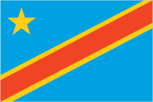
sky blue field divided diagonally from the lower hoist corner to upper fly corner by a red stripe bordered by two narrow yellow stripes; a yellow, five-pointed star appears in the upper hoist corner; blue represents peace and hope, red the blood of the country's martyrs, and yellow the country's wealth and prosperity; the star symbolizes unity and the brilliant future for the country
Government type
republic
Independence
30 June 1960 (from Belgium)
International law organization participation
accepts compulsory ICJ jurisdiction with reservations; accepts ICCt jurisdiction
International organization participation
ACP, AfDB, AU, CEMAC, CEPGL, COMESA, EITI (compliant country), FAO, G-24, G-77, IAEA, IBRD, ICAO, ICC (NGOs), ICCt, ICRM, IDA, IFAD, IFC, IFRCS, IHO, ILO, IMF, IMO, Interpol, IOC, IOM, IPU, ISO, ITSO, ITU, ITUC (NGOs), MIGA, NAM, OIF, OPCW, PCA, SADC, UN, UNCTAD, UNESCO, UNHCR, UNIDO, UNWTO, UPU, WCO, WFTU (NGOs), WHO, WIPO, WMO, WTO
Judicial branch
- highest court(s)
- Supreme Court of Justice (organized into legislative and judiciary sections and consists of 26 justices); Constitutional Court (consists of 9 judges)
- judge selection and term of office
- Supreme Court of Justice judges nominated by the Judicial Service Council, an independent body of public prosecutors and selected judges of the lower courts; judges tenure NA; Constitutional Court judges - 3 nominated by the president, 3 by the Judicial Service Council, and 3 by the legislature; judges appointed by the president to serve 9-year non-renewable terms
- subordinate courts
- State Security Court; Court of Appeals (organized into administrative and judiciary sections); Tribunal de Grande; magistrates' courts; customary courts
Legal system
civil law system primarily based on Belgian law, but also customary, and tribal law
Legislative branch
- description
- bicameral Parliament or Parlament consists of the Senate (108 seats; members indirectly elected by provincial assemblies by proportional representation vote; members serve 5-year terms) and the National Assembly (500 seats; 439 members directly elected in multi-seat constituencies by proportional representation vote and 61 directly elected in single-seat constituencies by simple majority vote; members serve 5-year terms)
- election results
- Senate - percent of vote by party - NA; seats by party - PPRD 22, MLC 14, FR 7, RCD 7, PDC 6, CDC 3, MSR 3, PALU 2, independent 26, other 18; National Assembly - percent of vote by party - NA; seats by party - PPRD 62, UDPS 41, PPPD 29, MSR 27, MLC 22, PALU 19, UNC 17, ARC 16, AFDC 15, ECT 11, RRC 11, independent 16, other 214 (includes numerous political parties that won 10 or fewer seats and 2 constituencies where voting was halted); note - the November 2011 election was marred by violence including the destruction of ballots in two constituencies resulting in the closure of polling sites; election results were delayed three months, strongly contested, and continue to be unresolved
- elections
- Senate - last held on 19 January 2007 (follow-on elections have been delayed); National Assembly - last held on 28 November 2011 (next to be held in 2016)
National anthem
- lyrics/music
- Joseph LUTUMBA/Simon-Pierre BOKA di Mpasi Londi
- name
- "Debout Congolaise" (Arise Congolese)
- note
- adopted 1960; replaced when the country was known as Zaire; but readopted in 1997
National holiday
Independence Day, 30 June (1960)
National symbol(s)
leopard; national colors: sky blue, red, yellow
Political parties and leaders
- Christian Democrat Party or PDC [Jose ENDUNDO]
- Congolese Rally for Democracy or RCD [Azarias RUBERWA]
- Convention of Christian Democrats or CDC
- Forces of Renewal or FR [Mbusa NYAMWISI]
- Movement for the Liberation of the Congo or MLC [Jean-Pierre BEMBA]
- People's Party for Reconstruction and Democracy or PPRD [Henri MOVA]
- Social Movement for Renewal or MSR [Pierre LUMBI]
- Unified Lumumbist Party or PALU [Antoine GIZENGA]
- Union for the Congolese Nation or UNC [Vital KAMERHE]
- Union for Democracy and Social Progress or UDPS [Etienne TSHISEKEDI]
Political pressure groups and leaders
- Allied Democratic Forces or ADF (anti-Ugandan government rebel groups]
- Forces Arm?es de la R?publique D?mocratique du Congor (Army of the Democratic Republic of the Congo) or FARDC
- Forces Democratiques de Liberation du Rwanda or FDLR (Rwandan militia group made up of some of the perpetrators of Rwanda's genocide in 1994)
Suffrage
18 years of age; universal and compulsory
Economy
Agriculture - products
coffee, sugar, palm oil, rubber, tea, cotton, cocoa, quinine, cassava (manioc, tapioca), bananas, plantains, peanuts, root crops, corn, fruits; wood products
Budget
- expenditures
- $6.385 billion (2014 est.)
- revenues
- $5.806 billion
Budget surplus (+) or deficit (-)
-1.6% of GDP (2014 est.)
Central bank discount rate
- 4% (31 December 2012)
- 20% (31 December 2011)
Commercial bank prime lending rate
- 18.69% (31 December 2014 est.)
- 19.38% (31 December 2013 est.)
Current account balance
- -$3.291 billion (2014 est.)
- -$3.479 billion (2013 est.)
Debt - external
- $6.562 billion (31 December 2014 est.)
- $6.082 billion (31 December 2013 est.)
Economy - overview
The economy of the Democratic Republic of the Congo - a nation endowed with vast natural resource wealth - is slowly recovering after decades of decline. Systemic corruption since independence in 1960, combined with countrywide instability and conflict that began in the mid-90s has dramatically reduced national output and government revenue and increased external debt. With the installation of a transitional government in 2003 after peace accords, economic conditions slowly began to improve as the transitional government reopened relations with international financial institutions and international donors, and President KABILA began implementing reforms. Progress has been slow to reach the interior of the country although clear changes are evident in Kinshasa and Lubumbashi. Renewed activity in the mining sector, the source of most export income, has boosted Kinshasa's fiscal position and GDP growth in recent years. An uncertain legal framework, corruption, and a lack of transparency in government policy are long-term problems for the large mining sector and for the economy as a whole. Much economic activity still occurs in the informal sector and is not reflected in GDP data. The DRC signed a Poverty Reduction and Growth Facility with the IMF in 2009 and received $12 billion in multilateral and bilateral debt relief in 2010, but the IMF at the end of 2012 suspended the last three payments under the loan facility - worth $240 million - because of concerns about the lack of transparency in mining contracts. In 2012, the DRC updated its business laws by adhering to OHADA, the Organization for the Harmonization of Business Law in Africa. The country marked its twelfth consecutive year of positive economic expansion in 2014.
Exchange rates
- Congolese francs (CDF) per US dollar -
- 925.23 (2014 est.)
- 925.23 (2013 est.)
- 920.25 (2012 est.)
- 899 (2011 est.)
- 905.91 (2010 est.)
Exports
- $12.98 billion (2014 est.)
- $11.61 billion (2013 est.)
Exports - commodities
diamonds, copper, gold, cobalt, wood products, crude oil, coffee
Exports - partners
China 39.3%, Zambia 24.7%, Italy 8.6%, Belgium 4.4% (2014)
Fiscal year
calendar year
GDP - composition, by end use
- (2014 est.)
- exports of goods and services
- 33.3%
- government consumption
- 13.3%
- household consumption
- 71.7%
- imports of goods and services
- -38.9%
- investment in fixed capital
- 21.4%
- investment in inventories
- -1%
GDP - composition, by sector of origin
- agriculture
- 21.2%
- industry
- 33.2%
- services
- 45.7% (2014 est.)
GDP - per capita (PPP)
- $700 (2014 est.)
- $700 (2013 est.)
- $600 (2012 est.)
- note
- data are in 2014 US dollars
GDP - real growth rate
- 9.2% (2014 est.)
- 8.5% (2013 est.)
- 7.1% (2012 est.)
GDP (official exchange rate)
$35.92 billion (2014 est.)
GDP (purchasing power parity)
- $57.78 billion (2014 est.)
- $52.92 billion (2013 est.)
- $48.78 billion (2012 est.)
- note
- data are in 2014 US dollars
Gross national saving
- 6.1% of GDP (2014 est.)
- 4.7% of GDP (2013 est.)
- 5.8% of GDP (2012 est.)
Household income or consumption by percentage share
- highest 10%
- 34.7% (2006)
- lowest 10%
- 2.3%
Imports
- $11.98 billion (2014 est.)
- $10.81 billion (2013 est.)
Imports - commodities
foodstuffs, mining and other machinery, transport equipment, fuels
Imports - partners
China 19.6%, South Africa 17.9%, Zambia 15.9%, Belgium 6.1%, Zimbabwe 4.9% (2014)
Industrial production growth rate
9.2% (2014 est.)
Industries
mining (copper, cobalt, gold, diamonds, coltan, zinc, tin, tungsten), mineral processing, consumer products (textiles, plastics, footwear, cigarettes), metal products, processed foods and beverages, timber, cement, commercial ship repair
Inflation rate (consumer prices)
- 1% (2014 est.)
- 0.8% (2013 est.)
Labor force
27.61 million (2014 est.)
Labor force - by occupation
- agriculture
- NA%
- industry
- NA%
- services
- NA%
Market value of publicly traded shares
$NA
Population below poverty line
63% (2012 est.)
Public debt
- 21.5% of GDP (2014 est.)
- 21.1% of GDP (2013 est.)
Reserves of foreign exchange and gold
- $1.443 billion (31 December 2015 est.)
- $1.557 billion (31 December 2014 est.)
Stock of broad money
- $4.402 billion (31 December 2014 est.)
- $3.774 billion (31 December 2013 est.)
Stock of domestic credit
- $2.607 billion (31 December 2014 est.)
- $2.212 billion (31 December 2013 est.)
Stock of narrow money
- $1.284 billion (31 December 2014 est.)
- $1.137 billion (31 December 2013 est.)
Taxes and other revenues
16.2% of GDP (2014 est.)
Unemployment rate
NA%
Energy
Carbon dioxide emissions from consumption of energy
2.481 million Mt (2012 est.)
Crude oil - exports
20,000 bbl/day (2012 est.)
Crude oil - imports
0 bbl/day (2012 est.)
Crude oil - production
20,000 bbl/day (2014 est.)
Crude oil - proved reserves
180 million bbl (1 January 2015 est.)
Electricity - consumption
7.292 billion kWh (2012 est.)
Electricity - exports
0 kWh (2012 est.)
Electricity - from fossil fuels
1.4% of total installed capacity (2012 est.)
Electricity - from hydroelectric plants
98.6% of total installed capacity (2012 est.)
Electricity - from nuclear fuels
0% of total installed capacity (2012 est.)
Electricity - from other renewable sources
0% of total installed capacity (2012 est.)
Electricity - imports
0 kWh (2012 est.)
Electricity - installed generating capacity
2.506 million kW (2012 est.)
Electricity - production
7.885 billion kWh (2012 est.)
Natural gas - consumption
0 cu m (2013 est.)
Natural gas - exports
0 cu m (2013 est.)
Natural gas - imports
0 cu m (2013 est.)
Natural gas - production
0 cu m (2013 est.)
Natural gas - proved reserves
991.1 million cu m (1 January 2014 est.)
Refined petroleum products - consumption
20,000 bbl/day (2013 est.)
Refined petroleum products - exports
0 bbl/day (2012 est.)
Refined petroleum products - imports
20,620 bbl/day (2012 est.)
Refined petroleum products - production
0 bbl/day (2012 est.)
Communications
Broadcast media
state-owned TV broadcast station with near national coverage; more than a dozen privately owned TV stations - 2 with near national coverage; 2 state-owned radio stations are supplemented by more than 100 private radio stations; transmissions of at least 2 international broadcasters are available (2007)
Internet country code
.cd
Internet users
- percent of population
- less than 1% (2008)
- total
- 290,000
Radio broadcast stations
AM 3, FM 11, shortwave 2 (2001)
Telephone system
- domestic
- state-owned operator providing less than 1 fixed-line connection per 100 persons; given the backdrop of a wholly inadequate fixed-line infrastructure, the use of mobile-cellular services has surged and mobile teledensity is roughly 20 per 100 persons
- general assessment
- barely adequate wire and microwave radio relay service in and between urban areas; domestic satellite system with 14 earth stations; inadequate fixed-line infrastructure
- international
- country code - 243; satellite earth station - 1 Intelsat (Atlantic Ocean) (2011)
Telephones - fixed lines
- subscriptions per 100 inhabitants
- less than 1 (2014 est.)
- total subscriptions
- 0
Telephones - mobile cellular
- subscriptions per 100 inhabitants
- 48 (2014 est.)
- total
- 37.1 million
Television broadcast stations
4 (2001)
Transportation
Airports
198 (2013)
Airports - with paved runways
- 1,524 to 2,437 m
- 17
- 2,438 to 3,047 m
- 3
- 914 to 1,523 m
- 2
- over 3,047 m
- 3
- total
- 26
- under 914 m
- 1 (2013)
Airports - with unpaved runways
- 65 (2013)
- 1,524 to 2,437 m
- 20
- 914 to 1,523 m
- 87
- total
- 172
Heliports
1 (2013)
Merchant marine
- by type
- petroleum tanker 1
- foreign-owned
- 1 (Republic of the Congo 1) (2010)
- total
- 1
Pipelines
gas 62 km; oil 77 km; refined products 756 km (2013)
Ports and terminals
- major seaport(s)
- Banana
- river or lake port(s)
- Boma, Bumba, Kinshasa, Kisangani, Matadi, Mbandaka (Congo); Kindu (Lualaba); Bukavu, Goma (Lake Kivu); Kalemie (Lake Tanganyika)
Railways
- narrow gauge
- 3,882 km 1.067-m gauge (858 km electrified); 125 km 1.000-m gauge (2014)
- total
- 4,007 km
Roadways
- paved
- 2,794 km
- total
- 153,497 km
- unpaved
- 150,703 km (2004)
Waterways
15,000 km (including the Congo, its tributaries, and unconnected lakes) (2011)
Military and Security
Manpower available for military service
- males age 16-49
- 15,980,106 (2010 est.)
Manpower fit for military service
- females age 16-49
- 10,331,693 (2010 est.)
- males age 16-49
- 10,168,258
Manpower reaching militarily significant age annually
- female
- 871,880 (2010 est.)
- male
- 877,684
Military branches
Armed Forces of the Democratic Republic of the Congo (Forces d'Armees de la Republique Democratique du Congo, FARDC): Army, National Navy (La Marine Nationale), Congolese Air Force (Force Aerienne Congolaise, FAC) (2011)
Military expenditures
- 1.72% of GDP (2012)
- 1.53% of GDP (2011)
- 1.72% of GDP (2010)
Military service age and obligation
18-45 years of age for voluntary and compulsory military service (2012)
Transnational Issues
Disputes - international
heads of the Great Lakes states and UN pledged in 2004 to abate tribal, rebel, and militia fighting in the region, including northeast Congo, where the UN Organization Mission in the Democratic Republic of the Congo (MONUC), organized in 1999, maintains over 16,500 uniformed peacekeepers; members of Uganda's Lords Resistance Army forces continue to seek refuge in Congo's Garamba National Park as peace talks with the Uganda government evolve; the location of the boundary in the broad Congo River with the Republic of the Congo is indefinite except in the Pool Malebo/Stanley Pool area; Uganda and DRC dispute Rukwanzi Island in Lake Albert and other areas on the Semliki River with hydrocarbon potential; boundary commission continues discussions over Congolese-administered triangle of land on the right bank of the Lunkinda River claimed by Zambia near the DRC village of Pweto; DRC accuses Angola of shifting monuments
Illicit drugs
one of Africa's biggest producers of cannabis, but mostly for domestic consumption; traffickers exploit lax shipping controls to transit pseudoephedrine through the capital; while rampant corruption and inadequate supervision leave the banking system vulnerable to money laundering, the lack of a well-developed financial system limits the country's utility as a money-laundering center (2008)
Refugees and internally displaced persons
- IDPs
- 1,491,769 (fighting between government forces and rebels since mid-1990s; most IDPs are in eastern provinces) (2015)
- refugees (country of origin)
- 38,028 (Rwanda) (2014); 98,281 (Central African Republic); 27,699 (Burundi) (2015)
Trafficking in persons
- current situation
- The Democratic Republic of the Congo is a source, destination, and possibly a transit country for men, women, and children subjected to forced labor and sex trafficking; the majority of this trafficking is internal, and much of it is perpetrated by armed groups and rogue government forces outside official control in the country's unstable eastern provinces; Congolese adults are subjected to forced labor, including debt bondage, in unlicensed mines, and women may be forced into prostitution; Congolese women and girls are subjected to forced marriages where they are vulnerable to domestic servitude or sex trafficking, while children are forced to work in agriculture, mining, mineral smuggling, vending, portering, and begging; Congolese women and children migrate to countries in Africa, the Middle East, and Europe where some are subjected to forced prostitution, domestic servitude, and forced labor in agriculture and diamond mining; indigenous and foreign armed groups, including the Lord’s Resistance Army, abduct and forcibly recruit Congolese adults and children to serve as laborers, porters, domestics, combatants, and sex slaves; some elements of the Congolese national army (FARDC) also forced adults to carry supplies, equipment, and looted goods, but no cases of the FARDC recruiting child soldiers were reported in 2014 – a significant change
- tier rating
- Tier 2 Watch List - The Democratic Republic of the Congo does not fully comply with the minimum standards for the elimination of trafficking; however, it is making significant efforts to do so; the government took significant steps to hold military and police officials complicit in human trafficking accountable with convictions for sex slavery and arrests of armed group commanders for the recruitment and use of child soldiers; the government appears to have ceased the recruitment of child soldiers through the implementation of a UN-backed action plan; little effort was made to address labor and sex trafficking crimes committed by persons other than officials, or to identify the victims, or to provide or refer the victims to care services; awareness of various forms of trafficking is limited among law enforcement personnel and training and resources are inadequate to conduct investigations (2015)