2006 Edition
CIA World Factbook 2006 (Project Gutenberg)
Introduction
Administrative divisions
10 provinces (provinces, singular - province) and 1 city* (ville); Bandundu, Bas-Congo, Equateur, Kasai-Occidental, Kasai-Oriental, Katanga, Kinshasa*, Maniema, Nord-Kivu, Orientale, Sud-Kivu
Age structure
0-14 years: 47.4% (male 14,906,488/female 14,798,210) 15-64 years: 50.1% (male 15,597,353/female 15,793,350) 65 years and over: 2.5% (male 632,143/female 933,007) (2006 est.)
Area
- land
- 2,267,600 sq km
- total
- 2,345,410 sq km
- water
- 77,810 sq km
Area - comparative
slightly less than one-fourth the size of the US
Background
Established as a Belgian colony in 1908, the Republic of the Congo gained its independence in 1960, but its early years were marred by political and social instability. Col. Joseph MOBUTU seized power and declared himself president in a November 1965 coup. He subsequently changed his name - to MOBUTU Sese Seko - as well as that of the country - to Zaire. MOBUTU retained his position for 32 years through several subsequent sham elections, as well as through the use of brutal force. Ethnic strife and civil war, touched off by a massive inflow of refugees in 1994 from fighting in Rwanda and Burundi, led in May 1997 to the toppling of the MOBUTU regime by a rebellion led by Laurent KABILA. He renamed the country the Democratic Republic of the Congo (DRC), but in August 1998 his regime was itself challenged by an insurrection backed by Rwanda and Uganda. Troops from Angola, Chad, Namibia, Sudan, and Zimbabwe intervened to support the Kinshasa regime. A cease-fire was signed in July 1999 by the DRC, Congolese armed rebel groups, Angola, Namibia, Rwanda, Uganda, and Zimbabwe but sporadic fighting continued. Laurent KABILA was assassinated in January 2001 and his son, Joseph KABILA, was named head of state. In October 2002, the new president was successful in negotiating the withdrawal of Rwandan forces occupying eastern Congo; two months later, the Pretoria Accord was signed by all remaining warring parties to end the fighting and establish a government of national unity. A transitional government was set up in July 2003; Joseph KABILA remains as president and is joined by four vice presidents representing the former government, former rebel groups, and the political opposition. The transitional government held a successful constitutional referendum in December 2005, and plans to hold a series of elections in 2006 to determine the presidency and National Assembly seats. Geography Congo, Democratic Republic of the
Birth rate
43.69 births/1,000 population (2006 est.)
Capital
- geographic coordinates
- 4 18 S, 15 18 E
- name
- Kinshasa
- time difference
- UTC+1 (six hours ahead of Washington, DC during Standard Time)
Climate
tropical; hot and humid in equatorial river basin; cooler and drier in southern highlands; cooler and wetter in eastern highlands; north of Equator - wet season (April to October), dry season (December to February); south of Equator - wet season (November to March), dry season (April to October)
Coastline
37 km
Constitution
18 February 2006
Country name
- abbreviation
- DRC
- conventional long form
- Democratic Republic of the Congo
- conventional short form
- none
- former
- Congo Free State, Belgian Congo, Congo/Leopoldville, Congo/Kinshasa, Zaire
- local long form
- Republique Democratique du Congo
- local short form
- none
Death rate
13.27 deaths/1,000 population (2006 est.)
Elevation extremes
- highest point
- Pic Marguerite on Mont Ngaliema (Mount Stanley) 5,110 m
- lowest point
- Atlantic Ocean 0 m
Environment - current issues
poaching threatens wildlife populations; water pollution; deforestation; refugees responsible for significant deforestation, soil erosion, and wildlife poaching; mining of minerals (coltan - a mineral used in creating capacitors, diamonds, and gold) causing environmental damage
Environment - international agreements
- party to
- Biodiversity, Climate Change, Desertification, Endangered Species, Hazardous Wastes, Law of the Sea, Marine Dumping, Ozone Layer Protection, Tropical Timber 83, Tropical Timber 94, Wetlands
- signed, but not ratified
- Environmental Modification
Ethnic groups
over 200 African ethnic groups of which the majority are Bantu; the four largest tribes - Mongo, Luba, Kongo (all Bantu), and the Mangbetu-Azande (Hamitic) make up about 45% of the population
Executive branch
- chief of state
- President Joseph KABILA (since 26 January 2001); note - following the assassination of his father, Laurent Desire KABILA, on 16 January 2001, Joseph KABILA succeeded to the presidency; the president is both the chief of state and head of
Geographic coordinates
0 00 N, 25 00 E
Geography - note
straddles equator; has very narrow strip of land that controls the lower Congo River and is only outlet to South Atlantic Ocean; dense tropical rain forest in central river basin and eastern highlands People Congo, Democratic Republic of the
Government type
transitional government
HIV/AIDS - adult prevalence rate
4.2% (2003 est.)
HIV/AIDS - deaths
100,000 (2003 est.)
HIV/AIDS - people living with HIV/AIDS
1.1 million (2003 est.)
Independence
30 June 1960 (from Belgium)
Infant mortality rate
- female
- 80.1 deaths/1,000 live births (2006 est.)
- male
- 96.9 deaths/1,000 live births
- total
- 88.62 deaths/1,000 live births
Irrigated land
110 sq km (2003)
Land boundaries
- border countries
- Angola 2,511 km (of which 225 km is the boundary of Angola's discontiguous Cabinda Province), Burundi 233 km, Central African Republic 1,577 km, Republic of the Congo 2,410 km, Rwanda 217 km, Sudan 628 km, Tanzania 459 km, Uganda 765 km, Zambia 1,930 km
- total
- 10,730 km
Land use
- arable land
- 2.86%
- other
- 96.67% (2005)
- permanent crops
- 0.47%
Languages
French (official), Lingala (a lingua franca trade language), Kingwana (a dialect of Kiswahili or Swahili), Kikongo, Tshiluba
Legal system
a new constitution was adopted by referendum 18 December 2005; accepts compulsory ICJ jurisdiction, with reservations
Life expectancy at birth
- female
- 52.94 years (2006 est.)
- male
- 50.01 years
- total population
- 51.46 years
Literacy
- definition
- age 15 and over can read and write French, Lingala, Kingwana, or Tshiluba
- female
- 55.1% (2003 est.) Government Congo, Democratic Republic of the
- male
- 76.2%
- total population
- 65.5%
Location
Central Africa, northeast of Angola
Major infectious diseases
- degree of risk
- very high
- food or waterborne diseases
- bacterial and protozoal diarrhea, hepatitis A, and typhoid fever
- vectorborne diseases
- malaria, plague, and African trypanosomiasis (sleeping sickness) are high risks in some locations
- water contact disease
- schistosomiasis (2005)
Map references
Africa
Maritime claims
- exclusive economic zone
- boundaries with neighbors
- territorial sea
- 12 nm
Median age
- female
- 16.4 years (2006 est.)
- male
- 16 years
- total
- 16.2 years
National holiday
Independence Day, 30 June (1960)
Nationality
- adjective
- Congolese or Congo
- noun
- Congolese (singular and plural)
Natural hazards
periodic droughts in south; Congo River floods (seasonal); in the east, in the Great Rift Valley, there are active volcanoes
Natural resources
cobalt, copper, niobium, tantalum, petroleum, industrial and gem diamonds, gold, silver, zinc, manganese, tin, uranium, coal, hydropower, timber
Net migration rate
- 0.23 migrant(s)/1,000 population
- note
- fighting between the Congolese Government and Uganda- and Rwanda-backed Congolese rebels spawned a regional war in DRC in August 1998, which left 2.33 million Congolese internally displaced and caused 412,000 Congolese refugees to flee to surrounding countries (2006 est.)
Population
- 62,660,551
- note
- estimates for this country explicitly take into account the effects of excess mortality due to AIDS; this can result in lower life expectancy, higher infant mortality and death rates, lower population and growth rates, and changes in the distribution of population by age and sex than would otherwise be expected (July 2006 est.)
Population growth rate
3.07% (2006 est.)
Religions
Roman Catholic 50%, Protestant 20%, Kimbanguist 10%, Muslim 10%, other syncretic sects and indigenous beliefs 10%
Sex ratio
- at birth
- 1.03 male(s)/female
- total population
- 0.99 male(s)/female (2006 est.)
- under 15 years
- 1.01 male(s)/female 15-64 years: 0.99 male(s)/female 65 years and over: 0.68 male(s)/female
Suffrage
18 years of age; universal and compulsory
Terrain
vast central basin is a low-lying plateau; mountains in east
Total fertility rate
6.45 children born/woman (2006 est.)
Government
Agriculture - products
coffee, sugar, palm oil, rubber, tea, quinine, cassava (tapioca), palm oil, bananas, root crops, corn, fruits; wood products
Airports
234 (2006)
Airports - with paved runways
- over 3,047 m
- 4 2,438 to 3,047 m: 2 1,524 to 2,437 m: 16 914 to 1,523 m: 2
- total
- 25
- under 914 m
- 1 (2006)
Airports - with unpaved runways
- total
- 209 1,524 to 2,437 m: 18 914 to 1,523 m: 94
- under 914 m
- 97 (2006)
Budget
- expenditures
- $750 million; including capital expenditures of $24 million (2004 est.)
- revenues
- $700 million
Currency (code)
Congolese franc (CDF)
Currency code
CDF
Debt - external
$10.6 billion (2003 est.)
Diplomatic representation from the US
- chief of mission
- Ambassador Roger MEECE
- embassy
- 310 Avenue des Aviateurs, Kinshasa
- mailing address
- Unit 31550, APO AE 09828
- telephone
- [243] (88) 43608
Diplomatic representation in the US
- chancery
- 1800 New Hampshire Avenue NW, Washington, DC 20009: note - Consular Office at 1726 M Street, NW, Washington, DC, 20036
- chief of mission
- Ambassador Faida MITIFU
- telephone
- [1] (202) 234-7690, 7691
Disputes - international
heads of the Great Lakes states and UN pledge to end conflict but unchecked tribal, rebel, and militia fighting continues unabated in the northeastern region of the Democratic Republic of the Congo, drawing in the neighboring states of Burundi, Rwanda and Uganda; the UN Organization Mission in the Democratic Republic of the Congo (MONUC) has maintained over 14,000 peacekeepers in the region since 1999; thousands of Ituri refugees from the Congo continue to flee the fighting primarily into Uganda; 90,000 Angolan refugees were repatriated by 2004 with the remainder in the DRC expected to return in 2005; in 2005, DRC and Rwanda established a border verification mechanism to address accusations of Rwandan military supporting Congolese rebels and the DRC providing rebel Rwandan "Interhamwe" forces the means and bases to attack Rwandan forces; the location of the boundary in the broad Congo River with the Republic of the Congo is indefinite except in the Pool Malebo/Stanley Pool area
Economic aid - recipient
$2.2 billion (FY03/04)
Economy - overview
The economy of the Democratic Republic of the Congo - a nation endowed with vast potential wealth - has declined drastically since the mid-1980s. The war, which began in August 1998, dramatically reduced national output and government revenue, increased external debt, and resulted in the deaths of perhaps 3.5 million people from violence, famine, and disease. Foreign businesses curtailed operations due to uncertainty about the outcome of the conflict, lack of infrastructure, and the difficult operating environment. Conditions improved in late 2002 with the withdrawal of a large portion of the invading foreign troops. The transitional government has reopened relations with international financial institutions and international donors, and President KABILA has begun implementing reforms. Much economic activity lies outside the GDP data. Economic stability improved in 2003-05, although an uncertain legal framework, corruption, and a lack of openness in government policy continues to hamper growth. In 2005, renewed activity in the mining sector, the source of most exports, boosted Kinshasa's fiscal position and GDP growth. Business and economic prospects are expected to improve once a new government is installed after elections.
Electricity - consumption
4.324 billion kWh (2003)
Electricity - exports
1.3 billion kWh (2003)
Electricity - imports
10 million kWh (2003)
Electricity - production
6.036 billion kWh (2003)
Electricity - production by source
- fossil fuel
- 1.8%
- hydro
- 98.2%
- nuclear
- 0%
- other
- 0% (2001)
Exchange rates
Congolese francs per US dollar - 437.86 (2005), 401.04 (2004), 405.34 (2003), 346.49 (2002), 206.62 (2001)
Exports
$1.108 billion f.o.b. (2004 est.)
Exports - commodities
diamonds, copper, crude oil, coffee, cobalt
Exports - partners
Belgium 38.2%, US 17.9%, China 11.7%, France 8%, Finland 7.8%, Chile 4.3% (2005)
FAX
- [1] (202) 234-2609
- [243] (88) 43467
Fiscal year
calendar year Communications Congo, Democratic Republic of the
Flag description
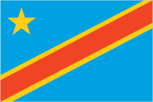
sky blue field divided diagonally from the lower hoist corner to upper fly corner by a red stripe bordered by two narrow yellow stripes; a yellow, five-pointed star appears in the upper hoist corner Economy Congo, Democratic Republic of the
GDP - composition by sector
- agriculture
- 55%
- industry
- 11%
- services
- 34% (2000 est.)
GDP - per capita (PPP)
$700 (2005 est.)
GDP - real growth rate
7.1% (2005 est.)
GDP (official exchange rate)
$7.328 billion (2005 est.)
GDP (purchasing power parity)
$40.67 billion (2005 est.)
Household income or consumption by percentage share
- highest 10%
- NA%
- lowest 10%
- NA%
IDPs
2.33 million (fighting between government forces and rebels since mid-1990s; most IDPs are in eastern provinces) (2005)
Illicit drugs
illicit producer of cannabis, mostly for domestic consumption; while rampant corruption and inadequate supervision leaves the banking system vulnerable to money laundering, the lack of a well-developed financial system limits the country's utility as a money-laundering center This page was last updated on 19 December, 2006
Imports
$1.319 billion f.o.b. (2004 est.)
Imports - commodities
foodstuffs, mining and other machinery, transport equipment, fuels
Imports - partners
South Africa 16.5%, Belgium 16.1%, France 9.1%, Zambia 6.9%, Kenya 5.7%, Germany 4.6%, US 4.5%, Cote d'Ivoire 4.3%, Netherlands 4.1% (2005)
Industrial production growth rate
NA%
Industries
mining (diamonds, copper, zinc), mineral processing, consumer products (including textiles, footwear, cigarettes, processed foods and beverages), cement, commercial ship repair
Inflation rate (consumer prices)
9% (2004 est.)
International organization participation
ACCT, ACP, AfDB, AU, CEPGL, COMESA, FAO, G-24, G-77, IAEA, IBRD, ICAO, ICCt, ICFTU, ICRM, IDA, IFAD, IFC, IFRCS, IHO (suspended), ILO, IMF, IMO, Interpol, IOC, IOM, IPU, ISO, ITU, MIGA, NAM, OIF, OPCW, PCA, SADC, UN, UNCTAD, UNESCO, UNHCR, UNIDO, UPU, WCL, WCO, WFTU, WHO, WIPO, WMO, WToO, WTO
Internet country code
.cd
Internet hosts
1,778 (2006)
Internet Service Providers (ISPs)
1 (2001)
Internet users
140,600 (2005) Transportation Congo, Democratic Republic of the
Judicial branch
Supreme Court or Cour Supreme
Labor force
14.51 million
Labor force - by occupation
- agriculture
- NA%
- industry
- NA%
- services
- NA%
Legislative branch
- bicameral legislature consists of a National Assembly (500 seats; 60 elected by majority vote and 440 by open list proportional representation; members serve 5-year terms) and a Senate (120 seats; members elected by indirect vote to serve 5-year terms)
- elections
- NA; members of the National Assembly were appointed by leaders in the factions integrated into the new government; elections scheduled for 30 July 2006 will establish a new legislature under the February 2006 constitution
Manpower available for military service
- males age 18-49
- 11,365,610 (2005 est.)
Manpower fit for military service
- males age 18-49
- 6,464,223 (2005 est.)
Merchant marine
- by type
- petroleum tanker 1
- foreign-owned
- 1 (Congo, Republic of the 1) (2006)
- total
- 1 ship (1000 GRT or over) 1,004 GRT/1,640 DWT
Military branches
Army, Navy, Air Force
Military expenditures - dollar figure
$103.7 million (2005 est.)
Military expenditures - percent of GDP
1.5% (2005 est.) Transnational Issues Congo, Democratic Republic of the
Military service age and obligation
18-45 years of age for military service
Natural gas - consumption
0 cu m (2003 est.)
Natural gas - production
0 cu m (2003 est.)
Natural gas - proved reserves
991.1 million cu m (1 January 2002)
Oil - consumption
8,300 bbl/day (2003 est.)
Oil - exports
NA bbl/day
Oil - imports
NA bbl/day
Oil - production
22,000 bbl/day (2003)
Oil - proved reserves
1.538 billion bbl (1 January 2002)
Pipelines
gas 54 km; oil 78 km (2006)
Political parties and leaders
Democratic Social Christian Party or PDSC [Andre BO-BOLIKO]; Forces for Renovation for Union and Solidarity or FONUS [Joseph OLENGHANKOY]; National Congolese Lumumbist Movement or MNC [Francois LUMUMBA]; Popular Movement of the Revolution or MPR (three factions: MPR-Fait Prive [Catherine NZUZI wa Mbombo]; MPR/Vunduawe [Felix VUNDUAWE]; MPR/Mananga [MANANGA Dintoka Mpholo]); Unified Lumumbast Party or PALU [Antoine GIZENGA]; Union for Democracy and Social Progress or UDPS [Etienne TSHISEKEDI wa Mulumba]; Union of Federalists and Independent Republicans or UFERI (two factions: UFERI [Lokambo OMOKOKO]; UFERI/OR [Adolph Kishwe MAYA])
Political pressure groups and leaders
NA
Population below poverty line
NA%
Ports and terminals
Banana, Boma, Bukavu, Bumba, Goma, Kalemie, Kindu, Kinshasa, Kisangani, Matadi, Mbandaka Military Congo, Democratic Republic of the
Radio broadcast stations
AM 3, FM 11, shortwave 2 (2001)
Radios
18.03 million (1997)
Railways
- narrow gauge
- 3,987 km 1.067-m gauge (858 km electrified); 125 km 1.000-m gauge; 1,026 km 0.600-m gauge (2005)
- total
- 5,138 km
Refugees and internally displaced persons
- refugees (country of origin)
- 5,277 (Republic of Congo) 11,816 (Rwanda) 18,953 (Uganda) 19,400 (Burundi) 45,226 (Sudan) 98,383 (Angola)
Roadways
- total
- 157,000 km (including 30 km of expressways) (1999)
Telephone system
- domestic
- barely adequate wire and microwave radio relay service in and between urban areas; domestic satellite system with 14 earth stations
- general assessment
- poor
- international
- country code - 243; satellite earth station - 1 Intelsat (Atlantic Ocean)
Telephones - main lines in use
10,600 (2005)
Telephones - mobile cellular
2.746 million (2005)
Television broadcast stations
4 (2001)
Televisions
6.478 million (1997)
Unemployment rate
NA%
Waterways
15,000 km (2005)