1998 Edition
CIA World Factbook 1998 (Internet Archive)
Geography
Area
total: 2,345,410 sq km land: 2,267,600 sq km water: 77,810 sq km
Area-comparative
slightly less than one-fourth the size of US
Climate
tropical; hot and humid in equatorial river basin; cooler and drier in southern highlands; cooler and wetter in eastern highlands; north of Equator - wet season April to October, dry season December to February; south of Equator - wet season November to March, dry season April to October
Coastline
37 km
Elevation extremes
lowest point: Atlantic Ocean 0 m highest point: Margherita Peak (Mount Stanley) 5,110 m
Environment-current issues
poaching threatens wildlife populations; water pollution; deforestation; refugees who arrived in mid-1994 were responsible for significant deforestation, soil erosion, and wildlife poaching in the eastern part of the country (most of those refugees were repatriated in November and December 1996)
Environment-international agreements
party to: Biodiversity, Climate Change, Desertification, Endangered Species, Hazardous Wastes, Law of the Sea, Marine Dumping, Nuclear Test Ban, Ozone Layer Protection, Tropical Timber 83, Tropical Timber 94, Wetlands signed, but not ratified: Environmental Modification
Geographic coordinates
0 00 N, 25 00 E
Geography-note
straddles Equator; very narrow strip of land that controls the lower Congo river and is only outlet to South Atlantic Ocean; dense tropical rain forest in central river basin and eastern highlands
Irrigated land
100 sq km (1993 est.)
Land boundaries
total: 10,271 km border countries: Angola 2,511 km, Burundi 233 km, Central African Republic 1,577 km, Republic of the Congo 2,410 km, Rwanda 217 km, Sudan 628 km, Uganda 765 km, Zambia 1,930 km
Land use
arable land: 3% permanent crops: 0% permanent pastures: 7% forests and woodland: 77% other: 13% (1993 est.)
Location
Central Africa, northeast of Angola
Map references
Africa
Maritime claims
exclusive economic zone: boundaries with neighbors territorial sea: 12 nm
Natural hazards
periodic droughts in south; volcanic activity
Natural resources
cobalt, copper, cadmium, petroleum, industrial and gem diamonds, gold, silver, zinc, manganese, tin, germanium, uranium, radium, bauxite, iron ore, coal, hydropower potential, timber
Terrain
vast central basin is a low-lying plateau; mountains in east
People and Society
Age structure
0-14 years: 48% (male 11,829,386; female 11,766,829) 15-64 years: 49% (male 11,778,121; female 12,339,837) 65 years and over: 3% (male 557,095; female 729,243) (July 1998 est.)
Birth rate
46.77 births/1,000 population (1998 est.)
Death rate
15.2 deaths/1,000 population (1998 est.)
Ethnic groups
over 200 African ethnic groups of which the majority are Bantu; the four largest tribes-Mongo, Luba, Kongo (all Bantu), and the Mangbetu-Azande (Hamitic) make up about 45% of the population
Infant mortality rate
101.6 deaths/1,000 live births (1998 est.)
Languages
French (official), Lingala (a lingua franca trade language), Kingwana (a dialect of Kiswahili or Swahili), Kikongo, Tshiluba
Life expectancy at birth
total population: 49.31 years male: 47.27 years female: 51.4 years (1998 est.)
Literacy
definition: age 15 and over can read and write in French, Lingala, Kingwana, or Tshiluba total population: 77.3% male: 86.6% female: 67.7% (1995 est.)
Nationality
noun: Congolese (singular and plural) adjective: Congolese or Congo
Net migration rate
-1.63 migrant(s)/1,000 population (1998 est.) note: in 1994, about a million refugees fled into Zaire (now called Democratic Republic of the Congo), to escape the fighting between the Hutus and the Tutsis in Rwanda and Burundi; the outbreak of widespread fighting between rebels and government forces in October 1996 spurred about 875,000 refugees to return to Rwanda in late 1996 and early 1997; additionally, Democratic Republic of the Congo is host to about 200,000 Angolan, about 110,000 Burundi, about 100,000 Sudanese, about 15,000 Ugandan, and about 18,000 Republic of the Congo refugees
Population
49,000,511 (July 1998 est.)
Population growth rate
2.99% (1998 est.)
Religions
Roman Catholic 50%, Protestant 20%, Kimbanguist 10%, Muslim 10%, other syncretic sects and traditional beliefs 10%
Sex ratio
at birth: 1.03 male(s)/female under 15 years: 1 male(s)/female 15-64 years: 0.95 male(s)/female 65 years and over: 0.76 male(s)/female (1998 est.)
Total fertility rate
6.51 children born/woman (1998 est.)
Government
Administrative divisions
10 provinces (provinces, singular-province) and one city* (ville); Bandundu, Bas-Congo, Equateur, Kasai-Occidental, Kasai-Oriental, Katanga, Kinshasa*, Maniema, Nord-Kivu, Orientale, Sud-Kivu
Constitution
24 June 1967, amended August 1974, revised 15 February 1978, amended April 1990; transitional constitution promulgated in April 1994; following successful rebellion the new government announced on 29 May 1997 a two-year time table of constitutional reform
Country name
conventional long form: Democratic Republic of the Congo conventional short form: none local long form: Republique Democratique du Congo local short form: none former: Belgian Congo, Congo/Leopoldville, Congo/Kinshasa, Zaire
Data code
CG
Executive branch
chief of state: Laurent Desire KABILA (since 17 May 1997); note-the president is both chief of state and head of government head of government: Laurent Desire KABILA (since 17 May 1997); note-the president is both chief of state and head of government cabinet: National Executive Council; KABILA's cabinet was appointed by him and has no prime minister elections: before Laurent Desire KABILA seized power, the president was elected by popular vote for a seven-year term; election last held 29 July 1984 (next was to be held in May 1997); formerly, the prime minister was elected by the High Council of the Republic; note-the term of the former government expired in 1991, elections were not held, and former president MOBUTU continued in office until his government was militarily defeated by KABILA on 17 May 1997 election results: MOBUTU Sese Seko Kuku Ngbendu wa Za Banga reelected president in 1984 without opposition note: Marshal MOBUTU Sese Seko Kuku Ngbendu wa Za Banga was president from 24 November 1965 until forced into exile on 16 May 1997 when his government was overturned militarily by Laurent Desire KABILA, who immediately assumed governing authority; in his 29 May 1997 inaugural address, President KABILA announced a two-year time table for political reform leading to elections by April 1999
FAX
- [1] (202) 686-3631 Diplomatic representation from the US: chief of mission: Ambassador Daniel H. SIMPSON embassy: 310 Avenue des Aviateurs, Kinshasa mailing address: Unit 31550, APO AE 09828 telephone: [243] (12) 21533 through 21535, 21104; [243] (88) 43604 through 43608
- [243] (88) 43805, 43467
Flag description
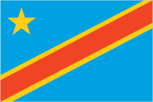
light blue with a large yellow five-pointed star in the center and a columnar arrangement of six small yellow five-pointed stars along the hoist side
Government type
dictatorship; presumably undergoing a transition to representative government
Independence
30 June 1960 (from Belgium)
International organization participation
ACCT, ACP, AfDB, CCC, CEEAC, CEPGL, ECA, FAO, G-19, G-24, G-77, IAEA, IBRD, ICAO, ICFTU, ICRM, IDA, IFAD, IFC, IFRCS, IHO, ILO, IMF, IMO, Intelsat, Interpol, IOC, ITU, NAM, OAU, PCA, UN, UNCTAD, UNESCO, UNHCR, UNIDO, UPU, WCL, WFTU, WHO, WIPO, WMO, WToO Diplomatic representation in the US: chief of mission: Charge d'Affaires ad interim Tambo A. Kabila MUKENDI chancery: 1800 New Hampshire Avenue NW, Washington, DC 20009 telephone: [1] (202) 234-7690, 7691
Judicial branch
Supreme Court (Cour Supreme) Political parties and leaders: sole legal party until January 1991-Popular Movement of the Revolution or MPR; other parties include Union for Democracy and Social Progress or UDPS [Etienne TSHISEKEDI wa Mulumba]; Democratic Social Christian Party or PDSC [Andre BO-BOLIKO]; Union of Federalists and Independent Republicans or UFERI [Gabriel KYUNGU wa Kumwunzu]; Unified Lumumbast Party or PALU [Antoine GIZENGA] note: President KABILA, who has banned political party activity indefinitely, currently leads the Alliance of Democratic Forces for the Liberation of Congo-Zaire or AFDL
Legal system
based on Belgian civil law system and tribal law; has not accepted compulsory ICJ jurisdiction
Legislative branch
legislative activity has been suspended pending the establishment of KABILA's promised constitutional reforms and the elections to be held by April 1999 elections: the country's first multi-party presidential and legislative elections had been scheduled for May 1997 but were not held; instead KABILA overthrew the MOBUTO government and seized control of the country
National capital
Kinshasa
National holiday
anniversary of independence from Belgium, 30 June (1960)
Suffrage
18 years of age; universal and compulsory
Economy
Agriculture-products
coffee, sugar, palm oil, rubber, tea, quinine, cassava (tapioca), palm oil, bananas, root crops, corn, fruits; wood products
Budget
revenues: $269 million expenditures: $244 million, including capital expenditures of $24 million (1996 est.)
Currency
1 zaire (Z) = 100 makuta
Debt-external
$13.8 billion (1995 est.)
Economic aid
recipient: ODA, $NA
Economy-overview
The economy of Democratic Republic of the Congo-a nation endowed with vast potential wealth-has declined significantly since the mid-1980s. The new government has instituted a tight fiscal policy that has curbed inflation and currency depreciation. Plans are underway to introduce a new national currency. Most formal transactions are conducted in hard currency but a barter economy flourishes in all but the largest cities. Most individuals and families survive through subsistence farming or petty trade. International investors show renewed interest, especially in the mining and telecommunications sectors. However, poor infrastructure, an uncertain legal framework, corruption and lack of transparency in government economic policy remain a brake on investment and growth. A number of IMF and World Bank missions have met with the new government to help it develop a coherent economic plan.
Electricity-capacity
2.831 million kW (1995)
Electricity-consumption per capita
95 kWh (1995)
Electricity-production
5.22 billion kWh (1995)
Exchange rates
new zaires (Z) per US$1-115,000 (January 1998), 83,764 (October 1996), 7,024 (1995), 1,194 (1994), 3 (1993) note: on 22 October 1993 the new zaire, equal to 3,000,000 old zaires, was introduced
Exports
total value: $1.9 billion (f.o.b., 1996 est.) commodities: diamonds, copper, coffee, cobalt, crude oil partners: Belgium, US, France, Germany, Italy, UK, Japan, South Africa
Fiscal year
calendar year Communications
GDP
purchasing power parity-$18 billion (1996 est.)
GDP-composition by sector
agriculture: 59% industry: 15% services: 26% (1995 est.)
GDP-per capita
purchasing power parity-$400 (1996 est.)
GDP-real growth rate
1.5% (1996 est.)
Imports
total value: $1.1 billion (c.i.f., 1996 est.) commodities: consumer goods, foodstuffs, mining and other machinery, transport equipment, fuels partners: Belgium, South Africa, US, France, Germany, Italy, Japan, UK
Industrial production growth rate
NA%
Industries
mining, mineral processing, consumer products (including textiles, footwear, cigarettes, processed foods and beverages), cement, diamonds
Inflation rate-consumer price index
NA%
Labor force
total: 14.51 million (1993 est.) by occupation: agriculture 65%, industry 16%, services 19% (1991 est.)
Radio broadcast stations
AM 10, FM 4, shortwave 0
Radios
3.87 million (1992 est.)
Telephone system
domestic: barely adequate wire and microwave radio relay service in and between urban areas; domestic satellite system with 14 earth stations international: satellite earth station-1 Intelsat (Atlantic Ocean)
Telephones
34,000 (1991 est.)
Television broadcast stations
18
Televisions
55,000 (1992 est.)
Unemployment rate
NA%
Transportation
Airports
234 (1997 est.) Airports-with paved runways: total: 24 over 3,047 m: 4 2,438 to 3,047 m: 3 1,524 to 2,437 m: 15 914 to 1,523 m: 2 (1997 est.) Airports-with unpaved runways: total: 210 1,524 to 2,437 m: 20 914 to 1,523 m: 96 under 914 m: 94 (1997 est.)
Highways
total: 145,000 km paved: 2,500 km unpaved: 142,500 km (1993 est.)
Merchant marine
none
Pipelines
petroleum products 390 km Ports and harbors: Banana, Boma, Bukavu, Bumba, Goma, Kalemie, Kindu, Kinshasa, Kisangani, Matadi, Mbandaka
Railways
total: 5,138 km (1995); note-severely reduced route-distance in use because of damage to facilities by civil strife narrow gauge: 3,987 km 1.067-m gauge (858 km electrified); 125 km 1.000-m gauge; 1,026 km 0.600-m gauge
Waterways
15,000 km including the Congo, its tributaries, and unconnected lakes
Military and Security
Military branches
Army, Navy, Air Force
Military expenditures-dollar figure
NA
Military expenditures-percent of GDP
NA
Military manpower-availability
males age 15-49: 10,543,138 (1998 est.) Military manpower-fit for military service: males: 5,366,937 (1998 est.)
Transnational Issues
Disputes-international
Democratic Republic of the Congo-Tanzania-Zambia tripoint in Lake Tanganyika may no longer be indefinite since it has been informally reported that the indefinite segment of the Democratic Republic of the Congo-Zambia boundary has been settled; long segment of the boundary with Republic of the Congo along the Congo river is indefinite (no division of the river or its islands has been made)
Illicit drugs
illicit producer of cannabis, mostly for domestic consumption