1990 Edition
CIA World Factbook 1990 (Project Gutenberg)
Geography
Climate
tropical; hot and humid in equatorial river basin; cooler and drier in southern highlands; cooler and wetter in eastern highlands; north of Equator--wet season April to October, dry season December to February; south of Equator--wet season November to March, dry season April to October
Coastline
37 km
Comparative area
slightly more than one-quarter the size of US
Disputes
Tanzania-Zaire-Zambia tripoint in Lake Tanganyika may no longer be indefinite since it is reported that the indefinite section of the Zaire-Zambia boundary has been settled; long section with Congo along the Congo River is indefinite (no division of the river or its islands has been made)
Environment
dense tropical rainforest in central river basin and eastern highlands; periodic droughts in south
Land boundaries
10,271 km total; Angola 2,511 km, Burundi 233 km, Central African Republic 1,577 km, Congo 2,410 km, Rwanda 217 km, Sudan 628 km, Uganda 765 km, Zambia 1,930 km
Land use
3% arable land; NEGL% permanent crops; 4% meadows and pastures; 78% forest and woodland; 15% other; includes NEGL% irrigated
Natural resources
cobalt, copper, cadmium, crude oil, industrial and gem diamonds, gold, silver, zinc, manganese, tin, germanium, uranium, radium, bauxite, iron ore, coal, hydropower potential
Note
straddles Equator; very narrow strip of land is only outlet to South Atlantic Ocean
Terrain
vast central basin is a low-lying plateau; mountains in east
Territorial sea
12 nm
Total area
2,345,410 km2; land area: 2,267,600 km2
People and Society
Birth rate
46 births/1,000 population (1990)
Death rate
13 deaths/1,000 population (1990)
Ethnic divisions
over 200 African ethnic groups, the majority are Bantu; four largest tribes--Mongo, Luba, Kongo (all Bantu), and the Mangbetu-Azande (Hamitic) make up about 45% of the population
Infant mortality rate
103 deaths/1,000 live births (1990)
Labor force
15,000,000; 75% agriculture, 13% industry, 12% services; 13% wage earners (1981); 51% of population of working age (1985)
Language
French (official), Lingala, Swahili, Kingwana, Kikongo, Tshiluba
Life expectancy at birth
51 years male, 55 years female (1990)
Literacy
55% males, 37% females
Nationality
noun--Zairian(s); adjective--Zairian
Net migration rate
NEGL migrants/1,000 population (1990)
Organized labor
National Union of Workers of Zaire (UNTZA) is the only trade union
Population
36,589,468 (July 1990), growth rate 3.3% (1990)
Religion
50% Roman Catholic, 20% Protestant, 10% Kimbanguist, 10% Muslim, 10% other syncretic sects and traditional beliefs
Total fertility rate
6.2 children born/woman (1990)
Government
Administrative divisions
8 regions (regions, singular--region) and 1 town* (ville); Bandundu, Bas-Zaire, Equateur, Haut-Zaire, Kasai-Occidental, Kasai-Oriental, Kinshasa*, Kivu, Shaba; note--there may now be 10 regions with the elimination of Kivu and addition of Maniema, Nord-Kivu, and Sud-Kivu
Capital
Kinshasa
Communists
no Communist party
Constitution
24 June 1967, amended August 1974, revised 15 February 1978
Diplomatic representation
Ambassador (vacant), Charge d'Affaires MUKENDI Tambo a Kabila; Chancery at 1800 New Hampshire Avenue NW, Washington DC 20009; telephone (202) 234-7690 or 7691; US--Ambassador William C. HARROP; Embassy at 310 Avenue des Aviateurs, Kinshasa (mailing address is APO New York 09662); telephone 243o (12) 25881 through 25886; there is a US Consulate General in Lubumbashi
Elections
President--last held 29 July 1984 (next to be held July 1991); results--President Mobutu was reelected without opposition; National Legislative Council--last held 6 September 1987 (next to be held September 1992); results--MPR is the only party; seats--(210 total) MPR 210
Executive branch
president, prime minister, Executive Council (cabinet)
Flag
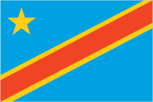
light green with a yellow disk in the center bearing a black arm holding a red flaming torch; the flames of the torch are blowing away from the hoist side; uses the popular pan-African colors of Ethiopia
Independence
30 June 1960 (from Belgium; formerly Belgian Congo, then Congo/Leopoldville, then Congo/Kinshasa)
Judicial branch
Supreme Court (Cour Supreme)
Leaders
Chief of State--President Marshal MOBUTU Sese Seko Kuku Ngbendu wa Za Banga (since 24 November 1965); Head of Government--Prime Minister LUNDA Bululu (since 25 April 1988)
Legal system
based on Belgian civil law system and tribal law; has not accepted compulsory ICJ jurisdiction
Legislative branch
unicameral National Legislative Council
Long-form name
Republic of Zaire
Member of
ACP, AfDB, APC, CCC, CIPEC, EAMA, EIB (associate), FAO, G-77, GATT, IAEA, IBRD, ICAO, ICO, IDA, IFAD, IFC, IHO, ILO, IMF, IMO, INTELSAT, INTERPOL, IPU, ITC, ITU, NAM, OAU, OCAM, UN, UNESCO, UPU, WHO, WIPO, WMO, WTO
National holiday
Anniversary of the Regime (Second Republic), 24 November (1965)
Political parties and leaders
only party--Popular Movement of the Revolution (MPR)
Suffrage
universal and compulsory at age 18
Type
republic with a strong presidential system
Economy
Agriculture
cash crops--coffee, palm oil, rubber, quinine; food crops--cassava, bananas, root crops, corn
Aid
US commitments, including Ex-Im (FY70-88), $998 million; Western (non-US) countries, ODA and OOF bilateral commitments (1970-87), $6.0 billion; OPEC bilateral aid (1979-89), $35 million; Communist countries (1970-88), $263 million
Budget
revenues $856 million; expenditures $2.3 billion, including capital expenditures of $655 million (1988)
Currency
zaire (plural--zaire); 1 zaire (Z) = 100 makuta
Electricity
2,574,000 kW capacity; 5,550 million kWh produced, 160 kWh per capita (1989)
Exchange rates
zaire (Z) per US$1--465.000 (January 1989), 381.445 (1989), 187.070 (1988), 112.403 (1987), 59.625 (1986), 49.873 (1985)
Exports
$2.2 billion (f.o.b., 1988); commodities--copper 37%, coffee 24%, diamonds 12%, cobalt, crude oil; partners--US, Belgium, France, FRG, Italy, UK, Japan
External debt
$8.6 billion (December 1989 est.)
Fiscal year
calendar year
GDP
$6.5 billion, per capita $195; real growth rate 2.8% (1988)
Illicit drugs
illicit producer of cannabis, mostly for domestic consumption
Imports
$1.9 billion (f.o.b., 1988); commodities--consumer goods, foodstuffs, mining and other machinery, transport equipment, fuels; partners--US, Belgium, France, FRG, Italy, Japan, UK
Industrial production
growth rate NA%
Industries
mining, mineral processing, consumer products (including textiles, footwear, and cigarettes), processed foods and beverages, cement, diamonds
Inflation rate (consumer prices)
82% (1988)
Overview
In 1988, in spite of large mineral resources and one of the most developed and diversified economies in Sub-Saharan Africa, Zaire had a GDP per capita of $195, one of the lowest on the continent. Agriculture, a key sector of the economy, employs 75% of the population but generates under 30% of GDP. The main impetus for economic development has been the extractive industries. Mining and mineral processing account for about one-third of GDP and two-thirds of total export earnings. During the period 1983-88 the economy experienced slow growth, high inflation, a rising foreign debt, and a drop in foreign exchange earnings. Recent increases in foreign prices for copper--a key export earner--and other minerals offer some hope of reversing the economic decline. Zaire is the world's largest producer of diamonds.
Unemployment rate
NA%
Communications
Airports
312 total, 258 usable; 25 with permanent-surface runways; 1 with runways over 3,659 m; 6 with runways 2,440-3,659 m; 71 with runways 1,220-2,439 m
Civil air
38 major transport aircraft
Highways
146,500 km total; 2,550 km bituminous, 46,450 km gravel and improved earth; remainder unimproved earth
Inland waterways
15,000 km including the Congo, its tributaries, and unconnected lakes
Merchant marine
4 ships (1,000 GRT or over) totaling 41,802 GRT/60,496 DWT; includes 1 passenger cargo, 3 cargo
Pipelines
refined products 390 km
Ports
Matadi, Boma, Banana
Railroads
5,254 km total; 3,968 km 1.067-meter gauge (851 km electrified); 125 km 1.000-meter gauge; 136 km 0.615-meter gauge; 1,025 km 0.600-meter gauge
Telecommunications
barely adequate wire and radio relay service; 31,200 telephones; stations--10 AM, 4 FM, 18 TV; satellite earth stations--1 Atlantic Ocean INTELSAT, 14 domestic
Military and Security
Branches
Army, Navy, Air Force, National Gendarmerie, Logistics Corps, Special Presidential Division
Defense expenditures
$67 million (1988)
Military manpower
males 15-49, 7,970,619; 4,057,561 fit for military service