2022 Edition
CIA World Factbook 2022 (factbook.json @ 61dadec0c9c9)
Introduction
Background
Upon independence in 1960, the former French region of Middle Congo became the Republic of the Congo. A quarter century of experimentation with Marxism was abandoned in 1990 and a democratically elected government took office in 1992. A two-year civil war that ended in 1999 restored former Marxist President Denis SASSOU-Nguesso, who had ruled from 1979 to 1992, and sparked a short period of ethnic and political unrest that was resolved by a peace agreement in late 1999. A new constitution adopted three years later provided for a multi-party system and a seven-year presidential term, and elections arranged shortly thereafter retained SASSOU-Nguesso. Following a year of renewed fighting, President SASSOU-Nguesso and southern-based rebel groups agreed to a final peace accord in March 2003. SASSOU-Nguesso was reeelected in 2009 and, after passing a referendum allowing him to run for a third term, was reelected again in 2016. The Republic of Congo is one of Africa's largest petroleum producers, but with declining production it will need new offshore oil finds to sustain its oil earnings over the long term.
Geography
Area
- land
- 341,500 sq km
- total
- 342,000 sq km
- water
- 500 sq km
Area - comparative
slightly smaller than Montana; about twice the size of Florida
Climate
tropical; rainy season (March to June); dry season (June to October); persistent high temperatures and humidity; particularly enervating climate astride the Equator
Coastline
169 km
Elevation
- highest point
- Mont Nabeba 1,020 m
- lowest point
- Atlantic Ocean 0 m
- mean elevation
- 430 m
Geographic coordinates
1 00 S, 15 00 E
Geography - note
about 70% of the population lives in Brazzaville, Pointe-Noire, or along the railroad between them
Irrigated land
20 sq km (2012)
Land boundaries
- border countries
- Angola 231 km; Cameroon 494 km; Central African Republic 487 km; Democratic Republic of the Congo 1,775 km; Gabon 2,567 km
- total
- 5,554 km
Land use
- agricultural land
- 31.1% (2018 est.)
- agricultural land: arable land
- arable land: 1.6% (2018 est.)
- agricultural land: permanent crops
- permanent crops: 0.2% (2018 est.)
- agricultural land: permanent pasture
- permanent pasture: 29.3% (2018 est.)
- forest
- 65.6% (2018 est.)
- other
- 3.3% (2018 est.)
Location
Central Africa, bordering the South Atlantic Ocean, between Angola and Gabon
Major aquifers
Congo Basin
Major rivers (by length in km)
Ubangi (shared with Central African Republic [s] and Democratic Republic of Congo [m]) - 2,270 kmnote – [s] after country name indicates river source; [m] after country name indicates river mouth
Major watersheds (area sq km)
Atlantic Ocean drainage: Congo (3,730,881 sq km)
Map references
Africa
Maritime claims
- contiguous zone
- 24 nm
- exclusive economic zone
- 200 nm
- territorial sea
- 12 nm
Natural hazards
seasonal flooding
Natural resources
petroleum, timber, potash, lead, zinc, uranium, copper, phosphates, gold, magnesium, natural gas, hydropower
Population distribution
the population is primarily located in the south, in and around the capital of Brazzaville as shown in this population distribution map
Terrain
coastal plain, southern basin, central plateau, northern basin
People and Society
Age structure
- 0-14 years
- 41.57% (male 1,110,484/female 1,089,732)
- 15-24 years
- 17.14% (male 454,981/female 452,204)
- 25-54 years
- 33.5% (male 886,743/female 886,312)
- 55-64 years
- 4.59% (male 125,207/female 117,810)
- 65 years and over
- 3.2% (male 75,921/female 93,676) (2020 est.)
Alcohol consumption per capita
- beer
- 5.11 liters of pure alcohol (2019 est.)
- other alcohols
- 0.01 liters of pure alcohol (2019 est.)
- spirits
- 0.52 liters of pure alcohol (2019 est.)
- total
- 5.74 liters of pure alcohol (2019 est.)
- wine
- 0.1 liters of pure alcohol (2019 est.)
Birth rate
31.82 births/1,000 population (2022 est.)
Child marriage
- men married by age 18
- 5.6% (2018 est.)
- women married by age 15
- 8.4%
- women married by age 18
- 29.1%
Children under the age of 5 years underweight
12.3% (2014/15)
Contraceptive prevalence rate
30.1% (2014/15)
Current health expenditure
2.1% of GDP (2019)
Death rate
8.38 deaths/1,000 population (2022 est.)
Demographic profile
The Republic of the Congo is one of the most urbanized countries in Africa, with nearly 70% of Congolese living in urban areas. The population is concentrated in the southwest of the country, mainly in the capital Brazzaville, Pointe-Noire, and along the railway line that connects the two. The tropical jungles in the north of the country are sparsely populated. Most Congolese are Bantu, and most belong to one of four main ethnic groups, the Kongo, Teke, Mbochi, and Sangha, which consist of over 70 subgroups. The Republic of Congo is in the early stages of a demographic transition, whereby a population shifts from high fertility and mortality rates to low fertility and mortality rates associated with industrialized societies. Its total fertility rate (TFR), the average number of children born per woman, remains high at 4.4. While its TFR has steadily decreased, the progress slowed beginning in about 1995. The slowdown in fertility reduction has delayed the demographic transition and Congo’s potential to reap a demographic dividend, the economic boost that can occur when the share of the working-age population is larger than the dependent age groups. The TFR differs significantly between urban and rural areas – 3.7 in urban areas versus 6.5 in rural areas. The TFR also varies among regions. The urban regions of Brazzaville and Pointe-Noire have much lower TFRs than other regions, which are predominantly or completely rural. The gap between desired fertility and actual fertility is also greatest in rural areas. Rural families may have more children to contribute to agricultural production and/or due to a lack of information about and access to contraception. Urban families may prefer to have fewer children because raising them is more expensive and balancing work and childcare may be more difficult. The number of births among teenage girls, the frequency of giving birth before the age of fifteen, and a lack of education are the most likely reasons for higher TFRs in rural areas. Although 90% of school-age children are enrolled in primary school, repetition and dropout rates are high and the quality of education is poor. Congolese women with no or little education start having children earlier and have more children in total than those with at least some secondary education.
Dependency ratios
- elderly dependency ratio
- 4.8
- potential support ratio
- 20.9 (2021 est.)
- total dependency ratio
- 78.8
- youth dependency ratio
- 74
Drinking water source
- improved: rural
- rural: 56.4% of population
- improved: total
- total: 84.2% of population
- improved: urban
- urban: 97.5% of population
- unimproved: rural
- rural: 43.6% of population
- unimproved: total
- total: 15.8% of population (2020 est.)
- unimproved: urban
- urban: 2.5% of population
Education expenditures
4.5% of GDP (2020 est.)
Ethnic groups
Kongo 40.5%, Teke 16.9%, Mbochi 13.1%, foreigner 8.2%, Sangha 5.6%, Mbere/Mbeti/Kele 4.4%, Punu 4.3%, Pygmy 1.6%, Oubanguiens 1.6%, Duma 1.5%, Makaa 1.3%, other and unspecified 1% (2014-15 est.)
HIV/AIDS - adult prevalence rate
3.8% (2021 est.)
Infant mortality rate
- female
- 43.34 deaths/1,000 live births (2022 est.)
- male
- 52.39 deaths/1,000 live births
- total
- 47.93 deaths/1,000 live births
Languages
- Languages
- French (official), French Lingala and Monokutuba (lingua franca trade languages), many local languages and dialects (of which Kikongo is the most widespread)
- major-language sample(s)
- Buku oyo ya bosembo ya Mokili Mobimba Ezali na Makanisi ya Liboso Mpenza. (Lingala)The World Factbook, the indispensable source for basic information.
Life expectancy at birth
- female
- 63.61 years (2022 est.)
- male
- 60.65 years
- total population
- 62.1 years
Literacy
- definition
- age 15 and over can read and write
- female
- 74.6% (2018)
- male
- 86.1%
- total population
- 80.3%
Major infectious diseases
- animal contact diseases
- rabies
- degree of risk
- very high (2020)
- food or waterborne diseases
- bacterial and protozoal diarrhea, hepatitis A, and typhoid fever
- note
- note: on 21 March 2022, the US Centers for Disease Control and Prevention (CDC) issued a Travel Alert for polio in Africa; the Republic of the Congo is currently considered a high risk to travelers for circulating vaccine-derived polioviruses (cVDPV); vaccine-derived poliovirus (VDPV) is a strain of the weakened poliovirus that was initially included in oral polio vaccine (OPV) and that has changed over time and behaves more like the wild or naturally occurring virus; this means it can be spread more easily to people who are unvaccinated against polio and who come in contact with the stool or respiratory secretions, such as from a sneeze, of an “infected” person who received oral polio vaccine; the CDC recommends that before any international travel, anyone unvaccinated, incompletely vaccinated, or with an unknown polio vaccination status should complete the routine polio vaccine series; before travel to any high-risk destination, the CDC recommends that adults who previously completed the full, routine polio vaccine series receive a single, lifetime booster dose of polio vaccine
- vectorborne diseases
- malaria and dengue fever
- water contact diseases
- schistosomiasis
Major urban areas - population
2.638 million BRAZZAVILLE (capital), 1.336 million Pointe-Noire (2023)
Maternal mortality ratio
378 deaths/100,000 live births (2017 est.)
Median age
- female
- 19.7 years (2020 est.)
- male
- 19.3 years
- total
- 19.5 years
Mother's mean age at first birth
- 19.6 years (2011/12 est.)
- note
- note: data represents median age at first birth among women 20-49
Nationality
- adjective
- Congolese or Congo
- noun
- Congolese (singular and plural)
Net migration rate
0 migrant(s)/1,000 population (2022 est.)
Obesity - adult prevalence rate
9.6% (2016)
Physicians density
0.1 physicians/1,000 population (2018)
Population
5,546,307 (2022 est.)
Population distribution
the population is primarily located in the south, in and around the capital of Brazzaville as shown in this population distribution map
Population growth rate
2.34% (2022 est.)
Religions
Roman Catholic 33.1%, Awakening Churches/Christian Revival 22.3%, Protestant 19.9%, Salutiste 2.2%, Muslim 1.6%, Kimbanguiste 1.5%, other 8.1%, none 11.3% (2007 est.)
Sanitation facility access
- improved: rural
- rural: 15.1% of population
- improved: total
- total: 54.7% of population
- improved: urban
- urban: 73.4% of population
- unimproved: rural
- rural: 84.9% of population
- unimproved: total
- total: 45.3% of population (2020 est.)
- unimproved: urban
- urban: 26.6% of population
School life expectancy (primary to tertiary education)
- female
- 11 years (2012)
- male
- 11 years
- total
- 11 years
Sex ratio
- 0-14 years
- 1.02 male(s)/female
- 15-24 years
- 1.01 male(s)/female
- 25-54 years
- 1.01 male(s)/female
- 55-64 years
- 1.08 male(s)/female
- 65 years and over
- 0.66 male(s)/female
- at birth
- 1.03 male(s)/female
- total population
- 1.01 male(s)/female (2022 est.)
Tobacco use
- female
- 2.1% (2020 est.)
- male
- 26.8% (2020 est.)
- total
- 14.5% (2020 est.)
Total fertility rate
4.36 children born/woman (2022 est.)
Urbanization
- rate of urbanization
- 3.19% annual rate of change (2020-25 est.)
- urban population
- 69.2% of total population (2023)
Government
Administrative divisions
12 departments (departments, singular - department); Bouenza, Brazzaville, Cuvette, Cuvette-Ouest, Kouilou, Lekoumou, Likouala, Niari, Plateaux, Pointe-Noire, Pool, Sangha
Capital
- etymology
- named after the Italian-born French explorer and humanitarian, Pierre Savorgnan de BRAZZA (1852-1905), who promoted French colonial interests in central Africa and worked against slavery and the abuse of African laborers
- geographic coordinates
- 4 15 S, 15 17 E
- name
- Brazzaville
- time difference
- UTC+1 (6 hours ahead of Washington, DC, during Standard Time)
Citizenship
- citizenship by birth
- no
- citizenship by descent only
- at least one parent must be a citizen of the Republic of the Congo
- dual citizenship recognized
- no
- residency requirement for naturalization
- 10 years
Constitution
- amendments
- proposed by the president of the republic or by Parliament; passage of presidential proposals requires Supreme Court review followed by approval in a referendum; such proposals may also be submitted directly to Parliament, in which case passage requires at least three-quarters majority vote of both houses in joint session; proposals by Parliament require three-fourths majority vote of both houses in joint session; constitutional articles including those affecting the country’s territory, republican form of government, and secularity of the state are not amendable
- history
- several previous; latest approved by referendum 25 October 2015
Country name
- conventional long form
- Republic of the Congo
- conventional short form
- Congo (Brazzaville)
- etymology
- named for the Congo River, which makes up much of the country's eastern border; the river name derives from Kongo, a Bantu kingdom that occupied its mouth at the time of Portuguese discovery in the late 15th century and whose name stems from its people the Bakongo, meaning "hunters"
- former
- French Congo, Middle Congo, People's Republic of the Congo, Congo/Brazzaville
- local long form
- Republique du Congo
- local short form
- Congo
Diplomatic representation from the US
- chief of mission
- Ambassador Eugene S. YOUNG (since 30 March 2022)
- email address and website
- BrazzavilleACS@state.govhttps://cg.usembassy.gov/
- embassy
- 70-83 Section D, Boulevard Denis Sassou N'Guesso, Brazzaville
- mailing address
- 2090 Brazzaville Place, Washington DC 20521-2090
- telephone
- [242] 06 612-2000, [242] 05 387-9700
Diplomatic representation in the US
- chancery
- 1720 16th Street NW, Washington, DC 20009
- chief of mission
- Ambassador Serge MOMBOULI (since 31 July 2001)
- consulate(s)
- New Orleans
- email address and website
- info@ambacongo-us.orghttp://www.ambacongo-us.org/en-us/home.aspx
- FAX
- [1] (202) 726-1860
- telephone
- [1] (202) 726-5500
Executive branch
- cabinet
- Council of Ministers appointed by the president
- chief of state
- President Denis SASSOU-Nguesso (since 25 October 1997)
- election results
- Denis SASSOU-Nguesso reelected president in the first round; percent of vote - Denis SASSOU-Nguesso (PCT) 88.4%, Guy Price Parfait KOLELAS (MCDDI) 8.0%, other 3.6% (2021)
- elections/appointments
- president directly elected by absolute majority popular vote in 2 rounds if needed for a 5-year term (eligible for 2 additional terms); election last held on 21 March 2021 (next to be held on 21 March 2026)
- head of government
- Prime Minister Clement MOUAMBA (since 24 April 2016); note - a constitutional referendum held in 2015 approved the change of the head of government from the president to the prime minister (2019)
Flag description
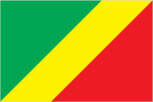
- divided diagonally from the lower hoist side by a yellow band; the upper triangle (hoist side) is green and the lower triangle is red; green symbolizes agriculture and forests, yellow the friendship and nobility of the people, red is unexplained but has been associated with the struggle for independence
- note
- note: uses the popular Pan-African colors of Ethiopia
Government type
presidential republic
Independence
15 August 1960 (from France)
International law organization participation
has not submitted an ICJ jurisdiction declaration; accepts ICCt jurisdiction
International organization participation
ACP, AfDB, AU, BDEAC, CEMAC, EITI (compliant country), FAO, FZ, G-77, IAEA, IBRD, ICAO, ICCt, ICRM, IDA, IFAD, IFC, IFRCS, ILO, IMF, IMO, Interpol, IOC, IOM, IPU, ISO (correspondent), ITSO, ITU, ITUC (NGOs), LCBC (observer), MIGA, NAM, OIF, OPCW, UN, UNCTAD, UNESCO, UNHCR, UNIDO, UNITAR, UNWTO, UPU, WCO, WFTU (NGOs), WHO, WIPO, WMO, WTO
Judicial branch
- highest court(s)
- Supreme Court or Cour Supreme (consists of NA judges); Constitutional Court (consists of 9 members); note - a High Court of Justice, outside the judicial authority, tries cases involving treason by the president of the republic
- judge selection and term of office
- Supreme Court judges elected by Parliament and serve until age 65; Constitutional Court members appointed by the president of the republic - 3 directly by the president and 6 nominated by Parliament; members appointed for renewable 9-year terms with one-third of the membership renewed every 3 years
- subordinate courts
- Court of Audit and Budgetary Discipline; courts of appeal; regional and district courts; employment tribunals; juvenile courts
Legal system
mixed legal system of French civil law and customary law
Legislative branch
- description
- bicameral Parliament or Parliament consists of:Senate (72 seats; members indirectly elected by local, district, and regional councils by simple majority vote to serve 6-year terms) note- the Senate is renewed in its entirety following a constitutional reform implemented in 2015 ending the renewal by halfNational Assembly (151 seats; members directly elected in single-seat constituencies by absolute majority popular vote in 2 rounds if needed; members serve 5-year terms) (2022)
- election results
- Senate - percent of vote by party - NA; seats by party - PCT 46, independent 12, MAR 2, RDPS 2, UPADS 2, DRD 1, FP 1, MCDDI 1, PRL 1, Pulp 1, PUR 1, RC 1; composition - men 58, women 14, percent of women 19.4%National Assembly - percent of vote by party - NA; seats by party - PCT 112, UPADS 7, UDH-YUKI 7, MAR 4, RLP 2, CLUB 2002 2, DRR 2, RDPS 2, PAC 1, MSD 1, MDP 1, CPR 1, PPRD 1, CR 1, MCDDI 1, independent 6; composition - men 134, women 17, percent of women 11.3%; note - total Parliament percent of women 13.9%National Assembly - percent of vote by party - NA; seats by party - PCT 96, UPADS 8, MCDDI 4, other 23 (less than 4 seats) independent 20; composition - men 134, women 17, percent of women 11.3%; note - total Parliament percent of women 13.9% (2022)
- elections
- Senate - last held on 31 August 2017 (next to be held in 2023)National Assembly - last held on 10 and 31 July 2022 (next to be held in July 2027) (2022)
National anthem
- lyrics/music
- Jacques TONDRA and Georges KIBANGHI/Jean ROYER and Joseph SPADILIERE
- name
- "La Congolaise" (The Congolese)
- note
- note: originally adopted 1959, restored 1991
National heritage
- selected World Heritage Site locales
- Sangha Trinational Forest
- total World Heritage Sites
- 1 (natural)
National holiday
Independence Day, 15 August (1960)
National symbol(s)
lion, elephant; national colors: green, yellow, red
Political parties and leaders
Alliance of the Presidential Majority or AMPAction Movement for Renewal or MAR [Roland BOUITI-VIAUDO]Citizen's Rally or RC [Claude Alphonse NSILOU]Congolese Labour Party or PCT [Denis SASSOU-Nguesso]Congolese Movement for Democracy and Integral Development or MCDDI [VACANT]Movement for Unity, Solidarity, and Work or MUST [Claudine MUNARI]Pan-African Union for Social Development or UPADS [Pascal Tsaty MABIALA]Party for the Unity and the Republic or PUR [Wilfrid NGUESSO]Patriotic Union for Democracy and Progress or UPDP [Auguste-Celestin GONGARD NKOUA]Perspectives and Realities Club or CPR [Aimé Hydevert MOUAGNI]Rally for Democracy and Social Progress or RDPS [Jean-Pierre Thystère TCHICAYA]Republican and Liberal Party or PRL [Bonaventure MIZIDY]Union of Democratic Forces or UDF [Josué Rodrigue NGOUONIMBA]Union for Democracy and Republic or UDR [Guy Kinfoussia ROMAIN]Union for the Republic or UR [Michel Bidimbou POUELA]
Suffrage
18 years of age; universal
Economy
Agricultural products
cassava, sugar cane, oil palm fruit, cassava leaves, bananas, plantains, roots/tubers, game meat, vegetables, mangoes/guavas
Budget
- expenditures
- 2.578 billion (2017 est.)
- revenues
- 1.965 billion (2017 est.)
Budget surplus (+) or deficit (-)
-7% (of GDP) (2017 est.)
Credit ratings
- Fitch rating
- CCC (2019)
- Moody's rating
- Caa2 (2018)
- note
- note: The year refers to the year in which the current credit rating was first obtained.
- Standard & Poors rating
- CCC+ (2020)
Current account balance
- Current account balance 2016
- -$5.735 billion (2016 est.)
- Current account balance 2017
- -$1.128 billion (2017 est.)
Debt - external
- Debt - external 31 December 2016
- $4.721 billion (31 December 2016 est.)
- Debt - external 31 December 2017
- $4.605 billion (31 December 2017 est.)
Economic overview
The Republic of the Congo’s economy is a mixture of subsistence farming, an industrial sector based largely on oil and support services, and government spending. Oil has supplanted forestry as the mainstay of the economy, providing a major share of government revenues and exports. Natural gas is increasingly being converted to electricity rather than being flared, greatly improving energy prospects. New mining projects, particularly iron ore, which entered production in late 2013, may add as much as $1 billion to annual government revenue. The Republic of the Congo is a member of the Central African Economic and Monetary Community (CEMAC) and shares a common currency – the Central African Franc – with five other member states in the region. The current administration faces difficult economic challenges of stimulating recovery and reducing poverty. The drop in oil prices that began in 2014 has constrained government spending; lower oil prices forced the government to cut more than $1 billion in planned spending. The fiscal deficit amounted to 11% of GDP in 2017. The government’s inability to pay civil servant salaries has resulted in multiple rounds of strikes by many groups, including doctors, nurses, and teachers. In the wake of a multi-year recession, the country reached out to the IMF in 2017 for a new program; the IMF noted that the country’s continued dependence on oil, unsustainable debt, and significant governance weakness are key impediments to the country’s economy. In 2018, the country’s external debt level will approach 120% of GDP. The IMF urged the government to renegotiate debts levels to sustainable levels before it agreed to a new macroeconomic adjustment package.
Exchange rates
- Currency
- Cooperation Financiere en Afrique Centrale francs (XAF) per US dollar -
- Exchange rates 2013
- 494.42 (2013 est.)
- Exchange rates 2014
- 591.45 (2014 est.)
- Exchange rates 2015
- 593.01 (2015 est.)
- Exchange rates 2016
- 593.01 (2016 est.)
- Exchange rates 2017
- 579.8 (2017 est.)
Exports
- Exports 2016
- $4.116 billion (2016 est.)
- Exports 2017
- $4.193 billion (2017 est.)
- note
- note: Data are in current year dollars and do not include illicit exports or re-exports.
Exports - commodities
crude petroleum, copper, lumber, ships, refined petroleum (2019)
Exports - partners
China 49%, United Arab Emirates 15%, India 6%, Italy 5% (2019)
Fiscal year
calendar year
GDP - composition, by end use
- exports of goods and services
- 62.9% (2017 est.)
- government consumption
- 9.6% (2017 est.)
- household consumption
- 47.6% (2017 est.)
- imports of goods and services
- -62.7% (2017 est.)
- investment in fixed capital
- 42.5% (2017 est.)
- investment in inventories
- 0.1% (2017 est.)
GDP - composition, by sector of origin
- agriculture
- 9.3% (2017 est.)
- industry
- 51% (2017 est.)
- services
- 39.7% (2017 est.)
GDP (official exchange rate)
$8.718 billion (2017 est.)
Gini Index coefficient - distribution of family income
- Gini Index coefficient - distribution of family income 2011
- 48.9 (2011 est.)
Household income or consumption by percentage share
- highest 10%
- 37.1% (2005)
- lowest 10%
- 2.1%
Imports
- Imports 2016
- $5.639 billion (2016 est.)
- Imports 2017
- $2.501 billion (2017 est.)
Imports - commodities
ships, chicken products, refined petroleum, processed fish, packaged medicines (2019)
Imports - partners
China 15%, France 12%, Belgium 6%, Angola 5% (2019)
Industrial production growth rate
-3% (2017 est.)
Industries
petroleum extraction, cement, lumber, brewing, sugar, palm oil, soap, flour, cigarettes
Inflation rate (consumer prices)
- Inflation rate (consumer prices) 2017
- 0.4% (2017 est.)
- Inflation rate (consumer prices) 2018
- 1.1% (2018 est.)
- Inflation rate (consumer prices) 2019
- 2.2% (2019 est.)
Labor force
2.055 million (2016 est.)
Labor force - by occupation
- agriculture
- 35.4%
- industry
- 20.6%
- services
- 44% (2005 est.)
Population below poverty line
40.9% (2011 est.)
Public debt
- Public debt 2016
- 128.7% of GDP (2016 est.)
- Public debt 2017
- 130.8% of GDP (2017 est.)
Real GDP (purchasing power parity)
- note
- note: data are in 2017 dollars
- Real GDP (purchasing power parity) 2018
- $20.63 billion (2018 est.)
- Real GDP (purchasing power parity) 2019
- $20.68 billion (2019 est.)
- Real GDP (purchasing power parity) 2020
- $19.03 billion (2020 est.)
Real GDP growth rate
- Real GDP growth rate 2015
- 2.6% (2015 est.)
- Real GDP growth rate 2016
- -2.8% (2016 est.)
- Real GDP growth rate 2017
- -3.1% (2017 est.)
Real GDP per capita
- note
- note: data are in 2017 dollars
- Real GDP per capita 2018
- $3,900 (2018 est.)
- Real GDP per capita 2019
- $3,800 (2019 est.)
- Real GDP per capita 2020
- $3,400 (2020 est.)
Reserves of foreign exchange and gold
- Reserves of foreign exchange and gold 31 December 2016
- $727.1 million (31 December 2016 est.)
- Reserves of foreign exchange and gold 31 December 2017
- $505.7 million (31 December 2017 est.)
Taxes and other revenues
22.5% (of GDP) (2017 est.)
Unemployment rate
- Unemployment rate 2014
- 36% (2014 est.)
Energy
Carbon dioxide emissions
- from coal and metallurgical coke
- 0 metric tonnes of CO2 (2019 est.)
- from consumed natural gas
- 2.747 million metric tonnes of CO2 (2019 est.)
- from petroleum and other liquids
- 1.777 million metric tonnes of CO2 (2019 est.)
- total emissions
- 4.523 million metric tonnes of CO2 (2019 est.)
Coal
- consumption
- 0 metric tons (2020 est.)
- exports
- 0 metric tons (2020 est.)
- imports
- 0 metric tons (2020 est.)
- production
- 0 metric tons (2020 est.)
- proven reserves
- 0 metric tons (2019 est.)
Electricity
- consumption
- 2,065,580,000 kWh (2019 est.)
- exports
- 44 million kWh (2019 est.)
- imports
- 23 million kWh (2019 est.)
- installed generating capacity
- 629,000 kW (2020 est.)
- transmission/distribution losses
- 1.623 billion kWh (2019 est.)
Electricity access
- electrification - rural areas
- 36% (2019)
- electrification - total population
- 72% (2019)
- electrification - urban areas
- 89% (2019)
Electricity generation sources
- biomass and waste
- 0% of total installed capacity (2020 est.)
- fossil fuels
- 70.1% of total installed capacity (2020 est.)
- geothermal
- 0% of total installed capacity (2020 est.)
- hydroelectricity
- 29.9% of total installed capacity (2020 est.)
- nuclear
- 0% of total installed capacity (2020 est.)
- solar
- 0% of total installed capacity (2020 est.)
- tide and wave
- 0% of total installed capacity (2020 est.)
- wind
- 0% of total installed capacity (2020 est.)
Energy consumption per capita
- Total energy consumption per capita 2019
- 16.156 million Btu/person (2019 est.)
Natural gas
- consumption
- 1.4 billion cubic meters (2019 est.)
- exports
- 0 cubic meters (2021 est.)
- imports
- 0 cubic meters (2021 est.)
- production
- 1.4 billion cubic meters (2019 est.)
- proven reserves
- 283.989 billion cubic meters (2021 est.)
Petroleum
- crude oil and lease condensate exports
- 331,700 bbl/day (2018 est.)
- crude oil and lease condensate imports
- 0 bbl/day (2018 est.)
- crude oil estimated reserves
- 2.882 billion barrels (2021 est.)
- refined petroleum consumption
- 12,600 bbl/day (2019 est.)
- total petroleum production
- 270,900 bbl/day (2021 est.)
Refined petroleum products - exports
5,766 bbl/day (2015 est.)
Refined petroleum products - imports
7,162 bbl/day (2015 est.)
Refined petroleum products - production
15,760 bbl/day (2015 est.)
Communications
Broadband - fixed subscriptions
- subscriptions per 100 inhabitants
- 0.02 (2020 est.)
- total
- 1,000 (2020 est.)
Broadcast media
1 state-owned TV and 3 state-owned radio stations; several privately owned TV and radio stations; satellite TV service is available; rebroadcasts of several international broadcasters are available
Internet country code
.cg
Internet users
- percent of population
- 9% (2019 est.)
- total
- 484,245 (2019 est.)
Telecommunication systems
- domestic
- fixed-line infrastructure inadequate, providing less than 1 fixed-line connection per 100 persons; mobile-cellular 89 per 100 persons (2020)
- general assessment
- suffering from economic challenges of stimulating recovery and reducing poverty; primary network consists of microwave radio relay and coaxial cable with services barely adequate for government use; key exchanges are in Brazzaville, Pointe-Noire, and Loubomo; intercity lines frequently out of order; youth are seeking the Internet more than their parents and often gain access through cyber cafes; only the most affluent have Internet access in their homes; operator has plans to upgrade national broadband through fiber link to West Africa Cable System (WACS) landing station at Pointe-Noire with connections to Angola and DRC; fiber network project with aims to connect north and south regions; DRC operator added fiber link between Brazzaville and Kinshasa (2020)
- international
- country code - 242; WACS submarine cables to Europe and Western and South Africa; satellite earth station - 1 Intelsat (Atlantic Ocean) (2019)
- note
- note: the COVID-19 pandemic continues to have a significant impact on production and supply chains globally; since 2020, some aspects of the telecom sector have experienced a downturn, particularly in mobile device production; progress toward 5G implementation has resumed, as well as upgrades to infrastructure; consumer spending on telecom services has increased due to the surge in demand for capacity and bandwidth; the crucial nature of telecom services as a tool for work and school from home is still evident, and the spike in this area has seen growth opportunities for development of new tools and increased services
Telephones - fixed lines
- subscriptions per 100 inhabitants
- (2020 est.) less than 1
- total subscriptions
- 17,000 (2020 est.)
Telephones - mobile cellular
- subscriptions per 100 inhabitants
- 89 (2020 est.)
- total subscriptions
- 4.89 million (2020 est.)
Transportation
Airports
- total
- 27 (2021)
Airports - with paved runways
- 1,524 to 2,437 m
- 5 (2021)
- 2,438 to 3,047 m
- 1
- over 3,047 m
- 2
- total
- 8
Airports - with unpaved runways
- 1,524 to 2,437 m
- 8
- 914 to 1,523 m
- 9
- total
- 19
- under 914 m
- 2 (2021)
Civil aircraft registration country code prefix
TN
Merchant marine
- by type
- general cargo 1, oil tanker 1, other 9 (2021)
- total
- 11
National air transport system
- annual freight traffic on registered air carriers
- 4.6 million (2018) mt-km
- annual passenger traffic on registered air carriers
- 333,899 (2018)
- inventory of registered aircraft operated by air carriers
- 12
- number of registered air carriers
- 3 (2020)
Pipelines
232 km gas, 4 km liquid petroleum gas, 982 km oil (2013)
Ports and terminals
- major seaport(s)
- Pointe-Noire
- note
- Impfondo (Oubangui) Ouesso (Sangha) Oyo (Alima)
- oil terminal(s)
- Djeno
- river port(s)
- Brazzaville (Congo)
Railways
- narrow gauge
- 510 km (2014) 1.067-m gauge
- total
- 510 km (2014)
Roadways
- note
- note: road network in Congo is composed of 23,324 km of which 17,000 km are classified as national, departmental, and routes of local interest: 6,324 km are non-classified routes
- paved
- 3,111 km (2017)
- total
- 23,324 km (2017)
- unpaved
- 20,213 km (2017)
Waterways
1,120 km (2011) (commercially navigable on Congo and Oubangui Rivers above Brazzaville; there are many ferries across the river to Kinshasa; the Congo south of Brazzaville-Kinshasa to the coast is not navigable because of rapids, necessitating a rail connection to Pointe-Noire; other rivers are used for local traffic only)
Military and Security
Military - note
as of 2022, the FAC had limited capabilities due to obsolescent and poorly maintained equipment and low levels of training; its primary focus was internal security; since its creation in 1961, the FAC has had a turbulent history; it has been sidelined by some national leaders in favor of personal militias, endured an internal rebellion (1996), and clashed with various rebel groups and political or ethnic militias (1993-1996, 2002-2005, 2017); during the 1997-1999 civil war, the military generally split along ethnic lines, with most northern officers supporting eventual winner SASSOU-Nguesso, and most southerners backing the rebels; others joined ethnic-based factions loyal to regional warlords; forces backing SASSOU-Nguesso were supported by Angolan troops and received some French assistance; the FAC also has undergone at least three reorganizations that included the incorporation of former rebel combatants and various ethnic and political militias; in recent years, France has provided some advice and training, and a military cooperation agreement was signed with Russia in 2019
Military and security forces
Congolese Armed Forces (Forces Armees Congolaises, FAC): Army, Navy, Congolese Air Force, Gendarmerie (2022)
Military and security service personnel strengths
approximately 12,000 active duty troops (8,000 Army; 800 Navy; 1,000 Air Force; 2,000 Gendarmerie) (2022)
Military equipment inventories and acquisitions
the FAC is armed with mostly aging Russian and Soviet-era weapons, with a smaller mix of French and South African equipment; the leading supplier of arms to the FAC since 2010 is South Africa (2021)
Military expenditures
- Military Expenditures 2017
- 3.6% of GDP (2017 est.) (approximately $580 million)
- Military Expenditures 2018
- 2.1% of GDP (2018 est.) (approximately $330 million)
- Military Expenditures 2019
- 2.3% of GDP (2019 est.) (approximately $350 million)
- Military Expenditures 2020
- 3.2% of GDP (2020 est.)
- Military Expenditures 2021
- 2.5% of GDP (2021 est.)
Military service age and obligation
18 years of age for voluntary military service for men and women; conscription ended in 1969 (2021)
Transnational Issues
Disputes - international
Republic of the Congo-Democratic Republic of Congo(DRC): the location of the boundary in the broad Congo River is indefinite except in the Pool Malebo/Stanley Pool areaRepublic of the Congo-Angola: (Kabinda Exclave) None identified
Refugees and internally displaced persons
- IDPs
- 159,830 (multiple civil wars since 1992) (2022)
- refugees (country of origin)
- 29,229 (Central African Republic), 22,150 (Democratic Republic of the Congo) (refugees and asylum seekers) (2022)
Environment
Air pollutants
- carbon dioxide emissions
- 3.28 megatons (2016 est.)
- methane emissions
- 2.24 megatons (2020 est.)
- particulate matter emissions
- 38.67 micrograms per cubic meter (2016 est.)
Climate
tropical; rainy season (March to June); dry season (June to October); persistent high temperatures and humidity; particularly enervating climate astride the Equator
Environment - current issues
air pollution from vehicle emissions; water pollution from raw sewage; tap water is not potable; deforestation; wildlife protection
Environment - international agreements
- party to
- Biodiversity, Climate Change, Climate Change-Kyoto Protocol, Climate Change-Paris Agreement, Desertification, Endangered Species, Hazardous Wastes, Law of the Sea, Marine Dumping-London Protocol, Ozone Layer Protection, Ship Pollution, Tropical Timber 2006, Wetlands
- signed, but not ratified
- none of the selected agreements
Food insecurity
- severe localized food insecurity
- due to refugee influx - as of 30 April 2022, about 29,100 refugees from the Central African Republic and 22,100 from the Democratic Republic of the Congo were residing in the country, mostly in Likouala and Plateaux departments; host communities face food shortages and limited livelihood opportunities, and refugees’ food security is essentially dependent on continued humanitarian assistance (2022)
Land use
- agricultural land
- 31.1% (2018 est.)
- agricultural land: arable land
- arable land: 1.6% (2018 est.)
- agricultural land: permanent crops
- permanent crops: 0.2% (2018 est.)
- agricultural land: permanent pasture
- permanent pasture: 29.3% (2018 est.)
- forest
- 65.6% (2018 est.)
- other
- 3.3% (2018 est.)
Major aquifers
Congo Basin
Major infectious diseases
- animal contact diseases
- rabies
- degree of risk
- very high (2020)
- food or waterborne diseases
- bacterial and protozoal diarrhea, hepatitis A, and typhoid fever
- note
- note: on 21 March 2022, the US Centers for Disease Control and Prevention (CDC) issued a Travel Alert for polio in Africa; the Republic of the Congo is currently considered a high risk to travelers for circulating vaccine-derived polioviruses (cVDPV); vaccine-derived poliovirus (VDPV) is a strain of the weakened poliovirus that was initially included in oral polio vaccine (OPV) and that has changed over time and behaves more like the wild or naturally occurring virus; this means it can be spread more easily to people who are unvaccinated against polio and who come in contact with the stool or respiratory secretions, such as from a sneeze, of an “infected” person who received oral polio vaccine; the CDC recommends that before any international travel, anyone unvaccinated, incompletely vaccinated, or with an unknown polio vaccination status should complete the routine polio vaccine series; before travel to any high-risk destination, the CDC recommends that adults who previously completed the full, routine polio vaccine series receive a single, lifetime booster dose of polio vaccine
- vectorborne diseases
- malaria and dengue fever
- water contact diseases
- schistosomiasis
Major rivers (by length in km)
Ubangi (shared with Central African Republic [s] and Democratic Republic of Congo [m]) - 2,270 kmnote – [s] after country name indicates river source; [m] after country name indicates river mouth
Major watersheds (area sq km)
Atlantic Ocean drainage: Congo (3,730,881 sq km)
Revenue from coal
- coal revenues
- 0% of GDP (2018 est.)
Revenue from forest resources
- forest revenues
- 3.17% of GDP (2018 est.)
Total renewable water resources
832 billion cubic meters (2017 est.)
Total water withdrawal
- agricultural
- 4 million cubic meters (2017 est.)
- industrial
- 24 million cubic meters (2017 est.)
- municipal
- 63.7 million cubic meters (2017 est.)
Urbanization
- rate of urbanization
- 3.19% annual rate of change (2020-25 est.)
- urban population
- 69.2% of total population (2023)
Waste and recycling
- municipal solid waste generated annually
- 451,200 tons (1993 est.)
- municipal solid waste recycled annually
- 118,214 tons (2005 est.)
- percent of municipal solid waste recycled
- 26.2% (2005 est.)