2012 Edition
CIA World Factbook 2012 Archive (HTML)
Introduction
Background
Upon independence in 1960, the former French region of Middle Congo became the Republic of the Congo. A quarter century of experimentation with Marxism was abandoned in 1990 and a democratically elected government took office in 1992. A brief civil war in 1997 restored former Marxist President Denis SASSOU-Nguesso, and ushered in a period of ethnic and political unrest. Southern-based rebel groups agreed to a final peace accord in March 2003, but the calm is tenuous and refugees continue to present a humanitarian crisis. The Republic of Congo was once one of Africa's largest petroleum producers, but with declining production it will need new offshore oil finds to sustain its oil earnings over the long term.
Geography
Area
- 342,000 sq km 341,500 sq km 500 sq km
- total
- 342,000 sq km
- water
- 500 sq km
Area - comparative
slightly smaller than Montana
Climate
tropical; rainy season (March to June); dry season (June to October); persistent high temperatures and humidity; particularly enervating climate astride the Equator
Coastline
169 km
Elevation extremes
- Atlantic Ocean 0 m Mount Berongou 903 m
- highest point
- Mount Berongou 903 m
- lowest point
- Atlantic Ocean 0 m
Environment - current issues
air pollution from vehicle emissions; water pollution from the dumping of raw sewage; tap water is not potable; deforestation
Environment - international agreements
- Biodiversity, Climate Change, Climate Change-Kyoto Protocol, Desertification, Endangered Species, Hazardous Wastes, Law of the Sea, Ozone Layer Protection, Ship Pollution, Tropical Timber 83, Tropical Timber 94, Wetlands none of the selected agreements
- party to
- Biodiversity, Climate Change, Climate Change-Kyoto Protocol, Desertification, Endangered Species, Hazardous Wastes, Law of the Sea, Ozone Layer Protection, Ship Pollution, Tropical Timber 83, Tropical Timber 94, Wetlands
- signed, but not ratified
- none of the selected agreements
Freshwater withdrawal (domestic/industrial/agricultural)
- 0.03 cu km/yr (59%/29%/12%) 8 cu m/yr (2000)
- per capita
- 8 cu m/yr (2000)
- total
- 0.03 cu km/yr (59%/29%/12%)
Geographic coordinates
1 00 S, 15 00 E
Geography - note
about 70% of the population lives in Brazzaville, Pointe-Noire, or along the railroad between them
Irrigated land
20 sq km (2003)
Land boundaries
- 5,504 km Angola 201 km, Cameroon 523 km, Central African Republic 467 km, Democratic Republic of the Congo 2,410 km, Gabon 1,903 km
- border countries
- Angola 201 km, Cameroon 523 km, Central African Republic 467 km, Democratic Republic of the Congo 2,410 km, Gabon 1,903 km
- total
- 5,504 km
Land use
- 1.45% 0.15% 98.4% (2005)
- arable land
- 1.45%
- other
- 98.4% (2005)
- permanent crops
- 0.15%
Location
Central Africa, bordering the South Atlantic Ocean, between Angola and Gabon
Map references
Africa
Maritime claims
- 200 nm
- territorial sea
- 200 nm
Natural hazards
seasonal flooding
Natural resources
petroleum, timber, potash, lead, zinc, uranium, copper, phosphates, gold, magnesium, natural gas, hydropower
Terrain
coastal plain, southern basin, central plateau, northern basin
Total renewable water resources
832 cu km (1987)
People and Society
Age structure
- 45.3% (male 996,811/ female 982,859) 51.9% (male 1,128,973/ female 1,137,082) 2.8% (male 49,366/ female 71,175) (2012 est.)
- 0-14 years
- 45.3% (male 996,811/ female 982,859)
- 15-64 years
- 51.9% (male 1,128,973/ female 1,137,082)
- 65 years and over
- 2.8% (male 49,366/ female 71,175) (2012 est.)
Birth rate
40.09 births/1,000 population (2012 est.)
Children under the age of 5 years underweight
11.8% (2005)
Death rate
11.25 deaths/1,000 population (July 2012 est.)
Education expenditures
1.9% of GDP (2005)
Ethnic groups
Kongo 48%, Sangha 20%, M'Bochi 12%, Teke 17%, Europeans and other 3%
Health expenditures
3% of GDP (2009)
HIV/AIDS - adult prevalence rate
3.4% (2009 est.)
HIV/AIDS - deaths
5,100 (2009 est.)
HIV/AIDS - people living with HIV/AIDS
77,000 (2009 est.)
Hospital bed density
1.6 beds/1,000 population (2005)
Infant mortality rate
- 74.22 deaths/1,000 live births 79.58 deaths/1,000 live births 68.7 deaths/1,000 live births (2012 est.)
- female
- 68.7 deaths/1,000 live births (2012 est.)
- total
- 74.22 deaths/1,000 live births
Languages
French (official), Lingala and Monokutuba (lingua franca trade languages), many local languages and dialects (of which Kikongo is the most widespread)
Life expectancy at birth
- 55.27 years 53.95 years 56.62 years (2012 est.)
- female
- 56.62 years (2012 est.)
- total population
- 55.27 years
Literacy
- age 15 and over can read and write 83.8% 89.6% 78.4% (2003 est.)
- definition
- age 15 and over can read and write
- female
- 78.4% (2003 est.)
- male
- 89.6%
- total population
- 83.8%
Major cities - population
BRAZZAVILLE (capital) 1.292 million (2009)
Major infectious diseases
- very high bacterial and protozoal diarrhea, hepatitis A, and typhoid fever malaria and African trypanosomiasis (sleeping sickness) rabies schistosomiasis (2009)
- animal contact disease
- rabies
- degree of risk
- very high
- food or waterborne diseases
- bacterial and protozoal diarrhea, hepatitis A, and typhoid fever
- vectorborne disease
- malaria and African trypanosomiasis (sleeping sickness)
- water contact disease
- schistosomiasis (2009)
Maternal mortality rate
560 deaths/100,000 live births (2010)
Median age
- 17.1 years 16.9 years 17.3 years (2012 est.)
- female
- 17.3 years (2012 est.)
- male
- 16.9 years
- total
- 17.1 years
Nationality
- Congolese (singular and plural) Congolese or Congo
- adjective
- Congolese or Congo
- noun
- Congolese (singular and plural)
Net migration rate
-0.35 migrant(s)/1,000 population (2012 est.)
Physicians density
0.095 physicians/1,000 population (2007)
Population
4,366,266 (July 2012 est.) estimates for this country explicitly take into account the effects of excess mortality due to AIDS; this can result in lower life expectancy, higher infant mortality, higher death rates, lower population growth rates, and changes in the distribution of population by age and sex than would otherwise be expected
Population growth rate
2.849% (2012 est.)
Religions
Christian 50%, animist 48%, Muslim 2%
Sanitation facility access
- urban: 31% of population rural: 29% of population total: 30% of population urban: 69% of population rural: 71% of population total: 70% of population
- rural
- 71% of population
- total
- 70% of population
- urban
- 69% of population
School life expectancy (primary to tertiary education)
- 10 years 11 years 10 years (2005)
- female
- 10 years (2005)
- male
- 11 years
- total
- 10 years
Sex ratio
- 1.03 male(s)/female 1.01 male(s)/female 0.99 male(s)/female 0.69 male(s)/female 0.99 male(s)/female (2011 est.)
- 15-64 years
- 0.99 male(s)/female
- 65 years and over
- 0.69 male(s)/female
- at birth
- 1.03 male(s)/female
- total population
- 0.99 male(s)/female (2011 est.)
- under 15 years
- 1.01 male(s)/female
Total fertility rate
5.59 children born/woman (2012 est.)
Urbanization
- 62% of total population (2010) 3% annual rate of change (2010-15 est.)
- rate of urbanization
- 3% annual rate of change (2010-15 est.)
- urban population
- 62% of total population (2010)
Government
Administrative divisions
10 regions (regions, singular - region) and 1 commune*; Bouenza, Brazzaville*, Cuvette, Cuvette-Ouest, Kouilou, Lekoumou, Likouala, Niari, Plateaux, Pool, Sangha
Capital
- Brazzaville 4 15 S, 15 17 E UTC+1 (6 hours ahead of Washington, DC during Standard Time)
- geographic coordinates
- 4 15 S, 15 17 E
- name
- Brazzaville
- time difference
- UTC+1 (6 hours ahead of Washington, DC during Standard Time)
Constitution
approved by referendum 20 January 2002
Country name
- Republic of the Congo Congo (Brazzaville) Republique du Congo none Middle Congo, Congo/Brazzaville, Congo
- conventional long form
- Republic of the Congo
- conventional short form
- Congo (Brazzaville)
- former
- Middle Congo, Congo/Brazzaville, Congo
- local long form
- Republique du Congo
- local short form
- none
Diplomatic representation from the US
- Ambassador Christopher W. MURRAY 70-83 Section D, Maya-Maya Boulevard, Brazzaville; B.P. 1015, Brazzaville [242] 612-6000
- chief of mission
- Ambassador Christopher W. MURRAY
- embassy
- 70-83 Section D, Maya-Maya Boulevard, Brazzaville;
- mailing address
- B.P. 1015, Brazzaville
- telephone
- [242] 612-6000
Diplomatic representation in the US
- Ambassador Serge MOMBOULI 4891 Colorado Avenue NW, Washington, DC 20011 [1] (202) 726-5500 [1] (202) 726-1860
- chancery
- 4891 Colorado Avenue NW, Washington, DC 20011
- chief of mission
- Ambassador Serge MOMBOULI
- FAX
- [1] (202) 726-1860
- telephone
- [1] (202) 726-5500
Executive branch
- President Denis SASSOU-Nguesso (since 25 October 1997, following the civil war in which he toppled elected president Pascal LISSOUBA); note - the president is both the chief of state and head of government President Denis SASSOU-Nguesso (since 25 October 1997); note - the position of prime minister was abolished in September 2009 Council of Ministers appointed by the president president elected by popular vote for a seven-year term (eligible for a second term); election last held on 12 July 2009 (next to be held in 2016) Denis SASSOU-Nguesso reelected president; percent of vote - Denis SASSOU-Nguesso 78.6%, Joseph Kignoumbi Kia MBOUNGOU 7.5%, Nicephore Fylla de SAINT-EUDES 7%, other 6.9%
- cabinet
- Council of Ministers appointed by the president
- chief of state
- President Denis SASSOU-Nguesso (since 25 October 1997, following the civil war in which he toppled elected president Pascal LISSOUBA); note - the president is both the chief of state and head of government
- election results
- Denis SASSOU-Nguesso reelected president; percent of vote - Denis SASSOU-Nguesso 78.6%, Joseph Kignoumbi Kia MBOUNGOU 7.5%, Nicephore Fylla de SAINT-EUDES 7%, other 6.9%
- elections
- president elected by popular vote for a seven-year term (eligible for a second term); election last held on 12 July 2009 (next to be held in 2016)
- head of government
- President Denis SASSOU-Nguesso (since 25 October 1997); note - the position of prime minister was abolished in September 2009
Flag description
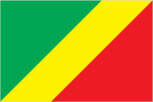
divided diagonally from the lower hoist side by a yellow band; the upper triangle (hoist side) is green and the lower triangle is red; green symbolizes agriculture and forests, yellow the friendship and nobility of the people, red is unexplained but has been associated with the struggle for independence uses the popular Pan-African colors of Ethiopia
Government type
republic
Independence
15 August 1960 (from France)
International law organization participation
has not submitted an ICJ jurisdiction declaration; accepts ICCt jurisdiction
International organization participation
ACP, AfDB, AU, BDEAC, CEMAC, EITI (candidate country), FAO, FZ, G-77, IAEA, IBRD, ICAO, ICRM, IDA, IFAD, IFC, IFRCS, ILO, IMF, IMO, Interpol, IOC, IOM, IPU, ISO (correspondent), ITSO, ITU, ITUC (NGOs), MIGA, NAM, OIF, OPCW, UN, UNCTAD, UNESCO, UNHCR, UNIDO, UNITAR, UNWTO, UPU, WCO, WFTU (NGOs), WHO, WIPO, WMO, WTO
Judicial branch
Supreme Court or Cour Supreme
Legal system
mixed legal system of French civil law and customary law
Legislative branch
- bicameral Parliament consists of the Senate (72 seats; members elected by indirect vote to serve five-year terms) and the National Assembly (139 seats; members elected by popular vote to serve five-year terms) Senate - last held on 5 August 2008 (next to be held in July 2013); National Assembly - last held on 15 July and 5 August 2012 (next to be held in 2017) Senate - percent of vote by party - NA; seats by party - RMP 33, FDU 23, UPADS 2, independents 7, other 7; National Assembly - percent of vote by party - NA; seats by party - PCT (and allies) 117, UPADS 7, independents 12, vacant 3
- election results
- Senate - percent of vote by party - NA; seats by party - RMP 33, FDU 23, UPADS 2, independents 7, other 7; National Assembly - percent of vote by party - NA; seats by party - PCT (and allies) 117, UPADS 7, independents 12, vacant 3
- elections
- Senate - last held on 5 August 2008 (next to be held in July 2013); National Assembly - last held on 15 July and 5 August 2012 (next to be held in 2017)
National anthem
- "La Congolaise" (The Congolese) Jacques TONDRA and Georges KIBANGHI/Jean ROYER and Joseph SPADILIERE originally adopted 1959, restored 1991
- lyrics/music
- Jacques TONDRA and Georges KIBANGHI/Jean ROYER and Joseph SPADILIERE
- name
- "La Congolaise" (The Congolese)
National holiday
Independence Day, 15 August (1960)
National symbol(s)
lion; elephant
Political parties and leaders
Action Movement for Renewal or MAR; Congolese Labour Party or PCT; Congolese Movement for Democracy and Integral Development or MCDDI [Michel MAMPOUYA]; Movement for Solidarity and Development or MSD; Pan-African Union for Social Development or UPADS [Martin MBERI]; Rally for Democracy and the Republic or RDR [Raymond Damasge NGOLLO]; Rally for Democracy and Social Progress or RDPS [Jean-Pierre Thystere TCHICAYA, president]; Rally of the Presidential Majority or RMP; Union for Democracy and Republic or UDR; United Democratic Forces or FDU [Sebastian EBAO]; many smaller parties
Political pressure groups and leaders
Congolese Trade Union Congress or CSC; General Union of Congolese Pupils and Students or UGEEC; Revolutionary Union of Congolese Women or URFC; Union of Congolese Socialist Youth or UJSC
Suffrage
18 years of age; universal
Economy
Agriculture - products
cassava (tapioca), sugar, rice, corn, peanuts, vegetables, coffee, cocoa; forest products
Budget
- $6.719 billion $4.475 billion (2012 est.)
- expenditures
- $4.475 billion (2012 est.)
- revenues
- $6.719 billion
Budget surplus (+) or deficit (-)
16.3% of GDP (2012 est.)
Central bank discount rate
4.25% (31 December 2009) 4.75% (31 December 2008)
Commercial bank prime lending rate
14.8% (31 December 2012 est.) 15% (31 December 2011 est.)
Current account balance
$1.277 billion (2012 est.) $1.85 billion (2011 est.)
Debt - external
$4.225 billion (31 December 2012 est.) $4.865 billion (31 December 2011 est.)
Economy - overview
The economy is a mixture of subsistence agriculture, an industrial sector based largely on oil and support services, and government spending. Oil has supplanted forestry as the mainstay of the economy, providing a major share of government revenues and exports. In the early 1980s, rapidly rising oil revenues enabled the government to finance large-scale development projects with GDP growth averaging 5% annually, one of the highest rates in Africa. Characterized by budget problems and overstaffing, the government has mortgaged a substantial portion of its oil earnings through oil-backed loans that have contributed to a growing debt burden and chronic revenue shortfalls. Economic reform efforts have been undertaken with the support of international organizations, notably the World Bank and the IMF. However, the reform program came to a halt in June 1997 when civil war erupted. Denis SASSOU-Nguesso, who returned to power when the war ended in October 1997, publicly expressed interest in moving forward on economic reforms and privatization and in renewing cooperation with international financial institutions. Economic progress was badly hurt by slumping oil prices and the resumption of armed conflict in December 1998, which worsened the republic's budget deficit. The current administration presides over an uneasy internal peace and faces difficult economic challenges of stimulating recovery and reducing poverty. The drop in oil prices during the global crisis reduced oil revenue by about 30%, but the subsequent recovery of oil prices has boosted the economy's GDP and near-term prospects. In March 2006, the World Bank and the International Monetary Fund (IMF) approved Heavily Indebted Poor Countries (HIPC) treatment for Congo, which received $1.9 billion in debt relief under the program in 2010.
Exchange rates
Cooperation Financiere en Afrique Centrale francs (XAF) per US dollar - 511.4 (2012 est.) 471.87 (2011 est.) 495.28 (2010 est.) 472.19 (2009) 447.81 (2008)
Exports
$12.35 billion (2012 est.) $12.38 billion (2011 est.)
Exports - commodities
petroleum, lumber, plywood, sugar, cocoa, coffee, diamonds
Exports - partners
China 38.5%, US 20.3%, Australia 6.4%, France 6.1%, Spain 4.9%, Italy 4.4%, Netherlands 4.4% (2011)
Fiscal year
calendar year
GDP - composition by sector
- 4.2% 71.3% 24.5% (2012 est.)
- agriculture
- 4.2%
- industry
- 71.3%
- services
- 24.5% (2012 est.)
GDP - per capita (PPP)
$4,700 (2012 est.) $4,600 (2011 est.) $4,600 (2010 est.) data are in 2012 US dollars
GDP - real growth rate
4.9% (2012 est.) 3.4% (2011 est.) 8.8% (2010 est.)
GDP (official exchange rate)
$13.74 billion (2012 est.)
GDP (purchasing power parity)
$19.27 billion (2012 est.) $18.36 billion (2011 est.) $17.75 billion (2010 est.) data are in 2012 US dollars
Household income or consumption by percentage share
- 2.1% 37.1% (2005)
- highest 10%
- 37.1% (2005)
- lowest 10%
- 2.1%
Imports
$4.751 billion (2012 est.) $4.917 billion (2011 est.)
Imports - commodities
capital equipment, construction materials, foodstuffs
Imports - partners
France 17.2%, China 12.5%, India 9.2%, Italy 7.5%, Brazil 7.3%, US 5.8% (2011)
Industrial production growth rate
12% (2010 est.)
Inflation rate (consumer prices)
3.5% (2012 est.) 1.9% (2011 est.)
Investment (gross fixed)
45.2% of GDP (2012 est.)
Labor force
1.514 million (2007)
Market value of publicly traded shares
$NA
Population below poverty line
NA%
Reserves of foreign exchange and gold
$6.033 billion (31 December 2012 est.) $5.658 billion (31 December 2011 est.)
Stock of broad money
$3.753 billion (31 December 2011 est.) $2.882 billion (31 December 2010 est.)
Stock of domestic credit
$2.392 billion (31 December 2011 est.) $1.982 billion (31 December 2010 est.)
Stock of narrow money
$3.341 billion (31 December 2011 est.) $3.341 billion (31 December 2011 est.)
Taxes and other revenues
48.9% of GDP (2012 est.)
Unemployment rate
NA%
Energy
Carbon dioxide emissions from consumption of energy
6.518 million Mt (2010 est.)
Crude oil - exports
269,800 bbl/day (2009 est.)
Crude oil - imports
0 bbl/day (2009 est.)
Crude oil - production
308,600 bbl/day (2011 est.)
Crude oil - proved reserves
1.6 billion bbl (1 January 2012 est.)
Electricity - consumption
563 million kWh (2009 est.)
Electricity - exports
0 kWh (2010 est.)
Electricity - from fossil fuels
19.6% of total installed capacity (2009 est.)
Electricity - from hydroelectric plants
80.4% of total installed capacity (2009 est.)
Electricity - from nuclear fuels
0% of total installed capacity (2009 est.)
Electricity - from other renewable sources
0% of total installed capacity (2009 est.)
Electricity - imports
440 million kWh (2009 est.)
Electricity - installed generating capacity
148,000 kW (2009 est.)
Electricity - production
502 million kWh (2009 est.)
Natural gas - consumption
930 million cu m (2010 est.)
Natural gas - exports
0 cu m (2010 est.)
Natural gas - imports
0 cu m (2010 est.)
Natural gas - production
930 million cu m (2010 est.)
Natural gas - proved reserves
90.61 billion cu m (1 January 2012 est.)
Refined petroleum products - consumption
10,710 bbl/day (2011 est.)
Refined petroleum products - exports
5,146 bbl/day (2008 est.)
Refined petroleum products - imports
5,326 bbl/day (2008 est.)
Refined petroleum products - production
10,460 bbl/day (2008 est.)
Communications
Broadcast media
1 state-owned TV and 3 state-owned radio stations; several privately-owned TV and radio stations; satellite TV service is available; rebroadcasts of several international broadcasters are available (2007)
Internet country code
.cg
Internet hosts
45 (2012)
Internet users
245,200 (2009)
Telephone system
- primary network consists of microwave radio relay and coaxial cable with services barely adequate for government use; key exchanges are in Brazzaville, Pointe-Noire, and Loubomo; intercity lines frequently out of order fixed-line infrastructure inadequate providing less than 1 connection per 100 persons; in the absence of an adequate fixed line infrastructure, mobile-cellular subscribership has surged to 90 per 100 persons country code - 242; satellite earth station - 1 Intelsat (Atlantic Ocean) (2011)
- domestic
- fixed-line infrastructure inadequate providing less than 1 connection per 100 persons; in the absence of an adequate fixed line infrastructure, mobile-cellular subscribership has surged to 90 per 100 persons
- general assessment
- primary network consists of microwave radio relay and coaxial cable with services barely adequate for government use; key exchanges are in Brazzaville, Pointe-Noire, and Loubomo; intercity lines frequently out of order
- international
- country code - 242; satellite earth station - 1 Intelsat (Atlantic Ocean) (2011)
Telephones - main lines in use
14,200 (2011)
Telephones - mobile cellular
3.885 million (2011)
Transportation
Airports
25 (2012)
Airports - with paved runways
- 4 (2012)
- 1,524 to 2,437 m
- 4 (2012)
- 2,438 to 3,047 m
- 1
- over 3,047 m
- 2
- total
- 7
Airports - with unpaved runways
- 1 (2012)
- 1,524 to 2,437 m
- 8
- 914 to 1,523 m
- 9
- total
- 18
- under 914 m
- 1 (2012)
Merchant marine
- 1 (Democratic Republic of the Congo 1) (2010)
- registered in other countries
- 1 (Democratic Republic of the Congo 1) (2010)
Pipelines
gas 65 km; oil 273 km (2010)
Ports and terminals
Brazzaville, Djeno, Impfondo, Ouesso, Oyo, Pointe-Noire
Railways
- 886 km 886 km 1.067-m gauge (2008)
- total
- 886 km
Roadways
- 17,289 km 864 km 16,425 km (2004)
- total
- 17,289 km
- unpaved
- 16,425 km (2004)
Waterways
1,120 km (commercially navigable on Congo and Oubanqui rivers above Brazzaville; there are many ferries across the river to Kinshasa; the Congo south of Brazzaville-Kinshasa to the coast is not navigable because of rapids, thereby necessitating a rail connection to Pointe Noire; other rivers are used for local traffic only) (2011)
Military and Security
Manpower available for military service
- 928,664 914,265 (2010 est.)
- females age 16-49
- 914,265 (2010 est.)
- males age 16-49
- 928,664
Manpower fit for military service
- 577,944 566,587 (2010 est.)
- females age 16-49
- 566,587 (2010 est.)
- males age 16-49
- 577,944
Manpower reaching militarily significant age annually
- 50,000 49,641 (2010 est.)
- female
- 49,641 (2010 est.)
- male
- 50,000
Military branches
- Congolese Armed Forces (Forces Armees Congolaises, FAC): Army (Armee de Terre), Navy, Congolese Air Force (Armee de l'Air Congolaise); Gendarmerie; Special Presidential Security Guard (GSSP) (2011)
- Congolese Armed Forces (Forces Armees Congolaises, FAC)
- Army (Armee de Terre), Navy, Congolese Air Force (Armee de l'Air Congolaise); Gendarmerie; Special Presidential Security Guard (GSSP) (2011)
Military expenditures
0.9% of GDP (2009)
Military service age and obligation
18 years of age for voluntary military service; women can serve in the Armed Forces (2012)
Transnational Issues
Disputes - international
the location of the boundary in the broad Congo River with the Democratic Republic of the Congo is undefined except in the Pool Malebo/Stanley Pool area
Refugees and internally displaced persons
- 131,648 (Democratic Republic of Congo); 8,374 (Rwanda) (2011) 7,800 (multiple civil wars since 1992) (2009)
- IDPs
- 7,800 (multiple civil wars since 1992) (2009)
- refugees (country of origin)
- 131,648 (Democratic Republic of Congo); 8,374 (Rwanda) (2011)
Trafficking in persons
- Republic of the Congo is a source and destination country for children trafficked for the purposes of forced labor or, to a lesser extent, sex trafficking; most child trafficking victims are from Benin, though Togo, Mali, Guinea, Cameroon, Senegal, and the Democratic Republic of the Congo are also sources of victims subjected to forced domestic labor, market vending, and fishing, as well as commercial sexual exploitation Tier 2 Watch List - the Republic of the Congo is on the Tier 2 Watch List for its failure to show evidence of increasing efforts to combat trafficking in persons; the government enacted the Child Protection Code in June 2010, informally referred victims to foster care, and continued implementation of its 2009-10 National Action Plan; a lack of trained law enforcement personnel and adequate, consistent funding for prevention efforts seriously limited the government's ability to address trafficking and assist victims (2008)
- current situation
- Republic of the Congo is a source and destination country for children trafficked for the purposes of forced labor or, to a lesser extent, sex trafficking; most child trafficking victims are from Benin, though Togo, Mali, Guinea, Cameroon, Senegal, and the Democratic Republic of the Congo are also sources of victims subjected to forced domestic labor, market vending, and fishing, as well as commercial sexual exploitation
- tier rating
- Tier 2 Watch List - the Republic of the Congo is on the Tier 2 Watch List for its failure to show evidence of increasing efforts to combat trafficking in persons; the government enacted the Child Protection Code in June 2010, informally referred victims to foster care, and continued implementation of its 2009-10 National Action Plan; a lack of trained law enforcement personnel and adequate, consistent funding for prevention efforts seriously limited the government's ability to address trafficking and assist victims (2008)