1996 Edition
CIA World Factbook 1996 (Project Gutenberg)
Introduction
Description
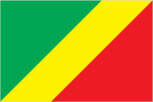
divided diagonally from the lower hoist side by a yellow band; the upper triangle (hoist side) is green and the lower triangle is red; uses the popular pan-African colors of Ethiopia
Location
1 00 S, 15 00 E -- Western Africa, bordering the South Atlantic Ocean, between Angola and Gabon Flag ----
Geography
Area
- comparative area
- slightly smaller than Montana
- land area
- 341,500 sq km
- total area
- 342,000 sq km
Climate
tropical; rainy season (March to June); dry season (June to October); constantly high temperatures and humidity; particularly enervating climate astride the Equator
Coastline
169 km
Environment
- current issues
- air pollution from vehicle emissions; water pollution from the dumping of raw sewage; tap water is not potable; deforestation
- international agreements
- party to - Endangered Species, Ozone Layer Protection, Tropical Timber 83; signed, but not ratified - Biodiversity, Climate Change, Desertification, Law of the Sea, Tropical Timber 94
- natural hazards
- seasonal flooding
Geographic coordinates
1 00 S, 15 00 E
Geographic note
about 70% of the population lives in Brazzaville, Pointe Noire, or along the railroad between them
International disputes
long segment of boundary with Zaire along the Congo River is indefinite (no division of the river or its islands has been made)
Irrigated land
40 sq km (1989)
Land boundaries
- border countries
- Angola 201 km, Cameroon 523 km, Central African Republic 467 km, Gabon 1,903 km, Zaire 2,410 km
- total
- 5,504 km
Land use
- arable land
- 2%
- forest and woodland
- 62%
- meadows and pastures
- 29%
- other
- 7%
- permanent crops
- 0%
Location
Western Africa, bordering the South Atlantic Ocean, between Angola and Gabon
Map references
Africa
Maritime claims
- territorial sea
- 200 nm
Natural resources
petroleum, timber, potash, lead, zinc, uranium, copper, phosphates, natural gas
Terrain
- coastal plain, southern basin, central plateau, northern basin
- highest point
- Mount Berongou 903 m
- lowest point
- Atlantic Ocean 0 m
People and Society
Age structure
0-14 years: 43% (male 550,971; female 545,096) 15-64 years: 53% (male 657,035; female 688,441) 65 years and over: 4% (male 34,973; female 51,325) (July 1996 est.)
Birth rate
39.19 births/1,000 population (1996 est.)
Death rate
17.35 deaths/1,000 population (1996 est.)
Ethnic divisions
- center
- Teke 17%, Europeans 8,500 (mostly French)
- north
- Sangha 20%, M'Bochi 12%
- south
- Kongo 48%
Infant mortality rate
108.1 deaths/1,000 live births (1996 est.)
Languages
French (official), African languages (Lingala and Kikongo are the most widely used)
Life expectancy at birth
- female
- 47.37 years (1996 est.)
- male
- 44.21 years
- total population
- 45.77 years
Literacy
- age 15 and over can read and write (1995 est.)
- female
- 67.2%
- male
- 83.1%
- total population
- 74.9%
Nationality
- adjective
- Congolese or Congo
- noun
- Congolese (singular and plural)
Net migration rate
0 migrant(s)/1,000 population (1996 est.)
Population
2,527,841 (July 1996 est.)
Population growth rate
2.19% (1996 est.)
Religions
Christian 50%, animist 48%, Muslim 2%
Sex ratio
- all ages
- 0.97 male(s)/female (1996 est.)
- at birth
- 1.03 male(s)/female
- under 15 years
- 1.01 male(s)/female 15-64 years: 0.95 male(s)/female 65 years and over: 0.68 male(s)/female
Total fertility rate
5.15 children born/woman (1996 est.)
Government
Administrative divisions
9 regions (regions, singular - region) and 1 commune*; Bouenza, Brazzaville*, Cuvette, Kouilou, Lekoumou, Likouala, Niari, Plateaux, Pool, Sangha
Capital
Brazzaville
Constitution
new constitution approved by referendum March 1992
Data code
CF
Diplomatic representation in US
- chancery
- 4891 Colorado Avenue NW, Washington, DC 20011
- chief of mission
- Ambassador (vacant); Charge d'Affaires Daniel MOUELLET
- telephone
- [1] (202) 726-0825
Executive branch
- cabinet
- Council of Ministers appointed by the president
- chief of state
- President Pascal LISSOUBA (since August 1992); elected for a five-year term by universal suffrage; election last held NA August 1992 (next to be held NA August 1997); results - President Pascal LISSOUBA won 61% of the vote
- head of government
- Prime Minister Jacques Joachim YHOMBI-OPANGO (since 23 June 1993) appointed by the president
FAX
- [1] (202) 726-1860
- [242] 83 63 38
Flag
divided diagonally from the lower hoist side by a yellow band; the upper triangle (hoist side) is green and the lower triangle is red; uses the popular pan-African colors of Ethiopia
Independence
15 August 1960 (from France)
International organization participation
ACCT, ACP, AfDB, BDEAC, CCC, CEEAC, ECA, FAO, FZ, G-77, IBRD, ICAO, ICRM, IDA, IFAD, IFC, IFRCS, ILO, IMF, IMO, Intelsat, Interpol, IOC, ITU, NAM, OAU, UDEAC, UN, UNAMIR, UNAVEM III, UNCTAD, UNESCO, UNIDO, UPU, WFTU, WHO, WIPO, WMO, WToO
Judicial branch
Supreme Court (Cour Supreme)
Legal system
based on French civil law system and customary law
Legislative branch
bicameral
Name of country
- conventional long form
- Republic of the Congo
- conventional short form
- Congo
- former
- Congo/Brazzaville
- local long form
- Republique Populaire du Congo
- local short form
- Congo
National Assembly (Assemblee Nationale)
election last held 3 October 1993 (next to be held NA); results - percent of vote by party NA; seats - (125 total) UPADS 64, URD/PCT 58, others 3
National holiday
Congolese National Day, 15 August (1960)
Other political or pressure groups
Union of Congolese Socialist Youth (UJSC); Congolese Trade Union Congress (CSC); Revolutionary Union of Congolese Women (URFC); General Union of Congolese Pupils and Students (UGEEC)
Political parties and leaders
of Congo's many political parties, the most important are Congolese Labor Party (PCT), Denis SASSOU-NGUESSO, president; Association for Democracy and Development (RDD), Joachim Yhombi OPANGO, president; Association for Democracy and Social Progress (RDPS), Jean-Pierre Thystere TCHICAYA, president; Congolese Movement for Democracy and Integral Development (MCDDI), Bernard KOLELAS, leader; Pan-African Union for Social Development (UPADS), Pascal LISSOUBA, leader; Union of Democratic Forces (UFD), David Charles GANAO, leader; Union for Democratic Renewal (URD); Union for Development and Social Progress (UDPS), Jean-Michael BOKAMBA-YANGOUMA, leader
Senate
election last held 26 July 1992 (next to be held NA July 1998); results - percent of vote by party NA; seats - (60 total) UPADS 23, MCDDI 14, RDD 8, RDPS 5, PCT 2, others 8
Suffrage
18 years of age; universal
Type of government
republic
US diplomatic representation
- chief of mission
- Ambassador William C. RAMSEY
- embassy
- Avenue Amilcar Cabral, Brazzaville
- mailing address
- B. P. 1015, Brazzaville
- telephone
- [242] 83 20 70
Economy
Agriculture
cassava (tapioca) accounts for 90% of food output, sugar, rice, corn, peanuts, vegetables, coffee, cocoa; forest products
Budget
- expenditures
- $NA, including capital expenditures of $NA
- revenues
- $2.18 billion (1994 est.)
Currency
1 Communaute Financiere Africaine franc (CFAF) = 100 centimes
Economic aid
- recipient
- ODA, $NA
Economic overview
Congo's economy is a mixture of village agriculture and handicrafts, an industrial sector based largely on oil, support services, and a government characterized by budget problems and overstaffing. Oil has supplanted forestry as the mainstay of the economy, providing about 90% of government revenues and exports. In the early 1980s, rapidly rising oil revenues enabled Congo to finance large-scale development projects with GDP growth averaging 5% annually, one of the highest rates in Africa. Subsequently, falling oil prices cut GDP growth by half. Moreover, the Congolese Government has mortgaged a substantial portion of its oil earnings, contributing to the government's shortage of revenues. The 12 January 1994 devaluation of Franc Zone currencies by 50% resulted in inflation of 61% in 1994. Recent efforts to implement economic reforms have begun to show progress; the IMF has recommended approval of an Enhanced Structural Adjustment Facility agreement in 1996.
Electricity
- capacity
- 120,000 kW
- consumption per capita
- 201 kWh (1993)
- production
- 400 million kWh
Exchange rates
- CFA francs (CFAF) per US$1 - 500.56 (January 1996), 499.15 (1995), 555.20 (1994), 283.16 (1993), 264.69 (1992), 282.11 (1991)
- note
- beginning 12 January 1994, the CFA franc was devalued to CFAF 100 per French franc from CFAF 50 at which it had been fixed since 1948
Exports
- $1 billion (f.o.b., 1995)
- commodities
- crude oil 90%, lumber, plywood, sugar, cocoa, coffee, diamonds
- partners
- Italy, France, Spain, other EU countries, US, Taiwan
External debt
$5 billion (1993)
Fiscal year
calendar year
GDP
purchasing power parity - $7.7 billion (1995 est.)
GDP composition by sector
- agriculture
- 11.4%
- industry
- 35.2%
- services
- 53.4% (1993)
GDP per capita
$3,100 (1995 est.)
GDP real growth rate
3.3% (1995 est.)
Imports
- $600 million (c.i.f., 1995)
- commodities
- intermediate manufactures, capital equipment, construction materials, foodstuffs, petroleum products
- partners
- France, Italy, other EU countries, US, Japan, Thailand
Industrial production growth rate
3.7% (estimated average annual growth rate for 1980-92)
Industries
petroleum extraction, cement kilning, lumbering, brewing, sugar milling, palm oil, soap, cigarette making
Inflation rate (consumer prices)
61% (1994 est.)
Labor force
- 79,100 wage earners
- by occupation
- agriculture 75%, commerce, industry, and government 25%
Unemployment rate
NA%
Communications
Branches
Army, Navy (includes Marines), Air Force, National Police
Defense expenditures
exchange rate conversion - $110 million, 3.8% of GDP (1993)
Manpower availability
- males age 15-49
- 582,103
- males fit for military service
- 296,602
- males reach military age (20) annually
- 25,247 (1996 est.)
Radio broadcast stations
AM 4, FM 1, shortwave 0
Radios
NA
Telephone system
- services adequate for government use; key exchanges are in Brazzaville, Pointe-Noire, and Loubomo
- domestic
- primary network consists of microwave radio relay and coaxial cable
- international
- satellite earth station - 1 Intelsat (Atlantic Ocean)
Telephones
18,000 (1983 est.)
Television broadcast stations
4 (1987 est.)
Televisions
8,500 (1993 est.) Defense
Transportation
Airports
- total
- 34
- with paved runways 1 524 to 2 437 m
- 3
- with paved runways over 3 047 m
- 1
- with paved runways under 914 m
- 9
- with unpaved runways 1 524 to 2 437 m
- 7
- with unpaved runways 914 to 1 523 m
- 14 (1995 est.)
Highways
- paved
- 1,236 km
- total
- 12,745 km
- unpaved
- 11,509 km (1992 est.)
Merchant marine
- total
- 1 cargo ship (1,000 GRT or over) totaling 2,218 GRT/4,100 DWT (1995 est.)
Pipelines
crude oil 25 km
Ports
Brazzaville, Impfondo, Ouesso, Oyo, Pointe-Noire
Railways
- narrow gauge
- 795 km 1.067-m gauge (includes 285 km that are privately owned)
- total
- 795 km (1995 est.)
Waterways
the Congo and Ubangi (Oubangui) Rivers provide 1,120 km of commercially navigable water transport; other rivers are used for local traffic only