2011 Edition
CIA World Factbook 2011 Archive (HTML)
Introduction
Background
Comoros has endured more than 20 coups or attempted coups since gaining independence from France in 1975. In 1997, the islands of Anjouan and Moheli declared independence from Comoros. In 1999, military chief Col. AZALI seized power in a bloodless coup, and helped negotiate the 2000 Fomboni Accords power-sharing agreement in which the federal presidency rotates among the three islands, and each island maintains its own local government. AZALI won the 2002 presidential election, and each island in the archipelago elected its own president. AZALI stepped down in 2006 and President SAMBI was elected to office. In 2007, Mohamed BACAR effected Anjouan's de-facto secession from the Union, refusing to step down in favor of fresh Anjouanais elections when Comoros' other islands held legitimate elections in July. The African Union (AU) initially attempted to resolve the political crisis by applying sanctions and a naval blockade on Anjouan, but in March 2008, AU and Comoran soldiers seized the island. The move was generally welcomed by the island's inhabitants.
Geography
Area
- 2,235 sq km 2,235 sq km 0 sq km
- total
- 2,235 sq km
- water
- 0 sq km
Area - comparative
slightly more than 12 times the size of Washington, DC
Climate
tropical marine; rainy season (November to May)
Coastline
340 km
Elevation extremes
- Indian Ocean 0 m Karthala 2,360 m
- highest point
- Karthala 2,360 m
- lowest point
- Indian Ocean 0 m
Environment - current issues
soil degradation and erosion results from crop cultivation on slopes without proper terracing; deforestation
Environment - international agreements
- Biodiversity, Climate Change, Climate Change-Kyoto Protocol, Desertification, Endangered Species, Hazardous Wastes, Law of the Sea, Ozone Layer Protection, Ship Pollution, Wetlands none of the selected agreements
- party to
- Biodiversity, Climate Change, Climate Change-Kyoto Protocol, Desertification, Endangered Species, Hazardous Wastes, Law of the Sea, Ozone Layer Protection, Ship Pollution, Wetlands
- signed, but not ratified
- none of the selected agreements
Freshwater withdrawal (domestic/industrial/agricultural)
- 0.01 cu km/yr (48%/5%/47%) 13 cu m/yr (1999)
- per capita
- 13 cu m/yr (1999)
- total
- 0.01 cu km/yr (48%/5%/47%)
Geographic coordinates
12 10 S, 44 15 E
Geography - note
important location at northern end of Mozambique Channel
Irrigated land
NA
Land boundaries
0 km
Land use
- 35.87% 23.32% 40.81% (2005)
- arable land
- 35.87%
- other
- 40.81% (2005)
- permanent crops
- 23.32%
Location
Southern Africa, group of islands at the northern mouth of the Mozambique Channel, about two-thirds of the way between northern Madagascar and northern Mozambique
Map references
Africa
Maritime claims
- 12 nm 200 nm
- exclusive economic zone
- 200 nm
- territorial sea
- 12 nm
Natural hazards
- cyclones possible during rainy season (December to April); volcanic activity on Grand Comore Karthala (elev. 2,361 m) on Grand Comore Island last erupted in 2007; a 2005 eruption forced thousands of people to be evacuated and produced a large ash cloud
- volcanism
- Karthala (elev. 2,361 m) on Grand Comore Island last erupted in 2007; a 2005 eruption forced thousands of people to be evacuated and produced a large ash cloud
Natural resources
NEGL
Terrain
volcanic islands, interiors vary from steep mountains to low hills
Total renewable water resources
1.2 cu km (2003)
People and Society
Age structure
- 41.6% (male 166,141/female 164,788) 55.3% (male 217,046/female 222,093) 3.1% (male 11,053/female 13,562) (2011 est.)
- 0-14 years
- 41.6% (male 166,141/female 164,788)
- 15-64 years
- 55.3% (male 217,046/female 222,093)
- 65 years and over
- 3.1% (male 11,053/female 13,562) (2011 est.)
Birth rate
34.19 births/1,000 population (2011 est.)
Children under the age of 5 years underweight
25% (2000)
Death rate
7.23 deaths/1,000 population (July 2011 est.)
Drinking water source
- urban: 91% of population rural: 97% of population total: 95% of population urban: 9% of population rural: 3% of population total: 5% of population (2008)
- rural
- 3% of population
- total
- 5% of population (2008)
- urban
- 9% of population
Education expenditures
7.6% of GDP (2008)
Ethnic groups
Antalote, Cafre, Makoa, Oimatsaha, Sakalava
Health expenditures
3.4% of GDP (2009)
HIV/AIDS - adult prevalence rate
0.1% (2009 est.)
HIV/AIDS - deaths
fewer than 100 (2009 est.)
HIV/AIDS - people living with HIV/AIDS
fewer than 500 (2009 est.)
Hospital bed density
2.2 beds/1,000 population (2006)
Infant mortality rate
- 62.63 deaths/1,000 live births 70.3 deaths/1,000 live births 54.73 deaths/1,000 live births (2011 est.)
- female
- 54.73 deaths/1,000 live births (2011 est.)
- total
- 62.63 deaths/1,000 live births
Languages
Arabic (official), French (official), Shikomoro (a blend of Swahili and Arabic)
Life expectancy at birth
- 64.2 years 61.76 years 66.72 years (2011 est.)
- female
- 66.72 years (2011 est.)
- total population
- 64.2 years
Literacy
- age 15 and over can read and write 56.5% 63.6% 49.3% (2003 est.)
- definition
- age 15 and over can read and write
- female
- 49.3% (2003 est.)
- male
- 63.6%
- total population
- 56.5%
Major cities - population
MORONI (capital) 49,000 (2009)
Maternal mortality rate
340 deaths/100,000 live births (2008)
Median age
- 19 years 18.7 years 19.3 years (2011 est.)
- female
- 19.3 years (2011 est.)
- male
- 18.7 years
- total
- 19 years
Nationality
- Comoran(s) Comoran
- adjective
- Comoran
- noun
- Comoran(s)
Net migration rate
0 migrant(s)/1,000 population (2011 est.)
Physicians density
0.15 physicians/1,000 population (2004)
Population
794,683 (July 2011 est.)
Population growth rate
2.696% (2011 est.)
Religions
Sunni Muslim 98%, Roman Catholic 2%
Sanitation facility access
- urban: 50% of population rural: 30% of population total: 36% of population urban: 50% of population rural: 70% of population total: 64% of population (2008)
- rural
- 70% of population
- total
- 64% of population (2008)
- urban
- 50% of population
School life expectancy (primary to tertiary education)
- 11 years 12 years 10 years (2005)
- female
- 10 years (2005)
- male
- 12 years
- total
- 11 years
Sex ratio
- 1.03 male(s)/female 1.01 male(s)/female 0.98 male(s)/female 0.83 male(s)/female 0.98 male(s)/female (2011 est.)
- 15-64 years
- 0.98 male(s)/female
- 65 years and over
- 0.83 male(s)/female
- at birth
- 1.03 male(s)/female
- total population
- 0.98 male(s)/female (2011 est.)
- under 15 years
- 1.01 male(s)/female
Total fertility rate
4.72 children born/woman (2011 est.)
Urbanization
- 28% of total population (2010) 2.8% annual rate of change (2010-15 est.)
- rate of urbanization
- 2.8% annual rate of change (2010-15 est.)
- urban population
- 28% of total population (2010)
Government
Administrative divisions
3 islands and 4 municipalities*; Grande Comore (N'gazidja), Anjouan (Ndzuwani), Domoni*, Fomboni*, Moheli (Mwali), Moroni*, Moutsamoudou*
Capital
- Moroni 11 42 S, 43 14 E UTC+3 (8 hours ahead of Washington, DC during Standard Time)
- geographic coordinates
- 11 42 S, 43 14 E
- name
- Moroni
- time difference
- UTC+3 (8 hours ahead of Washington, DC during Standard Time)
Constitution
23 December 2001
Country name
- Union of the Comoros Comoros Udzima wa Komori (Comorian); Union des Comores (French); Jumhuriyat al Qamar al Muttahidah (Arabic) Komori (Comorian); Comores (French); Juzur al Qamar (Arabic)
- conventional long form
- Union of the Comoros
- conventional short form
- Comoros
- local long form
- Udzima wa Komori (Comorian); Union des Comores (French); Jumhuriyat al Qamar al Muttahidah (Arabic)
- local short form
- Komori (Comorian); Comores (French); Juzur al Qamar (Arabic)
Diplomatic representation from the US
the US does not have an embassy in Comoros; the ambassador to Madagascar is accredited to Comoros
Diplomatic representation in the US
- Ambassador Mohamed TOIHIRI; note - also serves Permanent Representative to the UN Mission to the US, 866 United Nations Plaza, Suite 418, New York, NY 10017 [1] (212) 750-1637
- chancery
- Mission to the US, 866 United Nations Plaza, Suite 418, New York, NY 10017
- chief of mission
- Ambassador Mohamed TOIHIRI; note - also serves Permanent Representative to the UN
- telephone
- [1] (212) 750-1637
Executive branch
- President Ikililou DHOININE (since 26 May 2011) President Ikililou DHOININE (since 26 May 2011) Council of Ministers appointed by the president as defined by the 2001 constitution, the presidency rotates every four years among the elected presidents from the three main islands in the Union; election last held on 7 November and 26 December 2010 (next to be held in 2014) Ikililou DHOININE elected president; percent of vote - Ikililou DHOININE 61.1%, Mohamed Said FAZUL 32.7%, Abdou DJABIR 6.2%
- cabinet
- Council of Ministers appointed by the president
- chief of state
- President Ikililou DHOININE (since 26 May 2011)
- election results
- Ikililou DHOININE elected president; percent of vote - Ikililou DHOININE 61.1%, Mohamed Said FAZUL 32.7%, Abdou DJABIR 6.2%
- elections
- as defined by the 2001 constitution, the presidency rotates every four years among the elected presidents from the three main islands in the Union; election last held on 7 November and 26 December 2010 (next to be held in 2014)
- head of government
- President Ikililou DHOININE (since 26 May 2011)
Flag description
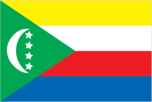
four equal horizontal bands of yellow (top), white, red, and blue, with a green isosceles triangle based on the hoist; centered within the triangle is a white crescent with the convex side facing the hoist and four white, five-pointed stars placed vertically in a line between the points of the crescent; the horizontal bands and the four stars represent the four main islands of the archipelago - Mwali, N'gazidja, Nzwani, and Mahore (Mayotte - territorial collectivity of France, but claimed by Comoros) the crescent, stars, and color green are traditional symbols of Islam
Government type
republic
Independence
6 July 1975 (from France)
International law organization participation
has not submitted an ICJ jurisdiction declaration; accepts ICCt jurisdiction
International organization participation
ACP, AfDB, AMF, AOSIS, AU, COMESA, FAO, FZ, G-77, IBRD, ICAO, ICRM, IDA, IDB, IFAD, IFC, IFRCS, ILO, IMF, IMO, IMSO, InOC, Interpol, IOC, IPU, ITSO, ITU, ITUC, LAS, NAM, OIC, OIF, OPCW, UN, UNCTAD, UNESCO, UNIDO, UPU, WCO, WHO, WIPO, WMO, WTO (observer)
Judicial branch
Supreme Court or Cour Supremes (two members appointed by the president, two members elected by the Federal Assembly, one elected by the Council of each island, and others are former presidents of the republic)
Legal system
mixed legal system of Islamic religious law, the French civil code of 1975, and customary law
Legislative branch
- unicameral Assembly of the Union (33 seats; 15 deputies are selected by the individual islands' local assemblies and 18 by universal suffrage to serve for five years); last held on 6 and 20 December 2009 (next to be held in 2014) percent of vote by party - NA; seats by party - pro-union coalition 19, autonomous coalition 4, independents 1; note - 9 additional seats are filled by deputies from local island assemblies
- election results
- percent of vote by party - NA; seats by party - pro-union coalition 19, autonomous coalition 4, independents 1; note - 9 additional seats are filled by deputies from local island assemblies
- elections
- last held on 6 and 20 December 2009 (next to be held in 2014)
National anthem
- "Udzima wa ya Masiwa" (The Union of the Great Islands) Said Hachim SIDI ABDEREMANE/Said Hachim SIDI ABDEREMANE and Kamildine ABDALLAH adopted 1978
- lyrics/music
- Said Hachim SIDI ABDEREMANE/Said Hachim SIDI ABDEREMANE and Kamildine ABDALLAH
- name
- "Udzima wa ya Masiwa" (The Union of the Great Islands)
National holiday
Independence Day, 6 July (1975)
National symbol(s)
four stars and crescent
Political parties and leaders
Camp of the Autonomous Islands or CdIA (a coalition of parties organized by the islands' presidents in opposition to the Union President); Convention for the Renewal of the Comoros or CRC [AZALI Assowmani]; Front National pour la Justice or FNJ [Ahmed RACHID] (Islamic party in opposition); Mouvement pour la Democratie et le Progress or MDP-NGDC [Abbas DJOUSSOUF]; Parti Comorien pour la Democratie et le Progress or PCDP [Ali MROUDJAE]; Rassemblement National pour le Development or RND [Omar TAMOU, Abdoulhamid AFFRAITANE]
Political pressure groups and leaders
- environmentalists
- other
- environmentalists
Suffrage
18 years of age; universal
Economy
Agriculture - products
vanilla, cloves, ylang-ylang (perfume essence), copra, coconuts, bananas, cassava (tapioca)
Budget
- $118.2 million $NA (2010 est.)
- expenditures
- $NA (2010 est.)
- revenues
- $118.2 million
Budget surplus (+) or deficit (-)
-1.6% of GDP (2010 est.)
Central bank discount rate
1.93% (31 December 2010 est.) 2.21% (31 December 2009 est.)
Commercial bank prime lending rate
10.5% (31 December 2010 est.) 10.5% (31 December 2009 est.)
Current account balance
-$45.1 million (2010 est.) -$46.54 million (2009 est.)
Debt - external
$279.3 million (31 December 2009 est.) $279.3 million (2000 est.)
Economy - overview
One of the world's poorest countries, Comoros is made up of three islands that have inadequate transportation links, a young and rapidly increasing population, and few natural resources. The low educational level of the labor force contributes to a subsistence level of economic activity, high unemployment, and a heavy dependence on foreign grants and technical assistance. Agriculture, including fishing, hunting, and forestry, contributes 40% to GDP, employs 80% of the labor force, and provides most of the exports. Export income is heavily reliant on the three main crops of vanilla, cloves, and ylang-ylang and Comoros' export earnings are easily disrupted by disasters such as fires. The country is not self-sufficient in food production; rice, the main staple, accounts for the bulk of imports. The government - which is hampered by internal political disputes - lacks a comprehensive strategy to attract foreign investment and is struggling to upgrade education and technical training, privatize commercial and industrial enterprises, improve health services, diversify exports, promote tourism, and reduce the high population growth rate. Political problems have inhibited growth, which has averaged only about 1% in 2006-09. Remittances from 150,000 Comorans abroad help supplement GDP. In September 2009 the IMF approved Comoros for a three-year $21 million loan. The IMF gave generally positive reports of the country's program performance as of October 2010. The African Development Bank approved a $34.6 million debt-relief package loan for Comoros in September 2010, and Comoros will attempt to qualify for debt relief in 2012 under the IMF and World Bank's Heavily Indebted Poor Countries (HIPC) initiative.
Electricity - consumption
48.36 million kWh (2008 est.)
Electricity - exports
0 kWh (2009 est.)
Electricity - imports
0 kWh (2009 est.)
Electricity - production
52 million kWh (2008 est.)
Exchange rates
Comoran francs (KMF) per US dollar - 361.4 (2007) 391.8 (2006) 395.6 (2005) 396.21 (2004) 435.9 (2003)
Exports
$12.8 million (2010 est.) $11.94 million (2009 est.)
Exports - commodities
vanilla, ylang-ylang (perfume essence), cloves, copra
Exports - partners
France 25.2%, Singapore 21.5%, Turkey 11.5%, Saudi Arabia 7.4%, US 7.2%, Netherlands 7%, Germany 4.6% (2010)
GDP - composition by sector
- 41.8% 8.6% 49.6% (2010 est.)
- agriculture
- 41.8%
- industry
- 8.6%
- services
- 49.6% (2010 est.)
GDP - per capita (PPP)
$1,000 (2010 est.) $1,000 (2009 est.) $1,100 (2008 est.) data are in 2010 US dollars
GDP - real growth rate
2.1% (2010 est.) 1.8% (2009 est.) 1% (2008 est.)
GDP (official exchange rate)
$534 million (2010 est.)
GDP (purchasing power parity)
$800 million (2010 est.) $783.4 million (2009 est.) $769.2 million (2008 est.) data are in 2010 US dollars
Household income or consumption by percentage share
- 0.9% 55.2% (2004)
- highest 10%
- 55.2% (2004)
- lowest 10%
- 0.9%
Imports
$188.8 million (2010 est.) $169.6 million (2009 est.)
Imports - commodities
rice and other foodstuffs, consumer goods, petroleum products, cement, transport equipment
Imports - partners
France 15.6%, Pakistan 15.5%, UAE 9.5%, China 6.9%, India 5.7%, Kenya 5.3%, Spain 4.5% (2010)
Industrial production growth rate
NA%
Industries
fishing, tourism, perfume distillation
Inflation rate (consumer prices)
2.7% (2010 est.) 4.8% (2009 est.)
Investment (gross fixed)
10.9% of GDP (2020 est.)
Labor force
268,500 (2007 est.)
Labor force - by occupation
- 80% 20% (1996 est.)
- agriculture
- 80%
- industry and services
- 20% (1996 est.)
Natural gas - consumption
0 cu m (2009 est.)
Natural gas - exports
0 cu m (2009 est.)
Natural gas - imports
0 cu m (2009 est.)
Natural gas - production
0 cu m (2009 est.)
Natural gas - proved reserves
0 cu m (1 January 2011 est.)
Oil - consumption
1,000 bbl/day (2010 est.)
Oil - exports
0 bbl/day (2009 est.)
Oil - imports
967 bbl/day (2009 est.)
Oil - production
0 bbl/day (2010 est.)
Oil - proved reserves
0 bbl (1 January 2011 est.)
Population below poverty line
60% (2002 est.)
Reserves of foreign exchange and gold
$146.1 million (31 December 2010 est.) $150.9 million (31 December 2009 est.)
Stock of broad money
$186.7 million (31 December 2010 est.) $168.6 million (31 December 2009 est.)
Stock of domestic credit
$120.6 million (31 December 2010 est.) $108.8 million (31 December 2009 est.)
Stock of narrow money
$115.8 million (31 December 2010 est.) $104.7 million (31 December 2009 est.)
Taxes and other revenues
22.1% of GDP (2010 est.)
Unemployment rate
20% (1996 est.)
Communications
Broadcast media
national state-owned TV station and a TV station run by Anjouan regional government; national state-owned radio; regional governments on the islands of Grande Comore and Anjouan each operate a radio station; a few independent and small community radio stations operate on the islands of Grande Comore and Moheli, and these two islands have access to Mayotte Radio and French TV (2007)
Internet country code
.km
Internet hosts
14 (2010)
Internet users
24,300 (2009)
Telephone system
- sparse system of microwave radio relay and HF radiotelephone communication stations fixed-line connections only about 3 per 100 persons; mobile cellular usage about 15 per 100 persons country code - 269; HF radiotelephone communications to Madagascar and Reunion
- domestic
- fixed-line connections only about 3 per 100 persons; mobile cellular usage about 15 per 100 persons
- general assessment
- sparse system of microwave radio relay and HF radiotelephone communication stations
- international
- country code - 269; HF radiotelephone communications to Madagascar and Reunion
Telephones - main lines in use
21,000 (2010)
Telephones - mobile cellular
165,300 (2010)
Transportation
Airports
4 (2010)
Airports - with paved runways
- 3 (2010)
- 2,438 to 3,047 m
- 1
- 914 to 1,523 m
- 3 (2010)
- total
- 4
Merchant marine
- bulk carrier 19, cargo 102, carrier 5, chemical tanker 6, container 2, passenger 3, passenger/cargo 1, petroleum tanker 15, refrigerated cargo 12, roll on/roll off 12 98 (Bangladesh 1, Bulgaria 8, China 1, Cyprus 2, Greece 3, Kenya 1, Kuwait 1, Latvia 1, Lebanon 3, Lithuania 3, Monaco 1, Nigeria 1, Norway 2, Pakistan 3, Russia 21, Syria 6, Turkey 16, UAE 11, UK 1, Ukraine 10, US 2) (2010)
- foreign-owned
- 98 (Bangladesh 1, Bulgaria 8, China 1, Cyprus 2, Greece 3, Kenya 1, Kuwait 1, Latvia 1, Lebanon 3, Lithuania 3, Monaco 1, Nigeria 1, Norway 2, Pakistan 3, Russia 21, Syria 6, Turkey 16, UAE 11, UK 1, Ukraine 10, US 2) (2010)
- total
- 177
Ports and terminals
Mayotte, Mutsamudu
Roadways
- 880 km 673 km 207 km (2002)
- total
- 880 km
- unpaved
- 207 km (2002)
Military and Security
Manpower available for military service
- 184,236 183,363 (2010 est.)
- females age 16-49
- 183,363 (2010 est.)
- males age 16-49
- 184,236
Manpower fit for military service
- 134,562 145,797 (2010 est.)
- females age 16-49
- 145,797 (2010 est.)
- males age 16-49
- 134,562
Manpower reaching militarily significant age annually
- 8,831 8,809 (2010 est.)
- female
- 8,809 (2010 est.)
- male
- 8,831
Military branches
- Army of National Development (l'Armee du Developpement Nationale, AND): Comoran Security Force (also called Comoran Defense Force (Force Comorieene de Defense FCD, includes Gendarmarie)), Comoran Coast Guard, Comoran Federal Police (2011)
- Army of National Development (l'Armee du Developpement Nationale, AND)
- Comoran Security Force (also called Comoran Defense Force (Force Comorieene de Defense FCD, includes Gendarmarie)), Comoran Coast Guard, Comoran Federal Police (2011)
Military expenditures
2.8% of GDP (2006)
Military service age and obligation
18 years of age for 2-year voluntary military service; no conscription; women first inducted into the Army in 2004 (2011)
Transnational Issues
Disputes - international
claims French-administered Mayotte and challenges France's and Madagascar's claims to Banc du Geyser, a drying reef in the Mozambique Channel; in May 2008, African Union forces are called in to assist the Comoros military recapture Anjouan Island from rebels who seized it in 2001
Trafficking in persons
- Comoros is a source country for men, women, and children subjected to forced labor and sex trafficking; children are subjected to forced labor within the country in domestic service, roadside and market vending, baking, and agriculture Tier 2 Watch List - Comoros does not fully comply with the minimum standards for the elimination of trafficking; however, it is making significant efforts to do so; the government, in partnership with international organizations, began implementation of a National Disarmament, Demobilization, and Reintegration Plan, through which 40 former child soldiers, some of whom were trafficking victims, received protective services; it also began implementation of a national action plan to address the worst forms of child labor; however, negligible efforts were made to prevent the use of forced child labor or to investigate suspected cases; the government made no discernible efforts to investigate, prosecute, or convict trafficking offenders, under existing legislation; care to victims of sex or labor trafficking and prevention efforts were minimal (2011)
- current situation
- Comoros is a source country for men, women, and children subjected to forced labor and sex trafficking; children are subjected to forced labor within the country in domestic service, roadside and market vending, baking, and agriculture
- tier rating
- Tier 2 Watch List - Comoros does not fully comply with the minimum standards for the elimination of trafficking; however, it is making significant efforts to do so; the government, in partnership with international organizations, began implementation of a National Disarmament, Demobilization, and Reintegration Plan, through which 40 former child soldiers, some of whom were trafficking victims, received protective services; it also began implementation of a national action plan to address the worst forms of child labor; however, negligible efforts were made to prevent the use of forced child labor or to investigate suspected cases; the government made no discernible efforts to investigate, prosecute, or convict trafficking offenders, under existing legislation; care to victims of sex or labor trafficking and prevention efforts were minimal (2011)