1997 Edition
CIA World Factbook 1997 (Project Gutenberg)
Geography
Area
total : 2,170 sq km land: 2,170 sq km water: 0 sq km
Area - comparative
slightly more than 12 times the size of Washington, DC
Climate
tropical marine; rainy season (November to May)
Coastline
340 km
Elevation extremes
lowest point: Indian Ocean 0 m highest point: Mount Kartala 2,360 m
Environment - current issues
soil degradation and erosion results from crop cultivation on slopes without proper terracing; deforestation
Environment - international agreements
party to: Biodiversity, Climate Change, Endangered Species, Hazardous Wastes, Law of the Sea, Ozone Layer Protection signed, but not ratified: Desertification
Geographic coordinates
12 10 S, 44 15 E
Geography - note
important location at northern end of Mozambique Channel
Irrigated land
NA sq km
Land boundaries
0 km
Land use
arable land: 35% permanent crops: 10% permanent pastures: 7% forests and woodland : 18% other: 30% (1993 est.)
Location
Southern Africa, group of islands in the Mozambique Channel, about two-thirds of the way between northern Madagascar and northern Mozambique
Map references
Africa
Maritime claims
exclusive economic zone: 200 nm territorial sea: 12 nm
Natural hazards
cyclones and tsunamis possible during rainy season (December to April); Mount Kartala on Grand Comore is an active volcano
Natural resources
negligible
Terrain
volcanic islands, interiors vary from steep mountains to low hills
People and Society
Age structure
0-14 years: 42% (male 112,404; female 111,936) 15-64 years: 55% (male 142,604; female 146,382) 65 years and over : 3% (male 7,432; female 8,135) (July 1997 est.)
Birth rate
40.75 births/1,000 population (1997 est.)
Death rate
9.82 deaths/1,000 population (1997 est.)
Ethnic groups
Antalote, Cafre, Makoa, Oimatsaha, Sakalava
Infant mortality rate
87.4 deaths/1,000 live births (1997 est.)
Languages
Arabic (official), French (official), Comoran (a blend of Swahili and Arabic)
Life expectancy at birth
total population: 59.88 years male : 57.52 years female: 62.32 years (1997 est.)
Literacy
definition: age 15 and over can read and write total population: 57.3% male: 64.2% female: 50.4% (1995 est.)
Nationality
noun: Comoran(s) adjective: Comoran
Net migration rate
0 migrant(s)/1,000 population (1997 est.)
Population
528,893 (July 1997 est.)
Population growth rate
3.09% (1997 est.)
Religions
Sunni Muslim 86%, Roman Catholic 14%
Sex ratio
at birth : 1.03 male(s)/female under 15 years: 1 male(s)/female 15-64 years: 0.97 male(s)/female 65 years and over: 0.91 male(s)/female total population: 0.98 male(s)/female (1997 est.)
Total fertility rate
5.54 children born/woman (1997 est.)
Government
Administrative divisions
three islands; Grand Comore (Njazidja), Anjouan (Nzwani), and Moheli (Mwali) note: there are also four municipalities named Domoni, Fomboni, Moroni, and Mutsamudu
Constitution
7 June 1992
Country name
conventional long form : Federal Islamic Republic of the Comoros conventional short form: Comoros local long form: Republique Federale Islamique des Comores local short form: Comores
Data code
CN
Diplomatic representation from the US
the US does not have an embassy in Comoros; the ambassador to Mauritius is accredited to Comoros
Diplomatic representation in the US
chief of mission: Ambassador (vacant) Charge d'Affaires ad interim Mahmoud M. ABOUD (ambassador to the US and Canada) chancery: (temporary) care of the Permanent Mission of the Federal and Islamic Republic of the Comoros to the United Nations, 336 East 45th Street, 2nd Floor, New York, NY 10017 telephone: [1] (212) 972-8010
Executive branch
chief of state: President Mohamed TAKI Abdulkarim (since 16 March 1996) head of government: Prime Minister Ahmed ABDOU (since 27 December 1996) cabinet: Council of Ministers appointed by the president elections: president elected by popular vote to a five-year term; election last held 16 March 1996 (next to be held NA March 2001); prime minister appointed by the president election results: Mohamed TAKI Abdulkarim elected president; share of vote - 64%
FAX
[1] (212) 983-4712
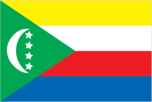
Flag description
green with a white crescent in the center of the field, its points facing downward; there are four white five-pointed stars placed in a line between the points of the crescent; the crescent, stars, and color green are traditional symbols of Islam; the four stars represent the four main islands of the archipelago - Mwali, Njazidja, Nzwani, and Mayotte (a territorial collectivity of France, but claimed by Comoros); the design, the most recent of several, is described in the constitution approved by referendum on 7 June 1992
Government type
independent republic
Independence
6 July 1975 (from France)
International organization participation
ACCT, ACP, AfDB, AL, CCC, ECA, FAO, FZ, G-77, IBRD, ICAO, IDA, IDB, IFAD, IFC, ILO, IMF, Intelsat (nonsignatory user), IOC, ITU, NAM, OAU, OIC, UN, UNCTAD, UNESCO, UNIDO, UPU, WHO, WMO, WTrO (applicant)
Judicial branch
Supreme Court or Cour Supreme), two members are appointed by the president, two members are elected by the Federal Assembly, one by the Council of each island, and former presidents of the republic
Legal system
French and Muslim law in a new consolidated code
Legislative branch
bicameral legislature consists of the Senate (15 seats; members selected by regional councils for six-year terms) and a Federal Assembly or Assemblee Federale (43 seats; members elected by popular vote to serve four-year terms) elections : last held 1 and 8 December 1996 (next to be held NA December 2000) election results: percent of vote by party - NA; seats by party - RND 39, RND candidate running as independent 1, FNJ 3
National capital
Moroni
National holiday
Independence Day, 6 July (1975)
Political parties and leaders
Rassemblement National pour le Development or RND [Mohamed TAKI Abdulkarim], party of the government; Front National pour la Justice or FNJ, Islamic party in opposition note: under a new constitution ratified in October 1996, a two party system was established; President Mohamed TAKI Abdulkarim called for all parties to dissolve and join him in creating the RND; the Constitution stipulates that only parties that win six seats in the Federal Assembly (two from each island) are permitted to be in opposition, but if no party accomplishes that the second most successful party will be in opposition; in the elections of December 1996 the FNJ appeared to qualify as opposition
Suffrage
18 years of age; universal
Economy
Agriculture - products
vanilla, cloves, perfume essences, copra, coconuts, bananas, cassava (tapioca)
Budget
revenues : $83 million expenditures: $92 million, including capital expenditures of $32 million (1992)
Currency
1 Comoran franc (CF) = 100 centimes
Debt - external
$189 million (1995 est.)
Economic aid
recipient: ODA, $NA
Economy - overview
One of the world's poorest countries, Comoros is made up of three islands that have inadequate transportation links, a young and rapidly increasing population, and few natural resources. The low educational level of the labor force contributes to a subsistence level of economic activity, high unemployment, and a heavy dependence on foreign grants and technical assistance. Agriculture, including fishing, hunting, and forestry, is the leading sector of the economy. It contributes nearly 40% to GDP, employs 80% of the labor force, and provides most of the exports. The country is not self-sufficient in food production; rice, the main staple, accounts for the bulk of imports. The government is struggling to upgrade education and technical training, to privatize commercial and industrial enterprises, to improve health services, to diversify exports, to promote tourism, and to reduce the high population growth rate. Continued foreign support is essential if the goal of 4% annual GDP growth is to be reached in the late 1990s.
Electricity - capacity
16,000 kW (1991)
Electricity - consumption per capita
52 kWh (1991 est.)
Electricity - production
25 million kWh (1991)
Exchange rates
Comoran francs (CF) per US$1 - 406.27 (January 1997), 383.66 (1996), 374.36 (1995), 416.40 (1994), 283.16 (1993), 264.69 (1992) note: beginning 12 January 1994, the Comoran franc was devalued to 75 per French franc from 50 per French franc at which it had been fixed since 1948
Exports
total value: $11.2 million (f.o.b., 1995 est.) commodities: vanilla, ylang-ylang, cloves, perfume oil, copra partners: France 54%, Germany 18%, US 18%
Fiscal year
calendar year
GDP
purchasing power parity - $370 million (1995 est.)
GDP - composition by sector
agriculture: 39% industry: 13% services : 48% (1995 est.)
GDP - per capita
purchasing power parity - $650 (1995 est.)
GDP - real growth rate
-2.3% (1995 est.)
Imports
total value: $40.9 million (f.o.b., 1993 est.) commodities: rice and other foodstuffs, consumer goods; petroleum products, cement, transport equipment partners: France 60%, South Africa 10%, Kenya 5%, Singapore 4%
Industrial production growth rate
-6.5% (1989 est.)
Industries
tourism, perfume distillation, textiles, furniture, jewelry, construction materials, soft drinks
Inflation rate - consumer price index
7.1% (1995 est.)
Labor force
total : 140,000 (1982) by occupation: agriculture 80%, government 3%
Unemployment rate
NA%
Communications
Radio broadcast stations
AM 2, FM 1, shortwave 0
Radios
NA
Telephone system
sparse system of microwave radio relay and HF radiotelephone communication stations domestic: HF radiotelephone communications and microwave radio relay international: HF radiotelephone communications to Madagascar and Reunion
Telephones
3,770 (1991 est.)
Televisions
200 (1991 est.)
Transportation
Airports
4 (1996 est.)
Airports - with paved runways
total: 4 2,438 to 3,047 m: 1 914 to 1,523 m: 3 (1996 est.)
Highways
total: 875 km paved: 669 km unpaved : 206 km (1995 est.)
Merchant marine
none
Ports and harbors
Fomboni, Moroni, Mutsamudu
Railways
0 km
Military and Security
Military branches
Comoran Security Force
Military expenditures - dollar figure
$NA
Military expenditures - percent of GDP
NA%
Military manpower - availability
males age 15-49: 125,378 (1997 est.)
Military manpower - fit for military service
males: 74,836 (1997 est.)
Transnational Issues
Disputes - international
claims French-administered Mayotte ______________________________________________________________________ CONGO, DEMOCRATIC REPUBLIC OF THE Republic of the]