1993 Edition
CIA World Factbook 1993 (Project Gutenberg)
Geography
Area
total area: 2,170 km2 land area: 2,170 km2 comparative area: slightly more than 12 times the size of Washington, DC
Climate
tropical marine; rainy season (November to May)
Coastline
340 km
Environment
soil degradation and erosion; deforestation; cyclones possible during rainy season
International disputes
claims French-administered Mayotte
Irrigated land
NA km2
Land boundaries
0 km
Land use
arable land: 35% permanent crops: 8% meadows and pastures: 7% forest and woodland: 16% other: 34%
Location
in the extreme northern Mozambique Channel, about two-thirds of the way between northern Madagascar and northern Mozambique
Map references
Africa, Standard Time Zones of the World
Maritime claims
exclusive economic zone: 200 nm territorial sea: 12 nm
Natural resources
negligible
Note
important location at northern end of Mozambique Channel
Terrain
volcanic islands, interiors vary from steep mountains to low hills
People and Society
Birth rate
46.75 births/1,000 population (1993 est.)
Death rate
11.31 deaths/1,000 population (1993 est.)
Ethnic divisions
Antalote, Cafre, Makoa, Oimatsaha, Sakalava
Infant mortality rate
81.8 deaths/1,000 live births (1993 est.)
Labor force
140,000 (1982) by occupation: agriculture 80%, government 3% note: 51% of population of working age (1985)
Languages
Arabic (official), French (official), Comoran (a blend of Swahili and Arabic)
Life expectancy at birth
total population: 57.35 years male: 55.23 years female: 59.55 years (1993 est.)
Literacy
age 15 and over can read and write (1980) total population: 48% male: 56% female: 40%
Nationality
noun: Comoran(s) adjective: Comoran
Net migration rate
0 migrant(s)/1,000 population (1993 est.)
Population
511,651 (July 1993 est.)
Population growth rate
3.54% (1993 est.)
Religions
Sunni Muslim 86%, Roman Catholic 14%
Total fertility rate
6.86 children born/woman (1993 est.)
Government
Administrative divisions
three islands; Njazidja (Grand Comore), Nzwani (Anjouan), and Mwali (Moheli) note: there are also four municipalities named Domoni, Fomboni, Moroni, and Mutsamudu
Capital
Moroni
Chief of State and Head of Government
President Said Mohamed DJOHAR (since 11 March 1990); Prime Minister Ibrahim HALIDI (since 1 January 1992)
Constitution
7 June 1992
Digraph
CN
Diplomatic representation in US
chief of mission: Ambassador Amini Ali MOUMIN chancery: (temporary) at the Comoran Permanent Mission to the UN, 336 East 45th Street, 2nd Floor, New York, NY 10017 telephone: (212) 972-8010
Executive branch
president, Council of Ministers (cabinet), prime minister
FAX
no service available at this time
Federal Assembly
last held November-December 1992 (next to be held NA March 1997); results - percent of vote by party NA; seats - (42 total) UNDC 7, CHUMA 3, ADP 2, MDP/NGDC 5, FDC 2, MAECHA BORA 2, FPC 2, RACHADE 1, UWEZO 1, MWANGAZA 1, 16 other seats to smaller parties
Flag
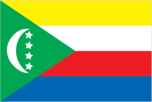
green with a white crescent placed diagonally (closed side of the crescent points to the upper hoist-side corner of the flag); there are four white five-pointed stars placed in a line between the points of the crescent; the crescent, stars, and color green are traditional symbols of Islam; the four stars represent the four main islands of the archipelago - Mwali, Njazidja, Nzwani, and Mayotte (which is a territorial collectivity of France, but claimed by the Comoros)
Independence
6 July 1975 (from France)
Judicial branch
Supreme Court (Cour Supreme)
Legal system
French and Muslim law in a new consolidated code
Legislative branch
unicameral Federal Assembly (Assemblee Federale)
Member of
ACCT, ACP, AfDB, ECA, FAO, FZ, G-77, IBRD, ICAO, IDA, IDB, IFAD, IFC, ILO, IMF, ITU, NAM, OAU, OIC, UN, UNCTAD, UNESCO, UNIDO, UPU, WHO, WMO
Names
conventional long form: Federal Islamic Republic of the Comoros conventional short form: Comoros local long form: Republique Federale Islamique des Comores local short form: Comores
National holiday
Independence Day, 6 July (1975)
Political parties and leaders
over 20 political parties are currently active, the most important of which are; Comoran Union for Progress (UDZIMA), Omar TAMOU; Islands' Fraternity and Unity Party (CHUMA), Said Ali KEMAL; Comoran Party for Democracy and Progress (PCDP), Ali MROUDJAE; Realizing Freedom's Capability (UWEZO), Mouazair ABDALLAH; Democratic Front of the Comoros (FDR), Moustapha CHELKH; Dialogue Proposition Action (DPA/MWANGAZA), Said MCHAWGAMA; Rally for Change and Democracy (RACHADE), Hassan HACHIM; Union for Democracy and Decentralization (UNDC), Mohamed Taki Halidi IBRAHAM; Maecha Bora, leader NA; MDP/NGDC (expansion NA), leader NA; Comoran Popular Front (FPC), Mohamed HASSANALI, Mohamed El Arif OUKACHA, Abdou MOUSTAKIM (Secretary General)
President
last held 11 March 1990 (next to be held March 1996); results - Said Mohamed DJOHAR (UDZIMA) 55%, Mohamed TAKI Abdulkarim (UNDC) 45%
Suffrage
18 years of age; universal
Type
independent republic
US diplomatic representation
chief of mission: Ambassador Kenneth N. PELTIER embassy: address NA, Moroni mailing address: B. P. 1318, Moroni telephone: [269] 73-22-03, 73-29-22
Economy
Agriculture
accounts for 40% of GDP; most of population works in subsistence agriculture and fishing; plantations produce cash crops for export - vanilla, cloves, perfume essences, copra; principal food crops - coconuts, bananas, cassava; world's leading producer of essence of ylang-ylang (for perfumes) and second-largest producer of vanilla; large net food importer
Budget
revenues $96 million; expenditures $88 million, including capital expenditures of $33 million (1991 est.)
Currency
1 Comoran franc (CF) = 100 centimes
Economic aid
US commitments, including Ex-Im (FY80-89), $10 million; Western (non-US) countries, ODA and OOF bilateral commitments (1970-89), $435 million; OPEC bilateral aid (1979-89), $22 million; Communist countries (1970-89), $18 million
Electricity
16,000 kW capacity; 25 million kWh produced, 50 kWh per capita (1991)
Exchange rates
Comoran francs (CF) per US$1 - 274.06 (January 1993), 264.69 (1992), 282.11 (1991), 272.26 (1990), 319.01 (1989), 297.85 (1988)); note - linked to the French franc at 50 to 1 French franc
Exports
$16 million (f.o.b., 1990 est.) commodities: vanilla, cloves, perfume oil, copra, ylang-ylang partners: US 53%, France 41%, Africa 4%, FRG 2% (1988)
External debt
$196 million (1991 est.)
Fiscal year
calendar year
Imports
$41 million (f.o.b., 1990 est.) commodities: rice and other foodstuffs, cement, petroleum products, consumer goods partners: Europe 62% (France 22%), Africa 5%, Pakistan, China (1988)
Industrial production
growth rate -6.5% (1989 est.); accounts for 10% of GDP
Industries
perfume distillation, textiles, furniture, jewelry, construction materials, soft drinks
Inflation rate (consumer prices)
4% (1991 est.)
National product
GDP - exchange rate conversion - $260 million (1991 est.)
National product per capita
$540 (1991 est.)
National product real growth rate
2.7% (1991 est.)
Overview
One of the world's poorest countries, Comoros is made up of several islands that have poor transportation links, a young and rapidly increasing population, and few natural resources. The low educational level of the labor force contributes to a low level of economic activity, high unemployment, and a heavy dependence on foreign grants and technical assistance. Agriculture, including fishing, hunting, and forestry, is the leading sector of the economy. It contributes 40% to GDP, employs 80% of the labor force, and provides most of the exports. The country is not self-sufficient in food production, and rice, the main staple, accounts for 90% of imports. During the period 1982-86 the industrial sector grew at an annual average rate of 5.3%, but its contribution to GDP was only 5% in 1988. Despite major investment in the tourist industry, which accounts for about 25% of GDP, growth has stagnated since 1983. A sluggish growth rate of 1.5% during 1985-90 has led to large budget deficits, declining incomes, and balance-of-payments difficulties. Preliminary estimates for FY92 show a moderate increase in the growth rate based on increased exports, tourism, and government investment outlays.
Unemployment rate
over 16% (1988 est.)
Communications
Airports
total: 4 usable: 4 with permanent-surface runways: 4 with runways over 3,659 m: with runways 2,440-3,659 m: 1 with runways 1,220-2,439 m: 3
Highways
750 km total; about 210 km bituminous, remainder crushed stone or gravel
Ports
Mutsamudu, Moroni
Telecommunications
sparse system of radio relay and high-frequency radio communication stations for interisland and external communications to Madagascar and Reunion; over 1,800 telephones; broadcast stations - 2 AM, 1 FM, no TV
Military and Security
Branches
Comoran Defense Force (FDC)
Defense expenditures
$NA, NA% of GDP
Manpower availability
males age 15-49 108,867; fit for military service 65,106 (1993 est.)