1990 Edition
CIA World Factbook 1990 (Project Gutenberg)
Geography
Climate
tropical marine; rainy season (November to May)
Coastline
340 km
Comparative area
slightly more than 12 times the size of Washington, DC
Disputes
claims French-administered Mayotte
Environment
soil degradation and erosion; deforestation; cyclones possible during rainy season
Extended economic zone
200 nm;
Land boundaries
none
Land use
35% arable land; 8% permanent crops; 7% meadows and pastures; 16% forest and woodland; 34% other
Natural resources
negligible
Note
important location at northern end of Mozambique Channel
Terrain
volcanic islands, interiors vary from steep mountains to low hills
Territorial sea
12 nm
Total area
2,170 km2; land area: 2,170 km2
People and Society
Birth rate
48 births/1,000 population (1990)
Death rate
12 deaths/1,000 population (1990)
Ethnic divisions
Antalote, Cafre, Makoa, Oimatsaha, Sakalava
Infant mortality rate
89 deaths/1,000 live births (1990)
Labor force
140,000 (1982); 80% agriculture, 3% government; 51% of population of working age (1985)
Language
Shaafi Islam (a Swahili dialect), Malagasy, French
Life expectancy at birth
54 years male, 58 years female (1990)
Literacy
15%
Nationality
noun--Comoran(s); adjective--Comoran
Net migration rate
0 migrants/1,000 population (1990)
Organized labor
NA
Population
460,188 (July 1990), growth rate 3.5% (1990)
Religion
86% Sunni Muslim, 14% Roman Catholic
Total fertility rate
7.0 children born/woman (1990)
Government
Administrative divisions
3 islands; Anjouan, Grande Comore, Moheli; note--there may also be 4 municipalities named Domoni, Fomboni, Moroni, and Mutsamudu
Capital
Moroni
Constitution
1 October 1978, amended October 1982 and January 1985
Diplomatic representation
Ambassador Amini Ali MOUMIN; Chancery (temporary) at the Comoran Permanent Mission to the UN, 336 East 45th Street, 2nd Floor, New York, NY 10017; telephone (212) 972-8010; US--Ambassador Howard K. WALKER, resides in Antananarivo (Madagascar); Embassy at address NA, Moroni (mailing address B. P. 1318, Moroni); telephone 73-12-03
Elections
President--last held 11 March 1990 (next to be held March 1996); results--Said Mohamed Djohar (Udzima) 55%; Mohamed Taki Abdulkarim (UNDC) 45%; Federal Assembly--last held 22 March 1987 (next to be held March 1992); results--percent of vote by party NA; seats--(42 total) Udzima 42
Executive branch
president, Council of Ministers (cabinet)
Flag
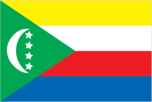
green with a white crescent placed diagonally (closed side of the crescent points to the upper hoist-side corner of the flag); there are four white five-pointed stars placed in a line between the points of the crescent; the crescent, stars, and color green are traditional symbols of Islam; the four stars represent the four main islands of the archipelago--Mwali, Njazidja, Nzwani, and Mayotte (which is a territorial collectivity of France, but claimed by the Comoros)
Independence
6 July 1975 (from France)
Judicial branch
Supreme Court (Cour Supreme)
Leaders
Chief of State and Head of Government--President Said Mohamed DJOHAR (since 11 March 1990)
Legal system
French and Muslim law in a new consolidated code
Legislative branch
unicameral Federal Assembly (Assemblee Federale)
Long-form name
Federal Islamic Republic of the Comoros
Member of
ACP, AfDB, FAO, G-77, IBRD, IDA, IDB--Islamic Development Bank, IFAD, ILO, IMF, ITU, NAM, OAU, OIC, UN, UNESCO, UPU, WHO, WMO
National holiday
Independence Day, 6 July (1975)
Political parties
Comoran Union for Progress (Udzima), Said Mohamed Djohar, president; National Union for Democracy (UNDC), Mohamed Taki
Suffrage
universal at age 18
Type
independent republic
Economy
Agriculture
accounts for 40% of GDP; most of population works in subsistence agriculture and fishing; plantations produce cash crops for export--vanilla, cloves, perfume essences, and copra; principal food crops--coconuts, bananas, cassava; world's leading producer of essence of ylang-ylang (for perfumes) and second-largest producer of vanilla; large net food importer
Aid
US commitments, including Ex-Im (FY80-88), $9 million; Western (non-US) countries, ODA and OOF bilateral commitments (1970-87), $371 million; OPEC bilateral aid (1979-89), $22 million; Communist countries (1970-88), $18 million
Budget
revenues $75.2 million; expenditures $77.9 million, including capital expenditures of $4.8 million (1988 est.)
Currency
Comoran franc (plural--francs); 1 Comoran franc (CF) = 100 centimes
Electricity
16,000 kW capacity; 24 million kWh produced, 55 kWh per capita (1989)
Exchange rates
Comoran francs (CF) per US$1--287.99 (January 1990), 319.01 (1989), 297.85 (1988), 300.54 (1987), 346.30 (1986), 449.26 (1985); note--linked to the French franc at 50 to 1 French franc
Exports
$12 million (f.o.b., 1987); commodities--vanilla, cloves, perfume oil, copra; partners--US 53%, France 41%, Africa 4%, FRG 2%
External debt
$238 million (December 1988)
Fiscal year
calendar year
GDP
$207 million, per capita $475; real growth rate 0.1% (1988 est.)
Imports
$52 million (c.i.f., 1987); commodities--rice and other foodstuffs, cement, petroleum products, consumer goods; partners--Europe 62% (France 22%, other 40%), Africa 5%, Pakistan, China
Industrial production
growth rate 3.4% (1988 est.)
Industries
perfume distillation
Inflation rate (consumer prices)
8.3% (1986)
Overview
One of the world's poorest countries, Comoros is made up of several islands that have poor transportation links, a young and rapidly increasing population, and few natural resources. The low educational level of the labor force contributes to a low level of economic activity, high unemployment, and a heavy dependence on foreign technical assistance. Agriculture, including fishing and forestry, is the leading sector of the economy. It contributes about 40% to GDP, employs 80% of the labor force, and provides most of the exports. The country is not self-sufficient in food production, and rice, the main staple, accounts for 90% of imports. During the period 1982-86 the industrial sector grew at an annual average rate of 5.3%, but its contribution to GDP was less than 4% in 1986. Despite major investment in the tourist industry, which accounts for about 25% of GDP, growth has stagnated since 1983.
Unemployment rate
over 16% (1988 est.)
Communications
Airports
4 total, 4 usable; 4 with permanent-surface runways; none with runways over 3,659 m; 1 with runways 2,440-3,659 m; 3 with runways 1,220-2,439 m
Civil air
4 major transport aircraft
Highways
750 km total; about 210 km bituminous, remainder crushed stone or gravel
Ports
Mutsamudu, Moroni
Telecommunications
sparse system of radio relay and high-frequency radio communication stations for interisland and external communications to Madagascar and Reunion; over 1,800 telephones; stations--2 AM, 1 FM, 1 TV
Military and Security
Branches
Army, Presidential Guard, Gendarmerie
Defense expenditures
3% of GDP (1981)
Military manpower
males 15-49, 97,504; 58,274 fit for military service