2009 Edition
CIA World Factbook 2009 (Project Gutenberg)
Introduction
Background
For centuries China stood as a leading civilization, outpacing the rest of the world in the arts and sciences, but in the 19th and early 20th centuries, the country was beset by civil unrest, major famines, military defeats, and foreign occupation. After World War II, the Communists under MAO Zedong established an autocratic socialist system that, while ensuring China's sovereignty, imposed strict controls over everyday life and cost the lives of tens of millions of people. After 1978, MAO's successor DENG Xiaoping and other leaders focused on market-oriented economic development and by 2000 output had quadrupled. For much of the population, living standards have improved dramatically and the room for personal choice has expanded, yet political controls remain tight.
Geography
Area
total: 9,596,961 sq km country comparison to the world: 4 land: 9,569,901 sq km water: 27,060 sq km
Area - comparative
slightly smaller than the US
Climate
extremely diverse; tropical in south to subarctic in north
Coastline
14,500 km
Elevation extremes
lowest point: Turpan Pendi -154 m highest point: Mount Everest 8,850 m
Environment - current issues
air pollution (greenhouse gases, sulfur dioxide particulates) from reliance on coal produces acid rain; water shortages, particularly in the north; water pollution from untreated wastes; deforestation; estimated loss of one-fifth of agricultural land since 1949 to soil erosion and economic development; desertification; trade in endangered species
Environment - international agreements
party to: Antarctic-Environmental Protocol, Antarctic Treaty, Biodiversity, Climate Change, Climate Change-Kyoto Protocol, Desertification, Endangered Species, Environmental Modification, Hazardous Wastes, Law of the Sea, Marine Dumping, Ozone Layer Protection, Ship Pollution, Tropical Timber 83, Tropical Timber 94, Wetlands, Whaling signed, but not ratified: none of the selected agreements
Freshwater withdrawal (domestic/industrial/agricultural)
total: 549.76 cu km/yr (7%/26%/68%) per capita: 415 cu m/yr (2000)
Geographic coordinates
35 00 N, 105 00 E
Geography - note
world's fourth largest country (after Russia, Canada, and US); Mount Everest on the border with Nepal is the world's tallest peak
Irrigated land
545,960 sq km (2003)
Land boundaries
total: 22,117 km border countries: Afghanistan 76 km, Bhutan 470 km, Burma 2,185 km, India 3,380 km, Kazakhstan 1,533 km, North Korea 1,416 km, Kyrgyzstan 858 km, Laos 423 km, Mongolia 4,677 km, Nepal 1,236 km, Pakistan 523 km, Russia (northeast) 3,605 km, Russia (northwest) 40 km, Tajikistan 414 km, Vietnam 1,281 km regional borders: Hong Kong 30 km, Macau 0.34 km
Land use
arable land: 14.86% permanent crops: 1.27% other: 83.87% (2005)
Location
Eastern Asia, bordering the East China Sea, Korea Bay, Yellow Sea, and South China Sea, between North Korea and Vietnam
Map references
Asia
Maritime claims
territorial sea: 12 nm contiguous zone: 24 nm exclusive economic zone: 200 nm continental shelf: 200 nm or to the edge of the continental margin
Natural hazards
frequent typhoons (about five per year along southern and eastern coasts); damaging floods; tsunamis; earthquakes; droughts; land subsidence
Natural resources
coal, iron ore, petroleum, natural gas, mercury, tin, tungsten, antimony, manganese, molybdenum, vanadium, magnetite, aluminum, lead, zinc, uranium, hydropower potential (world's largest)
Terrain
mostly mountains, high plateaus, deserts in west; plains, deltas, and hills in east
Total renewable water resources
2,829.6 cu km (1999)
People and Society
Age structure
0-14 years: 19.8% (male 140,877,745/female 124,290,090) 15-64 years: 72.1% (male 495,724,889/female 469,182,087) 65 years and over: 8.1% (male 51,774,115/female 56,764,042) (2009 est.)
Birth rate
14 births/1,000 population (2009 est.) country comparison to the world: 150
Death rate
7.06 deaths/1,000 population (July 2009 est.) country comparison to the world: 129
Education expenditures
1.9% of GDP (1999) country comparison to the world: 170
Ethnic groups
Han Chinese 91.5%, Zhuang, Manchu, Hui, Miao, Uyghur, Tujia, Yi, Mongol, Tibetan, Buyi, Dong, Yao, Korean, and other nationalities 8.5% (2000 census)
HIV/AIDS - adult prevalence rate
0.1% (2007 est.) country comparison to the world: 115
HIV/AIDS - deaths
39,000 (2007 est.) country comparison to the world: 14
HIV/AIDS - people living with HIV/AIDS
700,000 (2007 est.) country comparison to the world: 17
Infant mortality rate
total: 20.25 deaths/1,000 live births country comparison to the world: 105 male: 18.87 deaths/1,000 live births female: 21.77 deaths/1,000 live births (2009 est.)
Languages
Standard Chinese or Mandarin (Putonghua, based on the Beijing dialect), Yue (Cantonese), Wu (Shanghainese), Minbei (Fuzhou), Minnan (Hokkien-Taiwanese), Xiang, Gan, Hakka dialects, minority languages (see Ethnic groups entry)
Life expectancy at birth
total population: 73.47 years country comparison to the world: 105 male: 71.61 years female: 75.52 years (2009 est.)
Literacy
definition: age 15 and over can read and write total population: 90.9% male: 95.1% female: 86.5% (2000 census)
Major infectious diseases
degree of risk: intermediate food or waterborne diseases: bacterial diarrhea, hepatitis A, and typhoid fever vectorborne diseases: Japanese encephalitis and dengue fever soil contact disease: hantaviral hemorrhagic fever with renal syndrome (HFRS) animal contact disease: rabies note: highly pathogenic H5N1 avian influenza has been identified in this country; it poses a negligible risk with extremely rare cases possible among US citizens who have close contact with birds (2009)
Median age
total: 34.1 years male: 33.5 years female: 34.7 years (2009 est.)
Nationality
noun: Chinese (singular and plural) adjective: Chinese
Net migration rate
-0.39 migrant(s)/1,000 population (2009 est.) country comparison to the world: 104
Population
1,338,612,968 (July 2009 est.) country comparison to the world: 1
Population growth rate
0.655% (2009 est.) country comparison to the world: 146
Religions
Daoist (Taoist), Buddhist, Christian 3%-4%, Muslim 1%-2% note: officially atheist (2002 est.)
School life expectancy (primary to tertiary education)
total: 11 years male: 11 years female: 11 years (2006)
Sex ratio
at birth: 1.1 male(s)/female under 15 years: 1.13 male(s)/female 15-64 years: 1.06 male(s)/female 65 years and over: 0.91 male(s)/female total population: 1.06 male(s)/female (2009 est.)
Total fertility rate
1.79 children born/woman (2009 est.) country comparison to the world: 158
Urbanization
urban population: 43% of total population (2008) rate of urbanization: 2.7% annual rate of change (2005-10 est.)
Government
Administrative divisions
23 provinces (sheng, singular and plural), 5 autonomous regions (zizhiqu, singular and plural), and 4 municipalities (shi, singular and plural) provinces: Anhui, Fujian, Gansu, Guangdong, Guizhou, Hainan, Hebei, Heilongjiang, Henan, Hubei, Hunan, Jiangsu, Jiangxi, Jilin, Liaoning, Qinghai, Shaanxi, Shandong, Shanxi, Sichuan, Yunnan, Zhejiang; (see note on Taiwan) autonomous regions: Guangxi, Nei Mongol, Ningxia, Xinjiang Uygur, Xizang (Tibet) municipalities: Beijing, Chongqing, Shanghai, Tianjin note: China considers Taiwan its 23rd province; see separate entries for the special administrative regions of Hong Kong and Macau
Capital
name: Beijing geographic coordinates: 39 55 N, 116 23 E time difference: UTC+8 (13 hours ahead of Washington, DC during Standard Time) note: despite its size, all of China falls within one time zone; many people in Xinjiang Province observe an unofficial "Xinjiang timezone" of UTC+6, two hours behind Beijing
Constitution
most recent promulgation 4 December 1982 with amendments in 1988 and 1993
Country name
conventional long form: People's Republic of China conventional short form: China local long form: Zhonghua Renmin Gongheguo local short form: Zhongguo abbreviation: PRC
Diplomatic representation from the US
chief of mission: Ambassador Jon M. HUNTSMAN, Jr. embassy: 55 An Jia Lou Lu, 100600 Beijing mailing address: PSC 461, Box 50, FPO AP 96521-0002 telephone: [86] (10) 8531-3000
Diplomatic representation in the US
chief of mission: Ambassador ZHOU Wenzhong chancery: 12 International Place NW, Washington, DC 20008 telephone: [1] (202) 328-2500
Executive branch
chief of state: President HU Jintao (since 15 March 2003); Vice President XI Jinping (since 15 March 2008) head of government: Premier WEN Jiabao (since 16 March 2003); Executive Vice Premier LI Keqiang (17 March 2008), Vice Premier HUI Liangyu (since 17 March 2003), Vice Premier ZHANG Deijiang (since 17 March 2008), and Vice Premier WANG Qishan (since 17 March 2008) cabinet: State Council appointed by National People's Congress elections: president and vice president elected by National People's Congress for a five-year term (eligible for a second term); elections last held 15-17 March 2008 (next to be held in mid-March 2013); premier nominated by president, confirmed by National People's Congress election results: HU Jintao elected president by National People's Congress with a total of 2,963 votes; XI Jinping elected vice president with a total of 2,919 votes
FAX
- [1] (202) 328-2582 consulate(s) general: Chicago, Houston, Los Angeles, New York, San Francisco
- [86] (10) 8531-3300 consulate(s) general: Chengdu, Guangzhou, Shanghai, Shenyang, Wuhan
Flag description
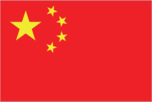
red with a large yellow five-pointed star and four smaller yellow five-pointed stars (arranged in a vertical arc toward the middle of the flag) in the upper hoist-side corner
Government type
Communist state
Independence
221 BC (unification under the Qin or Ch'in Dynasty); 1 January 1912 (Qing or Ch'ing Dynasty replaced by the Republic of China); 1 October 1949 (People's Republic of China established)
International organization participation
ADB, AfDB (nonregional member), APEC, APT, Arctic Council (observer), ARF, ASEAN (dialogue partner), BIS, CDB, EAS, FAO, G-20, G-24 (observer), G-77, IAEA, IBRD, ICAO, ICC, ICRM, IDA, IFAD, IFC, IFRCS, IHO, ILO, IMF, IMO, IMSO, Interpol, IOC, IOM (observer), IPU, ISO, ITSO, ITU, LAIA (observer), MIGA, MINURSO, MONUC, NAM (observer), NSG, OAS (observer), OPCW, PCA, PIF (partner), SAARC (observer), SCO, SICA (observer), UN, UN Security Council, UNAMID, UNCTAD, UNESCO, UNHCR, UNIDO, UNIFIL, UNITAR, UNMIL, UNMIS, UNMIT, UNOCI, UNTSO, UNWTO, UPU, WCO, WFTU, WHO, WIPO, WMO, WTO, ZC
Judicial branch
Supreme People's Court (judges appointed by the National People's Congress); Local People's Courts (comprise higher, intermediate, and basic courts); Special People's Courts (primarily military, maritime, railway transportation, and forestry courts)
Legal system
based on civil law system; derived from Soviet and continental civil code legal principles; legislature retains power to interpret statutes; constitution ambiguous on judicial review of legislation; has not accepted compulsory ICJ jurisdiction
Legislative branch
unicameral National People's Congress or Quanguo Renmin Daibiao Dahui (2,987 seats; members elected by municipal, regional, and provincial people's congresses, and People's Liberation Army to serve five-year terms) elections: last held December 2007-February 2008; date of next election - late 2012 to early 2013 election results: percent of vote - NA; seats - 2,987 note: only members of the CCP, its eight allied parties, and sympathetic independent candidates are elected
National holiday
Anniversary of the Founding of the People's Republic of China, 1 October (1949)
Political parties and leaders
Chinese Communist Party or CCP [HU Jintao]; eight registered small parties controlled by CCP
Political pressure groups and leaders
the China Democracy Party; the Falungong spiritual movement note: no substantial political opposition groups exist, although the government has identified the organizations listed above as subversive groups
Suffrage
18 years of age; universal
Economy
Agriculture - products
rice, wheat, potatoes, corn, peanuts, tea, millet, barley, apples, cotton, oilseed; pork; fish
Budget
revenues: $847.8 billion expenditures: $861.6 billion (2008 est.)
Central bank discount rate
2.79% (31 December 2008) country comparison to the world: 130 3.33% (31 December 2007)
Commercial bank prime lending rate
5.31% (31 December 2008) country comparison to the world: 136 5.58% (17 December 2007)
Current account balance
$426.1 billion (2008 est.) country comparison to the world: 1 $371.8 billion (2007 est.)
Debt - external
$400.6 billion (31 December 2008 est.) country comparison to the world: 23 $363 billion (31 December 2007 est.)
Distribution of family income - Gini index
47 (2007) country comparison to the world: 36 40 (2001)
Economy - overview
China's economy during the past 30 years has changed from a centrally planned system that was largely closed to international trade to a more market-oriented economy that has a rapidly growing private sector and is a major player in the global economy. Reforms started in the late 1970s with the phasing out of collectivized agriculture, and expanded to include the gradual liberalization of prices, fiscal decentralization, increased autonomy for state enterprises, the foundation of a diversified banking system, the development of stock markets, the rapid growth of the non-state sector, and the opening to foreign trade and investment. Annual inflows of foreign direct investment rose to nearly $84 billion in 2007. China has generally implemented reforms in a gradualist or piecemeal fashion. In recent years, China has re-invigorated its support for leading state-owned enterprises in sectors it considers important to "economic security," explicitly looking to foster globally competitive national champions. After keeping its currency tightly linked to the US dollar for years, China in July 2005 revalued its currency by 2.1% against the US dollar and moved to an exchange rate system that references a basket of currencies. Cumulative appreciation of the renminbi against the US dollar since the end of the dollar peg was more than 20% by late 2008, but the exchange rate has changed little since the onset of the global financial crisis. The restructuring of the economy and resulting efficiency gains have contributed to a more than tenfold increase in GDP since 1978. Measured on a purchasing power parity (PPP) basis that adjusts for price differences, China in 2008 stood as the second-largest economy in the world after the US, although in per capita terms the country is still lower middle-income. The Chinese government faces numerous economic development challenges, including: (a) strengthening its social safety net, including pension and health system reform, to counteract a high domestic savings rate and correspondingly low domestic demand; (b) sustaining adequate job growth for tens of millions of migrants, new entrants to the work force, and workers laid off from state-owned enterprises deemed not worth saving; (c) reducing corruption and other economic crimes; and (d) containing environmental damage and social strife related to the economy's rapid transformation. Economic development has been more rapid in coastal provinces than in the interior, and approximately 200 million rural laborers and their dependents have relocated to urban areas to find work - in recent years many have returned to their villages. One demographic consequence of the "one child" policy is that China is now one of the most rapidly aging countries in the world. Deterioration in the environment - notably air pollution, soil erosion, and the steady fall of the water table, especially in the north - is another long-term problem. China continues to lose arable land because of erosion and economic development. In 2007 China intensified government efforts to improve environmental conditions, tying the evaluation of local officials to environmental targets, publishing a national climate change policy, and establishing a high level leading group on climate change, headed by Premier WEN Jiabao. The Chinese government seeks to add energy production capacity from sources other than coal and oil. In late 2008, as China commemorated the 30th anniversary of its historic economic reforms, the global economic downturn began to slow foreign demand for Chinese exports for the first time in many years. The government vowed to continue reforming the economy and emphasized the need to increase domestic consumption in order to make China less dependent on foreign exports for GDP growth in the future.
Electricity - consumption
2.835 trillion kWh (2007 est.) country comparison to the world: 3
Electricity - exports
16.64 billion kWh (2008 est.)
Electricity - imports
3.842 billion kWh (2008 est.)
Electricity - production
3.041 trillion kWh (2007 est.) country comparison to the world: 3
Exchange rates
Renminbi yuan (RMB) per US dollar - 6.9385 (2008 est.), 7.61 (2007), 7.97 (2006), 8.1943 (2005), 8.2768 (2004)
Exports
$1.435 trillion (2008 est.) country comparison to the world: 3 $1.22 trillion (2007 est.)
Exports - commodities
electrical and other machinery, including data processing equipment, apparel, textiles, iron and steel, optical and medical equipment
Exports - partners
US 17.7%, Hong Kong 13.3%, Japan 8.1%, South Korea 5.2%, Germany 4.1% (2008)
GDP - composition by sector
agriculture: 11.3% industry: 48.6% services: 40.1% (2008 est.)
GDP - per capita (PPP)
$6,000 (2008 est.) country comparison to the world: 133 $5,500 (2007 est.) $4,900 (2006 est.) note: data are in 2008 US dollars
GDP - real growth rate
9% (2008 est.) country comparison to the world: 17 13% (2007 est.) 11.6% (2006 est.)
GDP (official exchange rate)
$4.327 trillion (2008 est.)
GDP (purchasing power parity)
$7.992 trillion (2008 est.) country comparison to the world: 3 $7.332 trillion (2007 est.) $6.489 trillion (2006 est.) note: data are in 2008 US dollars
Household income or consumption by percentage share
lowest 10%: 2.4% highest 10%: 31.4% (2004)
Imports
$1.074 trillion (2008 est.) country comparison to the world: 4 $904.6 billion (2007 est.)
Imports - commodities
electrical and other machinery, oil and mineral fuels, optical and medical equipment, metal ores, plastics, organic chemicals
Imports - partners
Japan 13.3%, South Korea 9.9%, US 7.2%, Germany 4.9% (2008)
Industrial production growth rate
9.3% (2008 est.) country comparison to the world: 15
Industries
mining and ore processing, iron, steel, aluminum, and other metals, coal; machine building; armaments; textiles and apparel; petroleum; cement; chemicals; fertilizers; consumer products, including footwear, toys, and electronics; food processing; transportation equipment, including automobiles, rail cars and locomotives, ships, and aircraft; telecommunications equipment, commercial space launch vehicles, satellites
Inflation rate (consumer prices)
5.9% (2008 est.) country comparison to the world: 99 4.8% (2007 est.)
Investment (gross fixed)
40.5% of GDP (2008 est.) country comparison to the world: 4
Labor force
807.3 million (2008 est.) country comparison to the world: 1
Labor force - by occupation
agriculture: 43% industry: 25% services: 32% (2006 est.)
Market value of publicly traded shares
$2.794 trillion (31 December 2008 est.) country comparison to the world: 3 $6.226 trillion (31 December 2007) $2.426 trillion (31 December 2006)
Natural gas - consumption
77.18 billion cu m (2008 est.) country comparison to the world: 12
Natural gas - exports
3.36 billion cu m (2008) country comparison to the world: 29
Natural gas - imports
4.5 billion cu m (2008 est.) country comparison to the world: 35
Natural gas - production
76.04 billion cu m (2008 est.) country comparison to the world: 11
Natural gas - proved reserves
2.265 trillion cu m (1 January 2009 est.) country comparison to the world: 17
Oil - consumption
7.85 million bbl/day (2008 est.) country comparison to the world: 3
Oil - exports
419,200 bbl/day (2007 est.) country comparison to the world: 32
Oil - imports
4.21 million bbl/day (2007) country comparison to the world: 4
Oil - production
3.973 million bbl/day (2008 est.) country comparison to the world: 5
Oil - proved reserves
16 billion bbl (1 January 2009 est.) country comparison to the world: 13
Population below poverty line
8% note: 21.5 million rural population live below the official "absolute poverty" line (approximately $90 per year); and an additional 35.5 million rural population above that but below the official "low income" line (approximately $125 per year) (2006 est.)
Public debt
15.6% of GDP (2008 est.) country comparison to the world: 101 31.4% of GDP (2004 est.)
Reserves of foreign exchange and gold
$1.955 trillion (31 December 2008 est.) country comparison to the world: 1 $1.534 trillion (31 December 2007 est.)
Stock of direct foreign investment - abroad
$149.3 billion (31 December 2008 est.) country comparison to the world: 22 $95.8 billion (31 December 2007 est.)
Stock of direct foreign investment - at home
$758.9 billion (2007 est.) country comparison to the world: 7
Stock of domestic credit
$5.555 trillion (31 December 2008) country comparison to the world: 4 $4.653 trillion (31 December 2007)
Stock of money
$2.434 trillion (31 December 2008) country comparison to the world: 3 $2.09 trillion (31 December 2007)
Stock of quasi money
$4.523 trillion (31 December 2008) country comparison to the world: 4 $3.437 trillion (31 December 2007)
Unemployment rate
4% (2008 est.) country comparison to the world: 46 4% (2007 est.) note: official data for urban areas only; including migrants may boost total unemployment to 9%; substantial unemployment and underemployment in rural areas
Communications
Internet country code
.cn
Internet hosts
14.156 million (2009) country comparison to the world: 7
Internet users
298 million (2008) country comparison to the world: 1
Radio broadcast stations
AM 369, FM 259, shortwave 45 (1998)
Telephone system
general assessment: domestic and international services are increasingly available for private use; unevenly distributed domestic system serves principal cities, industrial centers, and many towns; China continues to develop its telecommunications infrastructure, and is partnering with foreign providers to expand its global reach; China in the summer of 2008 began a major restructuring of its telecommunications industry, resulting in the consolidation of its six telecom service operators to three, China Telecom, China Mobile and China Unicom, each providing both fixed-line and mobile services domestic: interprovincial fiber-optic trunk lines and cellular telephone systems have been installed; mobile-cellular subscribership is increasing rapidly; the number of Internet users exceeded 250 million by summer 2008; a domestic satellite system with 55 earth stations is in place international: country code - 86; a number of submarine cables provide connectivity to Asia, the Middle East, Europe, and the US; satellite earth stations - 7 (5 Intelsat - 4 Pacific Ocean and 1 Indian Ocean; 1 Intersputnik - Indian Ocean region; and 1 Inmarsat - Pacific and Indian Ocean regions) (2008)
Telephones - main lines in use
365.6 million (2007) country comparison to the world: 1
Telephones - mobile cellular
634 million (2008) country comparison to the world: 1
Television broadcast stations
3,240 (of which 209 are operated by China Central Television, 31 are provincial TV stations, and nearly 3,000 are local city stations) (1997)
Transportation
Airports
482 (2009) country comparison to the world: 15
Airports - with paved runways
total: 425 over 3,047 m: 63 2,438 to 3,047 m: 132 1,524 to 2,437 m: 133 914 to 1,523 m: 25 under 914 m: 72 (2009)
Airports - with unpaved runways
total: 57 over 3,047 m: 3 2,438 to 3,047 m: 5 1,524 to 2,437 m: 10 914 to 1,523 m: 13 under 914 m: 26 (2009)
Heliports
45 (2009)
Merchant marine
total: 1,826 country comparison to the world: 3 by type: barge carrier 4, bulk carrier 451, cargo 689, carrier 2, chemical tanker 69, combination ore/oil 1, container 162, liquefied gas 44, passenger 8, passenger/cargo 83, petroleum tanker 244, refrigerated cargo 33, roll on/roll off 10, specialized tanker 9, vehicle carrier 17 foreign-owned: 20 (Ecuador 1, Greece 2, Hong Kong 12, Indonesia 1, Japan 2, South Korea 1, Norway 1) registered in other countries: 1,441 (Bahamas 10, Bangladesh 1, Belize 71, Bermuda 10, Bolivia 1, Cambodia 193, Cyprus 10, France 5, Georgia 10, Germany 2, Honduras 3, Hong Kong 324, India 1, Indonesia 2, Kiribati 15, South Korea 1, Liberia 11, Malta 12, Marshall Islands 7, Mongolia 1, Norway 36, Panama 532, Philippines 4, Saint Vincent and the Grenadines 94, Sierra Leone 15, Singapore 14, Thailand 1, Tuvalu 16, unknown 39) (2008)
Pipelines
gas 28,132 km; oil 20,204 km; refined products 9,746 km (2008)
Ports and terminals
Dalian, Guangzhou, Ningbo, Qingdao, Qinhuangdao, Shanghai, Shenzhen, Tianjin
Railways
total: 77,834 km country comparison to the world: 3 standard gauge: 77,084 km 1.435-m gauge (24,433 km electrified) narrow gauge: 750 km 0.750-m gauge (2008)
Roadways
total: 1,930,544 km country comparison to the world: 3 paved: 1,575,571 km (includes 41,005 km of expressways) unpaved: 354,973 km (2005)
Waterways
110,000 km navigable (2008) country comparison to the world: 1
Military and Security
Manpower available for military service
males age 16-49: 375,009,345 females age 16-49: 354,314,328 (2008 est.)
Manpower fit for military service
males age 16-49: 314,459,083 females age 16-49: 296,763,134 (2009 est.)
Manpower reaching militarily significant age annually
male: 10,621,373 female: 9,533,880 (2009 est.)
Military expenditures
4.3% of GDP (2006) country comparison to the world: 25
Military service age and obligation
18-22 years of age for selective compulsory military service, with 24-month service obligation; no minimum age for voluntary service (all officers are volunteers); 18-19 years of age for women high school graduates who meet requirements for specific military jobs (2009)
People's Liberation Army (PLA)
Ground Forces, Navy (includes marines and naval aviation), Air Force (includes airborne forces), and Second Artillery Corps (strategic missile force); People's Armed Police (PAP); PLA Reserve Force (2009)
Transnational Issues
Disputes - international
continuing talks and confidence-building measures work toward reducing tensions over Kashmir that nonetheless remains militarized with portions under the de facto administration of China (Aksai Chin), India (Jammu and Kashmir), and Pakistan (Azad Kashmir and Northern Areas); India does not recognize Pakistan's ceding historic Kashmir lands to China in 1964; China and India continue their security and foreign policy dialogue started in 2005 related to the dispute over most of their rugged, militarized boundary, regional nuclear proliferation, and other matters; China claims most of India's Arunachal Pradesh to the base of the Himalayas; lacking any treaty describing the boundary, Bhutan and China continue negotiations to establish a common boundary alignment to resolve territorial disputes due to cartographic discrepancies; Chinese maps show an international boundary symbol off the coasts of the littoral states of the South China Seas, where China has interrupted Vietnamese hydrocarbon exploration; China asserts sovereignty over the Spratly Islands together with Malaysia, Philippines, Taiwan, Vietnam, and possibly Brunei; the 2002 "Declaration on the Conduct of Parties in the South China Sea" eased tensions in the Spratly's but is not the legally binding "code of conduct" sought by some parties; Vietnam and China continue to expand construction of facilities in the Spratly's and in March 2005, the national oil companies of China, the Philippines, and Vietnam signed a joint accord on marine seismic activities in the Spratly Islands; China occupies some of the Paracel Islands also claimed by Vietnam and Taiwan; China and Taiwan continue to reject both Japan's claims to the uninhabited islands of Senkaku-shoto (Diaoyu Tai) and Japan's unilaterally declared equidistance line in the East China Sea, the site of intensive hydrocarbon exploration and exploitation; certain islands in the Yalu and Tumen rivers are in dispute with North Korea; North Korea and China seek to stem illegal migration to China by North Koreans, fleeing privations and oppression, by building a fence along portions of the border and imprisoning North Koreans deported by China; China and Russia have demarcated the once disputed islands at the Amur and Ussuri confluence and in the Argun River in accordance with their 2004 Agreement; China and Tajikistan have begun demarcating the revised boundary agreed to in the delimitation of 2002; the decade-long demarcation of the China-Vietnam land boundary is expected to be completed by the end of 2008, while the maritime boundary delimitation and fisheries agreements in the Gulf of Tonkin, ratified in June 2004, have been implemented; citing environmental, cultural, and social concerns, China has reconsidered construction of 13 dams on the Salween River, but energy-starved Burma, with backing from Thailand, remains intent on building five hydro-electric dams downstream despite regional and international protests; Chinese and Hong Kong authorities met in March 2008 to resolve ownership and use of lands recovered in Shenzhen River channelization, including 96-hectare Lok Ma Chau Loop; Hong Kong developing plans to reduce 2,000 out of 2,800 hectares of its restricted Closed Area by 2010
IDPs
90,000 (2007)
Illicit drugs
major transshipment point for heroin produced in the Golden Triangle region of Southeast Asia; growing domestic consumption of synthetic drugs, and heroin from Southeast and Southwest Asia; source country for methamphetamine and heroin chemical precursors, despite new regulations on its large chemical industry (2008) page last updated on November 11, 2009
Refugees and internally displaced persons
refugees (country of origin): 300,897 (Vietnam); estimated 30,000-50,000 (North Korea)
Trafficking in persons
current situation: China is a source, transit, and destination country for men, women, and children trafficked for the purposes of sexual exploitation and forced labor; the majority of trafficking in China occurs within the country's borders, but there is also considerable international trafficking of Chinese citizens to Africa, Asia, Europe, Latin America, the Middle East, and North America; Chinese women are lured abroad through false promises of legitimate employment, only to be forced into commercial sexual exploitation, largely in Taiwan, Thailand, Malaysia, and Japan; women and children are trafficked to China from Mongolia, Burma, North Korea, Russia, and Vietnam for forced labor, marriage, and prostitution; some North Korean women and children seeking to leave their country voluntarily cross the border into China and are then sold into prostitution, marriage, or forced labor tier rating: Tier 2 Watch List - China is on the Tier 2 Watch List for the fourth consecutive year for its failure to provide evidence of increasing efforts to combat human trafficking, particularly in terms of punishment of trafficking crimes and the protection of Chinese and foreign victims of trafficking; victims are sometimes punished for unlawful acts that were committed as a direct result of their being trafficked, such as violations of prostitution or immigration/emigration controls; the Chinese Government continued to treat North Korean victims of trafficking solely as economic migrants, routinely deporting them back to horrendous conditions in North Korea; additional challenges facing the Chinese Government include the enormous size of its trafficking problem and the significant level of corruption and complicity in trafficking by some local government officials (2008)