2005 Edition
CIA World Factbook 2005 (Project Gutenberg)
Introduction
Administrative divisions
23 provinces (sheng, singular and plural), 5 autonomous regions (zizhiqu, singular and plural), and 4 municipalities (shi, singular and plural) : provinces: Anhui, Fujian, Gansu, Guangdong, Guizhou, Hainan, Hebei, Heilongjiang, Henan, Hubei, Hunan, Jiangsu, Jiangxi, Jilin, Liaoning, Qinghai, Shaanxi, Shandong, Shanxi, Sichuan, Yunnan, Zhejiang : autonomous regions: Guangxi, Nei Mongol, Ningxia, Xinjiang, Xizang (Tibet) : municipalities: Beijing, Chongqing, Shanghai, Tianjin note: China considers Taiwan its 23rd province; see separate entries for the special administrative regions of Hong Kong and Macau
Age structure
0-14 years: 21.4% (male 148,134,928/female 131,045,415) 15-64 years: 71% (male 477,182,072/female 450,664,933) 65 years and over: 7.6% (male 47,400,282/female 51,886,182) (2005 est.)
Agriculture - products
rice, wheat, potatoes, corn, peanuts, tea, millet, barley, apples, cotton, oilseed, pork, fish
Airports
472 (2004 est.)
Airports - with paved runways
- total
- 383 over 3,047 m: 53 2,438 to 3,047 m: 116 1,524 to 2,437 m: 141 914 to 1,523 m: 23 under 914 m: 50 (2004 est.)
Airports - with unpaved runways
- total
- 89 over 3,047 m: 5 2,438 to 3,047 m: 4 1,524 to 2,437 m: 13 914 to 1,523 m: 32 under 914 m: 35 (2004 est.)
Area
- land
- 9,326,410 sq km
- total
- 9,596,960 sq km
- water
- 270,550 sq km
Area - comparative
slightly smaller than the US
Background
For centuries China stood as a leading civilization, outpacing the rest of the world in the arts and sciences, but in the 19th and early 20th centuries, the country was beset by civil unrest, major famines, military defeats, and foreign occupation. After World War II, the Communists under MAO Zedong established an autocratic socialist system that, while ensuring China's sovereignty, imposed strict controls over everyday life and cost the lives of tens of millions of people. After 1978, his successor DENG Xiaoping and other leaders focused on market-oriented economic development and by 2000 output had quadrupled. For much of the population, living standards have improved dramatically and the room for personal choice has expanded, yet political controls remain tight. Geography China
Birth rate
13.14 births/1,000 population (2005 est.)
Budget
- expenditures
- $348.9 billion, including capital expenditures of NA (2004 est.)
- revenues
- $317.9 billion
Capital
Beijing
Climate
extremely diverse; tropical in south to subarctic in north
Coastline
14,500 km
Constitution
most recent promulgation 4 December 1982
Country name
- abbreviation
- PRC
- conventional long form
- People's Republic of China
- conventional short form
- China
- local long form
- Zhonghua Renmin Gongheguo
- local short form
- Zhong Guo
Currency (code)
yuan (CNY) note:: also referred to as the Renminbi (RMB)
Currency code
CNY
Current account balance
$30.32 billion (2004 est.)
Death rate
6.94 deaths/1,000 population (2005 est.)
Debt - external
$233.3 billion (3rd quarter 2004 est.)
Diplomatic representation from the US
- chief of mission
- Ambassador Clark T. RANDT, Jr.
- consulate(s) general
- Chengdu, Guangzhou, Hong Kong, Shanghai, Shenyang
- embassy
- Xiu Shui Bei Jie 3, 100600 Beijing
- FAX
- [86] (10) 6532-6929
- mailing address
- PSC 461, Box 50, FPO AP 96521-0002
- telephone
- [86] (10) 6532-3831
Diplomatic representation in the US
- chancery
- 2300 Connecticut Avenue NW, Washington, DC 20008
- chief of mission
- Ambassador YANG Jiechi
- consulate(s)
- Los Angeles
- consulate(s) general
- Chicago, Houston, Los Angeles, New York, and San Francisco
- FAX
- [1] (202) 328-2582
- telephone
- [1] (202) 328-2500
Disputes - international
in 2005, China and India initiate drafting principles to resolve all aspects of their extensive boundary and territorial disputes together with a security and foreign policy dialogue to consolidate discussions related to the boundary, regional nuclear proliferation, and other matters; recent talks and confidence-building measures have begun to defuse tensions over Kashmir, site of the world's largest and most militarized territorial dispute with portions under the de facto administration of China (Aksai Chin), India (Jammu and Kashmir), and Pakistan (Azad Kashmir and Northern Areas); India does not recognize Pakistan's ceding historic Kashmir lands to China in 1964; about 90,000 ethnic Tibetan exiles reside primarily in India as well as Nepal and Bhutan; China asserts sovereignty over the Spratly Islands together with Malaysia, Philippines, Taiwan, Vietnam, and possibly Brunei; the 2002 "Declaration on the Conduct of Parties in the South China Sea" has eased tensions in the Spratlys but is not the legally binding "code of conduct" sought by some parties; in March 2005, the national oil companies of China, the Philippines, and Vietnam signed a joint accord on marine seismic activities in the Spratly Islands; China occupies some of the Paracel Islands also claimed by Vietnam and Taiwan; China and Taiwan have become more vocal in rejecting both Japan's claims to the uninhabited islands of Senkaku-shoto (Diaoyu Tai) and Japan's unilaterally declared exclusive economic zone in the East China Sea, the site of intensive hydrocarbon prospecting; certain islands in the Yalu and Tumen rivers are in an uncontested dispute with North Korea and a section of boundary around Mount Paektu is considered indefinite; China seeks to stem illegal migration of tens of thousands of North Koreans; in 2004, China and Russia divided up the islands in the Amur, Ussuri, and Argun Rivers, ending a century-old border dispute; demarcation of the China-Vietnam boundary proceeds slowly and although the maritime boundary delimitation and fisheries agreements were ratified in June 2004, implementation has been delayed; environmentalists in Burma and Thailand remain concerned about China's construction of hydroelectric dams upstream on the Nujiang/Salween River in Yunnan Province
Distribution of family income - Gini index
44 (2002)
Economic aid - recipient
NA
Economy - overview
In late 1978 the Chinese leadership began moving the economy from a sluggish, inefficient, Soviet-style centrally planned economy to a more market-oriented system. Whereas the system operates within a political framework of strict Communist control, the economic influence of non-state organizations and individual citizens has been steadily increasing. The authorities switched to a system of household and village responsibility in agriculture in place of the old collectivization, increased the authority of local officials and plant managers in industry, permitted a wide variety of small-scale enterprises in services and light manufacturing, and opened the economy to increased foreign trade and investment. The result has been a quadrupling of GDP since 1978. Measured on a purchasing power parity (PPP) basis, China in 2004 stood as the second-largest economy in the world after the US, although in per capita terms the country is still poor. Agriculture and industry have posted major gains especially in coastal areas near Hong Kong and opposite Taiwan and in Shanghai, where foreign investment has helped spur output of both domestic and export goods. The leadership, however, often has experienced - as a result of its hybrid system - the worst results of socialism (bureaucracy and lassitude) and of capitalism (growing income disparities and rising unemployment). China thus has periodically backtracked, retightening central controls at intervals. The government has struggled to (a) sustain adequate jobs growth for tens of millions of workers laid off from state-owned enterprises, migrants, and new entrants to the work force; (b) reduce corruption and other economic crimes; and (c) keep afloat the large state-owned enterprises, many of which had been shielded from competition by subsidies and had been losing the ability to pay full wages and pensions. From 100 to 150 million surplus rural workers are adrift between the villages and the cities, many subsisting through part-time, low-paying jobs. Popular resistance, changes in central policy, and loss of authority by rural cadres have weakened China's population control program, which is essential to maintaining long-term growth in living standards. At the same time, one demographic consequence of the "one child" policy is that China is now one of the most rapidly aging countries in the world. Another long-term threat to growth is the deterioration in the environment - notably air pollution, soil erosion, and the steady fall of the water table especially in the north. China continues to lose arable land because of erosion and economic development. As part of its effort to gradually slow the rapid economic growth seen in 2004, Beijing says it will reduce somewhat its spending on infrastructure in 2005, while continuing to focus on poverty relief and through rural tax reform. Accession to the World Trade Organization helps strengthen its ability to maintain strong growth rates but at the same time puts additional pressure on the hybrid system of strong political controls and growing market influences. China has benefited from a huge expansion in computer Internet use, with 94 million users at the end of 2004. Foreign investment remains a strong element in China's remarkable economic growth. Shortages of electric power and raw materials may affect industrial output in 2005. More power generating capacity is scheduled to come on line in 2006. In its rivalry with India as an economic power, China has a lead in the absorption of technology, the rising prominence in world trade, and the alleviation of poverty; India has one important advantage in its relative mastery of the English language, but the number of competent Chinese English-speakers is growing rapidly.
Electricity - consumption
1.63 trillion kWh (2003)
Electricity - exports
10.38 billion kWh (2002)
Electricity - imports
2.3 billion kWh (2002)
Electricity - production
1.91 trillion kWh (2003)
Electricity - production by source
- fossil fuel
- 80.2%
- hydro
- 18.5%
- nuclear
- 1.2%
- other
- 0.1% (2001)
Elevation extremes
- highest point
- Mount Everest 8,850 m
- lowest point
- Turpan Pendi -154 m
Environment - current issues
air pollution (greenhouse gases, sulfur dioxide particulates) from reliance on coal produces acid rain; water shortages, particularly in the north; water pollution from untreated wastes; deforestation; estimated loss of one-fifth of agricultural land since 1949 to soil erosion and economic development; desertification; trade in endangered species
Environment - international agreements
- party to
- Antarctic-Environmental Protocol, Antarctic Treaty, Biodiversity, Climate Change, Climate Change-Kyoto Protocol, Desertification, Endangered Species, Hazardous Wastes, Law of the Sea, Marine Dumping, Ozone Layer Protection, Ship Pollution, Tropical Timber 83, Tropical Timber 94, Wetlands, Whaling signed, but not ratified: none of the selected agreements
Ethnic groups
Han Chinese 91.9%, Zhuang, Uygur, Hui, Yi, Tibetan, Miao, Manchu, Mongol, Buyi, Korean, and other nationalities 8.1%
Exchange rates
yuan per US dollar - 8.2768 (2004), 8.277 (2003), 8.277 (2002), 8.2771 (2001), 8.2785 (2000)
Executive branch
- cabinet
- State Council appointed by the National People's Congress (NPC)
- chief of state
- President HU Jintao (since 15 March 2003) and Vice President ZENG Qinghong (since 15 March 2003)
- election results
- HU Jintao elected president by the Tenth National People's Congress with a total of 2,937 votes (four delegates voted against him, four abstained, and 38 did not vote); ZENG Qinghong elected vice president by the Tenth National People's Congress with a total of 2,578 votes (177 delegates voted against him, 190 abstained, and 38 did not vote); two seats were vacant
- elections
- president and vice president elected by the National People's Congress for five-year terms; elections last held 15-17 March 2003 (next to be held mid-March 2008); premier nominated by the president, confirmed by the National People's Congress
- head of government
- Premier WEN Jiabao (since 16 March 2003); Vice Premiers HUANG Ju (since 17 March 2003), WU Yi (17 March 2003), ZENG Peiyan (since 17 March 2003), and HUI Liangyu (since 17 March 2003)
Exports
$583.1 billion f.o.b. (2004 est.)
Exports - commodities
machinery and equipment, plastics, optical and medical equipment, iron and steel
Exports - partners
US 21.1%, Hong Kong 17%, Japan 12.4%, South Korea 4.7%, Germany 4% (2004)
Fiscal year
calendar year Communications China
Flag description
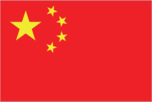
red with a large yellow five-pointed star and four smaller yellow five-pointed stars (arranged in a vertical arc toward the middle of the flag) in the upper hoist-side corner Economy China
GDP - composition by sector
- agriculture
- 13.8%
- industry and construction
- 52.9%
- services
- 33.3% (2004 est.)
GDP - per capita
purchasing power parity - $5,600 (2004 est.)
GDP - real growth rate
9.1% (official data) (2004 est.)
GDP (purchasing power parity)
$7.262 trillion (2004 est.)
Geographic coordinates
35 00 N, 105 00 E
Geography - note
world's fourth largest country (after Russia, Canada, and US); Mount Everest on the border with Nepal is the world's tallest peak People China
Government type
Communist state
Heliports
15 (2004 est.) Military China
Highways
- paved
- 395,410 km (with at least 25,130 km of expressways)
- total
- 1,765,222 km
- unpaved
- 1,369,812 km (2002 est.)
HIV/AIDS - adult prevalence rate
0.1% (2003 est.)
HIV/AIDS - deaths
44,000 (2003 est.)
HIV/AIDS - people living with HIV/AIDS
840,000 (2003 est.)
Household income or consumption by percentage share
lowest 10%: 2.4% highest 10%: 30.4% (1998)
Illicit drugs
major transshipment point for heroin produced in the Golden Triangle; growing domestic drug abuse problem; source country for chemical precursors and methamphetamine This page was last updated on 20 October, 2005 ======================================================================
Imports
$552.4 billion f.o.b. (2004 est.)
Imports - commodities
machinery and equipment, oil and mineral fuels, plastics, optical and medical equipment, organic chemicals, iron and steel
Imports - partners
Japan 16.8%, Taiwan 11.4%, South Korea 11.1%, US 8%, Germany 5.4% (2004)
Independence
221 BC (unification under the Qin or Ch'in Dynasty); 1 January 1912 (Manchu Dynasty replaced by a Republic); 1 October 1949 (People's Republic established)
Industrial production growth rate
17.1% (2004 est.)
Industries
mining and ore processing, iron, steel, aluminum, and other metals; coal; machine building; armaments; textiles and apparel; petroleum; cement; chemicals; fertilizers; consumer products, including footwear, toys, and electronics; food processing; transportation equipment, including automobiles, rail cars and locomotives, ships, and aircraft; telecommunications equipment, commercial space launch vehicles and satellites
Infant mortality rate
- female
- 27.5 deaths/1,000 live births (2005 est.)
- male
- 21.21 deaths/1,000 live births
- total
- 24.18 deaths/1,000 live births
Inflation rate (consumer prices)
4.1% (2004 est.)
International organization participation
AfDB, APEC, APT, ARF, AsDB, ASEAN (dialogue partner), BIS, CDB, FAO, G-77, IAEA, IBRD, ICAO, ICC, ICRM, IDA, IFAD, IFC, IFRCS, IHO, ILO, IMF, IMO, Interpol, IOC, IOM (observer), ISO, ITU, LAIA (observer), MIGA, MONUC, NAM (observer), NSG, OAS (observer), ONUB, OPCW, PCA, SCO, UN, UN Security Council, UNAMSIL, UNCTAD, UNESCO, UNHCR, UNIDO, UNITAR, UNMEE, UNMIL, UNMOVIC, UNOCI, UNTSO, UPU, WCO, WHO, WIPO, WMO, WToO, WTO, ZC
Internet country code
.cn
Internet hosts
160,421 (2003)
Internet Service Providers (ISPs)
3 (2000)
Internet users
94 million (2004) Transportation China
Investment (gross fixed)
46% of GDP (2004 est.)
Irrigated land
525,800 sq km (1998 est.)
Judicial branch
Supreme People's Court (judges appointed by the National People's Congress); Local Peoples Courts (comprise higher, intermediate and local courts); Special Peoples Courts (primarily military, maritime, and railway transport courts)
Labor force
760.8 million (2003)
Labor force - by occupation
agriculture 49%, industry 22%, services 29% (2003 est.)
Land boundaries
- border countries
- Afghanistan 76 km, Bhutan 470 km, Burma 2,185 km, India 3,380 km, Kazakhstan 1,533 km, North Korea 1,416 km, Kyrgyzstan 858 km, Laos 423 km, Mongolia 4,677 km, Nepal 1,236 km, Pakistan 523 km, Russia (northeast) 3,605 km, Russia (northwest) 40 km, Tajikistan 414 km, Vietnam 1,281 km
- regional borders
- Hong Kong 30 km, Macau 0.34 km
- total
- 22,117 km
Land use
- arable land
- 15.4%
- other
- 83.35% (2001)
- permanent crops
- 1.25%
Languages
Standard Chinese or Mandarin (Putonghua, based on the Beijing dialect), Yue (Cantonese), Wu (Shanghaiese), Minbei (Fuzhou), Minnan (Hokkien-Taiwanese), Xiang, Gan, Hakka dialects, minority languages (see Ethnic groups entry)
Legal system
a complex amalgam of custom and statute, largely criminal law; rudimentary civil code in effect since 1 January 1987; new legal codes in effect since 1 January 1980; continuing efforts are being made to improve civil, administrative, criminal, and commercial law
Legislative branch
- unicameral National People's Congress or Quanguo Renmin Daibiao Dahui (2,985 seats; members elected by municipal, regional, and provincial people's congresses to serve five-year terms)
- election results
- percent of vote - NA%; seats - NA
- elections
- last held December 2002-February 2003 (next to be held late 2007-February 2008)
Life expectancy at birth
- female
- 74.09 years (2005 est.)
- male
- 70.65 years
- total population
- 72.27 years
Literacy
- definition: age 15 and over can read and write
- female
- 86.5% (2002) Government China
- male
- 95.1%
- total population
- 90.9%
Location
Eastern Asia, bordering the East China Sea, Korea Bay, Yellow Sea, and South China Sea, between North Korea and Vietnam
Manpower available for military service
males age 18-49: 342,956,265 (2005 est.)
Manpower fit for military service
males age 18-49: 281,240,272 (2005 est.)
Manpower reaching military service age annually
- males
- 13,186,433 (2005 est.)
Map references
Asia
Maritime claims
- contiguous zone
- 24 nm
- continental shelf
- 200 nm or to the edge of the continental margin
- exclusive economic zone
- 200 nm
- territorial sea
- 12 nm
Median age
- female
- 32.67 years (2005 est.)
- male
- 31.87 years
- total
- 32.26 years
Merchant marine
- by type
- barge carrier 2, bulk carrier 362, cargo 696, chemical tanker 38, combination ore/oil 1, container 135, liquefied gas 30, passenger 7, passenger/cargo 81, petroleum tanker 246, refrigerated cargo 30, roll on/roll off 11, vehicle carrier 10
- foreign-owned
- 9 (Hong Kong 4, Japan 2, South Korea 2, United States 1)
- registered in other countries
- 872 (2005)
- total
- 1,649 ships (1,000 GRT or over) 18,724,653 GRT/27,749,784 DWT
Military branches
People's Liberation Army (PLA): Ground Forces, Navy (includes marines and naval aviation), Air Force (includes Airborne Forces), and II Artillery Corps (strategic missile force); People's Armed Police Force (internal security troops considered to be an adjunct to the PLA); Militia (2003)
Military expenditures - dollar figure
$67.49 billion (2004)
Military expenditures - percent of GDP
4.3% (2004) Transnational Issues China
Military service age and obligation
18-22 years of age for compulsory military service, with 24-month service obligation; no minimum age for voluntary service; 17 years of age for women who meet requirements for specific military jobs (2004)
National holiday
Anniversary of the Founding of the People's Republic of China, 1 October (1949)
Nationality
- adjective
- Chinese
- noun
- Chinese (singular and plural)
Natural gas - consumption
29.18 billion cu m (2002 est.)
Natural gas - exports
0 cu m (2002 est.)
Natural gas - imports
0 cu m (2002 est.)
Natural gas - production
35 billion cu m (2003 est.)
Natural gas - proved reserves
2.23 trillion cu m (2004)
Natural hazards
frequent typhoons (about five per year along southern and eastern coasts); damaging floods; tsunamis; earthquakes; droughts; land subsidence
Natural resources
coal, iron ore, petroleum, natural gas, mercury, tin, tungsten, antimony, manganese, molybdenum, vanadium, magnetite, aluminum, lead, zinc, uranium, hydropower potential (world's largest)
Net migration rate
-0.4 migrant(s)/1,000 population (2005 est.)
Oil - consumption
4.956 million bbl/day (2002 est.)
Oil - exports
427,800 bbl/day (2002)
Oil - imports
2.414 million bbl/day (2002)
Oil - production
3.392 million bbl/day (2003 est.)
Oil - proved reserves
17.74 billion bbl (2004 est.)
Pipelines
gas 15,890 km; oil 14,478 km; refined products 3,280 km (2004)
Political parties and leaders
Chinese Communist Party or CCP [HU Jintao, General Secretary of the Central Committee]; eight registered small parties controlled by CCP
Political pressure groups and leaders
no substantial political opposition groups exist, although the government has identified the Falungong spiritual movement and the China Democracy Party as subversive groups
Population
1,306,313,812 (July 2005 est.)
Population below poverty line
10% (2001 est.)
Population growth rate
0.58% (2005 est.)
Ports and harbors
Dalian, Guangzhou, Nanjing, Ningbo, Qingdao, Qinhuangdao, Shanghai
Public debt
31.4% of GDP (2004 est.)
Radio broadcast stations
AM 369, FM 259, shortwave 45 (1998)
Radios
417 million (1997)
Railways
- dual gauge
- 23,945 km (multiple track not included in total) (2002)
- standard gauge
- 71,898 km 1.435-m gauge (18,115 km electrified)
- total
- 71,898 km
Refugees and internally displaced persons
- refugees (country of origin)
- 299,287 (Vietnam) estimated 30,000-50,000 (North Korea) (2004)
Religions
Daoist (Taoist), Buddhist, Muslim 1%-2%, Christian 3%-4% note: officially atheist (2002 est.)
Reserves of foreign exchange and gold
$609.9 billion (2004 est.)
Sex ratio
- at birth
- 1.12 male(s)/female under 15 years: 1.13 male(s)/female 15-64 years: 1.06 male(s)/female 65 years and over: 0.91 male(s)/female
- total population
- 1.06 male(s)/female (2005 est.)
Suffrage
18 years of age; universal
Telephone system
- domestic
- interprovincial fiber-optic trunk lines and cellular telephone systems have been installed; a domestic satellite system with 55 earth stations is in place
- general assessment
- domestic and international services are increasingly available for private use; unevenly distributed domestic system serves principal cities, industrial centers, and many towns
- international
- country code - 86; satellite earth stations - 5 Intelsat (4 Pacific Ocean and 1 Indian Ocean), 1 Intersputnik (Indian Ocean region) and 1 Inmarsat (Pacific and Indian Ocean regions); several international fiber-optic links to Japan, South Korea, Hong Kong, Russia, and Germany (2000)
Telephones - main lines in use
263 million (2003)
Telephones - mobile cellular
269 million (2003)
Television broadcast stations
3,240 (of which 209 are operated by China Central Television, 31 are provincial TV stations and nearly 3,000 are local city stations) (1997)
Televisions
400 million (1997)
Terrain
mostly mountains, high plateaus, deserts in west; plains, deltas, and hills in east
Total fertility rate
1.72 children born/woman (2005 est.)
Unemployment rate
9.8% in urban areas; substantial unemployment and underemployment in rural areas; an official Chinese journal estimated overall unemployment (including rural areas) for 2003 at 20% (2004 est.)
Waterways
121,557 km (2002)